Contents15 sections
This guide was first published in German on handgetestet.de.
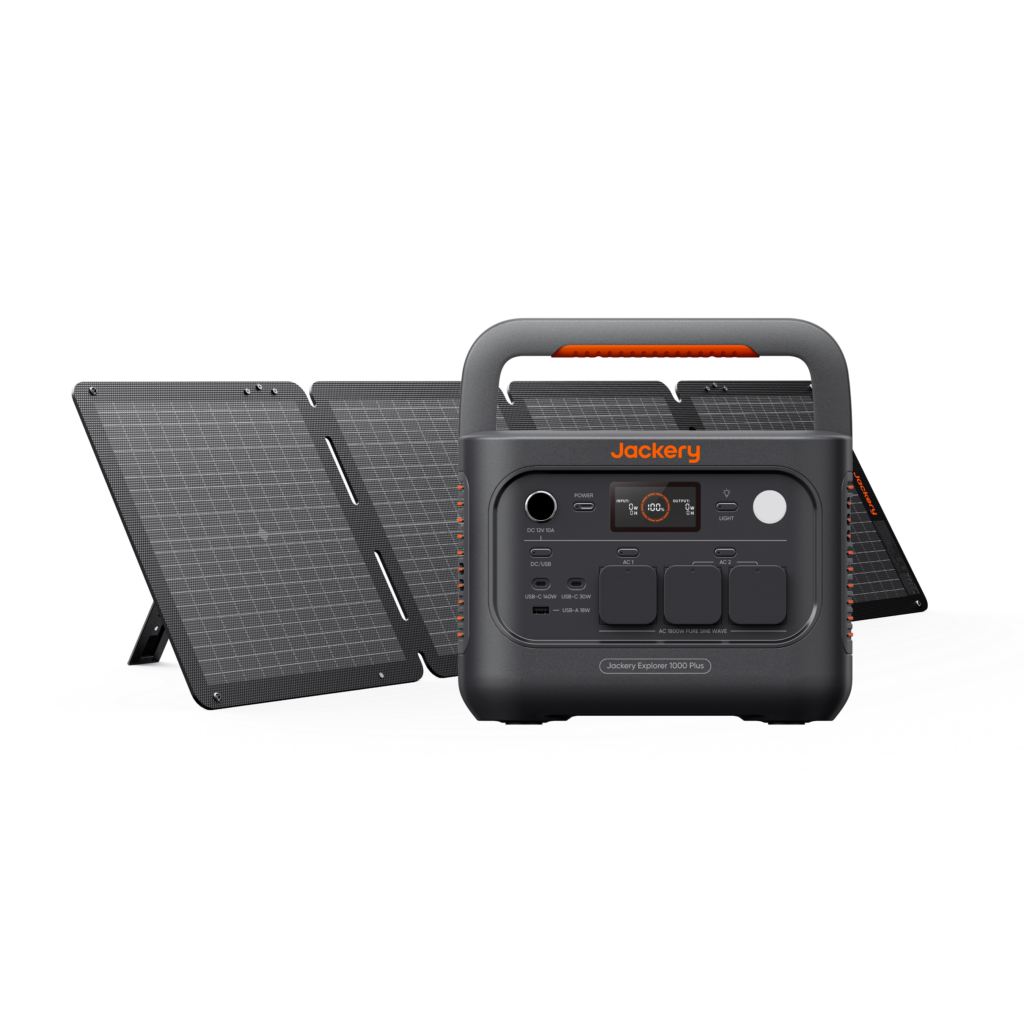
The question is actually framed the wrong way. LiFePO4 is itself a lithium-ion battery, just with a different material at the cathode. What people usually mean is the comparison between lithium iron phosphate (LFP) and nickel manganese cobalt (NMC). For a power station that is charged often or sits in the house for years, almost everything speaks for LFP, and we consider the Jackery Explorer 1000 Plus v2 the most well-rounded buy. NMC-type cells still have one real advantage, and it doesn’t weigh much. One caveat up front: the Explorer 1000 Plus v2 is new, and all we had were figures from Jackery and one retailer, no spec sheet and no independent measurement. Read its figures with corresponding caution.
What sets the two cell types apart?
Both store energy by moving lithium between two electrodes. In both cases, the anode is usually graphite. The difference lies in the cathode: the Fraunhofer Institute for Systems and Innovation Research (ISI) describes LFP as a cathode material with the formula LiFePO4 that offers a lower energy density. NMC, by contrast, is a whole material system of nickel, manganese and cobalt. In a large comparative study by Sandia National Laboratories, the LFP cells had a nominal voltage of 3.3 volts, the NMC cells 3.6 volts.
How many cycles do the cells really last?
Manufacturer figures are of limited help. The lab is more telling. The Sandia researchers charged and discharged commercially available cells under identical conditions for years. The LFP cells reached 2,500 to 9,000 full cycles, the NMC cells 200 to 2,500 down to 80 percent remaining capacity. Most LFP cells had not even reached that mark when the study ended. A clear result, with two caveats. The range within one chemistry is huge; temperature, depth of discharge and current shift the service life by thousands of cycles. And measured by energy throughput, the gap shrinks, because the LFP cell in the study had less capacity to begin with.
NMC also reacted more sensitively to using the full charge range from 0 to 100 percent. That is exactly what people often do with a power station in everyday use. With LFP, the round-trip efficiency over the whole charge cycle was also usually higher.
Now to the brochure figures. Jackery states 6,000 cycles to 70 percent capacity for the Explorer 1000 Plus v2, 4,000 to 70 percent for the Explorer 1000 v2, but 2,000 to 80 percent for the small Explorer 100 Plus. These numbers cannot be compared directly, because the measurement ends at a different point. After 6,000 cycles, around 717 of the 1,024 watt-hours would remain. The „30 years“ in the product information is also a calculation based on one charge every other day. What is binding is the warranty, and according to the retailer, it runs for a maximum of 5 years.
Does LFP really not burn?
Yes, it can burn. The risk is just significantly lower. In its fact check on electric cars, Fraunhofer ISI writes that the fire risk of LFP batteries is significantly lower than that of other lithium-ion batteries because of their chemical composition and thermal stability. The statement refers to vehicles, but the cell chemistry is comparable. We are deliberately not giving a temperature figure: the values in circulation contradict each other and depend on the cell and test setup.
That does not make anything fireproof. According to ISI, when lithium-ion batteries burn, considerable amounts of toxic fumes are produced. The German Environment Agency (Umweltbundesamt) warns that mechanical damage and heat can trigger internal short circuits. A device that has been dropped and dented therefore does not go back on the shelf, and an old device never goes in the household trash but to a collection point.
How much heavier is LFP?
On paper, a lot. Based on their data, the cells in the Sandia study work out to around 93 watt-hours per kilo (LFP, designed for high currents) and 230 (NMC). According to Fraunhofer ISI, current LFP cells reach more than 140. In the finished device, the gap shrinks. The housing, inverter and cooling add weight, and according to ISI, LFP cells can be installed with less effort. The loss from cell to battery pack is 15 to 30 percent in cars and 30 to 40 percent with high-energy cells.
Do the math on the Jackery devices. The old Explorer 1000, with 1,002 watt-hours and 10 kilos, comes to around 100 watt-hours per kilo. Its LFP successor is at 99 but delivers 1,500 instead of 1,000 watts. The Explorer 2000 v2 reaches 117. The advantage only becomes visible without an inverter: according to ELV (German retailer), the Aqiila Powerbird S140 reaches around 157 watt-hours per kilo, but it has no AC outlet either.
What does cold do to the battery?
Charging in frost is the tricky part above all. Sandia describes how, at low temperature, high state of charge and high charging current, metallic lithium can be deposited on the graphite anode. That affects the graphite side, and therefore both chemistries. Manufacturers specify a lower limit for charging. It is in the spec sheet and cannot be read from the cell chemistry.
The differences are considerable. According to Jackery, the Explorer 2000 v2 only charges from 0 degrees, the Explorer 500 v2 from as low as minus 20 degrees, and according to the retailer, the Explorer 1000 Plus v2 from minus 10 degrees. Jackery does not say how much capacity is lost in frost. We therefore cannot give you a reliable ranking of LFP and NMC at minus 20 degrees.
On aging, on the other hand, there is a clear finding. Between 15 and 35 degrees, the LFP cells aged faster as the temperature rose, the NMC cells more slowly. The authors therefore consider LFP better suited to cooler environments. Older studies see the least aging for LFP at around 5 to 10 degrees. So a cool basement beats the attic. The German Environment Agency warns against storage above 40 degrees anyway and advises recharging unused batteries after six months at the latest.
Seven devices, sorted by cell type
| Model | Cell, capacity, output | Cycles according to the manufacturer | Weight, Wh per kg | Charges from |
|---|---|---|---|---|
| Jackery Explorer 1000 Plus v2 | LFP, 1,024 Wh, 1,800 W | 6,000 to 70 % | 10.8 kg, around 95 | −10 °C (retailer) |
| Jackery Explorer 500 v2 | LFP, 512 Wh, 500 W | 6,000 to 70 % | 5.7 kg, around 90 | −20 °C |
| Jackery Explorer 1000 v2 | LFP, 1,070 Wh, 1,500 W | 4,000 to 70 % | 10.8 kg, around 99 | 0 °C (retailer) |
| Jackery Explorer 2000 v2 | LFP, 2,042 Wh, 2,200 W | 4,000 to 70 % | 17.5 kg, around 117 | 0 °C |
| Jackery Explorer 240 v2 | LFP, 256 Wh, 300 W | 3,000 | 3.6 kg, around 71 | not specified |
| Jackery Explorer 1000 (refurbished) | Lithium, cell type not stated, 1,002 Wh, 1,000 W | not specified | 10 kg, around 100 | not specified |
| Aqiila Powerbird S140 | Lithium-ion, 199.8 Wh, no AC outlet | not specified | 1.27 kg, around 157 | not specified |
Jackery Explorer 1000 Plus v2
For us, the most well-rounded mix. According to Jackery, it contains ceramic-coated LFP cells, plus 1,800 watts and a switchover time of 10 milliseconds. The device can be expanded to up to 11 kilowatt-hours with BP2000 batteries, which our guide Power station with expansion battery (in German) covers in more detail. The older Battery Pack 1000 Plus does not fit. We only know the weight and charging limit from retailer information.
Jackery Explorer 500 v2
The choice for cold places. The same cycle rating as the larger model, charging down to minus 20 degrees, only 5.7 kilos. At 500 watts, however, coffee makers and electric kettles are often left out.
Jackery Explorer 1000 v2
Slightly more capacity than the Plus version, but only 4,000 cycles and no expansion. If you rarely charge, you lose little as a result. Our guide Buying a power station (in German) compares more manufacturers. In spring 2025, the German automobile club ADAC downgraded the Explorer 1000 v2 to „poor“ because its two DC inputs are not decoupled. So never charge it via solar and the car socket at the same time, otherwise damage to the 12-volt vehicle electrical system is possible.
Jackery Explorer 2000 v2
Around 117 watt-hours per kilo is the highest figure among the LFP devices in this table. The charging limit of 0 degrees, however, makes it a device for the house, not for the winter cabin.
Jackery Explorer 240 v2
For the 240 v2, Jackery explicitly mentions the switch from NCM to LFP and states 3,000 cycles, plus 256 watt-hours, 300 watts at the AC outlet and 3.6 kilograms. The old Explorer 240, with lithium-ion cells and no cycle rating, is no longer available from Jackery (as of November 15, 2026). How the 240 v2 holds up against other small stations is covered in our guide to small power stations (in German).
Jackery Explorer 1000 (refurbished)
Here, Jackery only speaks of a lithium battery, with no cell type and no cycle count. What that means when buying is explained in our guide Refurbished power stations (in German). Without a clear price advantage, we advise against it.
Aqiila Powerbird S140
An honest alternative for a backpack and laptop. At 1.27 kilos, every gram counts for more than the cycle count, which ELV does not state. There is no AC outlet, and which lithium-ion chemistry is inside remains unclear.
Which cell type suits you?
- You charge often or want to keep the device for many years: LFP, ideally with 6,000 cycles.
- The device sits in a garage or garden shed: look at the charging limit first, then at the rest.
- You carry it on foot for long distances: here, a light lithium-ion station without an AC outlet is fine.
- You come across a device with no information on cell chemistry: ask, or leave it on the shelf.
Which charging limits apply below zero degrees is covered in our guide to power stations in freezing temperatures (in German).
Frequently asked questions
What is the difference between LiFePO4 and NMC?
Both are lithium-ion batteries; the difference lies in the cathode. LFP stands for lithium iron phosphate with lower energy density, NMC for a material system of nickel, manganese and cobalt. In a comparative study by Sandia National Laboratories, the LFP cells had a nominal voltage of 3.3 volts, the NMC cells 3.6 volts.
How many charge cycles does a LiFePO4 battery last?
In the Sandia lab study, LFP cells reached 2,500 to 9,000 full cycles, NMC cells 200 to 2,500 down to 80 percent remaining capacity. The range within one chemistry is wide. Manufacturer figures such as 6,000 cycles to 70 percent can only be compared if the measurement ends at the same point.
Can a LiFePO4 power station catch fire?
Yes, the risk is just significantly lower. Fraunhofer ISI rates the fire risk of LFP as significantly lower than that of other lithium-ion batteries because of its thermal stability. If they do burn, considerable amounts of toxic fumes are produced. A device that has been dropped and dented does not go back on the shelf, and an old device belongs at a collection point.
Is a LiFePO4 power station much heavier?
At cell level, yes; in the finished device, the gap shrinks because the housing, inverter and cooling add weight too. The old Jackery Explorer 1000 comes to around 100 watt-hours per kilo, its LFP successor to 99 with more power. Things only get noticeably lighter without an inverter, as with the Aqiila Powerbird S140.
Can I charge a power station in freezing temperatures?
That depends on the device, not the cell chemistry. When charging in frost, metallic lithium can be deposited on the graphite anode, which affects both chemistries. According to Jackery, the Explorer 2000 v2 only charges from 0 degrees, the Explorer 500 v2 from as low as minus 20 degrees. Check the spec sheet.
Where should a LiFePO4 battery be stored?
Somewhere cool. In the Sandia study, LFP cells aged faster with rising temperature between 15 and 35 degrees; older studies see the least aging at around 5 to 10 degrees. So a cool basement beats the attic. The German Environment Agency (Umweltbundesamt) warns against storage above 40 degrees and advises recharging after six months at the latest.
Sources
- Preger et al. (Sandia National Laboratories): Degradation of Commercial Lithium-Ion Cells, Journal of The Electrochemical Society 2020
- Fraunhofer ISI: Batteries for electric cars, fact check and need for action (2025)
- Fraunhofer ISI: Technology roadmap for stationary energy storage
- Umweltbundesamt: Batteries and rechargeable batteries
- Jackery: Explorer 500 v2, technical data
- Jackery: Explorer 2000 v2, technical data
- Product information from Jackery on the Explorer 1000 Plus v2, 1000 v2, 240 and 240 v2
- GreenDrive: Explorer 1000 Plus v2 (retailer information)
- GreenDrive: Explorer 1000 v2 (retailer information)
- ELV: Aqiila Powerbird S140
- ADAC: Portable power stations tested (spring 2025)
Where to buy
- Jackery Explorer 1000 Plus v2View at JackeryAvailable in Germany: JackeryCheck price at Amazon.deAvailable in Germany: Amazon.de
- Jackery Explorer 500 v2View at JackeryAvailable in Germany: JackeryCheck price at Amazon.deAvailable in Germany: Amazon.de
- Jackery Explorer 1000 v2View at JackeryAvailable in Germany: JackeryCheck price at Amazon.deAvailable in Germany: Amazon.de
- Jackery Explorer 2000 v2View at JackeryAvailable in Germany: JackeryCheck price at Amazon.deAvailable in Germany: Amazon.de
- Jackery Explorer 240 v2View at JackeryAvailable in Germany: JackeryCheck price at Amazon.deAvailable in Germany: Amazon.de
- Jackery Explorer 1000 (Generalüberholt)View at JackeryAvailable in Germany: Jackery
- Aqiila Powerbird S140View at ELVAvailable in Germany: ELV