Contents14 sections
This guide was first published in German on handgetestet.de.
Charging batteries, lighting, a rotary hammer during interior finishing work: a power station can do all that quietly and without exhaust fumes. It is no substitute for a site distribution board, though, because it does not cope well with rain and dust. For tradespeople who work indoors, we consider the Jackery Explorer 3000 v2 the most fitting choice, because its 3,600 watts leave headroom even for circular saws. If you climb stairs, reach for the lighter Explorer 2000 Plus v2. Start with your own situation.
You mainly charge tool batteries
Then you need less than the spec sheet promises. According to the manufacturer, a Metabo ASC 145 rapid charger delivers 145 watts, and Bosch’s GAL 18V-40 charges at 4 amps. Even three chargers at once stay below 500 watts. What matters is the energy. An 18-volt battery with 5 amp-hours holds 90 watt-hours. Using the factor of 0.85 from our guide to power station runtime, that works out to just under ten charges on the Explorer 1000 Plus v2 and 29 on the 3000 v2. In practice it will still be fewer, because the charger also has losses. For a team with mixed brands, our overview of battery systems also helps.
In short: for this situation, the 1 kWh class is enough. According to Jackery, the outlets deliver a pure sine wave.
You saw and drill during interior finishing work
Now the startup surge counts. For direct-starting electric motors, the German Social Accident Insurance (DGUV) cites five to seven times the rated current, and three times with electronic soft start. Bosch’s GKS 190 circular saw draws 1,400 watts and has a soft start. On paper, that is around 4,200 watts. On the Explorer 1000 Plus v2 with 3,600 watts of peak power, that gets tight; the 2000 Plus v2 with 4,800 watts just about manages it; the 3000 v2 with 7,200 watts has headroom. A Makita HS7601 draws 1,200 watts; the manufacturer does not say whether it has a soft start.
Rules of thumb like these apply to motors in general; every machine draws differently, and Jackery does not say how long the peak can be sustained. So try out your own saw while you can still return the station. The Bosch GBH 2-28 F rotary hammer, at 880 watts, is the easier case. In continuous operation at 1,400 watts, the 3000 v2 would be empty after just under two hours. But sawing happens in stages.
You need compressed air
Here we advise against it. The Metabo Basic 250-50 W from our compressor guide (in German) draws 1.5 kilowatts. With direct startup, the rule of thumb gives 7,500 to 10,500 watts. That is above every peak rating on this list. It might start anyway. But you should not plan on it.
You work outdoors, on a shell construction site or in dust
Then the station stays in the van or in a dry side room. In the manual for the Explorer 3000, the US version with the same key specs, Jackery writes: indoor use only, under no circumstances where rain or snow can reach it. The manual also rules out dusty and wet environments, and Jackery does not state an IP rating for the Explorer series. We count this among its biggest weaknesses on the job site.
The bar is high. DGUV Information 203-032 requires generators to have at least IP 54 outdoors and IP 43 inside buildings. From IP 23, use is only possible with additional measures such as an enclosure. Even the Scheppach SG3500i reaches no more than IP23M. According to Jackery, the Jackery Schutzhülle (protective cover) made of 600D fabric protects against splashing water, dust, dirt and scratches and fits the 1000 Plus v2 and 2000 Plus v2; we did not find an IP rating in the manufacturer’s specifications. You can bridge long distances with cable, see our cable reel guide. According to the DGUV, only H07RN-F or H07BQ-F rubber-sheathed cables are permitted on construction sites.
You run a business with employees
In its July 2025 edition, DGUV Information 203-032 explicitly classifies battery storage units as generators and even provides model operating instructions. Our summary is no substitute for a qualified electrician. With devices of design type A, only one load may be connected without further measures. From the second one on, each additional device needs residual current protection rated at 30 milliamps. A PRCD-S cannot be switched on there; the model instructions state this explicitly.
Jackery does not state which design type the Explorer stations correspond to. Clarify this before first use. The housings need special attention, because according to the DGUV, even slight deformations can trigger fires in energy storage units. In hot weather, the device belongs in the shade. According to Jackery, switch it off immediately after a fall or strong impacts.
Six devices for the job site
| Model | Capacity, continuous / peak | Weight | Best for |
|---|---|---|---|
| Jackery Explorer 3000 v2 | 3,072 Wh, 3,600 / 7,200 W | 27 kg | Interior finishing with a saw |
| Jackery Explorer 2000 Plus v2 | 2,048 Wh, 2,400 / 4,800 W | 19.1 kg | Older buildings, stairs, frost down to −10 °C |
| Jackery Explorer 1000 Plus v2 | 1,024 Wh, 1,800 / 3,600 W | 10.8 kg | Charging batteries, lighting |
| Jackery Schutzhülle | Accessory, no IP rating | Not specified | 1000 Plus v2 or 2000 Plus v2 on the job site |
| Anker SOLIX C1000 Gen 2 | 1,024 Wh, 2,000 / 3,000 W | 11.3 kg | Continuous load rather than startup surge |
| Scheppach SG3500i | Gasoline, 3,000 / 3,500 W | 22.5 kg | Outdoors, all day |
Jackery figures according to Jackery’s product information and retailer information from GreenDrive.
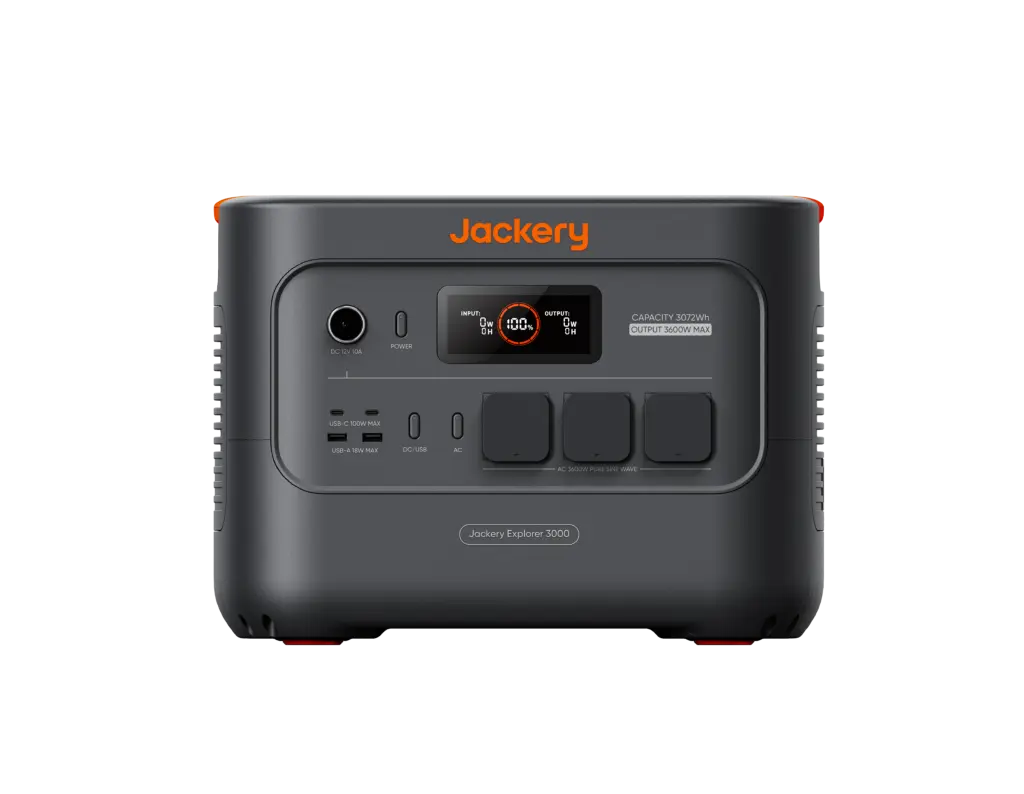
Jackery Explorer 3000 v2
According to Jackery, fully charged from the grid in 1.8 hours, and according to the retailer, it sits on wheels with a telescopic handle. Still, 27 kilograms on the stairs are 27 kilograms. It only charges from zero degrees up, and according to the retailer it limits output to 2,000 watts below minus 10 degrees. That is a poor fit for a cold shell construction site, and it cannot be expanded either. Our guide to the large power station compares it with the 3600 Plus.
Jackery Explorer 2000 Plus v2
Eight kilograms lighter and, according to the retailer, chargeable from minus 10 degrees. In return, it is borderline with the saw. Jackery specifies 6,000 cycles; the 3000 v2 manages 4,000.
Jackery Explorer 1000 Plus v2
The battery charger for the trunk. We would not ask it to handle a circular saw.
Jackery Schutzhülle
According to Jackery, the station can be operated without removing the cover, whether switched on or off. The manufacturer does not say whether cooling keeps up under full load. It is not listed for the 3000 v2; the Extreme Guard carrying bag intended for that model is currently unavailable from Jackery (as of November 13, 2026).
Anker SOLIX C1000 Gen 2
Two thousand watts of continuous output in the 1 kWh class, but only 3,000 watts of peak power. A good match for a fan heater or construction dryer with a steady load, less so for a saw.
Scheppach SG3500i
The honest alternative. According to Scheppach, 6.3 liters last for 3.6 hours at full load, and refueling is quick. For surge loads on generators, however, the DGUV recommends only 50 to 60 percent of the rated output. So there is less reserve for motor starts than the 3,000 watts would suggest. Add noise and exhaust fumes, which practically rules it out indoors. More on this in our generator guide.
How we would decide
- Only batteries and lighting: Explorer 1000 Plus v2.
- Saw and rotary hammer indoors: Explorer 3000 v2.
- Lots of stairs or frost: Explorer 2000 Plus v2.
- All day outdoors, compressor, rain: a generator or temporary site power.
What a cash register, refrigeration and coffee need over a day is shown in the wattage calculation for a market stall and food truck.
Frequently asked questions
Which power station is enough for charging tool batteries?
The 1 kWh class. Even three chargers at once stay below 500 watts. An 18-volt battery with 5 amp-hours holds 90 watt-hours; on the Explorer 1000 Plus v2, that works out to just under ten charges. In practice it will be fewer, because the charger also has losses.
Can a power station run a circular saw?
That depends on the startup current. With soft start, the German DGUV assumes three times the rated current, so for the 1,400-watt Bosch GKS 190 that is around 4,200 watts. The 2000 Plus v2 just about manages it; the 3000 v2 has headroom. Try your own saw while you can still return the station.
Can I run a compressor on a power station?
We advise against it. Under the rule of thumb, a 1.5-kilowatt compressor with direct startup reaches 7,500 to 10,500 watts. That is above every peak rating of the stations in this comparison. It might start anyway, but you should not plan on it.
Can a power station stand in the rain on a job site?
No. In the manual for the Explorer 3000, Jackery writes: indoor use only, not where rain or snow can reach it; the manufacturer does not state an IP rating. The German DGUV requires generators used outdoors to have at least IP 54. The station stays in the van or in a dry side room.
What applies to businesses with employees?
Since July 2025, DGUV Information 203-032 has classified battery storage units as generators. With devices of design type A, only one load may be connected without further measures; from the second load on, each device needs residual current protection rated at 30 milliamps. Jackery does not state which design type the Explorer stations correspond to.
Sources
- Jackery product information on the Explorer 3000 v2, 2000 Plus v2, 1000 Plus v2 and Schutzhülle
- DGUV Information 203-032: Generators on construction and assembly sites (PDF, in German)
- DGUV Information 203-006: Electrical installations on construction and assembly sites (PDF, in German)
- Jackery: Explorer 3000 manual (PDF)
- Bosch Professional: GKS 190
- Bosch Professional: GAL 18V-40
- Makita: HS7601
- Metabo: ASC 145 charger
- Metabo: Basic 250-50 W data sheet (PDF)
- Anker SOLIX: C1000 Gen 2
- Scheppach: SG3500i
- Scheppach: SG3500i manual (PDF)
- GreenDrive (retailer information): Explorer 3000 v2
- GreenDrive (retailer information): Explorer 2000 Plus v2
- GreenDrive (retailer information): Explorer 1000 Plus v2
Where to buy
- Jackery Explorer 3000 v2View at JackeryAvailable in Germany: JackeryCheck price at Amazon.deAvailable in Germany: Amazon.de
- Jackery Explorer 2000 Plus v2View at JackeryAvailable in Germany: JackeryCheck price at Amazon.deAvailable in Germany: Amazon.de
- Jackery Explorer 1000 Plus v2View at JackeryAvailable in Germany: JackeryCheck price at Amazon.deAvailable in Germany: Amazon.de
- Jackery SchutzhülleView at JackeryAvailable in Germany: Jackery
- Anker SOLIX C1000 Gen 2Check price at Amazon.deAvailable in Germany: Amazon.de
- Scheppach SG3500iView at scheppachAvailable in Germany: scheppachCheck price at Amazon.deAvailable in Germany: Amazon.de