Contents12 sections
This guide was first published in German on handgetestet.de.
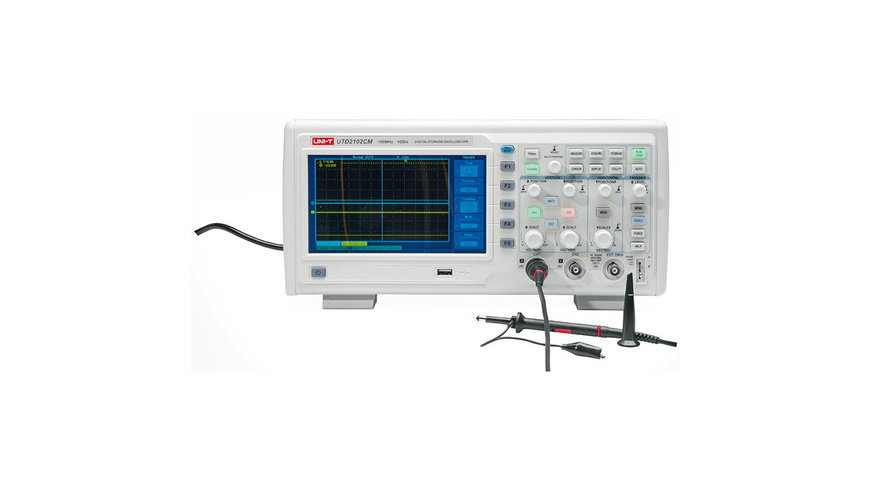
A multimeter tells you there are 2.5 volts on a pin. An oscilloscope shows you that it is actually a square wave jumping between 0 and 5 volts a thousand times per second. For getting started with repairs and electronics, we consider a benchtop unit with 70 to 100 MHz and two channels sufficient. Our recommendation is the UNI-T UTD2102CM from ELV (German retailer), above all because of its measurement category. If you can spend more, Rigol and Siglent offer modern units with 12 bits and four channels.
Datasheets are full of numbers. Four of them decide whether a unit suits your circuits.
Bandwidth: the three-to-five rule
Bandwidth is the frequency at which a sine wave is displayed at only about 70 percent of its amplitude. Above that, accuracy drops off quickly. In a white paper, Rohde & Schwarz gives a rule of thumb: bandwidth should be three to five times the fundamental frequency or clock rate of the measured signal. The reason is harmonics. A 10 MHz square wave consists of components at 30, 50, 70 MHz and more; if the oscilloscope cuts them off, sharp edges turn into soft curves.
What does that mean in practice? According to its datasheet, the Homematic IP LED Controller dims via pulse-width modulation at 1 kHz. Almost anything can handle that. By the rule, an SPI bus at 10 MHz needs 30 to 50 MHz. In addition, the same paper gives a simple approximation for rise time: 0.35 divided by the bandwidth. 100 MHz yields 3.5 nanoseconds, and that is exactly the value UNI-T states for the UTD2102CM.
Sample rate and memory depth go hand in hand
A digital oscilloscope does not measure continuously; it samples. Rohde & Schwarz recommends a sample rate of 2.5 to 5 times the bandwidth. At 70 MHz, that means at least 175 million samples per second (MSa/s). Watch the fine print: peak values often apply only when a single channel is active. According to the datasheet, the Rigol DHO804’s rate drops from 1.25 GSa/s with one channel to 312.5 MSa/s with all four.
Memory depth determines how long the unit can record at full rate. The math is simple. 1 GSa/s over 10 milliseconds gives 10 million points. A unit with 8,000 points has to lower its rate to 800,000 samples per second for the same time window, and fast glitches then slip through. If you are hunting rare faults in a circuit, you benefit more from plenty of memory than from extra bandwidth.
Just a word on resolution: 8 bits means 256 levels, 12 bits 4,096. Small signals on top of a large DC voltage, such as the ripple noise of a power supply, can be displayed much more finely with 12 bits.
Probe: 1x or 10x?
The included probes almost always have a switch. In the 10x position, they divide the voltage by ten and load the circuit less. That affects bandwidth. Rigol specifies 150 MHz for its standard PVP3150 probe in the 10x position, but only 20 MHz at 1x. The permissible voltage also depends on it: with its probes in category CAT II, UNI-T allows 150 volts at 1x and 300 volts at 10x. Our rule of thumb is therefore to use 10x as a matter of course and only switch for very small signals. You have to set the attenuation factor on the oscilloscope, too, or the readings will be wrong.
Before the first measurement, the probe is compensated. To do this, you pick up the unit’s test signal and turn a small screw on the probe until a clean square wave without overshoot appears. It takes a minute and saves you from drawing the wrong conclusions.
Ground, mains voltage and measurement category
This is where the dangerous mistakes happen. On typical benchtop oscilloscopes, the input ground is not isolated from the chassis. In the DHO800 manual, Rigol explicitly states that the unit is not isolated and that the ground clip must never be connected to high voltage; measurements against a potential other than earth require isolated probes. If you attach the ground clip to the wrong point inside a power supply, you risk a short circuit through the protective earth conductor. UNI-T additionally requires the unit to be operated only from an outlet with protective earth and the ground lead always to be connected first and disconnected last.
The measurement category (CAT) describes where a device may be used to measure. According to Rigol, CAT I applies to circuits without a direct connection to the mains, CAT II to devices plugged into an outlet, CAT III to the building installation. The Rigol DHO804 is rated for CAT I, and according to its manual the UNI-T UTD2102CM for CAT II up to 600 volts. None of the units here is intended for work on the building installation; for that, there are testers, which our multimeter guide explains.
Five oscilloscopes for beginners
| Model | Bandwidth and channels | Sample rate and memory | Best for |
|---|---|---|---|
| UNI-T UTD2102CM | 100 MHz, 2 channels, 8 bits | 1 GSa/s, up to 16 Mpts | Beginners at the bench, CAT II |
| Rigol DHO804 | 70 MHz, 4 channels, 12 bits | 1.25 GSa/s, 25 Mpts | Ambitious beginners, CAT I |
| Siglent SDS804X HD | 70 MHz, 4 channels, 12 bits | 2 GSa/s, 50 Mpts | Microcontrollers and buses |
| OWON HDS242S | 40 MHz, 2 channels, 8 bits | 8,000 points | On the go, with multimeter |
| Joy-IT JT-ScopeMega50 | 15 MHz, 2 channels, 8 bits | 48 MSa/s, on the PC | Arduino and logic analysis |
Sample rate and memory each apply to one active channel.
UNI-T UTD2102CM: solid and rated for mains-powered devices
According to the manual, it offers 100 MHz, 1 GSa/s in real time, memory depth up to 16 Mpts, FFT, 26 automatic measurements and a 178-millimeter color display. Two probes are included. What tips the balance for us is the CAT II rating up to 600 volts: for repairs on devices with a mains plug, that is the appropriate category. The drawbacks are clear. 8-bit resolution, a weight of 2.9 kilograms and operation that is more reminiscent of instruments from years past than of a touchscreen.
Rigol DHO804
Four channels, 12 bits, 25 Mpts, a 7-inch touchscreen and power via USB-C, according to the datasheet. Four passive probes are included, and Rigol gives a three-year warranty on the main unit. Beginners should know one note from the manual: because it is not grounded through a power cord, it should be grounded via the included ground cable before every measurement. And it is only rated for CAT I.
Siglent SDS804X HD
The direct competitor. According to Siglent, 2 GSa/s with one channel, 50 Mpts, 12 bits and serial decoding of I2C, SPI, UART, CAN and LIN out of the box. If you program microcontrollers, this often saves you a separate logic analyzer. At 2.6 kilograms, it is no lightweight.
OWON HDS242S
A handheld unit with a rechargeable battery, 40 MHz, two channels, a 20,000-count multimeter and a signal generator up to 25 MHz sine. According to OWON, the battery lasts three to six hours. The 8,000-point memory is tight, and the screen measures 3.5 inches. For a quick check on site, that works. OWON does not state a measurement category for the oscilloscope section on the product page, so we would not use it on mains voltage.
Joy-IT JT-ScopeMega50
A small USB box for your laptop: two analog channels with 15 MHz bandwidth according to the manual, 48 MSa/s, a 16-channel logic analyzer with I2C, SPI and UART decoding, plus a function generator up to 12.5 kHz. The inputs tolerate only ±30 volts, and the software runs on Windows. For first steps with Arduino, that is enough. It is not a replacement for a benchtop unit.
Which unit for which path?
Do you repair amplifiers, power supplies and household electronics? Then the UNI-T, because the CAT II category suits that work. Do you build circuits with microcontrollers and want to see four signals at once? Then Rigol or Siglent, one price class higher; the Siglent with its decoders, the Rigol with power via USB-C. For measurements on the go, the OWON makes sense. And if you only want to know whether your Arduino is sending anything at all, the Joy-IT gets you started for little money.
To practice, you need signals. The kit for the ELV DDS 130 DDS function generator delivers sine, square and triangle waves from 0.25 Hz to 30 MHz via PC software and doubles as good soldering practice; tips for getting started are in our guides to electronics kits (in German) and the right soldering station (in German). A current-limited power supply from our bench power supply guide (in German) protects the circuit if a probe tip slips.
A suitable test signal comes from a unit in our function generator guide (in German).
Frequently asked questions
How much bandwidth does an oscilloscope need?
Rohde & Schwarz gives a rule of thumb of three to five times the fundamental frequency or clock rate of the signal, because of the harmonics. By that rule, an SPI bus at 10 MHz needs 30 to 50 MHz. Almost any unit can handle pulse-width modulation at 1 kHz.
What sample rate and memory depth make sense?
Rohde & Schwarz recommends 2.5 to 5 times the bandwidth, so at least 175 MSa/s at 70 MHz. Peak values often apply only with one active channel. Plenty of memory maintains the full rate over a longer time; if you are hunting rare faults, you benefit from that more than from extra bandwidth.
Should the probe be set to 1x or 10x?
As a rule, 10x. The probe then loads the circuit less and reaches more bandwidth; with the Rigol PVP3150, that is 150 MHz instead of 20 MHz. Only switch for very small signals. Also set the attenuation factor on the oscilloscope and compensate the probe before the first measurement.
What does the CAT measurement category mean for oscilloscopes?
It describes where a device may be used to measure. According to Rigol, CAT I applies to circuits without a connection to the mains, CAT II to devices plugged into an outlet, CAT III to the building installation. The Rigol DHO804 is rated for CAT I, the UNI-T UTD2102CM for CAT II up to 600 volts.
What should you watch for when measuring mains-powered devices?
On typical benchtop oscilloscopes, the input ground is not isolated from the chassis. If the ground clip is attached to the wrong point, there is a risk of a short circuit through the protective earth conductor. Measure against a potential other than earth only with isolated probes. UNI-T requires an outlet with protective earth and connecting the ground lead first.
Is 12-bit worth it over 8-bit?
8 bits means 256 levels, 12 bits 4,096. Small signals on top of a large DC voltage, such as the ripple of a power supply, can be displayed much more finely with 12 bits. The Rigol DHO804 and Siglent SDS804X HD offer 12 bits and four channels; the UNI-T stays at 8 bits.
Sources
- ELV: UNI-T UTD2102CM
- UNI-T: UTD2102CM user manual
- ELV: Joy-IT JT-ScopeMega50
- PoScope: Mega50 manual and technical data
- ELV: DDS 130 DDS function generator kit
- Rigol: DHO800 datasheet
- Rigol: DHO800 user guide
- Siglent: SDS800X HD datasheet
- OWON: HDS200 series
- Rohde & Schwarz: Making Better Oscilloscope Measurements
- eQ-3: HmIP-RGBW datasheet (PWM frequency)
Where to buy
- UNI-T UTD2102CMView at ELVAvailable in Germany: ELV
- Joy-IT JT-ScopeMega50View at ELVAvailable in Germany: ELV
- ELV DDS-Funktionsgenerator DDS 130View at ELVAvailable in Germany: ELV
- Rigol DHO804Check price at Amazon.deAvailable in Germany: Amazon.de
- Siglent SDS804X HDCheck price at Amazon.deAvailable in Germany: Amazon.de
- OWON HDS242SCheck price at Amazon.deAvailable in Germany: Amazon.de