Contents14 sections
This guide was first published in German on handgetestet.de.
The number on the box is misleading. A mixer with a 130-liter drum does not mix 130 liters of concrete but considerably less, and that is exactly where foundations for the garden shed fall apart when the next batch cannot keep up. For DIYers with occasional projects, we currently consider the Scheppach MIX125 the most sensible choice: a cast gear, a 385 mm drum opening and, according to the manufacturer, a clear limit of 90 kg of mix. The Atika AKM 130 with folding chassis would be the alternative for limited storage space, but it is currently not available on Amazon. If you pour paths, walls and plinths every season, go one size up.
Drum capacity is not fill volume
A free-fall mixer works at an angle. The drum is tilted so that the mix falls over the paddles, and a drum filled to the brim simply overflows in the process. Atika states it openly for the AKM 130: 130 liters of drum capacity, 100 liters of nominal fill volume, each with a tolerance of 7 percent.
Scheppach calculates in kilograms. For the MIX125, it is a maximum of 90 kg of mix; for the MIX180, according to the manufacturer, 129 kg for building material and water combined. Sounds like a lot. But three 25-kilo bags of dry concrete plus mixing water already put the MIX125 right at that limit. Güde, in turn, gives a „fill volume“ of 130 and 160 liters for the GBM 130 and GBM 160 respectively, with no separate drum volume stated. So never compare liters with liters without knowing which ones are meant.
Watts, speed and why more is not always faster
The mixers in our selection range between 550 and 800 watts. Output mainly tells you whether the motor can still turn a full drum of stiff concrete without the thermal cutout tripping. The drum itself turns at a leisurely pace: 26.6 revolutions per minute on the Scheppach MIX125, 29.5 on the MIX180 and the Güde GBM 160, 35 on the smaller GBM 130. Faster does not mix better. Atika’s manual explicitly warns against changing the motor speed.
Then there is the cable. Long, thin cables cost voltage, and then the motor no longer reaches its rated output. Atika requires rubber cables of type H07RN-F with at least 1.5 mm² up to 25 m in length and 2.5 mm² beyond that, the cable reel fully unwound and the connection running through a 30 mA residual current device (RCD). Scheppach specifies the same cross-sections. Which reel can handle that is covered in the cable reel guide (in German).
Sheet metal or cast ring gear?
The ring gear sits on the outside of the drum and is driven by the motor’s pinion. It catches everything that sloshes over the rim. Scheppach and Güde use cast iron on all models in our table; for the AKM 130, Atika uses a ring made of sheet iron, which the manufacturer describes as break-proof. Both last if you maintain them. According to Atika, mortar residue on the pinion and ring gear should be removed immediately, and the ring is never greased, because grease binds sand. If the motor hums without starting, a blocked ring gear is one of the causes the manual lists.
From the car trunk to the excavation pit
A concrete mixer rarely stays where it was bought. At 43 kg, the AKM 130 is the lightest unit in our table; the Güde GBM 160 tips the scales at 65 kg. Often more important than weight is height: folded, the Atika measures 990 mm, assembled around 1,300 mm. For transport in a car, that is a real difference. When it comes to wheels, it is worth checking the data sheet. Güde fits 200 or 250 mm wheels with metal rims, Scheppach plastic wheels of 200 or 230 mm, and Atika 230 mm iron wheels on the AKM. On soft lawn, larger wheels roll noticeably more easily.
Before every move, pull the plug; during transport and storage, the drum opening faces down. You may only pull the mixer by hand, unless the manufacturer built it for towing behind a vehicle. The sand gets there by wheelbarrow (in German) anyway.
Five mixers, compared soberly
| Model | Drum / fill volume | Output, weight | Ring gear, wheels | Best for |
|---|---|---|---|---|
| Atika AKM 130 | 130 l drum, 100 l nominal fill volume | 700 W, approx. 43 kg | Sheet iron, 230 mm iron wheels | Occasional projects, little storage space |
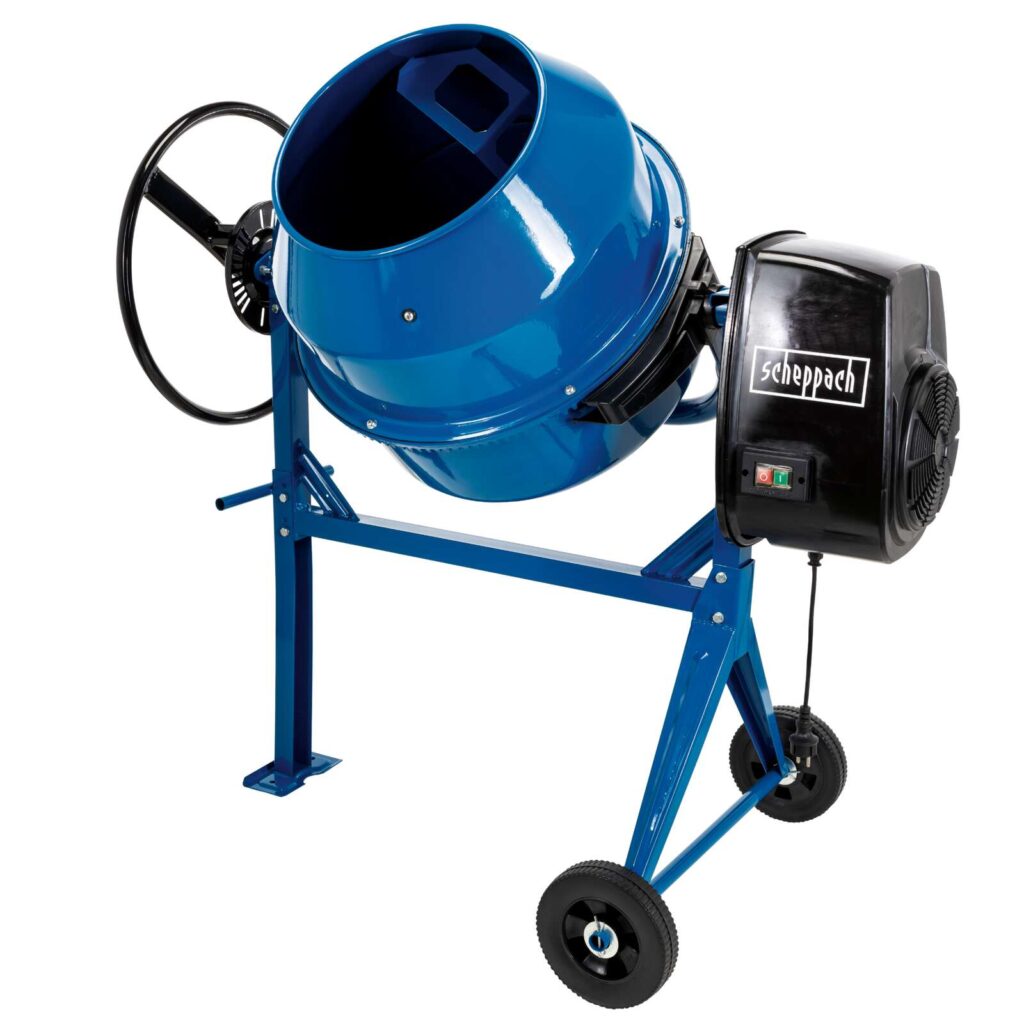
| Scheppach MIX125 | 125 l drum, max. 90 kg of mix | 550 W, 46 kg | Cast, 200 mm plastic wheels | Mortar and small foundations |
| Scheppach MIX180 | 180 l drum, max. 129 kg | 800 W, 58 kg | Cast, 230 mm plastic wheels | Larger floor slabs, several days in a row |
| Güde GBM 130 | 130 l fill volume | 550 W, 49 kg | Cast iron, 200 mm metal rims | Walls and plinths |
| Güde GBM 160 | 160 l fill volume | 800 W, 65 kg | Cast iron, 250 mm metal rims | Builders with soft ground |
Atika AKM 130
Atika mixers come from Altrad Equipment Germany in Burgau, which is why the AKM 130 carries both names in some listings. The mixer arrives unassembled in a box; according to the manufacturer, it has a 700-watt motor, thermal motor protection and restart protection. The folding chassis is its strongest argument. Anyone with a cramped garage will appreciate it. The AKM 130 is currently not available on Amazon (as of November 9, 2026).
Scheppach MIX125
A cast gear, IP44 and a drum opening of 385 mm: that is how Scheppach describes the MIX125. The 90 kg of mix sets a clear limit. That is plenty for mortar when bricklaying and for pad foundations; for a garage floor slab, it gets tedious.
Scheppach MIX180
With 800 watts and a 129 kg fill weight, the MIX180 is the workhorse of the series. The drum opening measures 390 mm, and the unit weighs 58 kg. If you pour a floor slab in several sections, it saves you batches, but it needs a fixed spot nearby.
Güde GBM 130
At 35 revolutions per minute, the GBM 130 runs a little faster than the other mixers with a stated speed and can be locked in 18 positions. Cast iron ring gear, wheels with metal rims, 49 kg net. A solid unit with no special features. For mortar on masonry, that is exactly enough.
Güde GBM 160
More volume, 800 watts and the largest wheels in our table. In return, at 65 kg and 1,380 mm tall, it is also the bulkiest unit. It is hardly suitable for transport in a car. On your own building plot, where it stays put for weeks, that does not matter.
And Einhell?
Einhell currently does not offer drum mixers, but mixing drills. For a bucket of tile adhesive or two bags of screed, a unit like the Einhell TC-MX 1400-2 E with 1,400 watts, two gears and an M14 chuck is the handier solution. From the third bag on, it becomes drudgery.
Cement is caustic, noise is regulated
Fresh concrete and mortar are strongly alkaline. The Heidelberg Materials safety data sheet states a pH of 11 to 13.5 and classifies cement-bound building materials as irritating to the skin and causing serious eye damage. Waterproof, alkali-resistant gloves, such as nitrile-impregnated cotton gloves, and tight-fitting safety goggles are recommended. Leather gloves are unsuitable because they let water through. If cement gets into your eye: rinse with running water for at least 20 minutes and see an eye doctor. When adding dry cement, Atika also requires a dust mask. Suitable models can be found in the work gloves guide.
Never reach into the rotating drum, the manual warns. According to Atika, young people under 16 may not operate the mixer. And the neighbors? Concrete and mortar mixers are listed in the annex to the German Equipment and Machinery Noise Protection Ordinance (32. BImSchV, no. 11). In residential areas, operating them outdoors is prohibited on Sundays and public holidays and on weekdays between 8 p.m. and 7 a.m.
How we would decide
- Individual projects, mortar and small foundations: Scheppach MIX125. With a folding chassis for the station wagon, it would be the Atika AKM 130 as soon as it is available again.
- Walls and mortar, fixed spot: Güde GBM 130 or Scheppach MIX125.
- Floor slab or building your own house: Scheppach MIX180 or Güde GBM 160.
- Only adhesive, plaster or a few bags: a mixing drill such as the Einhell TC-MX 1400-2 E.
Frequently asked questions
How much concrete actually fits in a 130-liter mixer?
Considerably less than the drum capacity, because the tilted drum would otherwise overflow. For the AKM 130, Atika states a nominal fill volume of 100 liters for its 130-liter drum. Scheppach calculates in kilograms: for the MIX125, a maximum of 90 kg of mix. So never compare liters with liters without knowing which ones are meant.
How many watts does a concrete mixer need?
The mixers in our selection range between 550 and 800 watts. Output mainly shows whether the motor can turn a full drum of stiff concrete without the thermal cutout tripping. Faster does not mix better; the drums deliberately turn at a leisurely pace.
Which extension cord does a concrete mixer need?
Atika requires rubber cables of type H07RN-F with at least 1.5 mm² up to 25 m in length, and 2.5 mm² beyond that. The cable reel must be fully unwound, and the connection must run through a 30 mA residual current device (RCD). Otherwise, long, thin cables cost voltage and power.
Sheet metal or cast ring gear?
Scheppach and Güde rely on cast iron; for the AKM 130, Atika uses a ring made of sheet iron, which the manufacturer describes as break-proof. Both last if maintained: remove mortar residue from the pinion and ring gear immediately, and never grease the ring, because grease binds sand.
What protective equipment do you need when mixing concrete?
Fresh concrete is strongly alkaline and, according to the safety data sheet, irritating to the skin and causes serious eye damage. Waterproof, alkali-resistant gloves and tight-fitting safety goggles are recommended; leather gloves let water through. When adding dry cement, Atika requires a dust mask.
When may a concrete mixer run in a residential area?
Concrete mixers are listed in the annex to the German Equipment and Machinery Noise Protection Ordinance. In residential areas, operating them outdoors is prohibited on Sundays and public holidays and on weekdays between 8 p.m. and 7 a.m.
Sources
- Atika: AKM 130
- Atika: AKM 130 data sheet (PDF)
- Atika: concrete mixer operating manual (PDF)
- Scheppach: MIX125
- Scheppach: MIX180
- Güde: GBM 130
- Güde: GBM 160
- Einhell: TC-MX 1400-2 E
- Heidelberg Materials: safety data sheet for cement-bound building materials (PDF)
- German 32. BImSchV, § 7 and annex
Where to buy
- Scheppach MIX125View at scheppachAvailable in Germany: scheppachCheck price at Amazon.deAvailable in Germany: Amazon.de
- Atika AKM 130Check price at Amazon.deAvailable in Germany: Amazon.de
- Scheppach MIX180View at scheppachAvailable in Germany: scheppachCheck price at Amazon.deAvailable in Germany: Amazon.de
- Güde GBM 130Check price at Amazon.deAvailable in Germany: Amazon.de
- Güde GBM 160Check price at Amazon.deAvailable in Germany: Amazon.de
- Einhell TC-MX 1400-2 ECheck price at Amazon.deAvailable in Germany: Amazon.de