Contents14 sections
This guide was first published in German on handgetestet.de.
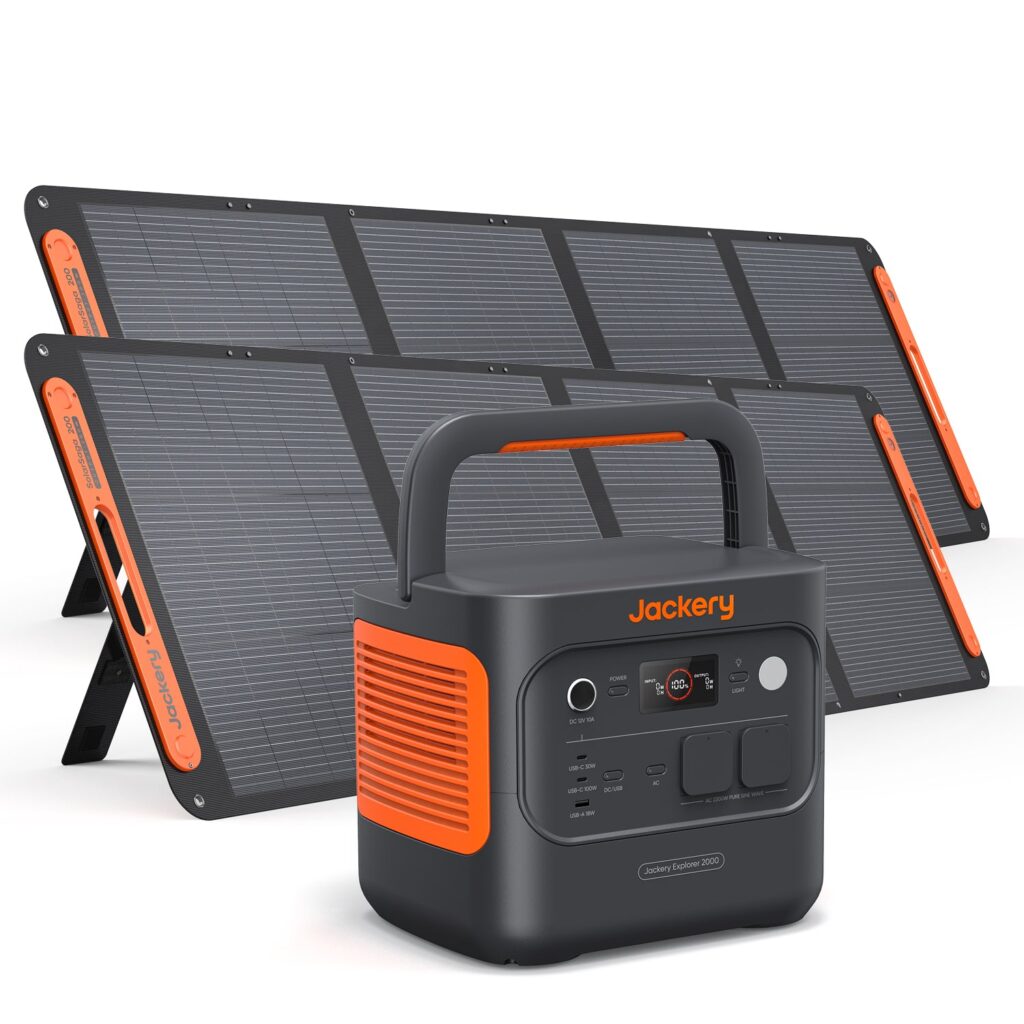
A solar generator cannot do anything a power station and a solar panel could not do on their own. The term means exactly this bundle. Even so, you should often buy it as a kit, because the panel costs considerably less that way than on its own. For backup power and longer weekends, among the bundles compared here we consider the Jackery Explorer 2000 v2 with two SolarSaga 200 panels the most coherent, because the battery and panel area match each other. The Explorer 1000 v2 with one panel is the same math at half the size.
What is in the box, and what is not?
The battery, inverter and solar charge controller sit inside the station. Then there are one or two foldable panels. There is no engine and no gasoline, and with them goes any chance of delivering more power at night than went into the battery during the day. If you need that, look for a gas-powered generator.
Take a close look at what is included. Under the name solar generator, Jackery also lists offers that, by picture and price, are just the station without a panel. The cable is tight, too. According to the retailer, the SolarSaga 200 comes with 1.3 meters. But the station should stay dry and away from heat, while the panel sits in the sun. 1.3 meters rarely reaches through the patio door; Jackery sells a 5-meter extension as an accessory.
Kit or separate purchase: what the price list reveals
At the beginning of November, Jackery’s list looked like this: with the Explorer 2000 v2, the first 200-watt panel in the kit cost about one seventh of its standalone price, and two panels together a good half of their standalone price. With the Explorer 1000 v2, the surcharge was around two thirds of the panel price. Promotions like these change. So check what the kit and the individual parts cost on the day you buy.
If you do not have a station at home yet, almost everything speaks for the bundle. Three cases turn the math around.
You already own a station. Then only the connection counts: according to the retailer, the Explorer 1000 v2 and 2000 v2 accept up to 400 watts at 16 to 60 volts via two inputs, and both inputs need the same panel model. The BLUETTI AC200L requires MC4 connectors, and the Anker SOLIX C1000 Gen 2 tolerates a maximum of 60 volts. The details are in our guide to the foldable solar panel.
The system is meant to stay in one place. Folding panels are built for transport, and if you leave them in the garden all year, you are paying for the folding for nothing. For a garden shed without a power connection (in German), the planning looks different.
Your main goal is to lower your electricity bill. That is not a job for a solar generator. On paper, a 200-watt panel yields around 205 kilowatt-hours a year, but only if it is set up every day and you actually draw the power from the battery. A permanently mounted balcony solar system (in German) takes this manual work off your hands.
From daily demand to panel size
The brochure figure hardly helps with sizing. Jackery quotes around 5.5 hours for the Explorer 2000 v2 with two panels, but in full sun. You are better off calculating with daily averages. For that, we consulted the European Commission’s PVGIS solar calculator: 200 watts, free-standing, tilted to the south, 14 percent system loss. At a 60-degree tilt, the panel delivers per day on the monthly average:
- Frankfurt: December 230, January 280, February 460, June 740 watt-hours
- Hamburg: December 180, January 200, February 370, June 730 watt-hours
That keeps the calculation short. Divide your daily demand by the value of the worst month in which the kit still has to carry the load. The result is the number of panels. For working out the demand itself, see our guide to runtime (in German).
The second check is the ratio to the battery. We plan for around 200 watts of panel per kilowatt-hour. The station is then full in about a day and a half in June, regardless of whether the bundle contains 1 or 2 kilowatt-hours. With the Explorer 2000 v2 and only one panel, it takes almost three days on the June average. That is how disappointed buyers come about: big battery, small panel area, because the bundle looks cheap on paper.
Winter is the honest yardstick
Between June and December, the panel loses almost 70 percent in Frankfurt and a good 75 percent in Hamburg. A refrigerator with an assumed 150 kilowatt-hours a year needs around 410 watt-hours a day. A single 200-watt panel does not cover that in December. Two just about manage it on the monthly average, not counting the station’s losses. And an average includes the sunny days. In a gloomy week, much less is left over.
By the numbers, it takes a good four days for two panels to fill the Explorer 2000 v2 in December. So in winter the kit is no full power supply. It stretches the battery. Greater demand belongs in the backup power (in German) plan.
You can gain a little through the angle. At 60 degrees, the panel in Frankfurt delivers around 15 percent more in December than at 35 degrees, but less in June: 740 instead of 880 watt-hours. So set it up steep in winter. The sun is low then, and even the tree at the edge of the property or the neighbor’s house can cost you half the day. The station stays indoors. Most models here can only be charged from 0 degrees Celsius.
Seven bundles compared
The yield column gives the calculated daily average in Frankfurt at 60 degrees, scaled to the panel area in the bundle.
| Model | Battery and continuous output | Panels in the bundle | Yield December / June | Best for |
|---|---|---|---|---|
| Jackery Explorer 2000 v2 + 2x SolarSaga 200 | 2,042 Wh, 2,200 W | 400 W | 460 / 1,480 Wh | Backup power, long weekends |
| Jackery Explorer 1000 v2 + SolarSaga 200 | 1,070 Wh, 1,500 W | 200 W | 230 / 740 Wh | small reserve at home, do not charge from a vehicle |
| Jackery Explorer 2000 v2 + SolarSaga 200 | 2,042 Wh, 2,200 W | 200 W | 230 / 740 Wh | Entry with an upgrade plan |
| Jackery Explorer 3000 v2 + 2x SolarSaga 200 | 3,072 Wh, 3,600 W | 400 W | 460 / 1,480 Wh | lots of battery, solar as a bonus |
| Jackery Explorer 500 v2 + SolarSaga 100 | 512 Wh, 500 W | 100 W | 115 / 370 Wh | Tent and weekend |
| Anker SOLIX C1000 Gen 2 + 200W Solarpanel | 1,024 Wh, 2,000 W | 200 W | 230 / 740 Wh | high loads, small battery |
| BLUETTI AC200L + 200W Solarpanel | 2,048 Wh, 2,400 W | 200 W | 230 / 740 Wh | fixed location, later expansion |
Jackery Explorer 2000 v2 + 2x SolarSaga 200
Here the ratio is right: according to the retailer, 400 watts is also the upper limit of the solar input, so this station cannot take more. On the other hand, it is not expandable, and with two panels and a 17.5-kilogram station, this is not a bundle for a backpack.
Jackery Explorer 1000 v2 + SolarSaga 200
Half the size with the same logic. At 10.8 kilograms, the station stays easy to handle. For a refrigerator in winter, however, the panel area falls short, although according to the retailer the station accepts a second panel. In spring 2025, the ADAC (German automobile club) downgraded the Explorer 1000 v2 to „poor“ because its two DC inputs are not decoupled. So never charge it via solar and a vehicle socket at the same time.
Jackery Explorer 2000 v2 + SolarSaga 200
The bundle with the smallest surcharge. It makes sense if you mainly want the battery and plan to buy the second panel later. Then, however, at the standalone price, so the advantage shrinks again.
Jackery Explorer 3000 v2 + 2x SolarSaga 200
According to the retailer, the station accepts up to 1,000 watts of panel area; two SolarSaga 200 panels do not come close to using that up. In June, a good two days are needed for a full charge. If you need 3 kilowatt-hours, you usually precharge from the wall outlet, and solar only stretches it.
Jackery Explorer 500 v2 + SolarSaga 100
Small, but with the same proportions. At 5.7 kilograms, it fits in the car, and it is enough for phones, lights and a laptop over the weekend. This bundle will not carry a refrigerator in winter.
Anker SOLIX C1000 Gen 2 + 200W Solarpanel
Anker specifies 1,024 watt-hours, 2,000 watts of continuous output and up to 600 watts of solar input. That is more headroom than with the Explorer 1000 v2. So you can add a larger panel later, but you have to watch the 60 volts. Charging in frost is not possible here either; Anker specifies 0 to 40 degrees Celsius.
BLUETTI AC200L + 200W Solarpanel
When it comes to solar input, the AC200L plays in a different league: up to 1,200 watts according to BLUETTI, with about four 200-watt panels recommended. That is exactly why a single panel seems too small here. At 28.3 kilograms, the unit is meant for a fixed location, and add-on batteries expand it to up to 8,192 watt-hours.
Which bundle suits which lifestyle
- A weekend in a tent or by the water: Explorer 500 v2 with SolarSaga 100.
- Campers and travelers with a cooler: Explorer 500 v2 with SolarSaga 100, with the cooler connected directly to 12 volts. More on this in our guide power station in a motorhome.
- Preparing for power outages at home: Explorer 2000 v2 with two panels.
- Lots of battery, sun only as a reserve: Explorer 3000 v2.
- Expansion to a large solar area planned: BLUETTI AC200L, and then with more than one panel right away.
- Lowering electricity costs: not a solar generator; look into a balcony solar system with storage (in German) instead.
If you are planning to live off the grid all year, you will find the December math in our guide to the off-grid system (in German).
Frequently asked questions
How many solar panels does my solar generator need?
Divide your daily demand by the yield of the worst month in which the kit still has to carry the load. A 200-watt panel tilted at 60 degrees in Frankfurt delivers around 230 watt-hours a day in December and 740 in June. On top of that, we plan for around 200 watts of panel per kilowatt-hour of battery.
Can a solar generator run a refrigerator in winter?
Hardly. A refrigerator with an assumed 150 kilowatt-hours a year needs around 410 watt-hours a day. A single 200-watt panel does not cover that in December; two just about manage it on the monthly average. In a gloomy week, much less is left over. In winter, the kit stretches the battery, nothing more.
Buy a kit, or the power station and panel separately?
If you do not have a station at home yet, almost everything speaks for the bundle. It is different if you already own a station, if the system is meant to be permanently installed, or if your main goal is to lower your electricity bill. A balcony solar system is the better fit for that. Check the prices of the kit and the individual parts on the day you buy.
At what angle should I set up the panel in winter?
Steep. At 60 degrees, the panel in Frankfurt delivers around 15 percent more in December than at 35 degrees, but less in June. The sun is low in winter, and even a tree or the neighbor's house can cost you half the day. The station stays indoors; most can only be charged from 0 degrees Celsius.
Is the included solar cable long enough?
Often not. According to the retailer, the SolarSaga 200 comes with 1.3 meters. The station should stay dry and away from heat, the panel in the sun, and 1.3 meters rarely reaches through the patio door. Jackery sells a 5-meter extension as an accessory.
Sources
- European Commission: PVGIS (our own calculation for Frankfurt and Hamburg)
- GreenDrive: Explorer 2000 v2 (retailer information)
- GreenDrive: Explorer 1000 v2 (retailer information)
- GreenDrive: Explorer 3000 v2 (retailer information)
- GreenDrive: Explorer 500 v2 (retailer information)
- GreenDrive: SolarSaga 200W (retailer information)
- Jackery: Explorer 2000 v2
- Anker SOLIX: C1000 Gen 2
- BLUETTI: AC200L
- ADAC (German automobile club): Portable power stations tested (spring 2025)
Where to buy
- Jackery Explorer 2000 v2 + 2x SolarSaga 200View at JackeryAvailable in Germany: JackeryCheck price at Amazon.deAvailable in Germany: Amazon.de
- Jackery Explorer 1000 v2 + SolarSaga 200View at JackeryAvailable in Germany: JackeryCheck price at Amazon.deAvailable in Germany: Amazon.de
- Jackery Explorer 2000 v2 + SolarSaga 200View at JackeryAvailable in Germany: JackeryCheck price at Amazon.deAvailable in Germany: Amazon.de
- Jackery Explorer 3000 v2 + 2x SolarSaga 200View at JackeryAvailable in Germany: JackeryCheck price at Amazon.deAvailable in Germany: Amazon.de
- Jackery Explorer 500 v2 + SolarSaga 100View at JackeryAvailable in Germany: Jackery
- Anker SOLIX C1000 Gen 2 + 200W SolarpanelCheck price at Amazon.deAvailable in Germany: Amazon.de
- BLUETTI AC200L + 200W SolarpanelCheck price at Amazon.deAvailable in Germany: Amazon.de