Contents11 sections
This guide was first published in German on handgetestet.de.
The bag says 200 watts, the power station shows 140. Nothing is broken. The figure on the label applies to laboratory conditions that almost never come together outdoors. If you know that and match the panel’s voltage to your power station’s solar input, you will buy the right thing. For flexible use with small and mid-size power stations, we consider a light 100-watt panel with around 20 volts the most sensible start, such as the bifacial Anker SOLIX PS100. If you own a larger station with a high-voltage input, go for the 200-watt class.
What the wattage on the label really means
The rated output in watt-peak (Wp) is measured under standard test conditions. That means 1,000 watts of solar irradiance per square meter, a standardized light spectrum (AM 1.5) and a cell temperature of 25 °C. That is how it is stated in the manual for EcoFlow’s bifacial 220 W panel. Outdoors on a clear day, you measure more like 800 to 900 W/m², and the cells heat up in the sun. EcoFlow states 160 to 180 watts for its 220 W panel under such conditions, so around three quarters of the rated output. The manufacturer observes values close to the label most often at midday in winter.
Why winter of all times? The cold. Silicon cells lose some output with every degree above 25 °C. EcoFlow states a temperature coefficient of −0.39% per degree for its 100 W panel and calculates that a module with a surface temperature of 60 °C in summer stays about 13% below its rated output. A dark panel on hot asphalt therefore has a worse day than one on grass that catches a little wind.
The angle counts just as much. If the light hits the surface perpendicularly, all is well, and according to EcoFlow, a deviation of up to about 10 degrees costs hardly any yield. For Europe, Anker recommends a 35-degree tilt between 10 a.m. and 5 p.m. Clouds and haze, on the other hand, reduce output considerably, as does any shade. According to EcoFlow, even the shadow of a branch can sharply reduce output. With mobile panels, that means in very practical terms: turn them every one to two hours. Jackery has a small sun angle indicator on the handle for this, whose shadow is supposed to fall into a white circle.
Bifacial panels also collect light on the back. Anker puts the gain at up to 10%. EcoFlow speaks of 5 to 25%, more with plenty of ambient light. On a dark forest floor, you should expect the lower end.
Voltage, connector, input: where bad purchases happen
It rarely gets expensive because of too few watts. It gets expensive when the panel and power station do not match electrically. Every station has a solar input with a voltage range. On the Bluetti EB55, according to the manual, that is 12 to 28 volts at a maximum of 200 watts. What matters is the open-circuit voltage (Voc), the voltage the panel delivers with no load connected. It is always higher than the operating voltage. A panel with an operating voltage of 48 volts such as the Anker SOLIX PS200 therefore does not belong on any input that tops out at 28 volts.
In the cold, the open-circuit voltage rises. For the bifacial 220 W panel, EcoFlow states a voltage coefficient of −0.33% per degree. Let’s do the math: two of these panels in series come to 43.6 volts open-circuit. At a cell temperature of 0 °C, 25 degrees below the standard condition, that becomes a good 47 volts. An input rated up to 60 volts handles this with room to spare. A third panel in series would exceed the limit at over 65 volts.
In series, the voltages add up; in parallel, the currents do. For 20-volt panels on a station with a high-voltage input, series is usually the better way. Parallel only helps if the input actually accepts double the current. For its Delta and River stations, which accept up to 12 amps, EcoFlow explicitly advises against it. Different panels in a series string limit each other to the current of the weakest one. So when expanding, buy the same model again.
When it comes to connectors, every manufacturer has its preferences. MC4 is the photovoltaic standard, XT60 the common input on power stations, Jackery uses round DC7909 and DC8020 plugs, and some stations also have Anderson sockets. There are adapter cables for almost everything. But they must be rated for the panel’s current. DJI goes its own way: on the DJI Power, the Zignes panel needs a separate MPPT adapter module.
Weight, packed size and weather protection in everyday use
The models below weigh between 2.8 and 5.6 kilos; EcoFlow’s old bifacial 220 W panel still came in at 9.5 kilos. If you carry the panel from the parking lot to the campsite, you feel every kilo. The packed size determines whether it fits behind the car seat or takes up half the trunk. Also pay attention to the stand. Anker relies on a fixed angle with slight adjustment, while DJI includes a stand with the Zignes panel.
Anker and EcoFlow advertise IP68, but caution still applies. In the FAQ for the PS100, Anker writes that the panel should not be exposed to heavy rain or submerged, and warns about the hot metal frame. EcoFlow only calls the panel body waterproof; the junction box and connectors should not be left in water for long. In its manual, Jackery advises not letting the panel get wet and cleaning it only with a damp cloth. So pack it away when it rains.
Charging directly via USB? The Jackery SolarSaga 100 has a USB-A output with 5 V and 2.4 A and USB-C with 5 V and 3 A. That is enough for a phone; a laptop needs more. In most cases, the power goes through the power station anyway.
Four foldable solar panels with their key data
| Model | Output and voltage | Connection and protection | Weight, folded | Best for |
|---|---|---|---|---|
| Anker SOLIX PS100 Bifacial | 100 W, 21.6 V / 4.63 A at operating point | XT60i cable included, IP68 | 2.8 kg, 51 × 60 × 6.4 cm | Light luggage, small to mid-size stations |
| Anker SOLIX PS200 Bifacial | 200 W, 48 V / 4.16 A at operating point | XT60i cable included, IP68 | 4.8 kg, 68.5 × 79.2 × 4.5 cm | Stations with a high-voltage input |
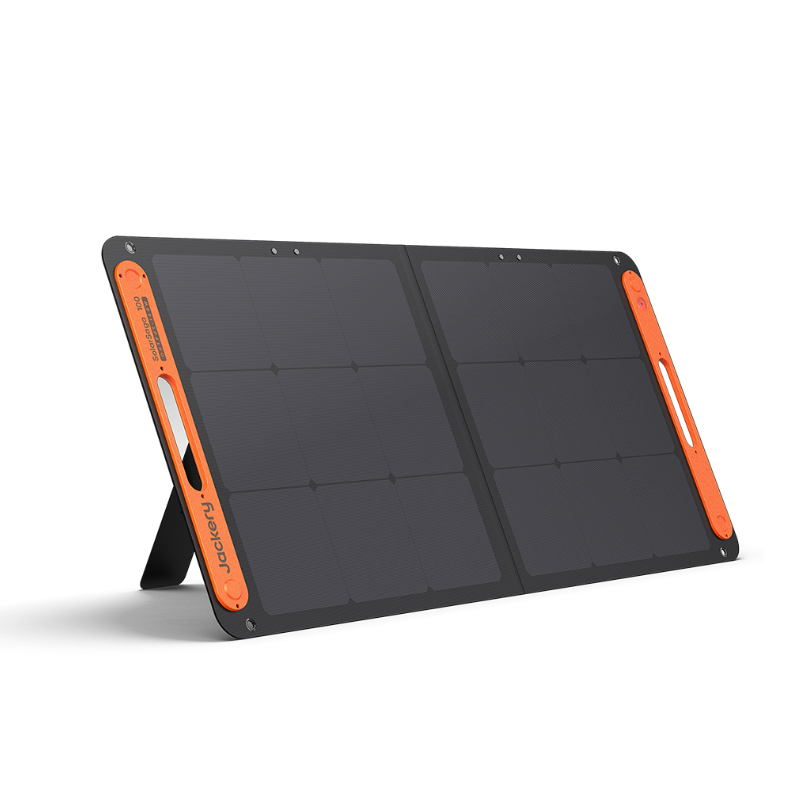
| Jackery SolarSaga 100 | 100 W, 20 V operating, 24.8 V open-circuit voltage | DC7909 with DC8020 adapter, USB-A and USB-C | 61 × 55.2 × 3.5 cm | Jackery owners, charging a phone directly |
| DJI Zignes 120W Solar Panel | 120 W, max. 26 V open-circuit, max. 7 A | via DJI MPPT module, IP65 | 5.6 kg, 36.5 × 58 × 7 cm | Owners of a DJI Power |
All values are manufacturer specifications from product pages and manuals.
Anker SOLIX PS100 Bifacial
At 2.8 kg, it is the lightest panel on this list. The operating voltage of 21.6 volts matches the usual 12-to-28-volt inputs of small stations. Two of them in series can later serve a high-voltage input as well. According to Anker, an XT60i cable and two solar cables are included. By EcoFlow’s rule of thumb for 100 W panels, more like 70 to 80 watts arrive on a clear midday. For a 1 kWh station, that is not much; for lights, a phone and a cooler on the weekend, it fits.
Anker SOLIX PS200 Bifacial
Twice the output at 4.8 kg. The sticking point is the voltage. With 48 volts at the operating point, and the open-circuit voltage even higher, the PS200 only belongs on stations with a correspondingly high solar input. Check this in your station’s data sheet before you order. If it fits, one 200 W panel saves cables and setup time compared with two 100 W panels.
Jackery SolarSaga 100
A classic for Jackery stations. The manual states 20 volts operating and 24.8 volts open-circuit voltage, plus USB-A and USB-C directly on the panel. The DC7909 plug fits Jackery’s Explorer series, and an adapter to DC8020 is included. On other brands‘ stations, you need an adapter cable. The manufacturer is cautious about moisture, so better not leave it out in the rain.
DJI Zignes 120W Solar Panel
Built for the DJI Power 500, 1000 and 1000 V2. Plugging it in directly does not work. You need the DJI Power adapter module (MPPT), which accepts up to three panels, or a car socket cable for exactly one. According to DJI, a stand and a 3-meter extension cable are included. With IP65, it is protected against splashing water, but it should not be submerged.
And the balcony power plant?
A foldable panel charges a battery with direct current. It does not feed anything into the household grid. According to the Bundesnetzagentur (Germany’s Federal Network Agency), a plug-in solar device consists of solar modules, an inverter and a plug for the socket. In Germany, the module output may reach up to 2,000 watts, the inverter may deliver at most 800 VA, and the device must be registered in the market master data register. If you want to generate power permanently on your balcony, the guide to balcony power plants with storage (in German) is the right place. The foldable panels here are designed for use on the go.
How we would decide
- You have a small station with a 12-to-28-volt input or want to stay flexible: Anker SOLIX PS100 Bifacial, later a second one in series.
- Your station accepts 60 volts or more: Anker SOLIX PS200 Bifacial, one panel instead of two.
- You use a Jackery Explorer and want to charge your phone directly from the panel: Jackery SolarSaga 100.
- You own a DJI Power: DJI Zignes 120W including the MPPT module.
Which station suits your needs is covered in our guide to buying a power station (in German). If the panel is to supply a cooler, the guide to compressor coolers (in German) will help.
Why a panel rarely delivers its rated output and how long it takes to charge a power station is explained in the guide Charging a power station with a solar panel (in German).
Rigid modules with a glass back, and when the back side pays off, are explained in the guide to bifacial solar modules (in German).
For permanent mounting with little weight, there is the guide to lightweight solar modules (in German).
Ready-made packages of station and foldable module are compared in the guide Solar generator kits (in German).
Frequently asked questions
Why does my solar panel deliver fewer watts than stated?
The rated output is measured under standard test conditions, with 1,000 watts of irradiance per square meter and a cell temperature of 25 °C. Outdoors, clear days bring more like 800 to 900 W/m², and the cells heat up. EcoFlow states 160 to 180 watts for a 220 W panel under such conditions, so around three quarters.
Does every solar panel fit my power station?
No. Every station has a solar input with a voltage range, for example 12 to 28 volts on the Bluetti EB55. What matters is the open-circuit voltage, which is higher than the operating voltage and rises in the cold. A panel with an operating voltage of 48 volts such as the Anker SOLIX PS200 does not belong on any input that tops out at 28 volts.
Should solar panels be connected in series or in parallel?
In series, the voltages add up; in parallel, the currents do. For 20-volt panels on a station with a high-voltage input, series is usually the better way. Parallel only helps if the input accepts double the current. Different panels in a series string are limited to the weakest one, so buy the same model again.
How do you position a foldable solar panel correctly?
Light should hit the surface as close to perpendicular as possible; according to EcoFlow, a deviation of up to about 10 degrees costs hardly any yield. For Europe, Anker recommends a 35-degree tilt between 10 a.m. and 5 p.m. Even the shadow of a branch can sharply reduce output. In practice, that means turning it every one to two hours.
Can a foldable solar panel be left out in the rain?
Better not, even with IP68. Anker writes about the PS100 that the panel should not be exposed to heavy rain or submerged. EcoFlow only calls the panel body waterproof, not the junction box and connectors, and Jackery advises not letting the panel get wet. So pack it away when it rains.
Can a foldable solar panel serve as a balcony power plant?
No. A foldable panel charges a battery with direct current and does not feed anything into the household grid. According to the Bundesnetzagentur (Germany's Federal Network Agency), a plug-in solar device consists of modules, an inverter and a plug for the socket, and must be registered in the German market master data register. Foldable panels are designed for use on the go.
Sources
- Anker SOLIX PS100 bifacial portable solar panel (manufacturer)
- Anker SOLIX PS200 bifacial portable solar panel (manufacturer)
- Jackery SolarSaga 100, user manual (PDF)
- EcoFlow 220W Bifacial Solar Panel, manual with technical data (PDF)
- EcoFlow 100W Solar Panel, manual with temperature coefficients (PDF)
- DJI Store: Zignes 120W Solar Panel
- Bluetti EB55, user manual with solar input (PDF)
- Bundesnetzagentur: Balcony solar systems
Where to buy
- Anker SOLIX PS100 BifazialCheck price at Amazon.deCheck price at Amazon.co.ukCheck price at Amazon.nlCheck price at Amazon.com.beCheck price at Amazon.frCheck price at Amazon.itCheck price at Amazon.esCheck price at Amazon.plCheck price at Amazon.seAvailable in Germany: Amazon.de
- Anker SOLIX PS200 BifazialCheck price at Amazon.deCheck price at Amazon.co.ukCheck price at Amazon.nlCheck price at Amazon.com.beCheck price at Amazon.frCheck price at Amazon.itCheck price at Amazon.esCheck price at Amazon.plCheck price at Amazon.seAvailable in Germany: Amazon.de
- Jackery SolarSaga 100View at JackeryAvailable in Germany: Jackery
- DJI Zignes 120W SolarpanelCheck price at Amazon.deCheck price at Amazon.co.ukCheck price at Amazon.nlCheck price at Amazon.com.beCheck price at Amazon.frCheck price at Amazon.itCheck price at Amazon.esCheck price at Amazon.plCheck price at Amazon.seAvailable in Germany: Amazon.de