Contents16 sections
This guide was first published in German on handgetestet.de.
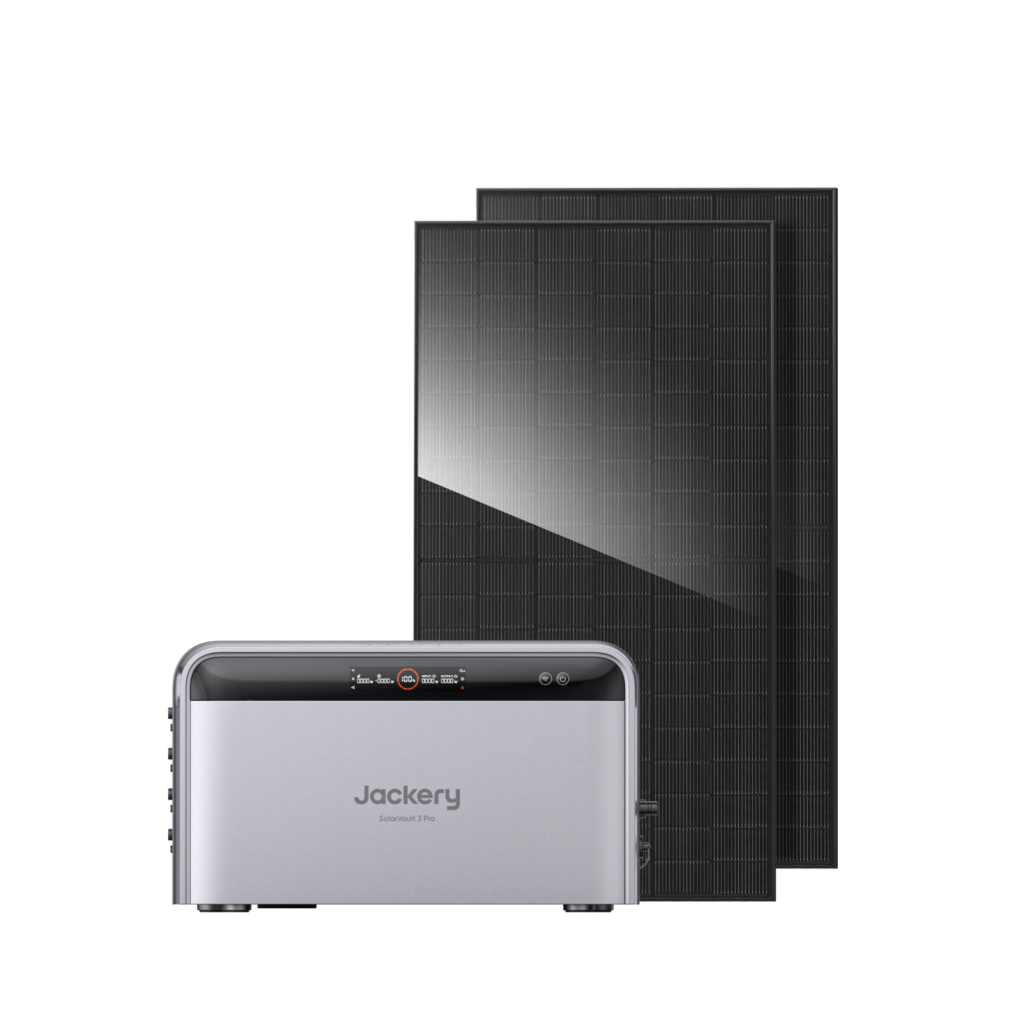
On a balcony, one number decides between all three models: 800. That is how many watts every SolarVault 3 feeds into the household grid out of the box, including the big Pro Max. More only becomes available once an electrician has checked the circuit and you request the unlock in the app. For a balcony solar system, we therefore consider the SolarVault 3 Pro the right choice. The Pro Max only shows its strength with an electrician and an extra battery, and the Pro Max AC belongs with an existing rooftop system.
What do the three have in common?
More than the names suggest. All three carry the same 2,520-watt-hour battery, lithium iron phosphate, rated according to the data sheet for 6,000 cycles at 90 percent depth of discharge down to at least 70 percent remaining capacity. All come in an IP65 housing and operate from minus 20 to 55 degrees Celsius. Up to five BP2500 extra batteries can be stacked under each unit, for a total of 15.12 kilowatt hours. If the grid fails, the unit’s outlet switches to battery within 20 milliseconds, according to the manual. It explicitly does not replace a UPS, and Jackery advises running only one appliance at a time from it.
Where is the difference between the Pro and the Pro Max?
In the output, not on the solar side. Both have four inputs of 1,000 watts each, and both charge at the same nominal rate: 1,800 watts without an extra battery, 3,600 with one, 4,500 with two or more. They part ways on output. The Pro stays at 1,200 watts, no matter how many batteries are stacked underneath. The Pro Max manages 1,600 watts on its own and 2,500 watts with at least one BP2500. Its outlet passes through up to 3,680 watts from the grid, compared with 2,300 on the Pro. That is the entire premium. Plus one extra kilo of weight.
So what is the Pro Max AC for?
For people who already have power from the roof. It has no solar inputs at all, connects only to the household grid and stores what would otherwise flow out. On output, it matches the Pro Max. It only belongs on a balcony in one special case: you already own panels with a microinverter, never want to add panels and still need more than 1,200 watts. For everyone else, the Pro does the same job and has the four inputs on top. How retrofitting works with a rooftop system is explained in the home battery guide.
Are 2,500 watts even useful on a balcony?
Not at night. Let’s assume a 200-watt base load over twelve hours, which is 2.4 kilowatt hours. At 90 percent depth of discharge, the battery provides a little over 2.2 of that, and 800 watts would drain it in under three hours. For the fridge, router and lights, output is therefore never the bottleneck.
When cooking, it is more of a factor. An induction hob draws 2,000 watts for half an hour, which is one kilowatt hour. At 800 watts, 0.4 comes from the battery and 0.6 from the grid. Every day, that would add up to around 220 kilowatt hours a year that a Pro Max with an extra battery could additionally cover, provided the battery is full in the evening. On the other side of the ledger are the electrician and a second battery. Whether even the small battery pays off is shown in our worked example for a balcony battery.
What is allowed on a balcony?
According to Germany’s Federal Network Agency (Bundesnetzagentur), the special rules for plug-in solar devices apply up to 2,000 watts of panel output and 800 volt-amperes of inverter output. The advertised 4,000 watts of solar input are therefore twice what still counts as a balcony solar system. A second statement from the agency is trickier: if the output can be set to different levels by switch or software, the highest selectable setting counts. That can affect the Pro at 1,200 watts and both Max units. So before buying, clarify in writing with the grid operator how it classifies the unit.
Then there is the plug. Under the German standard DIN VDE V 0126-95, according to the German consumer advice center (Verbraucherzentrale), the standard household Schuko plug is intended for up to 960 watts of panel output; larger systems need a dedicated feed-in outlet installed by an electrician. However, this standard does not apply to devices with a battery, and the EEG (Germany’s Renewable Energy Sources Act) makes no exception for such batteries. Registration with the grid operator and in the register therefore remain an issue; details are in the registration guide.
Will my existing balcony solar system work with it?
Usually yes, and without any rewiring. You plug the microinverter into the unit’s outlet, which on the Pro takes up to 2,300 watts from the grid according to the manual. Other sources, such as generators, are prohibited there. New panels go directly to the inputs. That leaves the total open: the microinverter and the battery are two inverters behind one meter, and the 800 volt-amperes apply in total. That, too, belongs in your request to the grid operator.
Third-party panels must stay below 60 volts open-circuit voltage and 28 amps short-circuit current per input. Two standard panels in series quickly exceed that, so a look at the panel data sheet saves trouble. Because each input has its own controller, a shaded east-facing panel does not interfere with the south-facing one. For consumption-based control, you also need a meter or a reading head; see the zero export guide (in German).
Can the unit simply go out on the balcony?
IP65 sounds like it could go to the swimming pool. The manual is more cautious: for continuous operation, the unit should stand in a dry, well-ventilated place, protected from sun, rain and snow, on level ground with no more than five degrees of slope and 30 centimeters of space on the sides. The outlet is off-limits in the rain. If you stack, secure the tower to the wall with anchors, which in a rented apartment is a question for the landlord. According to Jackery, the battery is happiest at 15 to 30 degrees Celsius; below zero, it preheats before charging.
Six batteries compared
| Model | Connecting panels | Capacity | Feed into grid | Outlet without grid | Best for |
|---|---|---|---|---|---|
| Jackery SolarVault 3 Pro | 4 inputs, outlet for microinverter | 2.52 to 15.12 kWh | 800 W, 1,200 W with unlock | 1,200 W | Balcony with 2 to 4 panels |
| Jackery SolarVault 3 Pro Max | 4 inputs, outlet for microinverter | 2.52 to 15.12 kWh | 800 W, 2,500 W with unlock | 1,600 W, 2,500 W with extra battery | Electrician planned, cooking in the evening |
| Jackery SolarVault 3 Pro Max AC | no inputs, only via household grid or microinverter | 2.52 to 15.12 kWh | 800 W, 2,500 W with unlock | 1,600 W, 2,500 W with extra battery | existing rooftop system |
| Jackery HomePower 2000 Ultra | 2 inputs | 2.05 to 8 kWh | 800 W | 1,500 W | smaller balcony, backup power |
| Anker SOLIX Solarbank 4 E5000 Pro | 4 inputs | 5 to 30 kWh | 800 W, 2,500 W with a qualified electrician | 2,500 W | high evening consumption |
| EcoFlow STREAM AC Pro | no inputs | 1.92 to 11.52 kWh | 800 W | not specified | small AC entry point |
Jackery SolarVault 3 Pro
Our top recommendation for the balcony. It takes new panels and an old balcony solar system at the same time, charges at 1,800 watts and, going by Jackery’s list price, is the cheapest of the three. The limit: it never goes beyond 1,200 watts, not even with extra batteries.
Jackery SolarVault 3 Pro Max
Makes sense if heavy loads run in the evening or the backup outlet needs to handle an electric kettle. Both require the BP2500. Without an electrician, you are paying for output that sits idle in the unit.
Jackery SolarVault 3 Pro Max AC
The battery for the roof. On a balcony, you give up the advantage of charging directly from panels with direct current, because every additional conversion costs energy. Without a microinverter or rooftop system, it only charges from the grid.
Jackery HomePower 2000 Ultra
The smaller alternative from the same company, somewhat cheaper still going by list price. Two solar inputs, a little over two kilowatt hours and a 1,500-watt load output, which is more than the Pro’s 1,200 watts. That is enough for two panels.
Anker SOLIX Solarbank 4 E5000 Pro
Twice the base capacity and 10,000 cycles according to Anker, also 800 watts out of the box. Above 800 watts, Anker explicitly requires a qualified electrician, a dedicated circuit and registration with the grid operator. At 50 kilos, this is not a unit you carry up to the fourth floor yourself.
EcoFlow STREAM AC Pro
A small battery without a solar input for an existing balcony solar system, weighing 21.5 kilos. According to the data sheet, it charges at 1,050 watts, and two outlets pass through up to 2,300 watts from the grid.
Who needs what?
- New balcony solar system, two to four panels: Jackery SolarVault 3 Pro at 800 watts.
- Old balcony solar system stays, more panels to be added: also the Pro.
- Only two panels and a tight budget: Jackery HomePower 2000 Ultra.
- Electrician is coming anyway, the kitchen runs in the evening: Pro Max with one BP2500.
- Rooftop system without a battery: Pro Max AC.
- High consumption after sunset and room for 50 kilos: Anker SOLIX Solarbank 4 E5000 Pro.
Frequently asked questions
What is the difference between the SolarVault 3 Pro and the Pro Max?
Only the output. The battery and the four solar inputs are the same. The Pro delivers a maximum of 1,200 watts, no matter how many batteries are stacked underneath. The Pro Max manages 1,600 watts on its own and 2,500 watts with at least one BP2500, and its outlet passes through up to 3,680 watts from the grid.
Who is the SolarVault 3 Pro Max AC meant for?
For households that already have power from the roof. It has no solar inputs, connects only to the household grid and stores what would otherwise flow out. On a balcony, it only fits if panels with a microinverter are already in place, no more are ever to be added, and more than 1,200 watts are needed.
Are 2,500 watts of output useful on a balcony?
Hardly at night. With a 200-watt base load over twelve hours, even 800 watts would drain the battery in under three hours. Cooking is a different story: at 800 watts of output, a 2,000-watt induction hob draws part of its power from the grid. On the other side of the ledger are the electrician and a second battery.
Can I keep using my existing balcony solar system with the SolarVault?
Usually yes, without any rewiring. The microinverter's plug goes into the unit's outlet, and new panels go directly to the inputs. Third-party panels must stay below 60 volts open-circuit voltage and 28 amps per input. Because the 800 volt-amperes apply in total, the combination belongs in your request to the grid operator.
Can the SolarVault stand outside on the balcony?
Despite IP65, the manual is cautious: for continuous operation, the unit should stand in a dry, ventilated place, protected from sun, rain and snow, with 30 centimeters of space on the sides. If you stack batteries, secure the tower to the wall with anchors, which in a rented apartment is a question for the landlord.
What do I need to clarify with the grid operator before buying?
According to Germany's Federal Network Agency (Bundesnetzagentur), with adjustable output the highest selectable setting counts. That can affect the Pro at 1,200 watts and both Max units. So clarify in writing how the grid operator classifies the unit. The German standard DIN VDE V 0126-95 does not apply to batteries, so registration and the register remain an issue.
Sources
- Jackery: SolarVault 3 Pro user manual (PDF)
- Jackery: SolarVault 3 Pro Max user manual (PDF)
- Jackery: SolarVault 3 Pro Max AC user manual (PDF)
- Jackery: SolarVault 3 Pro technical data (PDF)
- Jackery: SolarVault 3 Pro Max technical data (PDF)
- Jackery: SolarVault 3 Pro Max AC technical data (PDF)
- Product information from Jackery on the SolarVault 3, BP2500 and HomePower 2000 Ultra
- Bundesnetzagentur: Solar systems and plug-in solar devices
- Verbraucherzentrale: Plug-in solar
- VDE FNN: Plug-in PV systems
- Anker SOLIX: Solarbank 4 Pro
- EcoFlow: STREAM AC Pro data sheet (PDF)
Where to buy
- Jackery SolarVault 3 ProView at JackeryAvailable in Germany: JackeryCheck price at Amazon.deAvailable in Germany: Amazon.de
- Jackery HomePower 2000 UltraView at JackeryAvailable in Germany: JackeryCheck price at Amazon.deAvailable in Germany: Amazon.de
- Jackery SolarVault 3 Pro MaxView at JackeryAvailable in Germany: JackeryCheck price at Amazon.deAvailable in Germany: Amazon.de
- Jackery SolarVault 3 Pro Max ACView at JackeryAvailable in Germany: JackeryCheck price at Amazon.deAvailable in Germany: Amazon.de
- Anker SOLIX Solarbank 4 E5000 ProCheck price at Amazon.deAvailable in Germany: Amazon.de
- EcoFlow STREAM AC ProCheck price at Amazon.deAvailable in Germany: Amazon.de