Contents16 sections
This guide was first published in German on handgetestet.de.
With two vertical panels on a south-facing balcony, a battery usually does not pay for itself within ten years. If, on the other hand, you can mount four panels at an angle, you reach the break-even zone, provided the extra cost does not get out of hand. That is what our worked example with the plug-in solar simulator from HTW Berlin, a Berlin university of applied sciences, shows. If you are buying a battery for the backup outlet or a higher share of self-supplied power, there is little against it, and in that case we consider the Jackery HomePower 2000 Ultra the right size. As a pure financial investment, the case remains thin.
Where the calculation starts: with the power you give away
A balcony solar system produces at midday, while many households use power in the evening. Whatever nobody needs at that moment flows into the grid. According to the German consumer advice center (Verbraucherzentrale), there is usually no compensation for it. This surplus is the only raw material a battery has to work with. It cannot shift any more than that.
The capacity on the box says nothing about the benefit as long as too little is left over during the day. And every kilowatt hour shrinks on its way through the battery. In its calculator for plug-in batteries, HTW assumes a system efficiency of 82.5 percent. Of 100 kilowatt hours stored, around 82 therefore reach the house in the evening.
Our assumptions, laid out
The plug-in solar simulator is based on minute-by-minute simulations using 41 measured household profiles. The assumptions:
- Household using 2,500 kilowatt hours a year, panels facing south, no shading.
- 800-watt inverter, 2-kilowatt-hour battery.
- Electricity price of 33 cents per kilowatt hour, with no price increase. That is the calculator’s default, not a forecast.
- Extra cost for the battery in three tiers: the 500-euro class, the 1,000-euro class and the 1,500-euro class. The first two correspond to the premium cited by the Verbraucherzentrale; the third stands for larger units.
The result in kilowatt hours
What counts is the grid power you avoid buying. The list shows the value without and with a battery. The savings are the additional kilowatt hours times the electricity price:
- Two panels (900 Wp), vertical on the railing: 367 and 573 kilowatt hours. Plus 206.
- Two panels, tilted at 30 degrees: 457 and 765. Plus 308.
- Four panels (1,800 Wp), tilted at 30 degrees: 601 and 1,046. Plus 445.
Now the actual formula: extra cost divided by annual savings, calculated at 33 cents. The vertical pair needs a little over 7 years in the 500-euro class, almost 15 in the 1,000-euro class and more than 22 in the 1,500-euro class. The tilted pair comes in at 5, 10 and 15 years. Four panels manage it in 3.4, 6.8 and just over 10 years.
Why is ten years the benchmark? HTW assumes the plug-in battery will be replaced after ten years. Jackery for the HomePower and EcoFlow for the STREAM AC Pro also give ten-year warranties. The frequently advertised 6,000 cycles, on the other hand, are irrelevant. In the middle scenario, a battery of this size completes around 160 full cycles a year; reaching 6,000 would take almost 40 years. It simply ages before then.
What the calculator does not show
The simulator leaves out the battery’s own consumption, as its documentation states. That flatters every result. A single watt of continuous draw comes to 8.76 kilowatt hours a year. At ten watts, the vertical pair already loses 88 of its 206 kilowatt hours. For large home batteries, HTW’s 2026 battery storage inspection measured standby values between 4 and 64 watts. Ask the retailer for this figure before you buy.
The electricity price also shifts everything. At 40 cents, every saving rises by a little over a fifth; at 25 cents, it drops by just under a quarter. And in winter, two panels leave hardly any surplus, so the battery is likely to sit empty much of the time.
Bigger is almost never better here
With the vertical pair, the first kilowatt hour of storage provides 171 kilowatt hours a year. The second only 35. The third 8. With four tilted panels, the third kilowatt hour at least still has something to do, at 69. So buy the smallest sensible unit and measure for one summer. With an energy meter (in German), you can see what really runs through overnight.
Something else is surprising, too. The Verbraucherzentrale writes that a battery becomes more attractive the higher the power consumption and the larger the system. The calculator clearly confirms this for system size. For consumption, not necessarily: with a battery, two tilted panels bring a gain of 332 at an annual consumption of 1,500 kilowatt hours, but only 213 at 4,000. The large household already uses more itself at midday, so less is left over to store. With four panels, the gap is smaller: 445 at 2,500 kilowatt hours, 394 at 4,000.
What comes before the battery
Check the cheaper levers first. If you can tilt the panels, the calculator shows a yield of 889 instead of 622 kilowatt hours from 900 Wp, without any battery at all. Our guide explains which balcony mount (in German) allows that. Two additional panels bring 144 kilowatt hours more without a battery. That is less than a battery, but in HTW’s cost assumptions it is also considerably cheaper. Running the dishwasher and washing machine at midday costs nothing at all.
Topping up with grid power is rarely the way out. HTW calculates that with prices of 25 and 35 cents, a system efficiency of at least 71 percent is needed just to avoid losing anything. Whether that suits you is covered in the guide to dynamic electricity rates (in German).
And the studies showing a four-year payback?
EUPD Research and Anker Solix cite around four years for 2,000 Wp and 2 kilowatt hours. Anker sells batteries like these, and the study was produced together with the supplier. It also looks at the entire system, not the extra cost of the battery, and a large part of the savings comes from the panels. Incidentally, the same study reports that 73 percent of respondents rated the battery as economically unattractive.
Good reasons beyond the return
They do exist. In the middle example, self-sufficiency rises from 18 to 31 percent. According to the Verbraucherzentrale, most batteries for plug-in solar devices have their own backup outlet that keeps working during a power outage. How much that helps in an emergency is covered in the guide Backup power with a power station (in German). But consider the effort: the simplified rules for balcony solar systems do not apply to the battery; according to the Verbraucherzentrale, it has to be entered in the Marktstammdatenregister (the German energy market register) and usually reported to the grid operator. Control and connection are explained in our guides Zero export (in German) and Retrofitting a battery, and the legal limits in the buying guide to balcony solar systems with a battery (in German).
Five batteries that fit the calculation
| Model | Capacity according to manufacturer | Outlet on the unit | Best for |
|---|---|---|---|
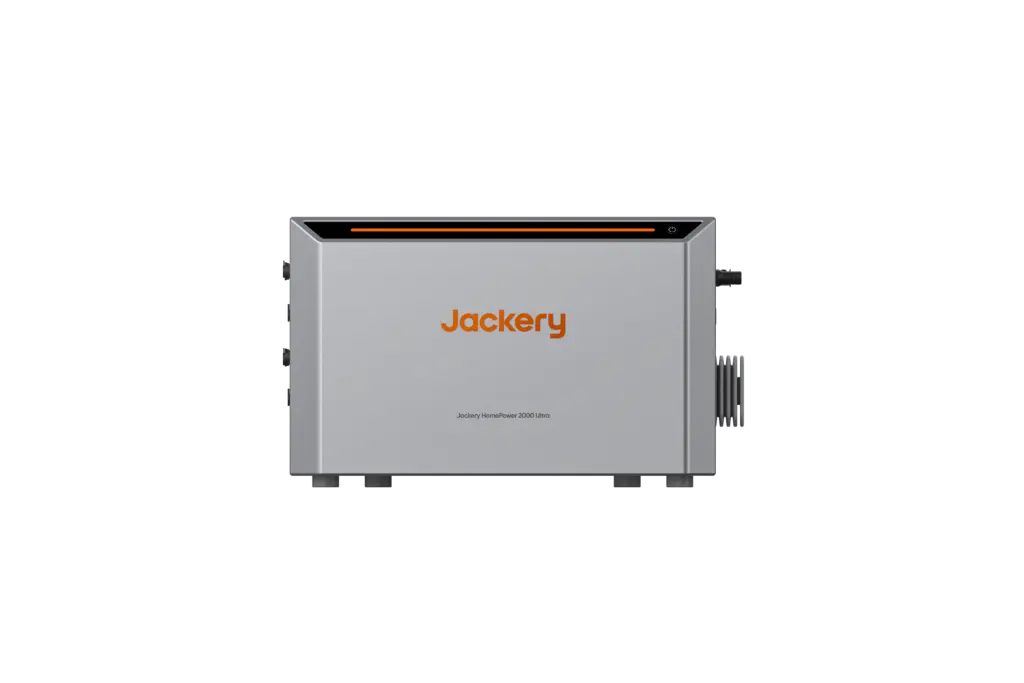
| Jackery HomePower 2000 Ultra | 2.05 kWh, up to 8 kWh | 1,500 W, 20 ms switchover | two to four panels, backup power wanted |
| Jackery SolarVault 3 Pro | 2.52 kWh, up to 15.12 kWh | 1,200 W | an existing balcony solar system that is meant to grow |
| Jackery SolarVault 3 Pro Max AC | 2.52 kWh, up to 15.12 kWh | up to 2,500 W | an existing rooftop system |
| EcoFlow STREAM AC Pro | 1.92 kWh, up to 11.52 kWh | no information on backup power | smallest entry point |
| Anker SOLIX Solarbank 4 E5000 Pro | 5 kWh, up to 30 kWh | no information on backup power | large system, high evening consumption |
Jackery HomePower 2000 Ultra
At 2 kilowatt hours, it sits right where the curve in the calculation flattens out. Jackery specifies 1,945 watt hours of rated energy, a 10-year warranty and a 1,500-watt load output that takes over within 20 milliseconds if the grid fails. Without the need for backup power, though, the extra cost would still be too high for us with the vertical pair.
Jackery SolarVault 3 Pro
Four solar inputs, and an existing microinverter can be connected to the unit’s outlet. The 2.52 kilowatt hours are mainly put to full use by systems with four panels. At 25.5 kilos, it is not something you want to carry up narrow stairs.
Jackery SolarVault 3 Pro Max AC
No solar inputs; the battery charges solely through the household grid. Usually the wrong choice for a balcony, it is a better match for a rooftop system.
EcoFlow STREAM AC Pro
The smallest battery here. According to the data sheet, 1.92 kilowatt hours, 6,000 cycles and a 10-year warranty. On paper, that is enough for two panels.
Anker SOLIX Solarbank 4 E5000 Pro
Five kilowatt hours as the base unit. For balcony systems, our calculation clearly argues against this size.
How we would decide
- Two vertical panels, goal is saving money: do not buy a battery; tilt the panels or add more instead.
- Two tilted panels: only if the extra cost is at the low end, and with an eye on standby consumption.
- Four tilted panels: the most viable case, with the Jackery HomePower 2000 Ultra.
- Backup power is the goal: Jackery HomePower 2000 Ultra; the return is then a side issue.
You can check your own situation in the HTW simulator, using your annual consumption and the price of the unit you have in mind.
Which Jackery unit it could be is shown in the comparison of the SolarVault models (in German) and the guide to the HomePower 2000 Ultra (in German). Whether a portable station serves the same purpose is covered in Power station with a balcony solar system (in German).
Frequently asked questions
Is a battery worth it for a balcony solar system?
Rarely as a financial investment. With a vertical pair of panels, our calculation with the HTW simulator shows the extra cost takes a little over 7 years to pay off in the cheapest tier, and almost 15 or more than 22 in the more expensive ones. Four tilted panels manage it in 3.4 to just over 10 years. HTW assumes a replacement after ten years.
How much electricity does a balcony battery save per year?
In the example with 2,500 kilowatt hours of consumption, two vertical panels with a battery provide 206 kilowatt hours more, two tilted panels 308 and four tilted panels 445. The battery's own consumption, which the simulator leaves out, still has to be subtracted: even one watt of continuous draw adds up to 8.76 kilowatt hours a year.
How large should a balcony battery be?
As small as makes sense. With the vertical pair, the first kilowatt hour of storage provides 171 kilowatt hours a year, the second only 35, the third 8. With four tilted panels, the third still has something to do, at 69. Measure for one summer what runs through overnight.
What should I check before buying a battery?
The cheaper levers. If you can tilt the panels, the calculator shows 889 instead of 622 kilowatt hours of yield from 900 Wp, without any battery at all. Two additional panels bring 144 kilowatt hours more. Running the dishwasher and washing machine at midday costs nothing. Also ask about standby consumption.
Are the studies showing a four-year payback accurate?
The study by EUPD Research and Anker Solix was produced together with a battery supplier and looks at the entire system, not just the extra cost of the battery. A large part of the savings there comes from the panels. The same study reports that 73 percent of respondents rated the battery as economically unattractive.
What reasons still speak for a battery?
In the middle example, self-sufficiency rises from 18 to 31 percent, and according to the German consumer advice center (Verbraucherzentrale), most batteries have a backup outlet for power outages. Consider the effort, though: a battery has to be entered in the German Marktstammdatenregister (energy market register) and usually reported to the grid operator.
Sources
- HTW Berlin: Stecker-Solar-Simulator (plug-in solar simulator)
- HTW Berlin: Documentation of the plug-in solar simulator (PDF)
- HTW Berlin and aquu: Battery Storage Inspection 2026
- Verbraucherzentrale: Plug-in solar, solar power from the balcony
- pv magazine: Report on the study by EUPD Research and Anker Solix
- Jackery: SolarVault 3 Pro technical data (PDF)
- Jackery: SolarVault 3 Pro Max AC technical data (PDF)
- EcoFlow: STREAM AC Pro data sheet (PDF)
- Anker SOLIX: Solarbank 4 Pro
- Product information from Jackery on the HomePower 2000 Ultra
Where to buy
- Jackery HomePower 2000 UltraView at JackeryAvailable in Germany: JackeryCheck price at Amazon.deAvailable in Germany: Amazon.de
- Jackery SolarVault 3 ProView at JackeryAvailable in Germany: JackeryCheck price at Amazon.deAvailable in Germany: Amazon.de
- Jackery SolarVault 3 Pro Max ACView at JackeryAvailable in Germany: JackeryCheck price at Amazon.deAvailable in Germany: Amazon.de
- EcoFlow STREAM AC ProCheck price at Amazon.deAvailable in Germany: Amazon.de
- Anker SOLIX Solarbank 4 E5000 ProCheck price at Amazon.deAvailable in Germany: Amazon.de