Contents14 sections
This guide was first published in German on handgetestet.de.
There is no such thing as a daylight projector. There are bright projectors and there are curtains, and the second purchase often does more. If you can only partly darken your living room, the XGIMI Horizon 20 Max is the best choice among the models compared here, because the German magazine audiovision measured more than 3,000 lumens even in its quiet, color-accurate movie mode. In direct sunlight, though, even that does not help. Then a TV remains the honest solution.
What ambient light does to the image
A projector cannot project black. Black is the area where no light falls, and it is exactly as bright as the wall in the room. If daylight falls on it, every dark part of the image is lifted. That is why a projector in a bright room loses contrast first, not brightness.
Let us run the numbers. A 100-inch image in 16:9 format measures roughly 2.21 by 1.25 meters, or 2.75 square meters. Lumens divided by area gives lux; lux divided by pi gives approximately the luminance in candela per square meter, provided the surface is matte and white. For the room, we assume 200 lux on the wall on an overcast afternoon. That is roughly 64 candela sitting on every pixel, including the black ones.
- 3,220 lumens yield 373 candela. Contrast in the room: (373 + 64) divided by 64, roughly 7:1.
- 946 lumens yield 109 candela. Contrast in the room: just under 3:1.
- The same 3,220 lumens on 120 inches: 258 candela, only 5:1.
- If the sun pushes the wall up to 500 lux, the 3,220 lumens at 100 inches drop to a little over 3:1.
In a dark lab, audiovision measures an ANSI contrast of 420:1 for the Horizon 20 Max. In afternoon light, what is left of those values is a single-digit number. Our calculation is simplified and shows the order of magnitude, not a measurement. But it explains why a movie with night scenes fails during the day, while soccer or a bright TV series still works well.
The curtain beats 2,000 lumens
Now the uncomfortable part for anyone who wants to buy technology. Lower the ambient light from 200 to 50 lux, for example with heavy curtains on the window next to the screen wall. The 946 lumens then reach almost 8:1, putting them ahead of the 3,220 lumens in an open room. With the bright model, the same curtain pushes contrast up to roughly 24:1.
Check your room before you spend money. A light meter app on your phone is imprecise but good enough for the order of magnitude: at the time of day you want to watch, hold the phone against what will be the screen wall. If the reading is above 500 lux, none of the projectors in this comparison really helps. All that matters is how much light lands on the image area. A window opposite the screen therefore costs more than one in the same wall.
Why the lumen figure in the brochure does not count
Three examples show the range. XGIMI advertises 5,700 lumens for the Horizon 20 Max, and audiovision even confirms that, in High Performance mode. In that mode, the image has a green tint and the fan reaches 40 decibels; the German magazine connect describes the same mode as a turquoise-green veil. The usable setting is movie mode, with 3,220 lumens and 22 decibels. With the Viewsonic X1-4KE Pro, 1,500 of the promised 3,300 lumens remain in a color-accurate setting. And the BenQ TK705i, rated at 3,000 lumens in the brochure, reaches 946 in eco mode in the measurements of the German magazine hifitest.
One exception is the BenQ LK830ST, which according to audiovision holds its 4,000 lumens and still delivers 3,600 when calibrated, albeit with weaker color coverage. So never compare brochures with each other. Incidentally, Stiftung Warentest, the German consumer testing organization, assesses suitability for bright surroundings based on the measured luminous flux in normal operation, while its viewing tests take place in a heavily darkened room on an image 1.70 meters wide. A good grade therefore says little about your afternoon.
Gray screens and ambient light rejecting screens: what they can do
An ambient light rejecting screen is the second lever. It reflects projector light specifically toward the sofa and sends ambient light in other directions. That comes with a condition, and it is geometric: such screens are tuned to one angle of incidence. CLR surfaces for projectors on a TV stand do not suit a ceiling-mounted projector. Our guide to projector screens (in German) sorts the types by location, so only buy the screen once the projector’s position is settled. audiovision explicitly names a CLR screen as a prerequisite for daytime use of an ultra-short-throw projector. Without a special screen, plan on a smooth wall that is as white as possible, and keep the image size small. Smaller is always brighter here.
Five projectors by measured brightness
| Model | According to the manufacturer | Independently measured | Setup | Best for |
|---|---|---|---|---|
| XGIMI Horizon 20 Max | 5,700 ISO lumens | 3,220 lumens calibrated (audiovision) | Conventional, zoom and lens shift | Half-darkened room, movies and sports |
| Hisense C2 Ultra | 3,000 ANSI lumens | up to 250 nits in HDR (hifi.de) | Conventional, rotating stand | Changing locations, some light in the evening |
| Hisense PX3 Pro | 3,000 lumens | about 210 nits in SDR (hifi.de) | Ultra-short throw, TV stand | No ceiling spot, with a CLR screen |
| XGIMI Aura 2 | 2,300 ISO lumens | about 215 nits (hifi.de) | Ultra-short throw, TV stand | No ceiling spot, bright wall during the day |
| BenQ TK705i | 3,000 lumens | 946 lumens in eco mode (hifitest) | Conventional | Evenings, otherwise only with darkening |
Lumens and nits cannot be converted into each other as long as the magazines do not state the image size. Only compare within one unit.
XGIMI Horizon 20 Max
Lots of light without noise: that is the argument here. At 22 decibels in movie mode, it is barely audible, and according to audiovision the light output in a dark room is enough for image widths of up to 5.80 meters. In a bright room, you trade this reserve for contrast. Motorized zoom and lens shift make setup easier, and Netflix is built in. Weaknesses: at 1.79 lumens in a dark room, the black level looks rather gray, and the price bracket is high. connect praises the build quality but finds the housing somewhat lightweight for the price. So at night you give up something here that you gain during the day.
Hisense C2 Ultra
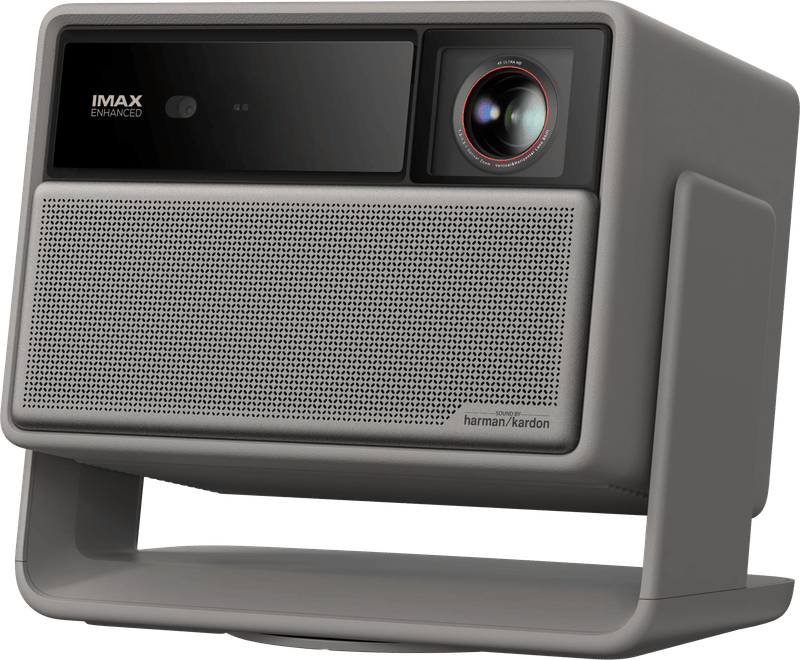
The German site hifi.de measures up to 250 nits and counts it among the brightest models on the market, saying that a lot can still be seen even in sunshine. Even so, the editors advise against direct sunlight. The stand with built-in subwoofer rotates all the way around and tilts up to 135 degrees, so the projector moves easily from room to room. Lens shift is missing, and black looks dark gray. If you only leave a little light on in the evening, it will serve you well.
Hisense PX3 Pro
A laser TV that sits close to the wall and, according to hifi.de, shows enough reserves even in a bright room. The editors recommend 120 inches instead of the possible 150. Its advantage in a bright room is the matching CLR screen, which is not an option for ceiling projectors. The screen is, however, a mandatory accessory.
XGIMI Aura 2
On the spec sheet, it looks the weakest; measured, it comes in just ahead of the PX3 Pro. During the day, according to hifi.de, the image stays clearly visible on bright walls, while contrast suffers in strong sunlight. Netflix is missing without an extra device.
BenQ TK705i
It is listed here as a warning, not as a bad buy. hifitest credits it with very accurate colors and says around 900 lumens are enough for a real cinema feel in a moderately darkened room. That is exactly the limit. With the blinds down in the evening, it is a lovely projector; on a bright afternoon, it works out to just under 3:1.
Where the limit lies
According to hifi.de, modern TVs reach more than 3,000 nits, ten times as much as a bright projector on a screen. Stiftung Warentest names usability in daylight as a clear plus for the TV and sends readers who do not want to darken their room straight there. We agree. If the picture is to run every day at noon, take a look at the TV guide or at Mini LED TVs, which offer plenty of brightness. For evenings with some light and for a large screen size, the projector remains appealing; the basics are in the general projector guide (in German).
The order in which we would proceed
- Measure the lux on the screen wall at the time of day you watch.
- Tame the windows with curtains or blinds. Only then spend money on technology.
- Keep the image size small: 100 instead of 120 inches gives a good 40 percent more luminance.
- Choose the model: XGIMI Horizon 20 Max for the half-dark room, Hisense PX3 Pro with a CLR screen if there is no ceiling spot.
Black Friday: curtain and screen first, then the deal
Bright projectors are among the devices advertised with big percentage signs around Black Friday on November 27. The calculation above still applies. A good deal on 5,700 brochure lumens does less in a room with a window opposite the screen than a curtain, which fits on the Christmas list anyway. So only buy the projector once you know the lux reading on the screen wall.
Check the crossed-out price against the reference price. If a retailer advertises a price reduction, it must state the lowest price of the last 30 days (Section 11 of the German Price Indication Ordinance). For our pick, the XGIMI Horizon 20 Max, you can set a price alert above: we will send you an email as soon as the price drops at the partner retailer. More price drops are collected on the Black Friday 2026 (in German) page.
Frequently asked questions
Can you use a projector in daylight?
To a limited extent. Ambient light lifts every dark part of the image, so contrast suffers first. Soccer or bright TV series still work in the afternoon; movies with night scenes do not. If more than 500 lux fall on the screen wall, none of the projectors in the comparison really helps.
What does more: a brighter projector or a curtain?
Often the curtain. If ambient light drops from 200 to 50 lux, a model with 946 lumens reaches almost 8:1 contrast on paper, putting it ahead of a 3,220-lumen projector in an open room. Check your room before you spend money on technology.
Why is the lumen figure in the brochure wrong?
Manufacturers often measure in the brightest mode, with a color cast and a loud fan. The Horizon 20 Max only manages 5,700 lumens with a green tint; in movie mode, it is 3,220. With the BenQ TK705i, the 3,000 in the brochure shrink to 946 in eco mode. Compare independent measurements.
Is an ambient light rejecting screen worth it in a bright room?
Yes, if it matches the setup. It reflects projector light toward the sofa and deflects ambient light, but it is tuned to one angle of incidence. CLR screens for projectors on a TV stand do not suit a ceiling-mounted projector. Only buy the screen once the projector's position is settled.
What image size makes sense in a bright living room?
Smaller is better, because smaller is always brighter here. 100 instead of 120 inches gives a good 40 percent more luminance. Without a special screen, plan on a smooth wall that is as white as possible and keep the image size deliberately modest.
Can you put a projector right in front of the wall?
Only with an ultra-short-throw projector, also called a laser TV, such as the Hisense PX3 Pro or the XGIMI Aura 2. A conventional model like the XGIMI Horizon 20 Max needs several meters of distance. In a bright room, a CLR screen is a must with ultra-short-throw models.
Sources
- audiovision: Xgimi Horizon 20 Max
- connect: XGIMI Horizon 20 Max
- audiovision: BenQ LK830ST
- audiovision: Viewsonic X1-4KE Pro
- hifitest: BenQ TK705i and TK705STi
- hifi.de: Hisense C2 Ultra
- hifi.de: Hisense PX3 Pro
- hifi.de: XGIMI Aura 2
- hifi.de: LG CineBeam HU915QE (comparison with TVs)
- Stiftung Warentest: Projectors tested (free section)
- audiovision: Hisense PL2 Laser Cinema (CLR screen)
- German Price Indication Ordinance, Section 11: Price reductions
Where to buy
- XGIMI Horizon 20 MaxView at CoolblueAvailable in Germany: CoolblueCheck price at Amazon.deAvailable in Germany: Amazon.de
- Hisense C2 UltraView at CoolblueAvailable in Germany: CoolblueCheck price at Amazon.deAvailable in Germany: Amazon.de
- Hisense PX3 ProView at CoolblueAvailable in Germany: CoolblueCheck price at Amazon.deAvailable in Germany: Amazon.de
- XGIMI Aura 2Check price at Amazon.deAvailable in Germany: Amazon.de
- BenQ TK705iView at CoolblueAvailable in Germany: CoolblueCheck price at Amazon.deAvailable in Germany: Amazon.de