Contents14 sections
This guide was first published in German on handgetestet.de.
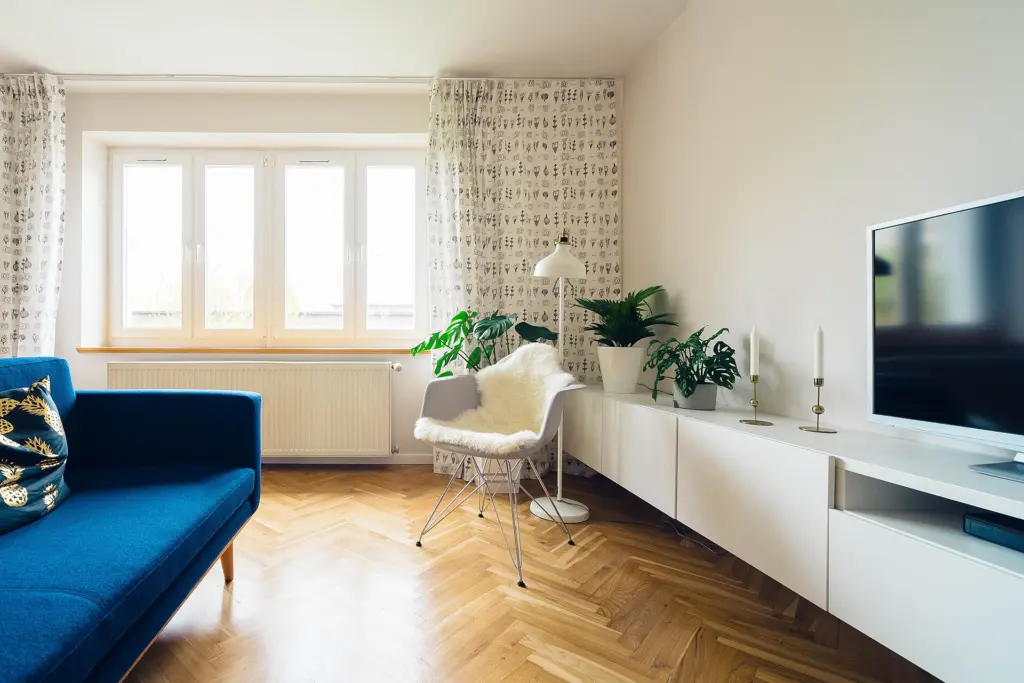
TVs are usually chosen by inches and price tag. But how happy you will be with one over the next few years comes down to three other questions: How bright is the room, how far away is the sofa, and will a console be connected to the set? If you watch movies and series in the evening with the lights dimmed, you will almost always end up with an OLED, and there the LG OLED evo C6 from the 2026 model year is our first choice. For sunny living rooms with a large wall of windows, on the other hand, more speaks in favor of Mini-LED. The rest is fine-tuning.
Measure the sofa first, then choose the screen size
Grab a tape measure. Measure from your seating position to the wall where the set is going to stand or hang. On its German website, Samsung keeps the math as simple as it gets: the distance in meters times 25 gives the recommended screen size in inches. At 2.60 meters, that is 65 inches.
It gets more precise with the viewing angle. LG gives a range of 1.2 to 1.6 times the screen diagonal. The shorter distance corresponds to roughly a 40-degree field of view, as THX recommends for a cinema feel; the longer one to about 30 degrees, the guideline of the engineering association SMPTE (Society of Motion Picture and Television Engineers) for normal TV viewing. For the same sofa at 2.60 meters, that means somewhere between 64 and 85 inches. According to Samsung, the old rule of thumb of three times the diagonal no longer applies to 4K sets.
Our take: if you are torn between two sizes, you will almost never regret the larger one later. In the kitchen, bedroom or guest room, different standards apply; we have compared compact TVs for small rooms (in German) separately. If the set is going to hang rather than stand, it is worth taking a look at our overview of TV wall mounts first.
Bright living room or home theater corner?
This is where the real technology decision is made. With OLED, every pixel produces its own light and switches off completely for black. No halo around subtitles. No gray haze in a space movie. QD-OLED is a variant of this in which a layer of quantum dots creates the colors; Sony explicitly markets the Bravia 8 II with this technology.
Mini-LED works on a different principle. Behind an LCD panel sit thousands of tiny LEDs, grouped into zones that are dimmed individually. That makes these sets very bright: for the C8K in 65 and 75 inches, TCL specifies a peak brightness of up to 4,500 nits. If the zones are too coarse, a slight glow appears around bright text on a dark background. QLED without the „Mini“ usually refers to a classic LED set with a quantum dot filter for richer colors. Very basic LED TVs without local dimming remain the budget baseline, with flatter blacks.
Our rule of thumb: south-facing windows and soccer on Saturday afternoons speak for Mini-LED or for an OLED with an anti-glare surface, which Samsung fits as standard on the S90H. Series nights by the light of a floor lamp speak for OLED. Our guides to OLED TVs and Mini-LED TVs explain the differences in detail.
A console or gaming PC on the TV?
Then there is no way around HDMI 2.1. Only that gets 4K images at 120 Hz and above to the TV, plus variable refresh rate (VRR), which smooths out stutter and screen tearing. Count the ports. Samsung lists four HDMI 2.1 inputs for the S90H; Sony gives the Bravia 8 II four HDMI sockets, but VRR only on HDMI 3 and 4. If the soundbar is also connected to the eARC port there, things get tight.
Rates beyond 120 Hz are aimed more at the PC. LG itself points out for the C6 that 165 Hz only works with games or PC sources that deliver this rate. The basic Samsung U8000F accepts at most 4K at 60 Hz on its three HDMI inputs. That is perfectly fine for watching TV, but with a current console you are leaving capabilities on the table.
Google TV, webOS, Tizen or Fire TV
All four come with the major broadcaster apps and streaming services. The differences lie in how they are operated and how long the manufacturer delivers updates. Google TV runs on Sony and TCL sets and, according to Philips, on the OLED810 as well. LG relies on webOS and, through its webOS Re:New program, promises up to five years of free upgrades. Samsung uses Tizen and commits to software updates for up to seven years for the S90H. Fire TV is Amazon’s own system and closely tied to Prime Video and Alexa.
If you already use Chromecast and an Android phone, you will quickly feel at home with Google TV. If you are not tied to anything, pay more attention to the update commitment than to the menu.
Sound and power consumption belong in the calculation
The slimmer the housing, the less room there is for speakers. For the U8000F, Samsung specifies 20 watts on two channels; that is enough for the news, but hardly for action movies. A soundbar is therefore the most sensible addition for almost every one of these sets; which one suits which room is covered in our soundbar guide (in German). And if you like light behind the screen without buying a Philips, you can add it with TV backlighting.
For power consumption, the EU energy label helps; a new version of it has applied to TVs since March 1, 2021. It runs from A to G and shows consumption separately for SDR and HDR content. According to the European Commission, consumption can be about twice as high with HDR. A QR code on the label leads to the European product database EPREL with further information, for example on standby consumption. Do not be alarmed by a G. Even high-end sets end up there: depending on size, the listings on Amazon show the LG C6 in classes D to G, and Samsung lists the 55-inch U8000F in class G. So compare the kilowatt-hours, not just the letter.
Six TVs for six living rooms
| Model | Display technology | Gaming | System | Best for |
|---|---|---|---|---|
| LG OLED evo C6 (2026) | OLED, 42 to 83 inches | 120 Hz, VRR up to 165 Hz with a suitable source | webOS | Movie nights in a darkened room, console |
| Samsung OLED S90H (2026) | OLED with Glare Free anti-reflective coating | 4 × HDMI 2.1, up to 165 Hz in 4K | Tizen | Bright rooms, anyone who wants OLED despite windows |
| Sony Bravia 8 II | QD-OLED | 120 Hz, VRR on HDMI 3 and 4 | Google TV | Movie fans with a PlayStation |
| TCL C8K | QD-Mini-LED, 65 to 98 inches | 144 Hz native | Google TV | Very bright rooms, large screen sizes |
| Philips OLED810 Ambilight | OLED with Ambilight, 42 to 77 inches | up to 144 Hz with VRR | Google TV (according to Philips) | Anyone who likes light behind the picture |
| Samsung Crystal UHD U8000F | 4K LED, 43 to 85 inches | at most 4K at 60 Hz | Tizen | Second TV, watching TV without a console |
LG OLED evo C6
The C6 comes in six sizes from 42 to 83 inches in the 2026 model year. LG lists Dolby Vision, Dolby Atmos and compatibility with G-Sync and FreeSync Premium. The small screen sizes also make the C6 interesting as a monitor replacement on a desk. If you look straight toward a window during the day, keep the reflections in mind.
Samsung OLED S90H
Samsung’s answer to the window problem is called Glare Free, a low-reflection surface that comes as standard on the S90H. On top of that come four HDMI 2.1 inputs and, according to Samsung, up to 165 Hz in 4K. Samsung does not list Dolby Vision on its website. For gamers with a wall of windows, we consider the S90H the most well-rounded choice among the sets presented here.
Sony Bravia 8 II
With the Bravia 8 II, Sony relies on QD-OLED and lists Dolby Vision, HDR10 and HLG. According to retailer information, the panel itself produces the sound (Acoustic Surface Audio+), and there are dedicated features for the PlayStation 5. Less appealing is the port layout: only two of the four HDMI sockets support VRR.
TCL C8K
A lot of picture for bright rooms. TCL combines Mini-LED with quantum dots, an anti-glare panel and sound by Bang & Olufsen. According to TCL’s own footnote, the advertised figure of up to 3,840 dimming zones applies only to the 98-inch version; the smaller sizes make do with fewer. If you want to put a large screen size into a bright room, you have the widest choice here.
Philips OLED810 Ambilight
Its unique selling point is the LEDs on the back, which extend the picture in color onto the wall behind it. Philips lists 144 Hz with VRR, Dolby Vision and Dolby Atmos. Some retailer listings show the set with Titan OS instead of Google TV; check which system is listed before you order.
Samsung Crystal UHD U8000F
A plain 4K LED TV with HDR10+, Tizen and three HDMI inputs. For the bedroom, as a second set or for watching TV only, that is enough. For movie nights in the dark or a new console, we would rather save up and go for one of the sets above later.
Which TV suits which living room
- Movie nights, room dark in the evening: LG OLED evo C6; with a bigger budget, the Sony Bravia 8 II.
- Bright room, console connected: Samsung OLED S90H with Glare Free.
- Very bright and very large: TCL C8K from 75 inches.
- The mood in the room matters too: Philips OLED810 with Ambilight.
- Second TV or small budget: Samsung U8000F, but then without gaming ambitions.
Dimensions, viewing distance and the 60 Hz trap at this size are covered in our guide to the 50-inch TV.
Whether the set fits on your furniture depends on the width between the feet; the footprint dimensions are in our guide to the 55-inch TV (in German).
When a large set can replace a projector is covered in our guide to the 85-inch TV (in German).
Dimensions, foot spacing and mounting hole patterns for exactly this size are in our guide to the 43-inch TV (in German).
If dialogue in particular gets lost, our guide to the soundbar for clear speech will help.
Foot spacing, wall load and the box size for this size are in our guide to the 65-inch TV.
Whether the box and the set will even fit into your home is covered in our guide to the 75-inch TV.
If the picture is to be larger than 100 inches, it is worth comparing it with a laser TV; what a projector can do in a bright room is explained in our guide Projectors in daylight (in German).
Frequently asked questions
Which TV size suits my viewing distance?
Samsung keeps the math simple: the distance in meters times 25 gives the screen size in inches, so 65 inches at 2.60 meters. LG gives a distance of 1.2 to 1.6 times the screen diagonal, which for the same sofa works out to 64 to 85 inches. If you are torn between two sizes, you will almost never regret the larger one later.
What is the difference between OLED and Mini-LED?
With OLED, every pixel produces its own light and switches off completely for black, with no halo around subtitles. Mini-LED uses thousands of tiny LEDs behind an LCD panel, controlled in zones, which makes it very bright. If the zones are too coarse, a slight glow appears around bright text on a dark background.
What does a TV need for a PlayStation or Xbox?
HDMI 2.1, because only that gets 4K at 120 Hz and variable refresh rate to the TV. The number of ports matters: Samsung lists four HDMI 2.1 inputs for the S90H, while Sony offers VRR only on HDMI 3 and 4 on the Bravia 8 II. The Samsung U8000F accepts at most 4K at 60 Hz.
Which operating system makes sense on a TV?
Google TV, webOS, Tizen and Fire TV all come with the major broadcaster apps and streaming services. More important than the menu is the update commitment: through webOS Re:New, LG promises up to five years of free upgrades, and Samsung promises software updates for up to seven years for the S90H.
How meaningful is the energy label on a TV?
The label runs from A to G and shows consumption separately for SDR and HDR; according to the European Commission, it can be about twice as high with HDR. Even high-end sets end up in class G, so it is better to compare the kilowatt-hours than just the letter. The QR code leads to the EPREL database.
Are a TV's built-in speakers good enough?
For the news, usually yes; for action movies, hardly. The slimmer the housing, the less room for speakers; for the U8000F, Samsung specifies 20 watts on two channels. A soundbar is therefore the most sensible addition for almost any set.
Sources
- LG: OLED evo C6, 65 inches
- Samsung: the S90H in detail
- Sony: technical data K-65XR8M2
- TCL: C8K Premium QD-MiniLED
- Philips: 65OLED810
- Samsung: Crystal UHD U8000F, 55 inches
- Samsung: the optimal TV size
- Samsung: calculating the distance to the TV
- LG: screen size and viewing distance
- European Commission: energy label for electronic displays
Where to buy
- LG OLED evo C6 (2026)Check price at Amazon.deAvailable in Germany: Amazon.de
- Samsung OLED S90H (2026)Check price at Amazon.deAvailable in Germany: Amazon.de
- Sony Bravia 8 IICheck price at Amazon.deAvailable in Germany: Amazon.de
- TCL C8KCheck price at Amazon.deAvailable in Germany: Amazon.de
- Philips OLED810 AmbilightCheck price at Amazon.deAvailable in Germany: Amazon.de
- Samsung Crystal UHD U8000FCheck price at Amazon.deAvailable in Germany: Amazon.de