Contents13 sections
This guide was first published in German on handgetestet.de.
If you keep reaching for the remote during a crime drama, you are rarely fighting too little volume. The problem is the gap between voices and everything else, and the volume button does not change that. We are not singling out one bar, because freely available measurements of speech intelligibility are lacking. The direction is still clear, though. If you sit in the middle and want dedicated buttons, look at the Denon DHT-S218, whose dialogue enhancement has three levels according to Denon. If you often sit off to the side of the TV, you need a dedicated center channel like the one in the Denon DHT-S517.
Is it the audio track, the setup or your hearing?
Three causes look the same from the outside. If the mix is to blame, the news sounds clear and only the feature film mumbles. If it is the setup, the TV speakers fire backward or downward, or the room echoes. And if you often have to ask people to repeat themselves at the dinner table too, no soundbar in the world will reliably help; that needs to be checked by a doctor, and until then a TV headphone with a speech mode (in German) often makes more sense, because it brings the voice straight to your ear.
The bar itself can only solve the first two cases. General information on connections and channels is in the soundbar guide (in German). This one is only about speech.
Why turning it up does not help
A worked example; the values are our assumption. In the film, the voice sits 10 decibels below the music. You turn it up by 6 decibels. Now the voice is louder, but so is the music, and the gap remains 10 decibels. At the next explosion, you reach for the remote again.
Two functions step in at this point, and they are often confused. Night mode compresses the dynamic range; Denon describes it as reducing the difference between loud and quiet sounds. That spares the neighbors and helps at low volume. Dialogue enhancement, on the other hand, targets the voice itself. If it raises the voice by 3 decibels, the gap in our example shrinks from 10 to 7 decibels without the living room getting any louder. More is not always better: with the Sonos Beam Ultra, TechRadar got the best results with the middle level. So try the levels one after another.
What a center channel really changes
In a movie theater, the voice comes from a dedicated speaker in the center. A 2.1 bar creates it from the left and right channels; the center is an illusion. Directly in front, that works well. Off to the side, it gets harder.
Let us assume the bar’s two speakers are each 40 centimeters from the center, and you sit three meters in front of it but one meter off-axis. Then the path to the left speaker is about 25 centimeters longer than to the right one, and the sound arrives 0.7 milliseconds apart. An offset like this partially cancels out certain frequencies, here mathematically around 680 hertz, 2,000 hertz and 3,400 hertz. As a result, the voice sounds different off to the side than directly in front. A dedicated center channel does not have this problem, because the voice comes from only one direction.
For a family on a wide sofa, that is a real argument. For two people sitting in the middle, hardly.
Before you spend money: the „Klare Sprache“ audio track
The German public broadcasters ARD and ZDF offer an additional audio track on many HD channels in which speech is brought to the foreground („Klare Sprache,“ or clear speech). According to a 2022 report by ifun.de, it is delivered via satellite and DVB-T2 HD, on some channels also in the livestream, and where available it sits alongside audio description and multichannel sound. You select it in the TV’s audio menu. It costs nothing and is worth a try before you bring a soundbar home. It does not help with Netflix or Blu-ray, of course.
Two simple steps also come first. Turn off the built-in TV speakers when the bar is running. And if the TV is wall-mounted, the bar should sit directly below it, not off to one side on a shelf; suitable solutions are in the guide to TV wall mounts.
Button or app: who will be using it?
An underrated question is how quickly you can reach the speech mode. According to the manual, the remotes of both Denon models have three dedicated buttons: LOW, MED and HIGH. With Sonos, you set the level in the app, and with Bose, personalizing the A.I. Dialogue Mode is also done in the app. For parents who are not comfortable with technology, that makes a difference no spec sheet shows. According to the manufacturer, both Denon models also learn commands from the TV remote, so the volume stays on the familiar device. If a new TV is due anyway, the guide to buying a TV (in German) will help.
Five soundbars compared for speech
| Model | Voice | Center | Speech mode controls | Best for |
|---|---|---|---|---|
| Denon DHT-S218 | Dialogue enhancement, 3 levels | no dedicated center (2.1) | LOW, MED, HIGH buttons | sitting in the middle, no extra device |
| Denon DHT-S517 | Dialogue enhancement, 3 levels | dedicated center channel (3.1.2) | LOW, MED, HIGH buttons | several seats side by side |
| Sonos Beam Ultra | automatic speech enhancement | forward-facing midrange tweeter | level in the app | Sonos households, app users |
| Bose Smart Ultra Soundbar | A.I. Dialogue Mode | not specified | setting in the app | if you do not want to keep adjusting |
| Teufel Cinebar 11 Mk4 2.1 | Speech mode | no dedicated center (2.1) | remote or control panel | bass and speech at the same time |
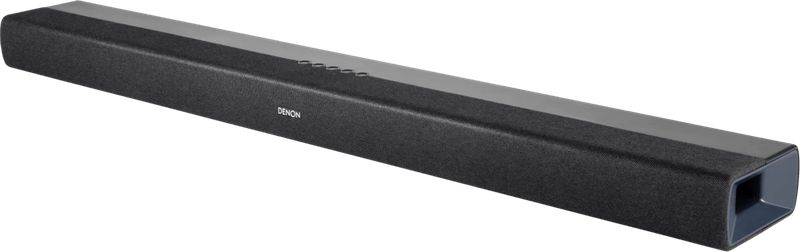
Denon DHT-S218
Six drivers, two downward-firing subwoofers in the housing, 89 centimeters wide, HDMI with eARC and an optical input. The dialogue enhancement works in three levels, each with its own button. Denon does not list an app, which here is more of a relief. The British consumer organization Which? also tests the bar for speech in its lab, but the result is behind a paywall. Its weakness remains the missing center: as a 2.1 model, it relies on the interplay of left and right, so the calculation above applies to it.
Denon DHT-S517
The dedicated center channel sets it apart from the S218; Denon specifies 3.1.2 with seven drivers and includes a wireless subwoofer. In TechRadar’s listening review, voices keep enough room even against loud backgrounds. For speech alone, the subwoofer is dead weight: it needs space and a power outlet. Stock in the Denon store is limited.
Sonos Beam Ultra
Sonos describes a forward-facing midrange tweeter for an even center image and automatic speech enhancement whose level you adjust in the app. TechRadar calls the dialogue clear and the speech enhancement effective. This is not a budget solution. If you already use Sonos, it is easy to justify. For pure speech problems, you are paying for a lot of Atmos as well.
Bose Smart Ultra Soundbar
According to the manufacturer, Bose’s A.I. Dialogue Mode detects when someone is speaking and balances voice and surround sound on its own. That sounds convenient, since nothing needs adjusting. Bose does not mention selectable levels like Denon’s; the setting is in the app. Suited to households that watch a lot of movies anyway and do not want to keep switching.
Teufel Cinebar 11 Mk4 2.1
The 95-centimeter-wide bar comes with a flat wireless subwoofer; Teufel lists a night mode and a speech mode. The manufacturer does not describe in detail how the speech mode works. The set is interesting if bass matters as much as dialogue. As a pure speech solution, it would be oversized.
Which bar suits which household
One or two people, in the middle in front of the TV, movies in the evening: the Denon DHT-S218. Several seats side by side, or often sitting off to the side: the Denon DHT-S517. You want technology that adapts to the room and like using an app? Then the Sonos Beam Ultra or, if nothing should need adjusting, the Bose Smart Ultra Soundbar.
And if one person struggles to understand while the other hears normally, no bar resolves the conflict. Then a TV headphone belongs in the mix.
Frequently asked questions
Why is dialogue in movies so hard to understand?
Usually it comes down to the gap between voices and everything else, not too little volume. TV speakers that fire backward or a reverberant room can also be to blame. If you often have to ask people to repeat themselves at the dinner table too, have it checked by a doctor; a soundbar will not reliably help then.
What is the difference between night mode and dialogue enhancement?
Night mode compresses the dynamic range, meaning the difference between loud and quiet sounds. That spares the neighbors. Dialogue enhancement raises the voice itself, by 3 decibels in our worked example, which narrows the gap to the music without making the living room any louder.
Do I need a soundbar with a center channel?
If you often sit off to the side, yes. A 2.1 bar creates the center from the left and right channels; off to the side, the two signals arrive with a time offset and partially cancel out certain frequencies. A dedicated center channel like the one in the Denon DHT-S517 does not have this problem. For two people sitting in the middle, it is hardly an argument.
What is the "Klare Sprache" audio track?
The German public broadcasters ARD and ZDF offer an additional audio track on many HD channels in which speech is brought to the foreground. You select it in the TV's audio menu. It costs nothing and is worth a try before you bring a soundbar home. It does not help with Netflix or Blu-ray, though.
Which soundbar is easy for older people to use?
One with dedicated buttons for the dialogue mode. According to the manual, the remotes of both Denon models have three buttons, LOW, MED and HIGH, and both models also learn commands from the TV remote. With Sonos and Bose, the setting is in the app, which makes a difference for parents who are not comfortable with technology.
Sources
- Denon: DHT-S218
- Denon: DHT-S218, user manual
- Denon: DHT-S517, specifications
- Denon: DHT-S517, sound modes
- Denon: DHT-S517, remote control
- Sonos: Beam Ultra
- Bose: Smart Ultra Soundbar
- Teufel: Cinebar 11 for Dolby Atmos 2.1 set
- ifun.de: „Klare Sprache“ audio track (2022)
- TechRadar: Denon DHT-S517 (2023)
- TechRadar: Sonos Beam Ultra (2026)
- Which?: Denon DHT-S218
Where to buy
- Denon DHT-S218View at CoolblueAvailable in Germany: CoolblueCheck price at Amazon.deAvailable in Germany: Amazon.de
- Denon DHT-S517View at CoolblueAvailable in Germany: CoolblueCheck price at Amazon.deAvailable in Germany: Amazon.de
- Sonos Beam UltraCheck price at Amazon.deAvailable in Germany: Amazon.de
- Bose Smart Ultra SoundbarCheck price at Amazon.deAvailable in Germany: Amazon.de
- Teufel Cinebar 11 Mk4 2.1Check price at Amazon.deAvailable in Germany: Amazon.de
- Sonos Beam Ultra SchwarzView at CoolblueAvailable in Germany: Coolblue