Contents9 sections
This guide was first published in German on handgetestet.de.
Coffee by the lake, light in the awning, the cooler running: when you camp without a hookup, a power station is handy. It is quieter than any generator and needs no gasoline. The most important question is how much power you really need. Everything depends on that.
Small, medium or large?
For a weekend with a phone, camera, lamps and laptop, a small station is enough: one that stows easily in a backpack or the trunk and, even after two nights, still has enough reserve for the headlamp and the navigation device on the drive home. If a cooler runs as well, it should be more. If you want to use a coffee maker or hair dryer in the RV, you need a high continuous output. Work out your needs in watt-hours, that is, power multiplied by usage time, and add some reserve.
| Model | According to the manufacturer | For whom |
|---|---|---|
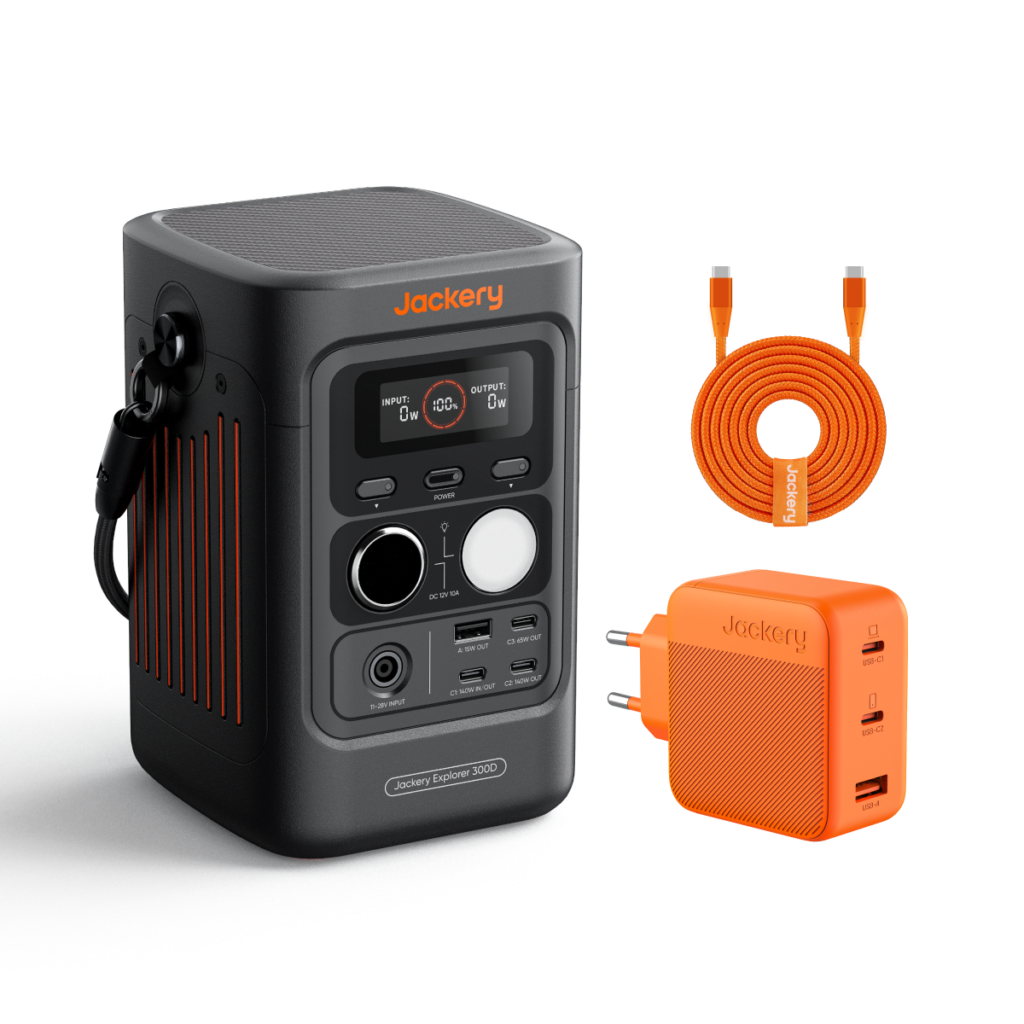
| Jackery Explorer 300D | 288 Wh, 300 W, 2.5 kg, three USB-C | Weekend, tent, photographers |
| Recommendation: Jackery Explorer 500 v2 | 512 Wh, 500 W, 5.7 kg, two AC outlets | one to two days with a cooler |
| Jackery Explorer 1000 v2 | 1,070 Wh, 1,500 W, 10.8 kg | Coffee maker, note the ADAC warning below |
Calculate your needs honestly
Deduct a little from the manufacturer’s figure right away. In spring 2025, the German automobile club ADAC measured eight power stations, and the usable capacity was on average 10 to 15 percent below the stated value. Part of it always stays in the battery for protection.
A sample calculation for the Explorer 500 v2 with 512 watt-hours: minus 15 percent leaves around 435 watt-hours. A cooler that constantly draws 50 watts would empty it in just under nine hours. The ADAC calculates similarly: a 1,000-watt-hour station runs a 50-watt cooler for about 20 hours. A smartphone with around 15 watt-hours, by contrast, can be filled many times over with the same charge. The conclusion: the cooler determines the size, not the phone.
An underestimated consumer is the station itself. According to the ADAC, the switched-on inverter alone can use 30 watts, and the display, Bluetooth and Wi-Fi also cost energy. If you only charge via USB at night, switch off the 230-volt output and use the energy-saving mode if there is one.
Weight counts
In the car, it hardly matters. On the way to the tent, it does. According to the manufacturer, the Explorer 300D weighs 2.5 kilograms and the 1000 v2 almost eleven.
Recharging on the road
All three charge from a wall outlet, in the car and via a solar panel, although it takes quite a while at the car’s twelve-volt socket until the battery is full again. Jackery states around twelve hours for the Explorer 1000 v2. In spring 2025, the ADAC downgraded the Explorer 1000 v2 to „poor“ because its two DC inputs are not decoupled. So never charge it via solar and the car socket at the same time, otherwise damage to the 12-volt vehicle electrical system is possible. For longer trips without shore power, a foldable solar panel is a sensible addition to the station, as the guide Charging a power station with a solar panel shows. In an RV, there are also chargers that charge via the alternator while driving. Handy.
Cold and heat
Not every kind of weather suits it. For the Explorer 1000 v2, Jackery specifies an operating range of minus 10 to plus 40 degrees Celsius. In summer, the station therefore belongs in the shade, and in winter, not overnight in a cold car.
What to look for when buying
- Battery type: the German consumer advice center (Verbraucherzentrale) recommends lithium iron phosphate (LFP).
- Outlets: enough 230-volt, 12-volt, USB-A and USB-C outputs for everything that needs to charge at the same time.
- Handles: the ADAC recommends two sturdy handles; otherwise heavy stations are awkward to carry.
- Quiet mode: according to the ADAC, all tested devices are loud at maximum output. At night in the tent, a quiet mode counts.
- Solar input: according to the ADAC, inputs are designed for up to 30 volts (200 watts) or up to 60 volts (400 watts). The panel has to match.
According to the ADAC, manufacturers‘ noise figures usually only refer to the base load. Under full load, for example when making coffee, the fans are clearly audible. Your neighbors at the campsite will thank you if that does not happen at six in the morning.
Frequently asked questions
Does a coffee maker run on every station?
No. According to the Verbraucherzentrale, a coffee maker needs 1,000 to 2,000 watts. Small stations cannot manage that; what matters is the continuous output of the inverter.
Are the output figures accurate?
For continuous output, yes: all eight devices in the ADAC test met it. For capacity, on average between a tenth and a seventh was missing.
Are the outputs protected against short circuits?
On all devices in the ADAC test, the AC and DC outputs were protected against short circuits and overload. Two stations were downgraded because of their inputs, see above.
Is an extra battery worth it?
If you might need more capacity later, yes. The ADAC names expandability as a sensible buying criterion.
Our advice
For most campers, the medium size is right. It weighs little and is enough. If you only charge phones and lamps, the small one will do. You will find more equipment in the guide Camping accessories for the RV, and models from other manufacturers in the guide Buying a power station.
If your camper has a permanently installed leisure battery, you can also fit an inverter instead of a power station. What applies to cables, fuses and the battery is covered in the guide to the voltage converter from 12 to 230 volts.
For a garden shed or an allotment garden, the guide Power in the garden house works through consumption and solar yield.
For the cooler, there is a separate calculation; for sleep therapy on the road, the guide Power station for CPAP devices; and if you are looking for a complete package, read the guide to the solar generator set.
Which charging limits apply below zero degrees is explained in the guide to the power station in frost.
How many watt-hours a battery charge costs on the road is worked out in the guide Charging an e-bike with a power station.
What an induction hob and kettle draw from the station is covered in the guide Cooking with a power station.
Frequently asked questions
What size power station do I need for camping?
It depends on your needs. For a weekend with a phone, camera, lamps and laptop, a small station such as the Explorer 300D is enough. If a cooler runs as well, it should be the Explorer 500 v2. Multiply power by usage time to get watt-hours and add some reserve.
How heavy is a power station for camping?
According to the manufacturer, the Explorer 300D weighs 2.5 kg, the Explorer 500 v2 5.7 kg and the 1000 v2 almost eleven kilograms. In the car, that hardly matters; on the way to the tent, it does.
How do I charge the power station on the road?
From a wall outlet, in the car and via a solar panel. Charging from the car's twelve-volt socket takes a long time; Jackery states around twelve hours for the Explorer 1000 v2. For longer trips without shore power, a foldable solar panel complements the station. Never charge the Explorer 1000 v2 via solar and the car socket at the same time.
Can a power station handle heat and cold?
Not every kind of weather. For the Explorer 1000 v2, Jackery specifies an operating range of minus 10 to plus 40 degrees Celsius. In summer, the station therefore belongs in the shade, and in winter, not overnight in a cold car.
Sources
- Jackery: Explorer 300D, technical data
- Jackery: Explorer 500 v2, technical data
- Jackery: Explorer 1000 v2, technical data
- ADAC: Mobile power stations tested (spring 2025)
- Verbraucherzentrale: Off-grid photovoltaic systems
Where to buy
- Jackery Explorer 300DView at JackeryAvailable in Germany: Jackery
- Jackery Explorer 500 v2View at JackeryAvailable in Germany: Jackery
- Jackery Explorer 1000 v2View at JackeryAvailable in Germany: Jackery