Contents13 sections
This guide was first published in German on handgetestet.de.
Before you buy, make a phone call. If you want to continue your sleep therapy at the campsite or during a power outage, first ask your equipment provider or sleep lab how your device may be run from a power station. After that, the humidifier is the main factor that determines the size. We consider the EcoFlow DELTA 3 Plus the most well-rounded choice, because it manages just under two nights on paper even in the worst case, and the German automobile club ADAC highlighted its quiet fan. Without a humidifier, the Explorer 500 v2 is often enough.
Step one: find out what your device is allowed to do
This text is not a substitute for medical advice, and it does not evaluate any therapy. It only does the math. Whether you can get through a night without your device, whether settings may be changed and which accessories are approved are questions to clarify with your doctor and equipment provider. That also applies to the humidifier. Do not switch it off on your own just to make the battery last longer.
What happens if the power goes out at night? The trade portal Medinside quotes experts as follows: if air is missing, the body wakes up. Full face masks normally have a safety valve that opens when there is no airflow. In the manual for the CPAP 20, Löwenstein says to remove the mask as soon as possible in the event of a failure and to follow the instructions for the exhalation system.
Ventilators are a different calculation. The German Federal Office of Civil Protection and Disaster Assistance (BBK) counts them among the assistive devices that can be vital during a power outage and advises asking your care service in advance whether and how care will continue during a longer outage. Anyone who uses such a device plans with their equipment provider and doctor. A power station off the camping shelf is not what we recommend for that.
Step two: find your own consumption
Manufacturer specifications vary widely, because pressure, humidifier and heated tubing all play a role. For the DeVilbiss Blue, the manual states a typical 10 watts without and 25 watts with a humidifier, and a maximum of 65 watts. For the CPAP 20 at 12 volts, Löwenstein specifies 1.6 amps, and with the CLICK 2 humidifier it is 2.6 amps, or roughly 19 and 31 watts. For the ResMed AirSense 11, the data sheet from the equipment provider VitalAire lists power consumption of 56.1 watts and 1.9 watts in standby. The sheet does not say with which settings. We therefore treat that figure as the worst case.
From this range, we choose two planning values: 20 watts for devices without a humidifier and 56 watts for the full setup. Eight hours of sleep then come to 160 or just under 450 watt-hours. You get a more accurate figure with an energy meter (in German) between the outlet and the power supply that runs for an entire night. That value is what counts, not our table. The general method is explained in our guide on calculating power station runtime.
Step three: outlet or DC power?
The simplest option is to plug your normal power supply into the station’s 230-volt outlet. That costs energy. The Jackery retailer GreenDrive calculates with a factor of 0.85, and the inverter also draws some power at idle. BLUETTI specifies 4.5 watts of standby consumption for the Elite 30 V2. With a 20-watt device, that makes a big difference.
DC power is more efficient, provided the manufacturer allows it. Löwenstein offers a DC adapter for 12 to 24 volts, DeVilbiss a DC cable for 11 to 17 volts, and Philips a cable for the DreamStation. Philips explicitly permits only its own accessories; anything else can damage the device. In addition, the DreamStation must not be run from a vehicle battery while the engine is running. So ask for the right cable for your model instead of ordering a cheap one online. We had no manufacturer information for the ResMed AirSense 11.
One requirement is surprising. DeVilbiss requires at least 400 watts of output power at 220 volts when running through an inverter, even though the device draws only up to 65 watts. Stations with 300 watts fail that requirement, even if the battery would last. Also check whether the station delivers a pure sine wave. What the difference means is explained in our guide to the power inverter.
Three pitfalls for the night
Energy-saving mode: on the Explorer 500 v2, when enabled, it switches outputs off after six hours as soon as the load on the outlet is below 25 watts. An efficient CPAP machine falls right into that range. Leave the mode off, and check for this on other stations too.
The cold. Löwenstein and DeVilbiss state 5 degrees Celsius as the lower operating limit, and Philips names this limit for the humidifier. In an unheated tent porch in October, temperatures quickly drop below that.
The restart. If the station is connected to the grid as a UPS, the SOLIX C1000 Gen 2 takes over within 10 milliseconds, according to Anker. Whether your device rides through that without interruption is an open question. According to its manual, the DreamStation shows the start screen after an interruption, and you then have to resume therapy yourself. So do a trial run before your trip, an entire night at home. In the morning, the battery indicator shows what was actually used.
Six stations, calculated for eight hours
The table shows full nights using the factor of 0.85. Idle consumption and cold are not factored in, so at 20 watts it is safer to subtract one night.
| Model | Capacity, 230 V | Weight | Nights at 20 W | Nights at 56 W |
|---|---|---|---|---|
| EcoFlow DELTA 3 Plus | 1,024 Wh, 1,800 W | 12.5 kg | a good 5 | just under 2 |
| Jackery Explorer 500 v2 | 512 Wh, 500 W | 5.7 kg | a good 2.5 | just under 1 |
| Jackery Explorer 300D | 288 Wh, no 230 V outlet | 2.5 kg | 1.5, DC only | a little over half |
| Jackery Explorer 2000 v2 | 2,042 Wh, 2,200 W | 17.5 kg | just under 11 | just under 4 |
| BLUETTI Elite 30 V2 | 288 Wh, 600 W | 4.3 kg | 1.5 | a little over half |
| Anker SOLIX C1000 Gen 2 | 1,024 Wh, 2,000 W | 11.3 kg | a good 5 | just under 2 |
EcoFlow DELTA 3 Plus
Just under two nights even with a humidifier and heated tubing, which gives you breathing room until the next power hookup. In spring 2025, the ADAC gave it a grade of 2.1 („good“ on the German school grading scale) and explicitly mentioned the quiet fan, which matters next to the bed. Nobody needs the 1,800 watts here, but you still carry the 12.5 kilos.
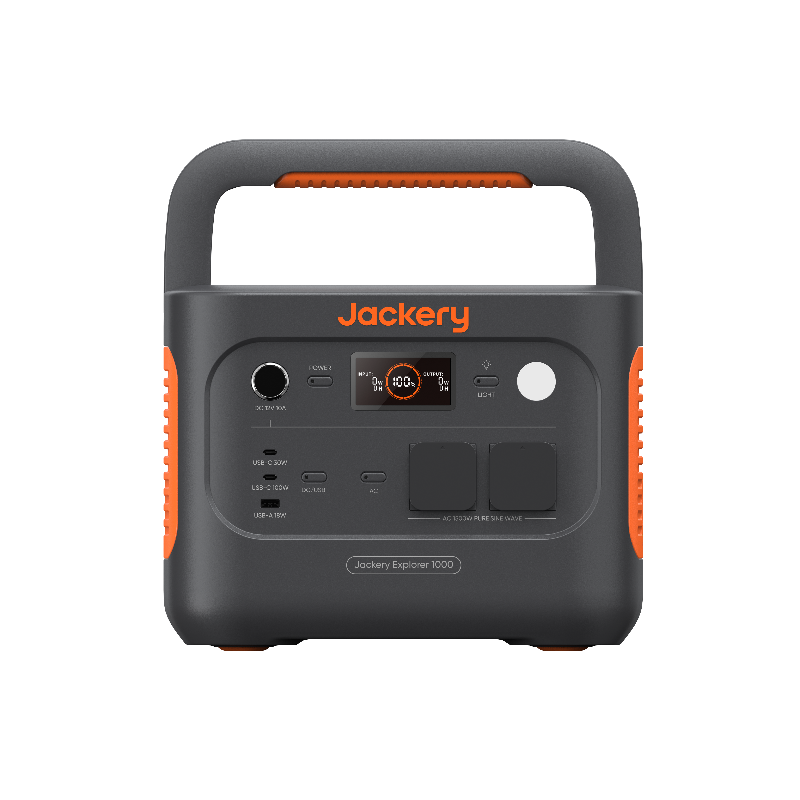
We no longer list the Jackery Explorer 1000 v2, which would come out similarly on paper, as a recommendation. The ADAC downgraded it to „poor“ because its two DC inputs are not decoupled: if it is charged via a solar panel and the car socket at the same time, damage to the 12-volt vehicle electrical system is possible. At the bedside, that does not matter; in a camper, it does.
Jackery Explorer 500 v2
Half the weight, considerably cheaper, and according to Jackery under 28 decibels while discharging. With the full setup, the reserve runs out shortly before morning, so we recommend it only for users without a humidifier or with a measured value below 50 watts. The energy-saving mode issue is covered above.
Jackery Explorer 300D
No fan and therefore, according to Jackery, practically silent, and a light 2.5 kilos. There is no 230-volt outlet. So it only makes sense if you own the approved DC cable for your device.
Jackery Explorer 2000 v2
For a longer power outage at home, where weight matters less. On a camping vacation, 17.5 kilos is too much for this job. What else to connect in an emergency is covered in our guide to backup power with a power station (in German).
BLUETTI Elite 30 V2
The lightest station with an outlet in this list: 4.3 kilos, 600 watts and, according to BLUETTI, under 30 decibels. That means it also meets the DeVilbiss 400-watt requirement. The 288 watt-hours, however, are only enough for a single night without a humidifier, with some reserve.
Anker SOLIX C1000 Gen 2
On paper, it is on par with the DELTA 3 Plus. Its advantage is charging speed from the grid: according to Anker, it is full in 49 minutes at 1,600 watts. That helps with announced power cuts or when the campsite only supplies power during the day. Expansion batteries are not compatible.
Which station suits which night
- Camping with a humidifier, just under two nights without a hookup: EcoFlow DELTA 3 Plus.
- Without a humidifier, a weekend: Jackery Explorer 500 v2.
- One night without a humidifier, as light as possible: BLUETTI Elite 30 V2.
- Approved 12-volt cable on hand: Jackery Explorer 300D.
- Preparedness for several days at home: Jackery Explorer 2000 v2 and a conversation with your equipment provider.
Traveling longer without a hookup? Then recharging becomes the issue; see our guide to the power station for camping (in German).
Frequently asked questions
How much power does a CPAP machine use per night?
That depends on pressure, humidifier and heated tubing. As planning values, use 20 watts without a humidifier and 56 watts with the full setup, which means 160 or just under 450 watt-hours for eight hours. You get a more accurate figure with an energy meter that runs for an entire night.
Is DC power more efficient than the 230-volt outlet?
Yes, provided the manufacturer allows it. Going through the outlet loses energy to conversion losses and idle consumption. Löwenstein, DeVilbiss and Philips offer their own DC cables. Philips permits only its own accessories, so ask for the right cable for your model instead of ordering a cheap one.
What pitfalls are there at night with a power station?
The energy-saving mode of the Explorer 500 v2 switches outputs off after six hours if the load is below 25 watts. Then there is the cold: several manufacturers name 5 degrees Celsius as the lower limit. And after an interruption, some devices require you to resume therapy yourself.
Is a small 300-watt station enough for a CPAP machine?
Not always. DeVilbiss requires at least 400 watts of output power when running through an inverter, even though the device draws only up to 65 watts. Stations with 300 watts fail that requirement, even if the battery would last. Also check whether the station delivers a pure sine wave.
Which power station is right for a power outage at home?
For several days at home, where weight matters less, the Jackery Explorer 2000 v2 with 2,042 Wh, which works out to just under four nights with the full setup. This should go hand in hand with a conversation with your equipment provider. Ventilators are a different calculation; people who use them plan with their equipment provider and doctor.
How do I check before a trip whether the station is enough?
With a trial run over an entire night at home. In the morning, the battery indicator shows what was actually used. Do not switch off the humidifier on your own to make the battery last longer; clarify that with your doctor and equipment provider.
Sources
- VitalAire: data sheet AirSense 11 AutoSet (PDF)
- DeVilbiss: operating instructions Blue CPAP and APAP (PDF)
- Löwenstein Medical: instructions for use CPAP 20 (PDF)
- Philips: DreamStation CPAP user manual (PDF)
- Medinside: What happens to the apnea device when power runs short?
- BBK: Power outage, preparedness and self-help (PDF)
- GreenDrive: Jackery Explorer 1000 v2 (retailer information)
- GreenDrive: Jackery Explorer 500 v2 (retailer information)
- GreenDrive: Jackery Explorer 2000 v2 (retailer information)
- Product information from Jackery on the Explorer models
- Anker SOLIX: C1000 Gen 2
- BLUETTI: Elite 30 V2
- ADAC: Portable power stations tested (spring 2025)
- EcoFlow: DELTA 3 Plus
Where to buy
- EcoFlow DELTA 3 PlusCheck price at Amazon.deAvailable in Germany: Amazon.de
- Jackery Explorer 500 v2View at JackeryAvailable in Germany: JackeryCheck price at Amazon.deAvailable in Germany: Amazon.de
- Jackery Explorer 300DView at JackeryAvailable in Germany: JackeryCheck price at Amazon.deAvailable in Germany: Amazon.de
- Jackery Explorer 2000 v2View at JackeryAvailable in Germany: JackeryCheck price at Amazon.deAvailable in Germany: Amazon.de
- BLUETTI Elite 30 V2Check price at Amazon.deAvailable in Germany: Amazon.de
- Anker SOLIX C1000 Gen 2Check price at Amazon.deAvailable in Germany: Amazon.de