Contents7 sections
This guide was first published in German on handgetestet.de.
If you fly to the Canary Islands in winter and want to see more than the pool, a rental car gets you the furthest. Our advice up front: rent directly at the airport, choose a class with a strong engine rather than the smallest car, and read the ferry rules before you book.
Which island, which station?
According to ADAC Autovermietung (the German automobile club’s car rental service), there are airport rental stations on Tenerife North and South, Gran Canaria, Fuerteventura and Lanzarote. On Tenerife, the counters of Avis, Europcar, Hertz and Sixt are inside the terminal at both airports. On Gran Canaria, there are also stations in Playa del Inglés, Maspalomas, Meloneras and Las Palmas. The airport there is around 18 kilometers from Las Palmas, and Playa del Inglés is about 20 minutes away.
Tolls cost nothing. On Tenerife, the TF-1 runs toll-free from Santa Cruz to Adeje, and on Gran Canaria, according to ADAC Autovermietung, all roads and highways are free.
Small car or something bigger?
For the coast and the towns, a small car is enough. In the mountains, things look different. The roads there are winding, narrow and partly steep, and according to ADAC Autovermietung you sometimes have to back up a little for oncoming traffic. A more powerful engine helps on the climbs. Still, the car should not be too big; on hairpin bends, a wide car quickly becomes a nuisance.
| Vehicle | Best for | Good to know |
|---|---|---|
| Small rental car | Coast, towns, short trips | slow on the climbs, even short distances take time |
| Recommended: compact rental car | Round-the-island trip for two or three | more space and power for steep roads |
| SUV rental car | Families, lots of luggage, volcanic areas | rather unwieldy on narrow hairpin bends |
The weather plays a part too. The south of Gran Canaria is dry and warm; according to ADAC Autovermietung, highs in January are just under 21 degrees. In the cooler north, it rains occasionally.
Taking the rental car on the ferry?
The answer is in the fine print. Whether you may cross with the car from Tenerife to Gran Canaria is up to the rental company alone. Some prohibit ferry trips entirely. Others allow them if you register it on site and return the car on the island where you rented it. Also ask whether the car is insured during the crossing. If the rental terms say nothing about it, you are better off booking a separate car on each island.
Rules of the road
The Canary Islands are part of Spain, so Spanish traffic law applies. On highways, 120 km/h is allowed; on rural roads, 90. In built-up areas, ADAC Autovermietung names 50 km/h, whereas the ADAC country page for Spain gives 30 as the general rule, with 50 only on roads with two or more lanes in each direction. Signs take precedence. The blood alcohol limit is 0.5, and 0.3 for drivers who have held their license for less than two years.
- Phone calls only hands-free, without headphones.
- Children up to 135 cm need a suitable seat and generally sit in the back.
- Since January 1, 2026, Spanish rental cars must carry a V16 warning beacon for breakdowns.
- If you get out of the car outside built-up areas after a breakdown or accident, wear a high-visibility vest.
- Radar detectors are prohibited.
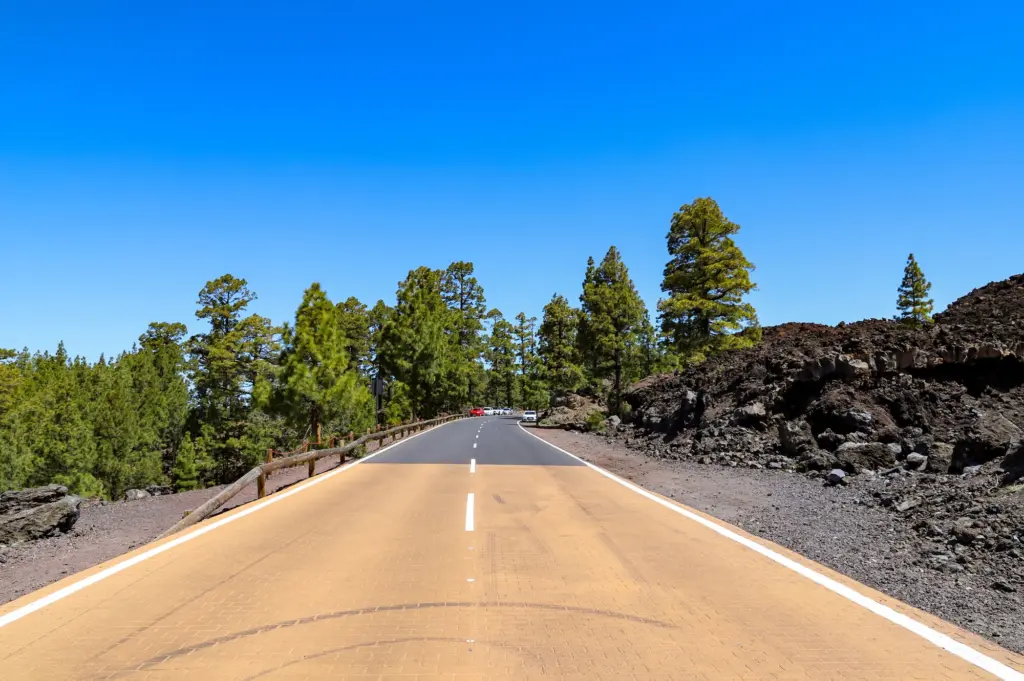
Two routes call for patience. On the narrow, winding road to Masca on Tenerife, you will meet tour buses coming the other way. On Gran Canaria, ADAC Autovermietung calls the GC-200 between Mogán and Puerto de las Nieves, with around 400 curves, the most dangerous road in Spain. Allow plenty of time. To get to Teide, take the TF-21; according to ADAC Autovermietung, parking at the cable car’s valley station is free.
From booking to return
- Have your documents ready: driver’s license, ID card or passport, a credit card for the contract and deposit, and the booking confirmation, printed or on your phone.
- Check the minimum age. It is usually 21, and drivers under 25 may have to pay a surcharge.
- At pickup, have every scratch entered in the report and take photos.
- Choose the full-to-full fuel policy; according to the European Consumer Centre, it is often cheaper than a flat rate.
- Return the car during opening hours so that you are present for the return report.
In Spain, fines cost only half if you pay within 20 days. If the notice comes via the rental company, many rental companies also charge a fee for passing on your details, according to the EVZ (European Consumer Centre Germany).
Frequently asked questions
Do I need an International Driving Permit?
No, a German driver’s license is sufficient in Spain.
Can I use a dashcam?
According to the ADAC, yes, at low resolution. You delete recordings you do not need after five days. Our dashcam guide compares devices.
Where do I park in Las Palmas?
ADAC Autovermietung names the Elder parking garage on Calle Luis Morote and Parking Portoluz on Calle Albareda. At the end of the GC-5, there is a large parking lot, around 300 meters from Plaza de Santa Ana.
What should I do after an accident?
According to the ADAC, accidents must be reported to the police; for property damage, the European Accident Statement helps. More in our guide Accidents and damage with a rental car.
How to handle the deposit and pickup properly is covered in our guide Booking a rental car, and the rules for the mainland in our guide Rental car in Spain. Traveling with children? Advice on seats is in our child car seat guide.
Frequently asked questions
Is a small car enough in the Canary Islands?
For the coast, the towns and short trips, a small car is enough. In the mountains, the roads are winding, narrow and partly steep, and a small car is slow there. A more powerful engine helps on the climbs, but the car still should not be too big for hairpin bends.
Can you take a rental car on the ferry between the islands?
That is up to the rental company alone. Some only allow driving on the island where you rented the car; others permit the ferry if you register it on site. Also check whether the car is insured during the crossing.
Where are the rental stations in the Canary Islands?
According to ADAC Autovermietung (the German automobile club's car rental service), there are stations at the airports of Tenerife North and South, Gran Canaria, Fuerteventura and Lanzarote. On Gran Canaria, there are also stations in Playa del Inglés, Maspalomas and Las Palmas.
Which traffic rules apply in the Canary Islands?
Traffic drives on the right, with 50 km/h in towns, 90 on rural roads and 120 on highways. The blood alcohol limit is 0.5. Phone calls are only allowed hands-free, and smoking while driving is prohibited.
What do you need to pick up the rental car?
You need your driver's license, ID, credit card and booking confirmation. The minimum age is usually 21, and drivers under 25 may have to pay a surcharge. Children under twelve and under 135 cm need a suitable seat.
Are there highway tolls on Tenerife and Gran Canaria?
No. On Tenerife, the toll-free TF-1 runs from Santa Cruz to Adeje, and the highways on Gran Canaria are free as well. If you pick up the car at the airport, you can drive off right away without a transfer and without toll fees.
Sources
- ADAC Autovermietung: Rental cars in the Canary Islands
- ADAC Autovermietung: Rental cars on Tenerife
- ADAC Autovermietung: Rental cars on Gran Canaria
- ADAC: Traffic rules in Spain
- European Consumer Centre Germany: Rental cars
Where to buy
- Mietwagen der KompaktklasseView at CHECK24Available in Germany: CHECK24
- Mietwagen als KleinwagenView at CHECK24Available in Germany: CHECK24
- Mietwagen als SUVView at CHECK24Available in Germany: CHECK24