Contents13 sections
This guide was first published in German on handgetestet.de.
„How old is the child?“ With this harmless question, a lot goes wrong when buying a child car seat. What matters is height. And small children ride rear-facing for as long as possible. To start, we recommend the Joie i-Gemm 3 infant carrier with i-Base Encore, because in the ADAC test from October 2026 it came in almost level with the most expensive model. From a height of about one meter, a seat with a high backrest such as the Britax Römer Kidfix Pro follows.
We do not carry out our own crash tests. All safety ratings on this page come from the child seat test of the ADAC, Germany’s largest automobile club, each with its test date.
Can the old R44 seat still go in the car in 2026?
According to the ADAC, since September 2024 new child seats may only be sold with approval to UN R129, known as i-Size. Seats approved to the older ECE R44 standard have therefore disappeared from stores, but there is no ban on using them. So you may continue to use an R44 seat of the 44/03 or 44/04 series. Only the very old 44/01 and 44/02 series have been off-limits since April 2008. The approval number under the E mark tells you which one you have.
R44 classified by weight, R129 by height. Under R129, a side impact test is mandatory. And in i-Size seats, children up to 15 months must never sit facing forward, no matter how tall they are. Under Section 21 of the German Road Traffic Regulations (StVO), children must be secured by law until they are twelve years old or 150 centimeters tall.
Why rear-facing for so long?
Because of the neck. In a frontal collision, a forward-facing seat only holds the upper body. The head is thrown forward and pulls on the neck. In a rear-facing seat, by contrast, the child’s head and back press into the shell at the same time, and according to the ADAC’s explanation the load on the cervical spine stays considerably lower. A small child’s head is heavy in proportion, and the neck is still weak. The ADAC therefore recommends securing children rear-facing at least until their second birthday, i.e., considerably longer than the 15 months required by the standard.
That takes space. Rear-facing seats are bulky, the front passenger seat often has to move far forward, and only a trial installation in your own car shows whether it fits. On the front passenger seat there is a hard limit: a rear-facing seat must never be placed there with the front airbag active.
When is it time for the next seat?
You switch by centimeters, not by the calendar.
- Infant carrier (about 40 to 85 cm): from birth. You switch when the head sticks out over the edge of the shell or the manufacturer’s height limit is reached, not by the calendar.
- Toddler seat or rear-facing seat (about 61 to 105 cm): with its own harness system, sensibly rear-facing for a long time.
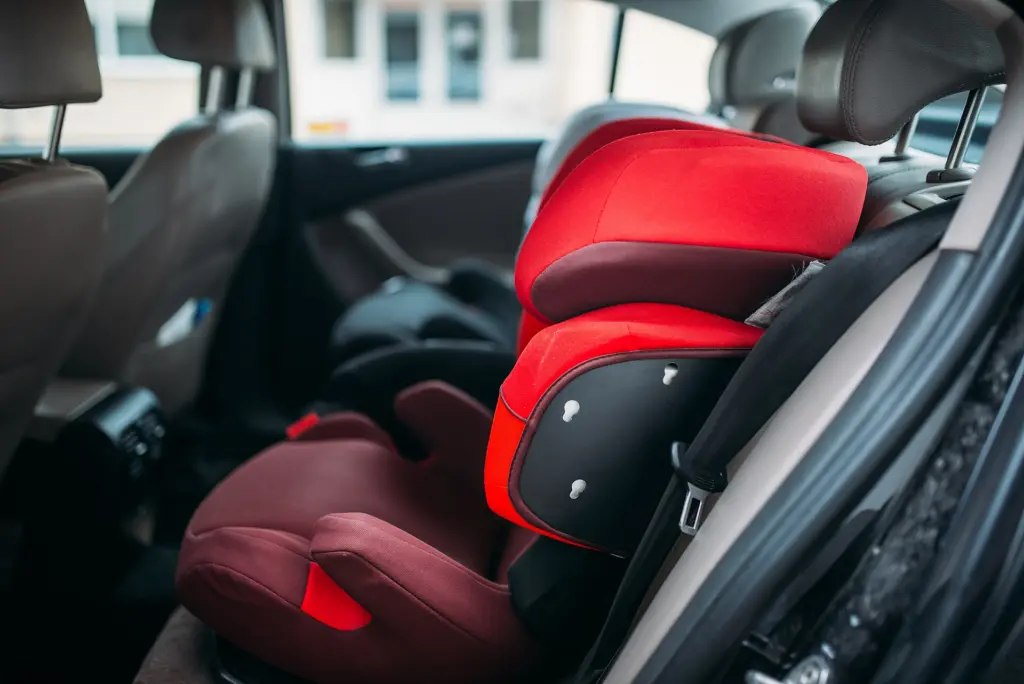
- Seat with a backrest (100 to 150 cm): the child is secured with the car’s three-point seat belt, and the seat guides the belt correctly over the shoulder and pelvis.
- Booster cushion without a backrest: according to the ADAC, without proper shoulder belt guidance and without side protection. The club therefore does not test them at all.
Isofix is convenient for infant carriers and rear-facing seats because the base stays in the car. Most cars, however, only have Isofix in two seats. With a third child or in the grandparents‘ second car, seats that also hold with the seat belt have the advantage. A look at the manufacturer’s vehicle list is part of the process, especially for bases with a support leg.
Which seats are currently doing well?
| Model | Type and height | ADAC rating (test date) | Best for |
|---|---|---|---|
| Maxi-Cosi Coral Slide Pro + FamilyFix Slide Pro | Infant carrier, 40–87 cm | 2.1 good (10/2026) | those who carry the shell often and have the budget |
| Joie i-Gemm 3 + i-Base Encore | Infant carrier, 40–85 cm | 2.2 good (10/2026) | most families to start with |
| Cybex Sirona G3 + Base G3 | Rear-facing seat, 61–105 cm, rotating | 2.5 good (10/2026) | rear-facing for a long time, car with Isofix |
| Britax Römer Kidfix Pro | Seat with backrest, 100–150 cm | 1.8 good (10/2025) | children from about four years |
| Kinderkraft Junior Fix 2 i-Size | Seat with backrest, 100–150 cm | 2.5 good (05/2026) | tight budget, second car |
The ADAC tightened its tests in 2025, so older ratings are not directly comparable. „Good“ ranges from 1.6 to 2.5.
Maxi-Cosi Coral Slide Pro with FamilyFix Slide Pro
The top rating among infant carriers in the ADAC test from October 2026 (2.1), and at the same time the most expensive model in the field. According to the manufacturer, the removable carrying unit weighs only 2.5 kilograms, and the base slides the seat 27 centimeters out toward the door. The ADAC criticizes the large space requirement and a cover that may only be hand-washed.
Joie i-Gemm 3 with i-Base Encore
With 2.2, the Joie combination came in just behind Maxi-Cosi in the same test, but costs noticeably less. According to the ADAC, the risk of injury in a frontal impact is low and only average in a side impact. The shell can also be installed without the base using the three-point seat belt, which is practical for a taxi or a second car. Check beforehand whether the belt is long enough.
Cybex Sirona G3 with Base G3
A rotating rear-facing seat for 61 to 105 centimeters; with the newborn insert, it fits from as little as 40 centimeters according to the manufacturer. The ADAC gave it a rating of 2.5 in October 2026. Strong in side impacts, only average in frontal impacts. It is installed exclusively on the Isofix base with a support leg, which also takes the Cloud G3 infant carrier. You then only buy the base once.
Also rated „good“ (2.3) in the same test was the Recaro Toron 1, a rear-facing seat from birth up to 105 centimeters. Because a new-item offer on Amazon.de could not be confirmed, it is missing from the table.
Britax Römer Kidfix Pro
With 1.8, the top rating in the ADAC test from October 2025, with a safety sub-rating of 1.7. The child is secured with the car’s seat belt, and Isofix additionally holds the seat in place. According to the ADAC, its weaknesses are the thin padding and a manual that is only adequate. Britax Römer itself points out that only the Classic collection was tested. So look closely at the version when buying.
Kinderkraft Junior Fix 2 i-Size
The affordable solution for the stage from 100 centimeters, and in the ADAC test from May 2026 just barely „good“ at 2.5. Operation and ergonomics are good, while safety at 2.9 is only satisfactory. For the main car, we would rather go for the Britax. Do not confuse it with the same manufacturer’s Mink Pro 2 infant carrier: with its base, it failed the same test.
What often goes wrong during installation?
- Pull the harness tight: according to the ADAC, only a flat hand should fit between the harness and the chest.
- Take off the thick winter jacket before buckling up; the lap belt belongs directly against the body.
- For infant carriers secured with the car’s seat belt, first place the lap belt over the foot end, then the shoulder belt around the head end. If swapped, the shell can twist out of the belt in a collision.
Is a used seat okay?
Yes, if its history is known. A used seat is not taboo, but a seat that has been in an accident is. So buy from people you know if possible and ask about accidents. The ADAC advises looking under the cover for cracks and stress whitening and insisting on the manual. The manufacturer’s stated service life counts, because plastic ages from sun and moisture.
And: check for recalls. In the test from October 2026, the Britax Römer Baby-Safe Pro infant carrier with Vario Base 5Z failed because the harness buckle opened in the reclined position. Carriers with a manufacturing date from Dec. 26, 2025 to Sept. 30, 2026 are being recalled. Also stay away from cheap seats from platforms outside Europe: two out of three such seats in an additional ADAC test did not even have R129 approval.
So which seat suits us?
For the first child and a normal budget, the Joie i-Gemm 3 with i-Base Encore is our choice. If the shell is carried a lot and money plays a smaller role, the Maxi-Cosi Coral Slide Pro is an option, provided the car offers enough space.
After the infant carrier, if the child is to ride rear-facing for a long time: Cybex Sirona G3, but try it in your own car first. From 100 centimeters, then the Britax Römer Kidfix Pro. As an affordable second seat, the Kinderkraft Junior Fix 2 is enough.
For family trips, see our guides to the roof box (in German) and the tow hitch bike rack (in German).
Frequently asked questions
Can an old R44 child seat still be used in 2026?
Yes. Since September 2024, only seats approved to UN R129 may be sold, but there is no ban on using older ones. Seats of the 44/03 and 44/04 series may still be used. Only the very old 44/01 and 44/02 series have been off-limits since April 2008; the approval number tells you which one you have.
How long should a child ride rear-facing?
The ADAC, Germany's largest automobile club, recommends securing children rear-facing at least until their second birthday, i.e., longer than the 15 months required by the standard. In a rear-facing seat, the child's head and back press into the shell at the same time in a frontal collision, so the load on the cervical spine stays considerably lower.
When is the next child seat due?
You switch by centimeters, not by the calendar. The infant carrier is too small when the head sticks out over the edge of the shell or the manufacturer's height limit is reached. Seats with a backrest fit from 100 to 150 cm. The ADAC does not test booster cushions without a backrest at all.
Which rear-facing seat does well in the ADAC test?
The rotating Cybex Sirona G3 with Base G3 for 61 to 105 centimeters received a rating of 2.5 in October 2026. It is strong in side impacts and only average in frontal impacts. It is installed only on the Isofix base with a support leg, so try it in your own car first.
Is a used child seat okay?
Yes, if its history is known; a seat that has been in an accident, on the other hand, is not. Buy from people you know if possible and ask about accidents. The ADAC advises looking under the cover for cracks and stress whitening and insisting on the manual. The manufacturer's stated service life also counts.
What often goes wrong when installing a child seat?
Harnesses are not pulled tight enough; according to the ADAC, only a flat hand should fit between the harness and the chest. The thick winter jacket comes off before buckling up. For infant carriers secured with the car's seat belt, first place the lap belt over the foot end, then the shoulder belt around the head end.
Sources
- ADAC: Child seat test fall 2026 (Oct. 20, 2026)
- ADAC: Britax Römer Kidfix Pro (test 10/2025)
- ADAC: Kinderkraft Junior Fix 2 i-Size (test 05/2026)
- ADAC press: Child seat test spring 2026
- ÖAMTC (Austrian automobile club): Child seat test fall 2026, data sheets
- ADAC: i-Size and ECE R44
- ADAC: Rear-facing seats
- ADAC: Used child seats
- ADAC: Tips for buying a child seat
- ADAC press: A tight harness protects children best
- Section 21 StVO (German Road Traffic Regulations)
- Maxi-Cosi: Coral Slide Pro
- Joie: i-Gemm 3
- Cybex: Sirona G3
- Britax Römer: Kidfix Pro
Where to buy
- Britax Römer Kidfix ProCheck price at Amazon.deAvailable in Germany: Amazon.de
- Cybex Sirona G3Check price at Amazon.deAvailable in Germany: Amazon.de
- Kinderkraft Junior Fix 2 i-SizeCheck price at Amazon.deAvailable in Germany: Amazon.de
- Joie i-Gemm 3Check price at Amazon.deAvailable in Germany: Amazon.de
- Cybex Cloud G3Check price at Amazon.deAvailable in Germany: Amazon.de