Contents8 sections
This guide was first published in German on handgetestet.de.
If you split ten stacked cubic meters of wood a year, you bend down thousands of times. Wood from the log splitter into the wheelbarrow, from the wheelbarrow into the mesh pallet box, from the box onto the trailer. A firewood conveyor belt takes over exactly this stretch: logs drop from the splitter onto the belt and land in the container two to three meters higher up. For most people who cut their own firewood, a 5-meter belt on a household outlet such as the Scheppach Muli 5000 is enough. If you load trailers or tall boxes, you need the larger Muli 4500.
First, one clarification. Many buyers only read it in the manual, which is too late.
A wood conveyor is not a soil conveyor
When people hear “conveyor belt,” many picture a machine for the building site that moves soil out of an excavation or gravel onto the patio. The belts in this price range are not built for that. Scheppach states explicitly in the Muli 5000 manual: split logs and pieces of wood only, at most 80 cm long and 5 kg in weight, with wood moisture up to 40 percent. Stones, metal parts, soil and people are prohibited. According to the manufacturer, the Muli 4500 is likewise intended exclusively for individual pieces.
Why? The design. A narrow belt with cleats grips logs but not loose sand. And stones damage the belt and rollers. If you want to move soil, you are better served by a dumper (in German) or a compact loader.
What the numbers mean
Conveying length and discharge height. A belt is set at an angle. The steeper it is, the higher the discharge point and the shorter the horizontal reach. The Muli 5000 reaches 1.90 m at 45 degrees, which is enough for mesh pallet boxes and woodpiles. The Muli 4500 discharges at 3.40 m at 45 degrees. That gets you over the side of a tipper trailer or into a loft above the garage.
Belt width. 100 mm on the Muli 5000 and the Crossfer FOR-5M, 250 mm on the Muli 4500. The wide belt is more forgiving of carelessly placed logs.
Load capacity. According to the manual, the Muli 5000 carries at most 20 kg per meter of belt. Over 5 m, that is 100 kg at a time. Scheppach states a conveying capacity of up to 5 m³ per hour.
Power. 230-volt models run on any outdoor outlet. 400 volts require a CEE connection, in other words three-phase power. If you already work with a 400-volt log splitter, you usually have one in your garage.
| Model | Length, discharge height | Belt, drive according to manufacturer | Best for |
|---|---|---|---|
| — | — | — | — |
| Scheppach Muli 5000 (230 V) | 5 m, 1.90 m | 100 mm, 480 W | Splitter to pallet box, household power |
| Scheppach Muli 5000 (400 V) | 5 m, 1.90 m | 100 mm, three-phase | if you have three-phase power at the splitter |
| Scheppach Muli 4500 (230 V) | 4.5 m, 3.40 m | 250 mm, 1.1 kW | Trailers, tall storage, lots of wood |
| Scheppach Muli 4500 (400 V) | 4.5 m, 3.40 m | 250 mm, 1.1 kW | Farmyard with three-phase power |
| Crossfer FOR-5M (230 V) | 5 m, 1.95 m | 10 cm, 0.8 m/s | Comparison with the Muli 5000 |
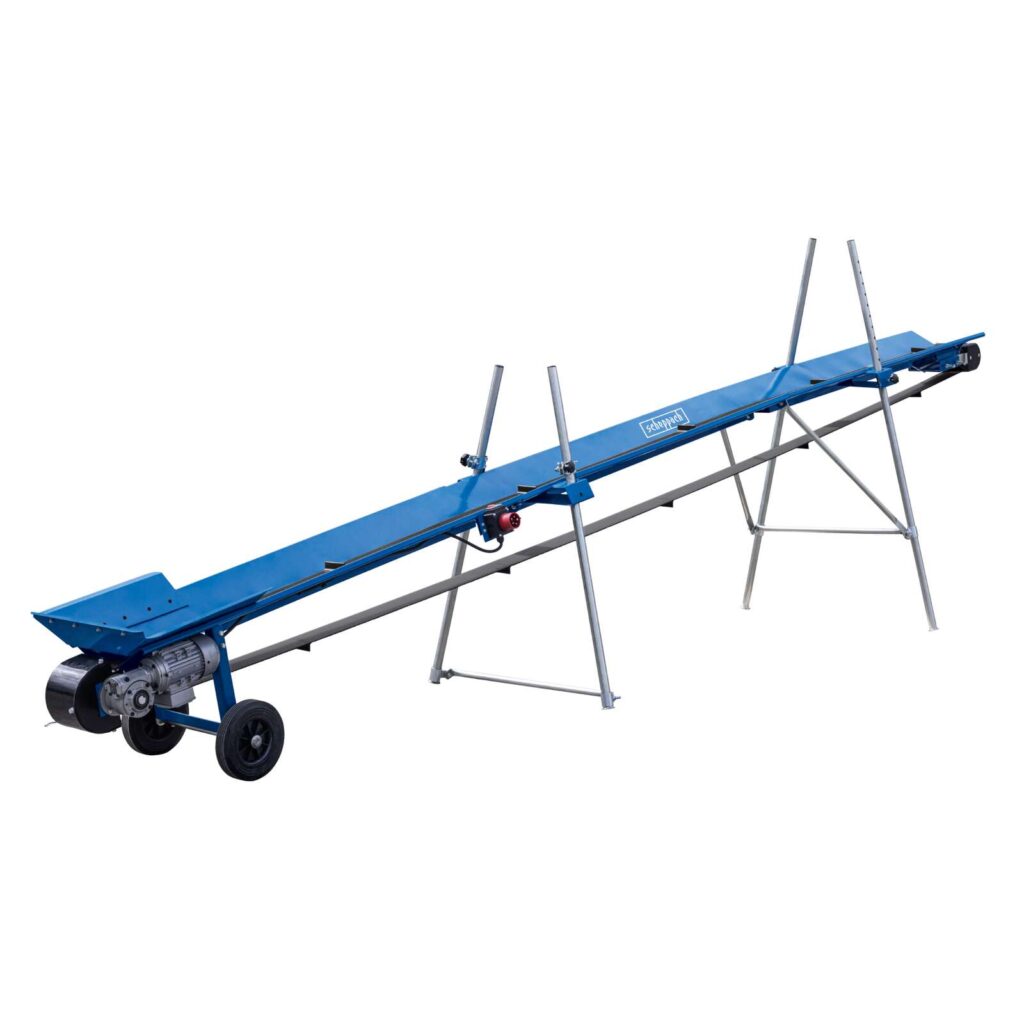
Scheppach Muli 5000
A light belt at 115 kg, on two wheels and with supports to hook in. The incline can be set between 8 and 45 degrees, and there is a 28 mm high cleat every 98 cm. According to the data sheet, the motor draws 480 W, and the 230-volt version is rated IP44. Scheppach states the sound pressure at the operator position for this version as 77.7 dB.
For the typical yard of a wood-stove owner, this is the right size. You rarely need more belt. One drawback remains: the 1.90 m discharge height ends below the side of a tall trailer, and if you set the belt too steep, you lose reach. Measure your pallet box before you order.
Scheppach Muli 4500
One class heavier. 245 kg, a fully galvanized trough, steel cleats, large pneumatic tires. You set the incline between 5 and 45 degrees with a hand cable winch, and folded up the belt measures 2.77 × 1.10 × 2.13 m. As accessories, Scheppach offers drawbars with a ball coupling or a tractor towing eye. The Muli 4500 is the belt for people who sell wood or load entire trailers.
Crossfer FOR-5M
The mail-order retailer Crossfer offers a 5-meter belt with almost the same key specs: 195 cm discharge height, 10 cm belt width, 0.8 m per second, 105 kg. According to the retailer, the belt’s texture and claws sort randomly placed split wood on their own. Crossfer does not state a motor output on the product page. Technically, it is a draw. Delivery time, service and spare parts tip the balance, and with Scheppach you also get the detailed German-language manual with clear limits on what may be conveyed.
Safety at the belt
A conveyor belt seems harmless. After all, it runs slowly. According to the Muli 4500 manual, there is a risk of crushing at several points from moving and rotating assemblies. Scheppach requires close-fitting clothing, no jewelry and tied-back hair. The plug comes out before any cleaning.
According to the Muli 4500 manual, bystanders keep at least 5 m away. No one may stand in the discharge area; a log falling from three meters up is no joke. When combined with a log splitter, whatever the splitter’s manual says also applies. Our log splitter guide compares suitable splitters, and if you cut logs to length first, you will find the saw in our tilting table saw guide.
Which belt for whom?
- Firewood for your own stove, household power: Scheppach Muli 5000 with 230 V.
- Splitter with three-phase power already in place: Muli 5000 with 400 V.
- Loading trailers, selling wood, tall storage: Scheppach Muli 4500.
- Soil, gravel, construction rubble: not a conveyor belt of this class, but a dumper or loader.
If you not only want to convey the wood but also bring it out of the forest with your own tractor, read our compact tractor guide, covering driver’s license, registration and towing capacity.
Frequently asked questions
Can a firewood conveyor belt also move soil or gravel?
No. Scheppach states explicitly in the Muli 5000 manual: split logs only. A narrow belt with cleats grips logs but not loose sand, and stones damage the belt and rollers. For soil, gravel and construction rubble, a dumper or compact loader is the right choice.
What discharge height does a firewood conveyor belt need?
That depends on the destination. The Muli 5000 reaches 1.90 m at 45 degrees, which is enough for mesh pallet boxes and woodpiles. The Muli 4500 discharges at 3.40 m at 45 degrees, so you can load trailers and tall storage. Measure your pallet box or trailer side before buying.
How much wood does a conveyor belt carry?
According to the manual, the Muli 5000 carries at most 20 kg per meter of belt, so 100 kg at a time over 5 m. Scheppach states a conveying capacity of up to 5 m³ per hour.
Do I need three-phase power for a conveyor belt?
Not necessarily. The 230-volt versions run on any outdoor outlet; 400 volts require a CEE connection. If you already work with a 400-volt log splitter, you usually have the connection in your garage.
What should I watch for in terms of safety on a conveyor belt?
According to the Muli 4500 manual, there is a risk of crushing at several points. Scheppach requires close-fitting clothing, no jewelry and tied-back hair. Bystanders keep at least 5 m away, and no one may stand in the discharge area.
Sources
- Scheppach: Muli 5000 conveyor belt, 230 V
- Scheppach: Muli 5000, operating manual (PDF)
- Scheppach: Muli 4500 conveyor belt, 230 V
- Scheppach: Muli 4500, operating manual (PDF)
- Crossfer: 230V FOR-5M conveyor belt
Where to buy
- Scheppach Muli 5000 (230 V)View at scheppachAvailable in Germany: scheppach
- Scheppach Muli 5000 (400 V)View at scheppachAvailable in Germany: scheppach
- Scheppach Muli 4500 (230 V)View at scheppachAvailable in Germany: scheppachCheck price at Amazon.deAvailable in Germany: Amazon.de
- Scheppach Muli 4500 (400 V)View at scheppachAvailable in Germany: scheppach
- Crossfer FOR-5M (230 V)Check price at Amazon.deAvailable in Germany: Amazon.de