Contents14 sections
This guide was first published in German on handgetestet.de.
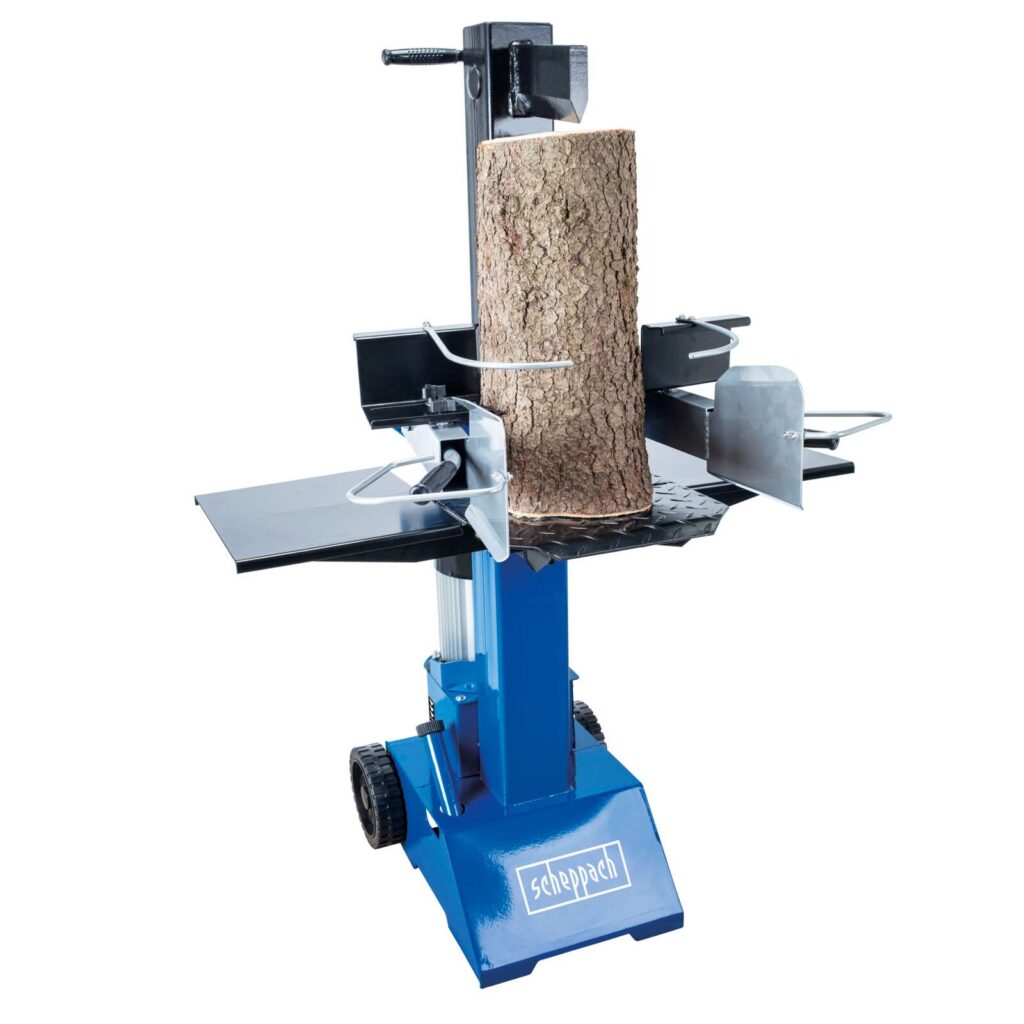
Most people buy by tonnage. Yet the diameter and length of your own rounds say more, along with the question of how often you want to lift each piece. If you make firewood up to 30 cm in diameter and work on a standard household power supply, a vertical 8-ton splitter for 230 volts such as the Scheppach HL810 is the right choice. For occasional splitting and thinner wood, a horizontal 7-ton splitter is enough.
How many tons does my wood need?
With manufacturers, splitting force and diameter are linked quite directly. Scheppach rates the horizontal 7-ton HL760LS up to 250 mm in diameter, the vertical 8-ton HL810 up to 300 mm and the Compact 10t up to 380 mm. Posch specifies a diameter of up to 45 cm for its 13-ton HydroCombi 13.
So head to the woodpile first. Measure the thick pieces from last winter, and only then look at the data sheets. Knotty or gnarled wood needs more reserve than straight-grown beech.
Horizontal or vertical?
With a horizontal splitter, you lift every piece onto the splitting bed. That works up to a good 25 cm, but with heavy hardwood it quickly becomes tiring. Vertical splitters take the round from below. Atika explicitly markets its vertical ASP 6 L-2 as an entry-level machine for home users.
Short logs or meter-long logs?
Depending on the model, short-log splitters handle 52 to 55 cm, enough for 25, 33 and 50 cm billets. Meter-long logs require a meter-log splitter with a splitting length of around 1,040 to 1,100 mm.
Is the outlet in the garage enough?
Often not. Atika builds its splitters from 8 tons upward only with a three-phase motor, while Scheppach also offers the HL810 and the Compact 10t for 230 volts. If there is no three-phase outlet at your woodpile, this one question already rules out half the selection.
A PTO drive only makes sense if there is a tractor on site anyway. Posch supplies the HydroCombi 13 with a PTO drive (300 to 450 rpm), with a 5.5 kW electric motor on 400 volts, or as a combination of both. Machines like these weigh 372 kg and up and are designed for quantities of more than 20 stacked cubic meters a year.
How fast is an inexpensive splitter?
Slow, often. According to Atika, the wedge on the ASP 6 L-2 advances at 3.6 cm/s; with a stroke of 495 mm, a full splitting stroke therefore takes more than ten seconds.
The two-hand control is the safeguard, and it is often bypassed
A log splitter pushes with several tons of force. The standard DIN EN 609-1:2017 for wedge-type log splitters therefore requires a two-hand control: the wedge must stop immediately as soon as you release one lever, and it must not be possible to operate it with a knee or elbow. Both hands are then necessarily outside the splitting area.
How serious this is can be seen from a market surveillance project by the Regierungspräsidium Kassel, a German regional authority. The Hessian equipment testing center (Hessische Geräteuntersuchungsstelle) tested eleven log splitters from DIY stores and online retailers against this standard. It found defects in the two-hand control on all eleven. Nine could be converted to one-handed operation with a piece of wood or adhesive tape, and six could be operated with other parts of the body. The authority saw no connection with price class or where the machines were bought. The report does not name the brands affected.
For everyday use, that means: never clamp the control down, not even „just for a moment.“ One person operates the machine; nobody else reaches into the splitting area. The standard requires warnings about eye, hand, foot and hearing protection. Atika specifies just under 90 dB(A) at the operator’s position while splitting for the ASP 6 L-2, so hearing protection is part of the deal. When buying, make sure the manufacturer explicitly mentions two-hand operation. That is the case for all five models below; Atika additionally cites the EN 609 standard on its product page.
Five log splitters for the home woodpile
| Model | Design, splitting force | Max. wood (length × Ø) | Power supply | Best for |
|---|---|---|---|---|
| Scheppach HL810 | vertical, 8 t | 550 × 300 mm | 230 V, 3,000 W (also 400 V) | Firewood up to 50 cm, hardwood too |
| Scheppach HL760LS | horizontal, 7 t | 520 × 250 mm | 230 V, 2,200 W | Occasional splitting, thinner wood |
| Güde GHS 500/8TE-H | horizontal, 8 t | 520 × 330 mm | 230 V, 3 kW | Horizontal, but with a splitting cross |
| ATIKA ASP 6 L-2 | vertical, 6 t | 550 × 300 mm | 230 V, 3,000 W | Small supply, working upright |
| Scheppach Compact 10t | vertical, 10 t | 1,070 × 380 mm | 230 V, 3,150 W (also 400 V) | Meter-long logs without three-phase power |
Scheppach HL810: a short-log splitter for almost any woodpile
Eight tons, a 55 cm splitting length and a 300 mm diameter cover typical firewood, with no need for three-phase power. According to Scheppach, a holding claw keeps the wood in place, and the two-hand control stops when released. With a 400-volt outlet, the same machine is available with 3,500 W. It is only too short for meter-long logs.
Scheppach HL760LS: horizontal and considerably cheaper
The Scheppach shop lists the HL760LS one price class below the HL810. In return, you lift every piece, and 250 mm in diameter is the limit. With its stand, it reaches a total height of 1,350 mm according to the manufacturer, and the stroke can be shortened for short billets. Splitting thinner wood now and then? It is enough for that. Thick oak rounds, no.
Güde GHS 500/8TE-H: horizontal with more reserve
Güde specifies 8 tons and up to 330 mm in diameter, more than is usual for horizontal splitters. A splitting cross and a splitting fan are included, so a round breaks into several billets in a single pass. At 131 kg, it is no lightweight. On Amazon.de, it is among the more expensive machines in this comparison.
ATIKA ASP 6 L-2: vertical, but leisurely
Atika refers to EN 609:2017, a two-hand control with access protection and an anti-tip guard for the split wood. At the same maximum diameter of 300 mm, it has two tons less than the HL810. That leaves less reserve for tough, knotty wood, and together with the slow advance, it argues against large quantities of beech or oak.
Scheppach Compact 10t: meter-long logs on household power
Up to 1,070 mm in length and 380 mm in diameter, and that on 230 volts. Scheppach lists a two-hand control, a safety bar, a log lifter, an anti-tip guard and a German GS safety mark. The machine weighs 131 kg net. If your wood comes in meter lengths and is only cut to stove length in winter, it saves you one step. If you have it delivered short anyway, you are paying for length you don’t need.
So which one is it?
Firewood, mixed wood species, 230 volts: Scheppach HL810. Little wood, thin rounds and a small budget point to the Scheppach HL760LS. Working horizontally and still splitting thicker pieces is possible with the Güde GHS 500/8TE-H.
- Small supply, working upright, no time pressure: ATIKA ASP 6 L-2.
- Meter-long logs without three-phase power: Scheppach Compact 10t.
- More than 20 stacked cubic meters and a tractor in the yard: a PTO splitter from an agricultural machinery dealer, for example from the Posch HydroCombi range. We did not find this range on Amazon.de.
Before splitting, the wood has to be cut to length. Which saw is enough for that is explained in our cordless chainsaw guide. How the billets get into the mesh box without bending down is shown in our firewood conveyor guide (in German).
Splitters with a PTO shaft need a tractor with a power take-off. What a compact tractor for your property has to deliver and how it gets road-legal is covered in our compact tractor guide (in German).
Frequently asked questions
How many tons does a log splitter need?
With manufacturers, splitting force and diameter are directly linked. Scheppach rates its horizontal 7-ton model up to 250 mm, the vertical 8-ton model up to 300 mm and the Compact 10t up to 380 mm. Measure the thick pieces on your woodpile first; knotty wood needs more reserve.
Horizontal or vertical log splitter?
With a horizontal splitter, you lift every piece onto the splitting bed. That works up to a good 25 cm, but with heavy hardwood it quickly becomes tiring. Vertical splitters take the round from below. According to the manufacturer, the horizontal Güde GHS 500/8TE-H handles up to 330 mm.
Is 230 volts enough for a log splitter?
Often not. Atika builds its splitters from 8 tons upward only with a three-phase motor. Scheppach also offers the HL810 and the Compact 10t for 230 volts. If there is no three-phase outlet at your woodpile, this question alone rules out half the selection.
Which log splitter is suitable for meter-long logs?
Meter-long logs require a meter-log splitter with a splitting length of around 1,040 to 1,100 mm. The Scheppach Compact 10t handles up to 1,070 mm in length and 380 mm in diameter on 230 volts. If your wood is delivered short anyway, you are paying for length you don't need.
Why is the two-hand control on a log splitter so important?
The standard DIN EN 609-1:2017 requires the wedge to stop immediately as soon as one lever is released. In an inspection by the Hessian equipment testing center (Hessische Geräteuntersuchungsstelle), all eleven log splitters had defects in the two-hand control. The control must therefore never be clamped down, not even briefly.
Do you need hearing protection when splitting wood?
Yes. Atika specifies just under 90 dB(A) at the operator's position while splitting for the ASP 6 L-2. The standard requires warnings about eye, hand, foot and hearing protection. One person operates the machine; nobody else reaches into the splitting area.
Sources
- Regierungspräsidium Kassel: Market surveillance project 2024, safety of log splitters
- Scheppach HL810 (230 V)
- Scheppach HL760LS
- Scheppach Compact 10t (230 V)
- Güde firewood processing catalog (GHS 500/8TE-H)
- ATIKA ASP 6 L-2
- ATIKA log splitter overview
- Posch HydroCombi 13
Where to buy
- Scheppach HL810 (230 V)View at scheppachAvailable in Germany: scheppachCheck price at Amazon.deCheck price at Amazon.co.ukCheck price at Amazon.nlCheck price at Amazon.com.beCheck price at Amazon.frCheck price at Amazon.itCheck price at Amazon.esCheck price at Amazon.plCheck price at Amazon.seAvailable in Germany: Amazon.de
- Scheppach HL760LSView at scheppachAvailable in Germany: scheppachCheck price at Amazon.deCheck price at Amazon.co.ukCheck price at Amazon.nlCheck price at Amazon.com.beCheck price at Amazon.frCheck price at Amazon.itCheck price at Amazon.esCheck price at Amazon.plCheck price at Amazon.seAvailable in Germany: Amazon.de
- Güde GHS 500/8TE-HCheck price at Amazon.deCheck price at Amazon.co.ukCheck price at Amazon.nlCheck price at Amazon.com.beCheck price at Amazon.frCheck price at Amazon.itCheck price at Amazon.esCheck price at Amazon.plCheck price at Amazon.seAvailable in Germany: Amazon.de
- ATIKA ASP 6 L-2Check price at Amazon.deCheck price at Amazon.co.ukCheck price at Amazon.nlCheck price at Amazon.com.beCheck price at Amazon.frCheck price at Amazon.itCheck price at Amazon.esCheck price at Amazon.plCheck price at Amazon.seAvailable in Germany: Amazon.de
- Scheppach Compact 10tView at scheppachAvailable in Germany: scheppachCheck price at Amazon.deCheck price at Amazon.co.ukCheck price at Amazon.nlCheck price at Amazon.com.beCheck price at Amazon.frCheck price at Amazon.itCheck price at Amazon.esCheck price at Amazon.plCheck price at Amazon.seAvailable in Germany: Amazon.de