Contents13 sections
This guide was first published in German on handgetestet.de.
A gray spot in the sky, always in the same place, especially at small apertures. Anyone who sees this for the first time is quick to order a complete kit with sensor swabs and fluid. That skips two steps. In their manuals, Canon, Nikon, Sony and Fujifilm call for something else: first the built-in sensor cleaning, then a simple blower without a brush. Only when both fail does it get serious.
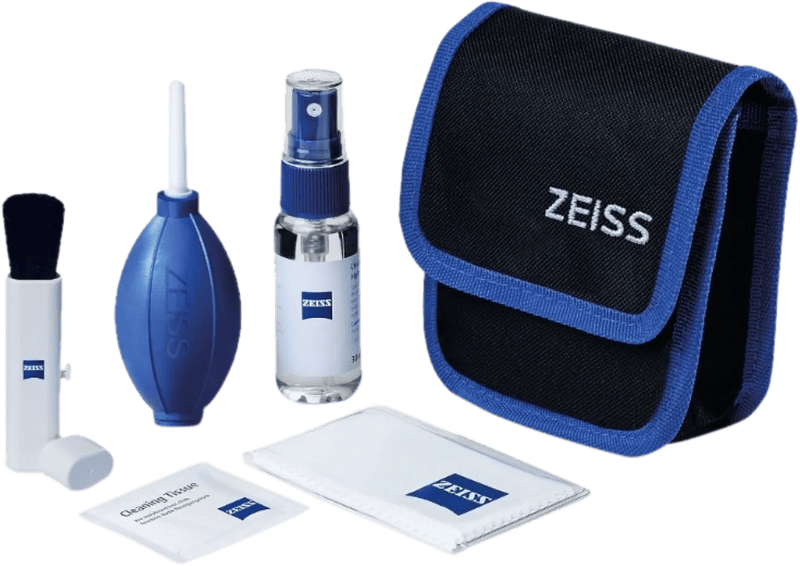
At the front of the optics, things are different. For lenses and filters, a solid kit of blower, brush, fluid and microfiber cloth is enough, the kind Zeiss puts together as its Lens Cleaning Kit. Wet sensor cleaning comes second. With some cameras, it does not belong in your own hands at all.
What the camera manufacturers write about sensor cleaning
The four manuals point in a similar direction. In the details they diverge, and it is precisely these details that decide which tools you need in the first place.
- Canon (EOS R6 user manual): first the automatic cleaning in the menu. After that, only a simple blower without a brush, because bristles can scratch the sensor. Never compressed air or gas, because the pressure can damage the sensor and the gas can permanently deposit on it. Do not insert the blower tip any farther than the lens mount, and only work with a fully charged battery, because the shutter closes if power is lost.
- Nikon (Z f manual): the sensor cleaning function shakes off the dust, and if desired every time the camera is switched off. Blower yes, blower brush no. The sensor should not be touched or wiped under any circumstances. According to Nikon, whatever the blower cannot manage can only be removed by an authorized service center.
- Sony (Alpha 7 IV help guide): the sensor cleaning in the menu makes the sensor vibrate briefly, and the battery needs at least three bars. When blowing, tilt the camera slightly downward, do not blow too hard, and do not use air spray, because it can spray water droplets into the body.
- Fujifilm (X-S10 manual): first the cleaning in the menu, then a blower instead of a brush. If the sensor is damaged during cleaning, repair or replacement is charged for.
None of these four manuals invites you to use swabs. Canon advises leaving direct cleaning to customer service, and Nikon puts it even more strongly. That rules out compressed air cans as well. Canon and Sony each give their own reasons for this.
Blower, brush, cloth: what goes where
The blower is the only tool that all four manufacturers name for the sensor. It should be large enough that a puff really reaches its target, and have a nozzle that you will not accidentally push past the lens mount. Combination tools with a brush on the nozzle are out. Canon, Nikon and Fujifilm warn against them in so many words.
On the front element and filter, a fixed order applies: blow first, then lift off loose grains with the brush, and wipe last. If you rub with the cloth right away, you push sand across the coating. And a microfiber cloth that has been loose in a jacket pocket for weeks collects exactly the dirt it is supposed to remove. Washing it helps.
On a mirrorless camera, the sensor sits right in front of you once the lens is removed, with no mirror in front of it. Which models are currently worth considering is covered in the guide to mirrorless cameras (in German). If you use a protective filter, you will clean the filter more often than the front element in everyday use; background on this is in the guide to lens filters (in German).
Seven cleaning tools side by side
| Model | Used for | Key data according to the manufacturer | Best for |
|---|---|---|---|
| ZEISS Lens Cleaning Kit | Lens, filter, blowing the sensor | Blower, dust brush, 30 ml solution, 18 × 18 cm cloth, 10 wet wipes, belt pouch | Anyone looking for a single kit for the bag |
| Kaiser Typhoon Swing | Blower | Silicone, approx. 182 mm long, bulb approx. 64 mm, swiveling nozzle with soft tip, suction foot | Frequent lens changes, cleaning at the table |
| Hama Lenspen Classic | Lens, filter on the go | 11.5 cm, 13 mm velvet tip, retractable brush, screw cap | Fingerprints on small surfaces |
| Kinetronics Tiger Cloth | Body, display, lens | 250 × 450 mm, microfiber with conductive fibers, washable | Anyone who wants a large, antistatic cloth |
| Kinetronics SpeckGRABBER Pro Kit | Individual particles | Pro handle, 3 tips, cleaning solution, antistatic cloth, box | Experienced users who remove individual grains precisely |
| VisibleDust Arctic Butterfly 724X | Dry sensor cleaning | Rotating brush, 2 LEDs, 2 × AAA (not included), hard case | Anyone who wants to remove dry dust themselves |
| VisibleDust EZ Sensor Cleaning Kit PLUS | Wet sensor cleaning | 5 swabs (24, 20 or 16 mm), sensor brush, 1.15 ml VDust Plus | Oil and smears, at your own risk |
ZEISS Lens Cleaning Kit
Zeiss packs a blower, a dust brush, 30 ml of cleaning solution, an 18 × 18 cm microfiber cloth and ten moist cleaning wipes into a belt pouch. According to Zeiss, the wipes are individually wrapped and intended for single use, and the brush retracts like a lipstick. The kit is intended for lenses, filters, binoculars and eyeglasses. Because the blower and brush are separate parts, the blower matches what Canon calls for on the sensor.
Kaiser Typhoon Swing
According to the manufacturer, the silicone blower from Kaiser Fototechnik measures around 182 mm in length and 64 mm in diameter. The nozzle swivels and has a soft tip, and at the back there is a valve for the air intake. At the bottom, a suction foot holds the blower on the table. Kaiser promises a particularly strong blowing effect. On the sensor, that means squeezing in measured doses, because Sony explicitly warns against blowing too hard.
Hama Lenspen Classic
An 11.5 cm pen: at one end a 13 mm velvet-covered tip under a screw cap, at the other a retractable brush. Hama recommends small, slow circles and, for stubborn dirt, breathing on the surface briefly. That is all. According to Hama, it is not made for large front elements, explicitly not for camera mirrors, and it has no business on the sensor.
Kinetronics Tiger Cloth
At 250 × 450 mm, this cloth has more than three times the area of the one in the Zeiss kit. Conductive fibers are woven into the microfiber to dissipate static charge, and without any fluid or impregnation that could dry out. It is washable. A sensible addition for the body, display and front element, but not for the sensor.
Kinetronics SpeckGRABBER Pro Kit
Here you do not blow, you pick. A strongly adhesive tip picks up individual dust grains; the kit contains a handle, three tips, cleaning solution and an antistatic cloth. According to Kaiser Fototechnik, the German distributor, it is suitable for the cover glass of camera sensors and for mirrors, lenses and eyepieces, and leaves no residue. The tip can be washed with the solution, water or soapy water. On the sensor, it remains a contact tool, and Nikon prohibits any touching. Nikon owners therefore leave the pen in the box when it comes to the sensor. On Amazon, the Pro Kit is currently unavailable (as of November 9, 2026); the SGL version with light is offered there instead.
VisibleDust Arctic Butterfly 724X
A brush with a motor. Before use, it spins the fibers so that they become charged; during the wiping itself, it stands still. VisibleDust describes the procedure precisely: spin three times for five seconds, position it across the full width of the sensor, sweep across once without spinning, and never spin it inside the camera body. Two LEDs illuminate the sensor, and the fibers hold without adhesive. The two AAA batteries are not included. According to the manufacturer, the brush is compatible with ITO-coated sensors, but the camera manufacturers only name the blower for the sensor.
VisibleDust EZ Sensor Cleaning Kit PLUS
The wet cleaning kit contains five green MXD-100 swabs, a sensor brush and 1.15 ml of VDust Plus. The swabs come in 24 mm for full frame, 16 mm for APS-C and 20 mm for other formats. According to VisibleDust, VDust Plus is an alcohol-based solution that dissolves oil and evaporates quickly. The instructions are strict: clean dry first, then wet, then dry again. Use each side of a swab only once, without pressure and with little fluid, then throw it away. The manufacturer prohibits using other fluids on the swabs.
Clean it yourself or send it to service?
In its instructions, VisibleDust distinguishes dry dust from oil, smears and lubricant. Only the latter need fluid. If a spot remains after the cleaning function and blower and does not move a millimeter, that is exactly this case. Canon and Sony then refer you to customer service, and Nikon does anyway. If you own a Fujifilm, you already know the bill: a sensor damaged during cleaning is repaired at your expense.
Our position is clear. Wet cleaning is only worth the risk for people who bring steady hands, good light and exactly the right swab size. We advise everyone else to use the camera manufacturer’s service or a specialist workshop.
Which tool for whom?
- Occasional photography, rare lens changes: the camera’s cleaning function plus the ZEISS Lens Cleaning Kit. That covers the lens, filter and the blower for the sensor.
- Frequent lens changes outdoors: additionally the Kaiser Typhoon Swing, which stays on the table at home.
- For the camera bag: Hama Lenspen Classic and a clean Tiger Cloth.
- A single grain that the blower does not dislodge: Arctic Butterfly 724X or SpeckGRABBER, but only if your camera manufacturer does not rule out contact.
- Oil and smears: VisibleDust EZ Kit PLUS with practice, otherwise the service center. With Nikon, go straight to the service center.
Frequently asked questions
How do I clean my camera sensor correctly?
First with the built-in sensor cleaning in the menu, then with a simple blower without a brush. Canon advises not inserting the blower tip any farther than the lens mount and only working with a fully charged battery, because the shutter closes if power is lost.
Can I use compressed air spray on my camera?
No. Canon warns that the pressure could damage the sensor and the gas could permanently deposit on it. Sony advises against air spray because it can spray water droplets into the body. The blower is the only tool that all four manufacturers name for the sensor.
In what order do you clean a lens?
Blow first, then lift off loose grains with the brush, and wipe last. If you rub with the cloth right away, you push sand across the coating. A microfiber cloth that has been loose in a jacket pocket for weeks collects exactly the dirt it is supposed to remove; washing it helps.
When is wet cleaning of the sensor necessary?
Only for oil, smears and lubricant; dry dust needs no fluid. If a spot that does not move remains after the cleaning function and blower, Canon and Sony refer you to customer service, and Nikon does anyway. This guide only recommends wet cleaning to experienced users with exactly the right swab size.
Which swab size fits my camera?
VisibleDust offers swabs in 24 mm for full frame, 16 mm for APS-C and 20 mm for other formats. Each side of a swab is used only once, without pressure and with little fluid. The manufacturer prohibits using other fluids on the swabs.
What does Nikon say about sensor cleaning?
Nikon is the strictest: blower yes, blower brush no, and the sensor should not be touched or wiped under any circumstances. According to Nikon, whatever the blower cannot remove can only be removed by an authorized service center. Contact tools such as the SpeckGRABBER stay in the box when it comes to the sensor on a Nikon.
Sources
- Canon: EOS R6 user manual, sensor cleaning
- Nikon: Z f manual, caring for the camera
- Sony: Alpha 7 IV help guide, cleaning the image sensor
- Fujifilm: X-S10 manual, sensor cleaning
- Zeiss: Accessories and Lens Cleaning Kit
- Zeiss: Lens Cleaning Kit product page
- Kaiser Fototechnik: Typhoon Swing
- Hama: Lenspen Classic
- Kaiser Fototechnik: Kinetronics Tiger Cloth
- Kaiser Fototechnik: Kinetronics SpeckGRABBER
- VisibleDust: Arctic Butterfly 724X
- VisibleDust: EZ Sensor Cleaning Kit PLUS
- VisibleDust: Wet cleaning instructions (PDF)
Where to buy
- ZEISS Lens Cleaning KitView at CoolblueAvailable in Germany: CoolblueCheck price at Amazon.deAvailable in Germany: Amazon.de
- Kaiser Typhoon Swing BlasebalgCheck price at Amazon.deAvailable in Germany: Amazon.de
- Hama Lenspen ClassicCheck price at Amazon.deAvailable in Germany: Amazon.de
- Kinetronics Tiger ClothCheck price at Amazon.deAvailable in Germany: Amazon.de
- Kinetronics SpeckGRABBER Pro Kit mit Licht (SGL)Check price at Amazon.deAvailable in Germany: Amazon.de
- Kinetronics SpeckGRABBER Pro KitCheck price at Amazon.deAvailable in Germany: Amazon.de
- VisibleDust Arctic Butterfly 724XCheck price at Amazon.deAvailable in Germany: Amazon.de
- VisibleDust EZ Sensor Cleaning Kit PLUSCheck price at Amazon.deAvailable in Germany: Amazon.de