Contents14 sections
This guide was first published in German on handgetestet.de.
Going uphill, your watch shows 182; at the top of the hill, it suddenly reads 128. Spikes like that rarely have anything to do with your heart and often have everything to do with the sensor on your wrist. If you want reliable readings, get a chest strap, ideally one that supports both Bluetooth and ANT+. The Polar H10 is the most versatile choice here, while Garmin runners with a compatible watch should take a closer look at the HRM 600.
Does a chest strap really measure more accurately than my watch?
Yes, and the reasons come down to physics. The strap picks up the heart’s electrical signal, much like an ECG. The watch, by contrast, estimates the pulse optically from blood flow under the skin, and every movement of the wrist interferes with that.
A 2017 Cleveland Clinic study checked this in 50 healthy adults. The chest strap tracked the ECG curve almost exactly, with an agreement value of 0.996. For the wrist-worn watches, it ranged between 0.67 and 0.92. Things looked worst on the bike and the elliptical trainer, where readings were off by up to 34 beats per minute depending on the activity.
A Swiss study from 2019 came out even more clearly. Ten participants wore a Polar H10 and a Holter ECG at the same time. The strap cleanly captured 99.6 percent of the intervals between heartbeats, and still 99.4 percent under hard exertion. The Holter ECG reached 94.6 percent. Both studies were small. The direction is clear nonetheless.
That said, a heart rate strap remains a training device, not a substitute for a medical examination. In its manual, Suunto explicitly advises people with a pacemaker or other implants to discuss this with their doctor before use.
Bluetooth or ANT+: what do I need?
Watches and smartphones use Bluetooth. Many bike computers, older treadmills and some indoor trainers rely on ANT+ instead. If you have both at home, choose a strap that supports both standards. Almost as important is the number of Bluetooth connections. An example: the watch is supposed to record your heart rate while the training app on your tablet displays it at the same time. That takes two connections. The H10 can do it, the Wahoo TRACKR even three according to the manufacturer, the H9 and the Suunto strap only one.
Coin cell or rechargeable battery, memory or not?
According to Polar and Garmin, a coin cell lasts about a year with one hour of training a day. After that, you replace it yourself. A rechargeable battery saves you buying batteries, but it needs to be plugged in every few weeks, and that is easy to forget.
Memory sounds like a luxury. For swimmers, it is a must. Bluetooth barely gets through underwater, so only a strap with its own memory can hand over the data afterward.
Do I need running dynamics?
Stride length, ground contact time and vertical oscillation help runners who are deliberately working on their form. If you go for an easy jog twice a week, you will rarely look at them. Both strap and watch have to support it. In the lineup below, only the Garmin HRM 600 does, and even then only with a compatible Garmin watch.
Which chest straps are worth considering in 2026?
| Model | Wireless | Power supply | Special feature | Best for |
|---|---|---|---|---|
| Polar H10 | Bluetooth (two connections), ANT+ | Coin cell, up to 400 hours | Memory for one session of up to 30 hours, waterproof to 30 m | If you use several devices and brands |
| Polar H9 | Bluetooth (one connection), ANT+ | Coin cell, up to 400 hours | No memory | Beginners with one watch or app |
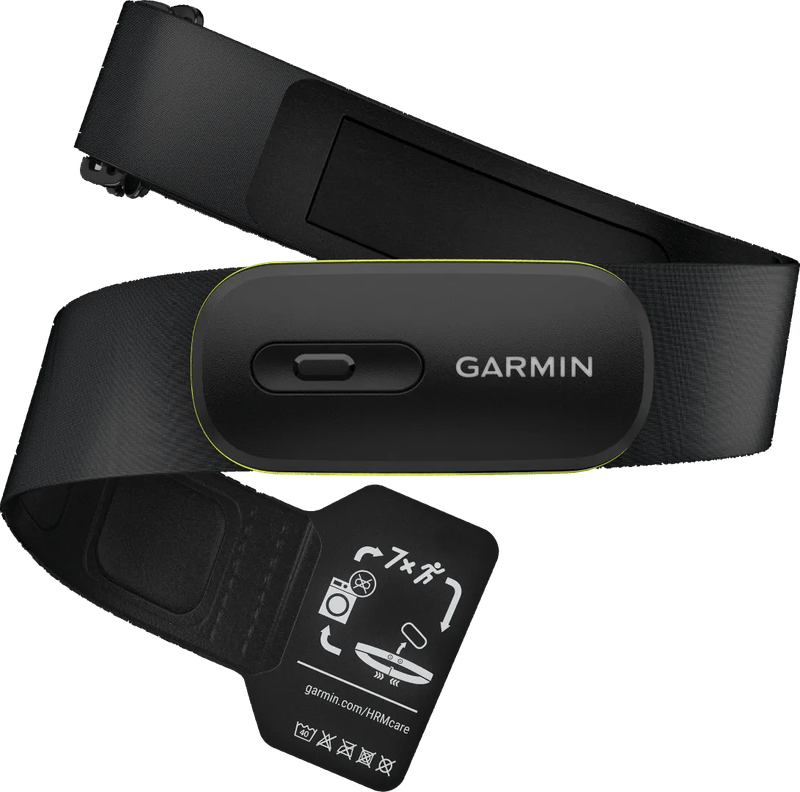
| Garmin HRM 600 | Bluetooth, ANT+ | Rechargeable battery, up to two months | Running dynamics, recording without a watch, 5 ATM | Runners with a compatible Garmin watch |
| Garmin HRM 200 | Bluetooth, ANT+ | CR2032 coin cell, up to one year | Heart rate and HRV, 3 ATM | Garmin users who only need heart rate |
| Wahoo TRACKR Heart Rate | Bluetooth (up to three connections), ANT+ | USB-C rechargeable battery, more than 100 hours | IPX7, strap hand wash only | Indoor cyclists with training apps |
| Suunto Smart Heart Rate Belt | Bluetooth only (one active connection) | CR2025 coin cell, about 500 hours | Memory for swimming with a Suunto watch, 30 m | Owners of a Suunto watch |
All specifications come from the manufacturers. Battery life figures apply to typical use and are shorter in the cold or with the memory active.
What speaks for the Polar H10?
Its openness. It transmits via Bluetooth and ANT+, holds two Bluetooth connections at the same time according to Polar, and records a session of up to 30 hours on its own. The coin cell is said to last around 400 training hours. It does not deliver running dynamics. If you wear a Polar today and maybe a Garmin tomorrow, this strap will not end up gathering dust.
Is the less expensive Polar H9 enough?
Often, yes. It also measures electrically and supports Bluetooth and ANT+. Memory and a second Bluetooth connection are missing. According to Polar’s own price list, it costs a good third less than the H10. Runners with exactly one watch who do not swim will not miss anything.
Is the Garmin HRM 600 worth the extra cost?
Only with the right watch. In addition to heart rate and heart rate variability, the strap transmits stride length, vertical oscillation and ground contact time. Paired with a Forerunner 970, Garmin also lists running economy and step speed loss during ground contact. Far from every Garmin watch displays all of these values, so checking Garmin’s compatibility list beforehand saves frustration. It runs on a rechargeable battery that lasts around two months according to Garmin. It records sessions even without a watch. If you do not wear a Garmin, you are paying for features that will never reach you.
And the Garmin HRM 200?
It is the no-frills counterpart. Heart rate and HRV go to your watch or bike computer via Bluetooth and ANT+, and according to Garmin the CR2032 should last a year. The module detaches, and the strap can go in the washing machine. Garmin does not list running dynamics or memory for this model.
What happened to the Wahoo TICKR?
In Wahoo’s European store, the only chest strap listed now is the TRACKR Heart Rate. It charges via a USB-C cable, and according to Wahoo one charge lasts more than 100 hours. Three simultaneous Bluetooth connections plus ANT+ make it interesting for people who spend a lot of time on an indoor trainer. Wahoo does not list any running metrics, and according to Wahoo the strap should be washed by hand.
Is the Suunto strap any good without a Suunto watch?
Not really. ANT+ is missing entirely, and only one Bluetooth connection is ever active. According to the manual, its memory, which buffers data while swimming, can only be used by a Suunto watch. The coin cell is said to last about 500 hours. With a Suunto on your wrist, it is a good match.
Doesn’t Coros make a chest strap?
No. Coros sells an optical sensor for the upper arm that, according to retailer information, transmits only via Bluetooth. For people who dislike straps, it is an option. However, the two studies above say nothing about it.
So which strap is right for me?
If you use several devices and possibly different brands, the Polar H10 is the right call. On a tight budget and with only one watch, the H9 will do. Garmin runners who are fine-tuning their form and own a compatible watch should take the HRM 600; all other Garmin users, the HRM 200. For indoor trainers and training apps, the Wahoo TRACKR makes sense. We only see the Suunto strap for Suunto owners who swim.
How much the watch alone can already do is shown in our overviews of fitness trackers (in German) and Garmin watches (in German). If you are working on stride length and ground contact, you should also think about your shoes. Our running shoe guide (in German) offers some ideas.
Frequently asked questions
Does a chest strap measure more accurately than a watch?
The strap picks up the heart's electrical signal, much like an ECG, while the watch estimates the pulse optically from blood flow. In a 2017 Cleveland Clinic study, the chest strap tracked the ECG curve almost exactly, while the watches were off by up to 34 beats per minute depending on the activity.
What is the difference between Bluetooth and ANT+ in a heart rate strap?
Watches and smartphones use Bluetooth, whereas many bike computers, older treadmills and some indoor trainers use ANT+. If you use both, you need a strap that supports both standards. The number of Bluetooth connections matters too: the H10 manages two, the Wahoo TRACKR three according to the manufacturer, and the H9 and the Suunto strap only one.
Coin cell or rechargeable battery: which is more practical?
According to Polar and Garmin, a coin cell lasts about a year with one hour of training a day, and you then replace it yourself. A rechargeable battery saves you buying batteries but has to be plugged in every few weeks. According to Garmin, the HRM 600 lasts around two months; the Wahoo TRACKR lasts more than 100 hours.
Which heart rate strap is suitable for swimming?
Bluetooth barely gets through underwater, so you need a strap with its own memory that hands over the data afterward. The Polar H10 stores one session of up to 30 hours and is waterproof to 30 m. The Suunto strap also buffers data while swimming, but according to its manual only with a Suunto watch.
Is the Garmin HRM 600 worth it without a Garmin watch?
Hardly. Its running dynamics, with stride length, vertical oscillation and ground contact time, only reach a compatible Garmin watch, and not every Garmin displays all the values. Check Garmin's compatibility list first. For Garmin users who only need heart rate, the HRM 200 with a coin cell is enough.
Can you wear a chest strap with a pacemaker?
A heart rate strap is a training device, not a substitute for a medical examination. In its manual, Suunto explicitly advises people with a pacemaker or other implants to discuss use with their doctor beforehand.
Sources
- Polar: H10 heart rate sensor
- Polar: H9 heart rate sensor
- Garmin: HRM 600, the benefits of running with a chest strap
- Garmin: press release on the HRM 600 (May 2025)
- Garmin: HRM 200 owner’s manual
- Garmin: press release on the HRM 200 (January 2025)
- Wahoo: TRACKR Heart Rate
- Suunto: Smart Heart Rate Belt user guide
- American College of Cardiology: Cleveland Clinic study on wrist-worn heart rate monitors (2017)
- Gilgen-Ammann et al.: RR interval signal quality of a heart rate monitor and an ECG Holter, European Journal of Applied Physiology 2019
Where to buy
- Polar H10Check price at Amazon.deAvailable in Germany: Amazon.deView at CoolblueAvailable in Germany: Coolblue
- Polar H9Check price at Amazon.deAvailable in Germany: Amazon.de
- Garmin HRM 600Check price at Amazon.deAvailable in Germany: Amazon.deView at CoolblueAvailable in Germany: Coolblue
- Garmin HRM 200Check price at Amazon.deAvailable in Germany: Amazon.deView at CoolblueAvailable in Germany: Coolblue
- Wahoo TRACKR Heart RateCheck price at Amazon.deAvailable in Germany: Amazon.de
- Suunto Smart Heart Rate BeltCheck price at Amazon.deAvailable in Germany: Amazon.de
- Polar H9 Herzfrequenzmesser Brustgurt Schwarz M-XXLView at CoolblueAvailable in Germany: Coolblue