Contents12 sections
This guide was first published in German on handgetestet.de.
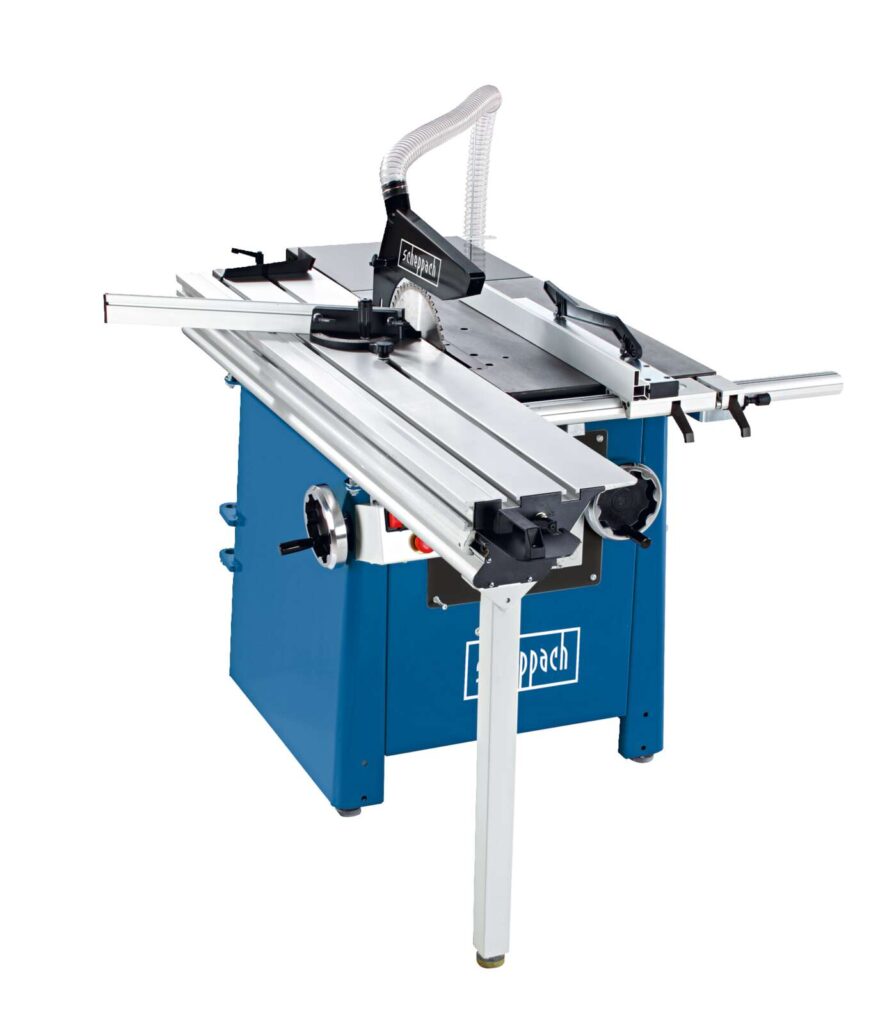
A table saw cuts strips. A sliding table saw cuts panels, and it cuts them so straight that cabinet sides fit together without rework. If you regularly build furniture from coated particleboard or multiplex plywood, there is hardly any way around one. For most hobby workshops with three-phase power, a machine with 1,600 mm of trimming length and a scoring blade is the right fit, such as the Scheppach Forsa 4.0.
What sets it apart from a table saw?
The sliding carriage.
On a sliding table saw, the workpiece rests on an aluminum carriage that travels past the saw blade on balls or rollers. The panel moves, your hands stay well away from the blade, and the cut is as straight as the guide.
The most important number is the trimming length. It tells you the maximum length of a cut with the carriage. Scheppach specifies 1,600 mm each for the Forsa 3.0 and Forsa 4.0, and 2,100 mm for the Forsa 4.1; Holzmann specifies 1,900 mm for the TS315VF2000. If you want to trim doors or tall cabinet sides in one pass, you need more than 1.60 meters.
Precision table saws such as the Scheppach Precisa are a middle ground. They have a heavy cast-iron table and can be retrofitted with a sliding carriage. According to the manufacturer, up to 800 mm of cutting depth in front of the saw blade is then possible.
Scoring blade: yes or no?
A scoring blade is a small second saw blade in front of the main blade that pre-scores the underside of the panel. Without it, the coating on the underside often chips out. You do not need it for solid wood. For melamine-coated particleboard and veneered panels, you do.
Scheppach offers the Forsa 4.0 and 4.1 with and without a scoring blade; the scoring blade is 120 mm in diameter and its height can be adjusted between 0 and 4 mm. The manufacturer does not say whether it can be retrofitted later. So decide when you buy.
Power, weight, noise
All the machines here run on 400 volts.
Without a three-phase connection in the workshop, nothing works, and that has to be installed by an electrician. Factor this in before you buy.
Then there is the weight, which is easily overlooked when buying online, because the machine comes by freight carrier to the curb and the rest is up to you: according to the manufacturer, the Forsa 3.0 weighs 137 kg, the Forsa 4.0 with scoring blade 256 kg, and the Holzmann 263 kg. That makes a basement staircase a real obstacle.
They are all loud.
Scheppach measures a sound pressure of 87.1 dB(A) under load at the workstation. Hearing protection is part of the basic equipment, and so is dust extraction.
| Model | Cutting height 90°, trimming length | Blade, scoring blade | For whom |
|---|---|---|---|
| Scheppach Forsa 4.0 with scoring blade | 107 mm, 1,600 mm | 315 mm, yes | coated panels, furniture making |
| Scheppach Forsa 3.0 | 87 mm, 1,600 mm | 270 mm, no | entry level, solid wood |
| Scheppach Forsa 4.1 with scoring blade | 107 mm, 2,100 mm | 315 mm, yes | long cuts, doors |
| Holzmann TS315VF2000 | 100 mm, 1,900 mm | 315 mm, yes | second brand, wide rip fence capacity |
| Scheppach Precisa 6.0 | 107 mm, carriage can be retrofitted | 315 mm | heavy table, little space |
| Scheppach Precisa 4.0 | 87 mm, carriage can be retrofitted | 270 mm | smaller budget |
Scheppach Forsa 4.0 with scoring blade
A 4.8 kW motor drives a 315 mm blade at a cutting speed of 66 m/s. According to the manufacturer, it achieves a cutting height of 107 mm at 90 degrees and 75 mm at 45 degrees. With the rip fence, a cutting width of 440 mm is possible, and around 1,100 mm with the optional table extension. The table is made of planed cast iron, and the carriage runs on ball bearings.
For furniture made from sheet material, the most balanced choice.
Scheppach Forsa 3.0
The more affordable entry point, with a 3.8 kW motor and a 270 mm blade. A cutting height of 87 mm is enough for panels and most planks, but not for thick beams. There is no scoring blade. In return, at 137 kg it is considerably lighter and more likely to make it into a basement.
Scheppach Forsa 4.1 with scoring blade
Technically a Forsa 4.0 with a longer carriage: 2,100 mm of trimming length instead of 1,600 mm, and with the crosscut table up to 1,480 mm of cutting depth in front of the blade. That takes up space.
Allow for the carriage in both end positions and measure your workshop.
Holzmann TS315VF2000
The comparison from a second brand, from Austria. Holzmann specifies a cutting height of 100 mm, a trimming length of 1,900 mm, a 2,000 mm sliding table and up to 1,250 mm of cutting width at the rip fence. The scoring blade is standard. Net weight 263 kg, 100 mm dust extraction port.
Scheppach Precisa 6.0
A precision table saw with the same 107 mm cutting height as the Forsa 4.0, 390 mm of cutting width at the rip fence and IP54 protection. Without a sliding carriage, it remains a very powerful table saw that can stand against the wall and still rip planks up to 107 mm thick. Scheppach offers the carriage in 1,400 or 2,000 mm as an accessory; according to the manufacturer, the short one allows up to 800 mm of cutting depth in front of the blade, which is enough for carcass parts, drawer fronts and shelves in standard furniture depths.
Scheppach Precisa 4.0
The smaller precision saw, with 3.6 kW, a 270 mm blade and 87 mm of cutting height. According to the manufacturer, it is aimed at beginners and advanced DIYers. If you will cut strips and boards first and panels later, you can start with this one.
Which saw for which workshop?
- Furniture from coated panels, three-phase power available: Scheppach Forsa 4.0 with scoring blade.
- Solid wood, small budget, cramped basement: Scheppach Forsa 3.0.
- Doors, long cabinet sides, plenty of space: Scheppach Forsa 4.1 with scoring blade or Holzmann TS315VF2000.
- Table saw first, carriage later: Scheppach Precisa 6.0 or 4.0.
Without three-phase power, a 230-volt table saw is the alternative. For clean edges on solid wood, a jointer-planer belongs in the workshop. Which blade suits which material is covered in our guide to the circular saw blade.
Black Friday: scoring blade and delivery before price
Workshop machines are also discounted around Black Friday on November 27. With a sliding table saw, the exact version comes first. According to Scheppach, the Forsa 4.0 and 4.1 are available with and without a scoring blade, and the manufacturer does not say whether one can be retrofitted. A deal without a scoring blade is the wrong machine for coated panels, however tempting the price.
If the saw is to be running over the holidays, plan the route into the workshop as well. It comes by freight carrier to the curb, the Forsa 4.0 weighs 256 kg, and the three-phase connection has to be in place beforehand. If a retailer advertises a price reduction, it must state the lowest price of the previous 30 days (Section 11 of the German Price Indication Ordinance, Preisangabenverordnung). For our pick, the Forsa 4.0 with scoring blade, you can set a price alert above. If you rough-cut large panels beforehand, you will find suitable tools in our guide to the plunge saw and circular saw. More deals are collected on our Black Friday 2026 (in German) page.
Frequently asked questions
What distinguishes a sliding table saw from a table saw?
The sliding carriage. On a sliding table saw, the workpiece rests on an aluminum carriage that travels past the saw blade; the panel moves, and your hands stay well away from the blade. The trimming length tells you the maximum length of a cut. Scheppach specifies 1,600 mm each for the Forsa 3.0 and 4.0, and 2,100 mm for the Forsa 4.1.
Do I need a scoring blade on a sliding table saw?
For melamine-coated particleboard and veneered panels, yes; for solid wood, no. The scoring blade pre-scores the underside of the panel; without it, the coating there often chips out. Scheppach does not say whether one can be retrofitted to the Forsa later. So decide when you buy.
Sources
- Scheppach: Forsa 4.0 sliding table saw with scoring blade
- Scheppach: Forsa 3.0 sliding table saw
- Scheppach: Forsa 4.1 sliding table saw with scoring blade
- Scheppach: Precisa 6.0 precision table saw
- Scheppach: Precisa 4.0 precision table saw
- Holzmann: TS315VF2000_400V sliding table saw
- Preisangabenverordnung § 11: price reductions
Where to buy
- Scheppach Forsa 4.0 mit VorritzerView at scheppachAvailable in Germany: scheppachCheck price at Amazon.deAvailable in Germany: Amazon.de
- Scheppach Forsa 3.0View at scheppachAvailable in Germany: scheppachCheck price at Amazon.deAvailable in Germany: Amazon.de
- Scheppach Forsa 4.1 mit VorritzerView at scheppachAvailable in Germany: scheppach
- Holzmann TS315VF2000Check price at Amazon.deAvailable in Germany: Amazon.de
- Scheppach Precisa 6.0View at scheppachAvailable in Germany: scheppach
- Scheppach Precisa 4.0View at scheppachAvailable in Germany: scheppachCheck price at Amazon.deAvailable in Germany: Amazon.de