Contents12 sections
This guide was first published in German on handgetestet.de.
The new countertop is resting on two sawhorses, the cutout for the sink is marked, and a circular saw lies within reach. This is the moment at the latest when you realize it is the wrong machine. Cutting countertops, door leaves or coated chipboard straight and without splintering calls for a saw that runs cleanly on a guide rail. So buy a track saw with a rail, ideally in the battery system you already own. If you are free to choose, the new Festool TSC 55 KS is a lightweight machine with a sensor-controlled kickback stop. For occasional cuts, the corded Scheppach PL55 is enough.
Two saws, two jobs
Both saws work with a round blade. Even so, they are built for different jobs. On a track saw, the blade sits inside the housing and only plunges into the material when you press it down, which lets you make cutouts in the middle of a panel, for a sink, for example. The circular saw is lighter, quicker to grab and meant for squared timber, roofing battens and rough cuts on the job site. Many models can be adapted to a rail. They rarely match the guidance of a true track saw, though.
Back to the countertop. The rail costs a few millimeters of cutting depth: for the GKT 18V-52 GC, Bosch states 52 mm freehand and 46 mm on the rail. That is still enough for 40 mm countertops, but not for 50 mm planks.
Then the rail itself. Check which rails your saw accepts; Bosch explicitly states that its cordless track saw also runs on rails from Festool, Mafell and Makita. A 1.4 m rail is enough for doors. For 2.5 m panels, you need two pieces and a connector.
The battery is put to work too. A saw draws more current than a drill/driver, which is why Bosch recommends batteries of 5.5 Ah or more for full performance of its track saw. The Makita DSP600 needs two 18 V batteries at the same time.
And finally, kickback. Sensor-based systems such as Festool’s KickbackStop or Bosch’s KickBack Control stop the blade when the saw jerks suddenly. That is no substitute for a clean working technique, but it takes some of the fear out of the most dangerous moment.
How the big battery platforms differ and when switching systems gets expensive is explained in our guide to battery systems. Without a single battery in the house, most people start with a drill/driver; help with choosing one is in the drill/driver guide.
What the German accident insurance institution says about sawing
The BG BAU, the German statutory accident insurance institution for the construction industry, summarizes the rules for circular saws in its module B 265. Some of its points apply to anyone sawing at home:
- For solid wood, set the cutting depth no more than 10 mm deeper than the thickness of the workpiece.
- Cut large-format panels with a circular saw and guide rail, clamp the workpiece and guide the machine with both hands.
- Wear hearing protection, no gloves while sawing; never set the machine down with the blade still running.
- Indoors, extract the wood dust.
The operating manual of the respective manufacturer also remains binding, for example regarding the riving knife, which not every track saw requires.
Seven saws and their key specs
| Model | Power, blade | Cutting depth 90° / 45° (according to the manufacturer) | Best for |
|---|---|---|---|
| Festool TSC 55 KS | 18 V, 160 mm | 55 / 43 mm | Furniture making, interior finishing, Festool users |
| Makita DSP600 | 2 × 18 V, 165 mm | 56 / 40 mm | Makita LXT owners |
| Bosch GKT 18V-52 GC | 18 V, 140 mm | 52 (46 on rail) / 32 mm | Bosch Professional and AMPShare users |
| Metabo KT 18 LTX 66 BL | 18 V, 165 mm | 66 (61 on rail) / 43 mm | Thick material, CAS batteries |
| Scheppach PL55 | 230 V, 1,200 W, 160 mm | 55 (49.5 on rail) / n/a | Occasional panel cuts |
| Makita DHS680 | 18 V, 165 mm | 57 / 41 mm | Job site, squared timber |
| Bosch GKS 18V-57-2 GX | 18 V, 165 mm | up to 57 mm, bevel up to 50° | Circular saw with rail option |
Festool TSC 55 KS
Available since March 2026, listed by some retailers as KSEB-Basic. According to Festool, it weighs 3.5 kg without accessories and runs on a single 18 V battery, unlike the older TSC 55 KEB with two batteries. The sensor-based KickbackStop stops the blade in the event of kickback; status and updates run through an app. The most expensive package here. It only pays off if you cut panels regularly.
Makita DSP600
Two 18 V LXT batteries and a 165 mm blade. Makita states 56 mm cutting depth and 4.4 to 5.1 kg including batteries. The rail is not included with the bare tool, and a kickback stop for the rail is listed as an accessory. If you already have four or five Makita batteries on the shelf, you get a lot of saw for your money here.
Bosch GKT 18V-52 GC
The smallest blade in the comparison, 140 mm, and therefore also the lowest cutting depth: 46 mm on the rail. In return, according to Bosch, it also runs on Festool, Mafell and Makita rails, and its battery fits into the AMPShare alliance. The set with the FSN 1400 rail and two 5.5 Ah batteries sits near the top in price.
Metabo KT 18 LTX 66 BL
With 66 mm freehand and 61 mm on the rail, the Metabo cuts deepest. That lets it handle double-laminated panels and thick planks. Metabo states 5.3 kg with battery, plus a fast run-down brake. The batteries fit into the cross-brand CAS system, which other brands use as well.
Scheppach PL55
The affordable corded solution. 1,200 W, a 160 mm blade, and two 700 mm rails with connector and tilt guard are included. Scheppach states 55 mm cutting depth, 49.5 mm on the rail. Some buyers notice a noticeable step at the rail connector, which is why a continuous 1.4 m rail is the better idea for many long cuts. For laminate flooring, shelves and the occasional door, the set is enough.
Makita DHS680
A classic cordless circular saw with a brushless motor, weighing 3.0 to 3.3 kg including battery according to Makita, with 57 mm cutting depth. The DHS680RTJ set includes a guide rail adapter. For roofing battens, squared timber and quick cuts outdoors, it is handier than any track saw.
Bosch GKS 18V-57-2 GX
The Bosch circular saw cuts up to 57 mm deep and bevels up to 50°. It comes with KickBack Control and a Stop-Control function that switches off at the end of the cut. The version with the FSN 440 X rail is intended for crosscuts; for long rip cuts, it fits the FSN rails. A compromise, then. Good if you want to stick with one saw.
Which saw for which workshop?
- You build furniture or kitchens and saw often: Festool TSC 55 KS with rail. Lightweight, with kickback stop, but only worthwhile if the saw really gets used.
- You already have Makita batteries: DSP600 as a bare tool plus a 1.4 m rail.
- You cut thick planks or double panels: Metabo KT 18 LTX 66 BL.
- You saw two or three times a year: Scheppach PL55. Buying a whole battery system just for this saw does not pay off.
- You mostly work outdoors with squared timber: Makita DHS680 or Bosch GKS 18V-57-2 GX.
If you also need to cut metal as well as wood, the cordless angle grinder (in German) is the right counterpart.
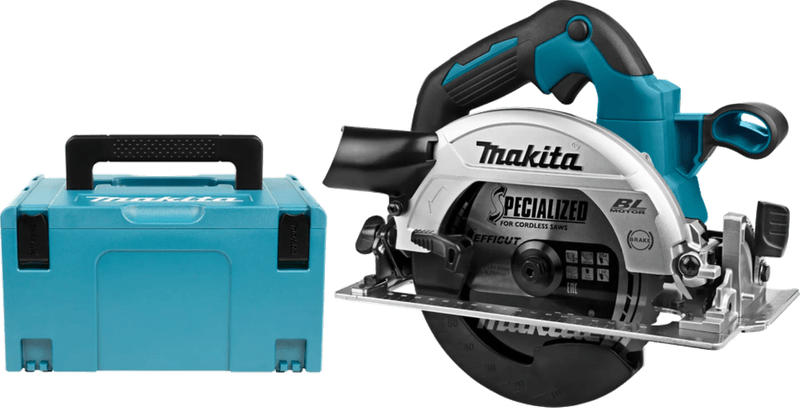
According to the manufacturer, the Makita DHS660 cordless circular saw is designed for 165 mm blades, reaches up to 57 mm cutting depth and has a motor brake; for panel cuts on the rail, the track saw remains the more suitable machine.
If you regularly cut full-size panels for furniture, you will eventually hit the limits of a rail and circular saw. What a stationary machine with a sliding table can do is explained in the guide to the panel saw (in German).
Frequently asked questions
What is the difference between a track saw and a circular saw?
On a track saw, the blade sits inside the housing and only plunges into the material when you press it down, so you can make cutouts in the middle of a panel. The circular saw is lighter, quicker to grab and meant for squared timber, roofing battens and rough cuts. It rarely matches the guidance of a track saw.
How much cutting depth does the guide rail cost?
A few millimeters. On the Bosch GKT 18V-52 GC, it is 52 mm freehand and 46 mm on the rail, so it handles 40 mm countertops but no longer 50 mm planks. The Metabo KT 18 LTX 66 BL cuts deepest, with 66 mm freehand and 61 mm on the rail.
What rail length do I need for a track saw?
A 1.4 m rail is enough for doors. For 2.5 m panels, you need two pieces and a connector. Also check which rails your saw accepts: Bosch states that its cordless track saw also runs on rails from Festool, Mafell and Makita.
What battery does a cordless track saw need?
A saw draws more current than a drill/driver. For full performance of its track saw, Bosch recommends batteries of 5.5 Ah or more, and the Makita DSP600 needs two 18 V batteries at the same time. The Festool TSC 55 KS, by contrast, runs on a single 18 V battery.
What does the German employers' liability insurance association recommend for sawing?
In its module B 265, the BG BAU lists, among other things: for solid wood, set the cutting depth no more than 10 mm deeper than the workpiece, cut large panels with a guide rail, clamp the workpiece and guide the saw with both hands. Also wear hearing protection, no gloves, never set the machine down with the blade still running, and extract wood dust.
Is a cordless track saw worth it for occasional cuts?
For two or three jobs a year, a whole battery system just for this saw does not pay off. In that case, the corded Scheppach PL55 with 1,200 W and two 700 mm rails is enough. Some buyers notice a step at the rail connector, so for many long cuts a continuous 1.4 m rail is better.
Sources
- Festool: Press release and technical data TSC 55 KS
- Festool: Track saw overview
- Makita: DSP600
- Makita: DHS680
- Bosch Professional: GKT 18V-52 GC
- Bosch Professional: GKS 18V-57-2 GX
- Metabo: KT 18 LTX 66 BL
- Scheppach: Track saws and circular saws
- BG BAU: Module B 265 job-site circular saws, circular saws
- Makita DHS660ZJ (without battery): product details
Where to buy
- Festool TSC 55 KSEB-BasicCheck price at Amazon.deAvailable in Germany: Amazon.de
- Scheppach PL55View at scheppachAvailable in Germany: scheppachCheck price at Amazon.deAvailable in Germany: Amazon.de
- Makita DSP600Check price at Amazon.deAvailable in Germany: Amazon.de
- Bosch Professional GKT 18V-52 GCCheck price at Amazon.deAvailable in Germany: Amazon.de
- Metabo KT 18 LTX 66 BLCheck price at Amazon.deAvailable in Germany: Amazon.de
- Makita DHS680Check price at Amazon.deAvailable in Germany: Amazon.de
- Bosch Professional GKS 18V-57-2 GXCheck price at Amazon.deAvailable in Germany: Amazon.de
- Makita DHS660ZJ (ohne Akku)View at CoolblueAvailable in Germany: Coolblue