Contents7 sections
This guide was first published in German on handgetestet.de.
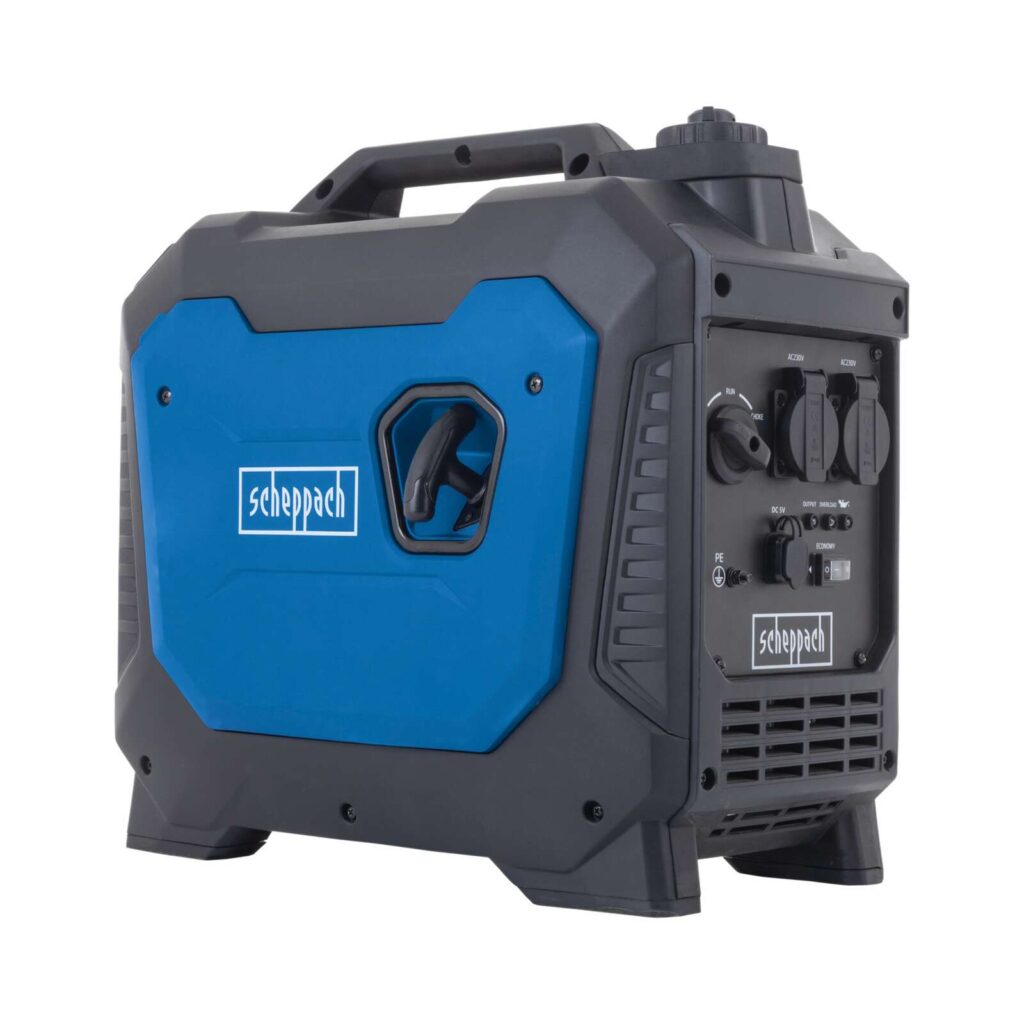
An electric kettle. That is all it takes to push the smaller of the two Scheppach inverters to its limit. Depending on the data sheet, the SG2500i delivers 1,600 to 1,800 watts continuously, the SG3500i 3,000 watts. For backup power at home with a fridge, router, lights and the occasional power tool, go for the SG3500i. Choose the SG2500i only if it really is just for camping, with a cooler, phone and a few lamps plugged in, and four kilos less to carry matters to you.
Both appear in our generator guide alongside models from Güde, Einhell and Honda. That guide also explains why an inverter is a must for electronics.
Calculate with the continuous output, not the number in the name
The digits in the model name are peak values. For the SG3500i, Scheppach states 3,500 watts peak, 3,200 watts maximum and 3,000 watts rated power in continuous operation. For the SG2500i, the data sheet lists 2,000 watts as the maximum, with a rated power of 1,800 watts in one place and 1,600 watts in the description. Go by the lower figure.
What that means is shown by a simple list for a winter power outage. Fridge-freezer, router, two LED lamps, chargers: by our calculation, that usually stays below 1,000 watts while running, which even the small one can handle. But add a fan heater, a hot plate or the electric kettle, and according to Germany’s Federal Office of Civil Protection and Disaster Assistance, devices like these quickly draw 1,500 to 2,000 watts each. At that point, the SG2500i is fully loaded on its own, while the SG3500i still has headroom for the fridge and lights.
The two inverters by the data sheet
| Model | Continuous / maximum output | Tank and run time | Weight | Outlets | Price class (Scheppach shop, November 8, 2026) |
|---|---|---|---|---|---|
| Scheppach SG3500i | 3,000 W / 3,200 W, peak 3,500 W | 6.3 l; about 3.6 h at full load, 14 h with no load | 22.5 kg | 2 × 230 V, 12 V, 2 × USB | 600-euro class |
| Scheppach SG2500i | 1,600 to 1,800 W / 2,000 W | 4.2 l; about 3.1 h at full load, 14.8 h with no load | 18.5 kg | 2 × 230 V, USB-A and USB-C | 390-euro class |
Both start with a pull cord, and both have an eco mode that lowers the engine speed under light load. The figures come from the product pages in the Scheppach shop. For the SG2500i, they contradict each other in several places, for example on the tank, for which one image also states 6.3 liters. We have used the values from the data sheet.
Run time: neither lasts a night without a fuel can
At about three hours at full load, the two are close. With no load, each tank lasts around 14 hours. The reality lies somewhere in between, and for a long night with a fridge, you will need spare fuel with either one. The BBK, Germany’s civil protection agency, allows at most 10 kilograms of gasoline in the basement, in suitable canisters.
A word on noise, because the numbers here are misleading. For the SG3500i, the shop states 66 dB(A), measured at a quarter load at seven meters. For the SG2500i, it lists 71.74 dB(A) sound pressure with no distance or load given. That is not a fair comparison. The sound power level, which does not depend on distance, is a guaranteed 95 dB for the SG2500i according to Scheppach, and the SG3500i manual states 96 dB. So neither is quiet; they are about equally loud.
What applies to both
A generator runs outdoors only. Scheppach describes the exhaust fumes as toxic, and the BBK warns of the risk of suffocation. Garages, basements and garden sheds are off-limits, even with the door open.
Just as important: no adapter into the house wiring. Only a licensed electrical contractor may feed power into the house grid, using a transfer switch. Without one, you power individual devices via extension cords, and it is best to plan how the cables will run into the house before the first power outage.
Choose the SG3500i if …
… the generator is meant to supply the house in an emergency, a power tool with high starting current will be plugged in, or you simply want reserve capacity. The roughly four extra kilos and the higher price are what you pay for continuous output that is almost twice as high. Scheppach lists a 12-volt outlet only for this model.
Choose the SG2500i if …
… it will mainly travel in the RV, to the campsite or to a garden party, powering lights, a cooler, speakers and phones there. For backup power at home, we would only choose it if really just the fridge and router need to run. Quieter and emission-free, but with a limited battery, is a portable power station; the trade-offs are covered in our guide power station or generator (in German).
Frequently asked questions
What is the difference between the Scheppach SG3500i and SG2500i?
Mainly the continuous output: according to Scheppach, the SG3500i delivers 3,000 watts of rated power, the SG2500i 1,600 to 1,800 watts depending on the data sheet. The SG3500i has a 6.3-liter instead of a 4.2-liter tank and a 12-volt outlet, but at 22.5 kg it weighs about four kilos more.
Is the Scheppach SG2500i enough as backup power for a house?
Only just. A fridge-freezer, router, lights and chargers usually stay below 1,000 watts while running. Add a fan heater, a hot plate or an electric kettle drawing 1,500 to 2,000 watts, and the SG2500i is already at capacity on its own. For backup power at home, the SG3500i is the right fit.
How long does the SG3500i run on one tank?
According to Scheppach, about 3.6 hours at full load and 14 hours with no load; for the SG2500i, it is 3.1 and 14.8 hours. For a long night with a fridge, you will need spare fuel with either one. The BBK, Germany's Federal Office of Civil Protection and Disaster Assistance, allows at most 10 kilograms of gasoline in the basement, in suitable canisters.
How loud are the Scheppach inverters?
About equally loud. Scheppach gives the sound power level of the SG2500i as a guaranteed 95 dB, and the SG3500i manual states 96 dB. The sound pressure figures in the online shop (66 and 71.74 dB(A)) were measured under different conditions and are not suitable for comparison.
Can you connect the generator to the house wiring?
Not via an adapter. Only a licensed electrical contractor may feed power into the house grid, using a transfer switch. Without one, you power individual devices via extension cords. The generator may only be run outdoors; garages, basements and garden sheds are off-limits because of the toxic exhaust fumes.
Sources
- Scheppach: SG3500i inverter
- Scheppach: SG2500i inverter generator
- BBK: Power outage. Preparedness and self-help (PDF, in German)
- BBK: Self-sufficient emergency power supply for the public (PDF, in German)