Contents14 sections
This guide was first published in German on handgetestet.de.
Filled to the brim, a tub from this comparison weighs 230 to 280 kilograms, and the tub itself accounts for a good fifth of that at most. That is why, when buying, the acrylic matters less than what happens underneath, behind and around the rim. For the most common case, replacing a tub in an existing alcove, we consider the Calmwaters Modern Select complete set the best documented, because it is the only supplier here that cites the acrylic bathtub standard. If the tub is to stand freely, the Home Deluxe LENI comes with the most detailed instructions.
Acrylic or enameled steel: what changes in everyday use?
Less than the price lists suggest. According to BauNetz Wissen (a German building reference portal), enameled steel is hard-wearing, durable and non-porous. However, the surface feels cold, the bath water cools relatively quickly, and where the coating is damaged, the steel can rust. Sanitary acrylic is lighter and retains heat better. On the other hand, it scratches more easily. Mineral cast feels warm and can be repaired.
All five tubs here are acrylic, so enameled steel is missing from this comparison. Even among acrylic tubs there are gradations: EN 198 is the European standard for bathtubs made from cross-linked cast acrylic sheets. Calmwaters cites it together with EN 263 and states a material thickness of 4 mm. Sanotechnik also cites 4 mm, reinforced with six layers of fiberglass and resin. Home Deluxe states a wall thickness of 1 cm. Whether these figures measure the same thing remains unclear, so they are not suitable for a ranking. If no figure is given at all, ask.
Which dimensions do you really need?
According to BauNetz Wissen, a standard tub should be at least 170 cm long and 75 cm wide, ideally 180 cm long. Short tubs up to 160 cm only allow sitting baths but save water and energy, while extra-large tubs go up to 210 cm. The nominal size, however, says little about lying in it. The Calmwaters set measures 170 cm on the outside, and the supplier states the reclining length as 124 cm.
The liters are even stranger. At 170 × 80 cm, the OTTO home Alvor is larger than the Sanotechnik RENO at 170 × 75 cm, yet it is said to hold 180 rather than 252 liters. Whether all suppliers calculate the same way is not clear from the information. Incidentally, a large capacity is not a pure gain. According to the Umweltbundesamt (Germany’s Federal Environment Agency), large tubs cause higher hot water costs, and if you usually shower, at 15 liters per minute you only exceed the consumption of a bath after more than ten minutes.
As for the room: plan at least 55 cm of clear space next to the tub; 105 cm is considered ideal. According to BauNetz Wissen, freestanding tubs require about 16 to 20 m². In a 6 m² bathroom, you are therefore looking at a built-in or wall-mounted model, to match the bathroom furniture (in German) and, if you shower over the tub, the shower screen (in German).
When replacing a tub, the alcove and the drain are what count. Measure from wall to wall, at floor level and at rim height. Also check where the pipe of the old tub sits, because the Calmwaters, Alvor and LENI have a central drain. If it used to be at the foot end, the pipe has to be adapted.
Can the floor carry it?
One liter of water weighs one kilogram. According to its instructions, the LENI weighs about 47 kg and holds up to 235 liters, so about 280 kg together. With an 80 kg person, that makes 360 kg on a footprint of 1.36 m². That works out to about 265 kg per square meter. For residential rooms, DIN EN 1991-1-1/NA (the German national annex to Eurocode 1) assumes an imposed load of 1.5 kN/m², roughly 150 kg per square meter. For floors without sufficient transverse load distribution, it is 2.0 kN/m² and a concentrated load of 1.0 kN.
That does not mean the floor will fail. Floors distribute loads, and what reserves are available depends on the type of construction, span and condition. Our calculation is no substitute for a structural analysis; it only shows why the question is justified. Home Deluxe requires a substrate that can withstand the load permanently and refers you to a structural engineer if in doubt. With timber joist floors, in older buildings and whenever a tub moves from the wall into the room, we would follow this advice before buying.
Calmwaters writes „suitable for older buildings thanks to its low weight“ and means 20 kg. That argument only half holds. The complete set weighs 31.9 kg, and the 220 liters of water weigh almost seven times as much. Whether an acrylic tub weighs 20 or 50 kg makes less difference to the floor load than its contents.
Who may connect the tub?
For water, the line is clearly drawn. In Germany, under Section 12 of the AVBWasserV (the German ordinance on water supply terms), installation and significant changes to the system downstream of the house connection may only be carried out by the utility or a registered installation company. If a pipe is relocated, that is a job for the company. The listing for the RENO explicitly names connection and leak testing as work for a professional. The LENI’s instructions describe the test: fill the tub halfway and check the stopper and pipe connections before anything is paneled over.
Check exactly what is included. The LENI comes with a faucet, but two ½-inch flexible hoses for cold and hot water are missing. The Alvor comes with a waste set and feet, while a floor-standing or wall-mounted faucet counts as an accessory. The RENO has no faucet. Freestanding faucets also need supply lines coming out of the floor, which quickly turns into a construction project in an existing building.
And electricity? The protection zones under DIN VDE 0100-701 (the German standard for electrical installations in bathrooms) move with the tub. Zone 0 is its interior, zone 1 the area above it up to a height of 2.25 m, and zone 2 adjoins it with a width of 60 cm. There, 230 V outlets are not permitted, with exceptions such as shaver outlets. If the tub moves closer to a mirror cabinet or an outlet, the change is a job for a qualified electrician.
More than the silicone joint: how the water stays in the tub
That is how an article by the Zentralverband Sanitär Heizung Klima (the German plumbing, heating and air-conditioning trade association) headlines the topic, and it is right. The tub rim is connected to the waterproofing layer with a sealing tape or a frame. The plumber attaches the tape to the rim before installation, and the tiler joins it watertight to the surface waterproofing. Only in front of that comes the elastic joint. Two trades, one seam. Agree beforehand on who is responsible for it.
The tub has to sit firmly. Under load, it may only move as much as the joint can tolerate, which is why the article lists suitable rim supports depending on the material, as well as sound insulation, as mandatory points. Panels made of polystyrene building boards or aerated concrete carry no load; stability comes from tub feet, mounting frames or tub anchors. The relevant standard for waterproofing is DIN 18534, which according to Forum Verlag (a German specialist publisher) generally means water exposure class W2-I for private bathrooms.
With the freestanding LENI, the floor takes center stage. Home Deluxe requires a sealed floor, for example with liquid waterproofing membrane, and recommends silicone on the wall side so that no water runs under the tub. One more thing: sealing tape and corners are not included in any of the five sets. A complete set saves you buying individual parts, not this work. In a rented apartment, you also need the landlord’s consent, because according to Mieterverein München (a Munich tenants‘ association), alterations to the building fabric require it.
Five tubs compared by liters and kilos
| Model | Dimensions L × W | Capacity | Filled, without a person | Included | Best for |
|---|---|---|---|---|---|
| Calmwaters Modern Select | 170 × 75 cm | 220 l | about 250 kg | tub, support, waste set | replacement in an alcove |
| Schulte Como | 170 × 75 cm | 225 l | about 255 kg | tub, support, waste set | replacement, one person |
| OTTO home Alvor | 170 × 80 cm | 180 l | about 230 kg | waste set, feet, no faucet | against the wall, oval shape |
| Home Deluxe LENI | 170 × 80 cm | 235 l | about 280 kg | faucet, overflow protection, drain set | freestanding with a structural check |
| Sanotechnik RENO | 170 × 75 cm | 252 l | over 250 kg | waste set, no faucet | black outer shell |
Retailer and manufacturer information; weight rounded from empty weight and capacity. A reliable empty weight is missing for the RENO.
Calmwaters Modern Select
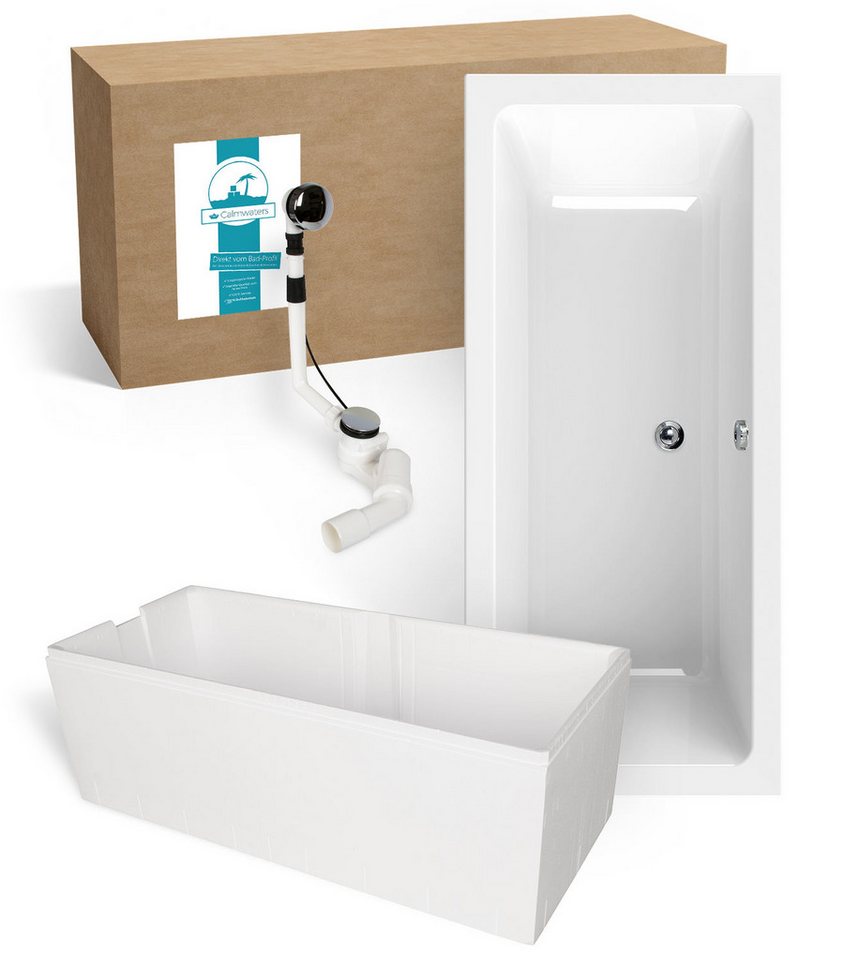
The set includes the tub, a 57 cm high polystyrene support and the chrome-plated waste set. According to the supplier, the support can be tiled directly and insulates against sound and heat. Important when ordering: the tub works with the support or with feet, not both. It is marketed as a tub for two because of its central drain. At 75 cm wide, we think that is a generous description.
Schulte Como
Almost the same key data, slightly cheaper: 225 liters, 31 kg as a set, tileable rigid foam support. The retailer lists it for one person. The listing does not cite a standard. If you are only comparing prices, this is the right choice; if you are looking for documentation, the Calmwaters set is the better bet.
OTTO home Alvor
An oval tub on adjustable feet, designed for installation against a wall, 56.5 cm high and weighing 52 kg. That is a lot for acrylic, while the 180 liters are on the low side. For bathrooms that want the look of a freestanding tub without having enough space for one.
Home Deluxe LENI
The only tub here with complete user instructions from the manufacturer. They state 47 kg and 235 liters; some retailers list different figures, and we go by the instructions. The faucet is included, and according to the manufacturer, the central drain allows sitting at either end. Leveling feet compensate for an uneven floor. A sealed floor and a load-bearing substrate are required, and in an existing building, neither is a minor matter.
Sanotechnik RENO
A ribbed black exterior, 58 cm high, with the largest capacity in this comparison. It looks like a piece of furniture, and you have to want that. A faucet and a professional installer come on top. The listing does not state a reliable empty weight; for the floor question, get it from the supplier.
How we would decide
- Old tub out, new one into the same alcove: Calmwaters Modern Select, or Schulte Como for the same alcove.
- Older building or timber joist floor: clarify the structural question first, then choose a tub with a small capacity.
- Freestanding in a large bathroom: Home Deluxe LENI, if the floor, supply lines and substrate are suitable.
- The look of a freestanding tub against the wall: OTTO home Alvor.
- Tub rarely used: better to buy smaller, which saves hot water with every bath.
Black Friday: what a discounted bathtub really costs
If you are planning a bathroom renovation for the winter, you will also see discounted tubs around Black Friday on November 27. Compare what is included, not just the price. A complete set with support and waste set is something different from a bare tub that still needs a faucet, flexible hoses, sealing tape and often the plumber’s labor on top. With freestanding models, new supply lines coming out of the floor may be added as well.
As for strike-through prices: in Germany, anyone advertising a price reduction must state the lowest price of the last 30 days (Section 11 of the German Price Indication Ordinance). For our pick, the Calmwaters Modern Select set, you can set a price alert above. The Black Friday 2026 (in German) page collects further price drops at our partner retailers.
Frequently asked questions
Acrylic or enameled steel: which bathtub is better?
According to BauNetz Wissen, enameled steel is hard-wearing and non-porous but feels cold, the water cools faster, and the steel can rust where it is damaged. Sanitary acrylic is lighter and retains heat better but scratches more easily. Mineral cast feels warm and can be repaired.
What dimensions should a bathtub have?
According to BauNetz Wissen, a standard tub should be at least 170 cm long and 75 cm wide, ideally 180 cm long. The nominal size says little about lying in it; the Calmwaters set has 124 cm of reclining length. Plan at least 55 cm of clear space next to the tub, and freestanding tubs need about 16 to 20 m².
Can the floor carry a filled bathtub?
If in doubt, a structural engineer will clarify this. The LENI weighs about 280 kg when filled, and with an 80 kg person that comes to about 265 kg per square meter. For residential rooms, the standard assumes roughly 150 kg per square meter. Floors distribute loads, but with timber joist floors and in older buildings, we would still ask before buying.
Can I connect a bathtub myself?
In Germany, under Section 12 of the AVBWasserV (the German ordinance on water supply terms), significant changes to the water installation may only be carried out by the utility or a registered installation company. The listing for the RENO names connection and leak testing as work for a professional. If the tub moves closer to outlets, that is a job for a qualified electrician because of the protection zones.
How do you seal a bathtub properly?
Not just with silicone. The tub rim is connected to the surface waterproofing with a sealing tape; the plumber attaches it and the tiler joins it. Only in front of that comes the elastic joint. Agree on who is responsible for the seam. Sealing tape is not included in any of the five sets.
How many liters does a bathtub hold?
According to retailer and manufacturer information, the five tubs in this comparison hold 180 to 252 liters, with outer dimensions of 170 × 75 or 170 × 80 cm. Size alone does not tell you the capacity: the larger OTTO home Alvor is said to hold less than the Sanotechnik RENO.
How heavy is a bathtub?
Empty acrylic tubs weigh little: the Calmwaters tub about 20 kg according to the supplier, the complete set 31.9 kg, and the freestanding Home Deluxe LENI about 47 kg. Filled, the tubs in this comparison weigh about 230 to 280 kg, and correspondingly more with a person in them. For the floor, it is mainly the water that counts.
Sources
- BauNetz Wissen: Bathtubs, materials
- BauNetz Wissen: Bathtubs, shapes and variants
- BauNetz Wissen: Dimensions of sanitary fixtures
- BauNetz Wissen: Electrical protection zones in the bathroom
- ZVSHK article: Waterproofing connections at bathtubs and shower trays (PDF)
- Forum Verlag: DIN 18534
- Imposed load (construction), table according to DIN EN 1991-1-1/NA
- DIN Media: DIN EN 198
- Section 12 AVBWasserV
- Umweltbundesamt: Hot water
- Mieterverein München: Tenant modernization
- Home Deluxe: LENI user instructions (PDF)
- Retailer information Calmwaters Modern Select (Hornbach, German retailer)
- Retailer information Schulte Como (Hornbach)
- Retailer information Alvor (BAUR, German retailer)
- Retailer information RENO (BAUR)
- German Price Indication Ordinance Section 11: Price reductions
Where to buy
- Calmwaters Modern SelectView at OTTOAvailable in Germany: OTTO
- Schulte ComoView at OTTOAvailable in Germany: OTTO
- OTTO home AlvorView at OTTOAvailable in Germany: OTTO
- Home Deluxe LENIView at OTTOAvailable in Germany: OTTO
- Sanotechnik RENOView at OTTOAvailable in Germany: OTTO