Contents15 sections
This guide was first published in German on handgetestet.de.
A warped board does not come out of a thickness planer straight. It just comes out thinner. Once you understand that, you look at a combined jointer-planer with different eyes: first the length of the jointer table counts, then the dust collection, and only after that the planing width. For a hobby workshop with a standard outlet, we consider a 260 mm machine with a jointer table of just over a meter the sensible middle ground, such as the Metabo HC 260 C. If you only work on moldings and small parts, the much smaller Scheppach HMS850 will do.
First flat, then parallel: what the two functions do
When jointing, the rough-sawn board lies on top of the table. The cutterhead removes material from the underside until a flat surface is created. Then, against the fence, the edge is planed at a right angle to it. Only now does the thickness planer come into play: the board lies with its straight side on the planer table, rollers pull it through under the cutterhead, and the top face becomes parallel to the underside. In the manual for the HOB310ECO, Holzmann explicitly states that the thicknessing function should only be used for workpieces with an already jointed face.
On combination machines, both functions share one cutterhead, so the machine has to be converted. On the Holzmann HOB310ECO, the entire jointer table folds up, the dust hood is flipped over and the hose is reconnected. On the HC 260 C, Metabo places a chip extraction hood over the cutterhead and describes the changeover as tool-free. In its information sheet on planing machines, the BG BAU, Germany’s statutory accident insurer for the construction industry, requires folded-up tables to be secured against falling back and the cover to be fitted in thicknessing mode. Our everyday advice: joint all the boards of a project first, then bring them all to thickness. That saves a dozen changeovers.
Table length beats planing width
A jointer table can only make a board as straight as the table is long. If a two-meter plank lies on 74 centimeters of table, more than half of it hangs in the air and follows its own curvature. This is exactly where the classes separate. According to the manufacturer, the Scheppach HMS850 has an overall length of 737 mm, the Metabo and the Scheppach HMS1500 come to 1040 mm, the Holzmann HOB260ECO to 1085 mm and the HOB310ECO to 1285 mm. For workpieces from 1500 mm in length, Metabo recommends an extra support or a helper.
The planing width, on the other hand, determines how wide a board can be in one piece. 204 mm is enough for frame stock and shelves made from narrow strips. With 260 mm, most furniture boards can be handled. You need 310 mm if you want to plane wide planks for tabletops without splitting them. Then there is the maximum height in thicknessing mode: 120 mm on the HMS850, 160 mm on the Metabo, 195 mm on the HOB260ECO and 225 mm on the HOB310ECO.
The depth of cut per pass also differs, from 2 mm on the small Scheppach to 3 mm on the larger machines. Metabo itself qualifies this: the full 3 mm should only be taken with very sharp knives.
Two knives, three knives or a helical cutterhead?
The classic cutterhead carries long straight knives. Four of the six machines here have two of them; Holzmann uses three in its ECO models. Metabo uses disposable double-edged reversible knives, while the HOB310ECO has resharpenable straight knives. When changing knives, care is what counts: the BG BAU calls for knife sets with identical dimensions and weight so that no imbalance occurs, and a maximum knife projection of 1.1 mm, set with a gauge.
The helical cutterhead works differently. Instead of continuous knives, many small indexable inserts sit staggered on the head. On the Holzmann HOB260ECOSMW2, according to the manufacturer, there are 20 inserts measuring 15 × 15 mm, and three spare inserts are included. According to the manual, each insert can be rotated three times, so it has four cutting edges. If you hit a nail, only the damaged insert is rotated. The noise level is striking. Holzmann states a sound power level of 83 dB(A) for the helical version and 93 dB(A) for the otherwise identical machine with three knives. On paper, that is a big gap.
For a garage in a residential area, that is a serious argument. According to Holzmann’s own price list, the helical cutterhead comes at a noticeable surcharge. Hearing protection is still a must, as the BG BAU also requires.
Chips: the part many people underestimate
A planer produces a sackful of chips in minutes. That is why the manufacturers give clear figures for dust collection. For the HC 260 C, Metabo requires at least 550 m³/h, 740 Pa of negative pressure and 20 m/s air velocity at the 100 mm port. For its ECO models, Holzmann specifies at least 1000 m³/h and 800 Pa. The manual for the HOB310ECO also states that 28 m/s is needed for damp chips above 12 percent wood moisture and that the hoses must be flame-retardant and antistatic. So what is meant is a chip extractor, not a small shop vac with a thin hose.
Metabo points out that dust from oak, beech and ash can cause cancer when inhaled, and only permits work indoors with a suitable extraction system. The Holzmann HOB260ABS comes with its own extraction rated at 270 m³/h. That saves space and a second purchase. Whether it is sufficient in thicknessing mode, the manufacturer does not say. If you are planning to connect a table saw to the same system anyway, a separate extractor with a manifold gives you more flexibility.
Weight, footprint and power supply
According to Scheppach, the HMS850 weighs around 22 kg and needs a workbench; its working height is 355 mm. The Metabo and HMS1500, at 71 kg each, stand on their own legs and have transport wheels. The HOB260ABS weighs in at 88 kg, the HOB260ECO series at 146 kg and the HOB310ECO at 179.5 kg with a footprint of 1285 × 750 mm. A machine like that isn’t something you just push into a corner. We cover the HOB310ECO in its 400-volt version. For that, the workshop needs a three-phase power connection: Holzmann specifies connection via a three-phase CEE connector (the European industrial plug standard) and requires a 30 mA residual current device. According to the manual, the direction of rotation must be checked after connecting. One difference lies in the motor. The HMS850 uses a brushed motor, the Metabo and HMS1500 an induction motor, which Metabo describes as quiet and maintenance-free.
Six machines side by side
| Model | Planing width / max. height | Jointer table | Cutterhead | Best for |
|---|---|---|---|---|
| Scheppach HMS850 | 204 mm / 120 mm | 737 mm | 2 knives | small parts, workbench |
| Scheppach HMS1500 | 260 mm / 160 mm | 1040 mm | 2 HSS knives | 230 V, with stand |
| Metabo HC 260 C 2,2 WNB | 260 mm / 160 mm | 1040 mm | 2 reversible knives | hobby workshop, 230 V |
| Holzmann HOB260ABS 230V | 260 mm / 160 mm | 1050 mm | 2 knives, built-in extraction | without a separate extraction system |
| Holzmann HOB260ECOSMW2 230V | approx. 250 mm / 195 mm | 1085 mm | helical cutterhead, 20 inserts | noise-sensitive surroundings |
| Holzmann HOB310ECO 400V | 310 mm / 225 mm | 1285 mm | 3 straight knives | wide planks, workshop with 400 V |
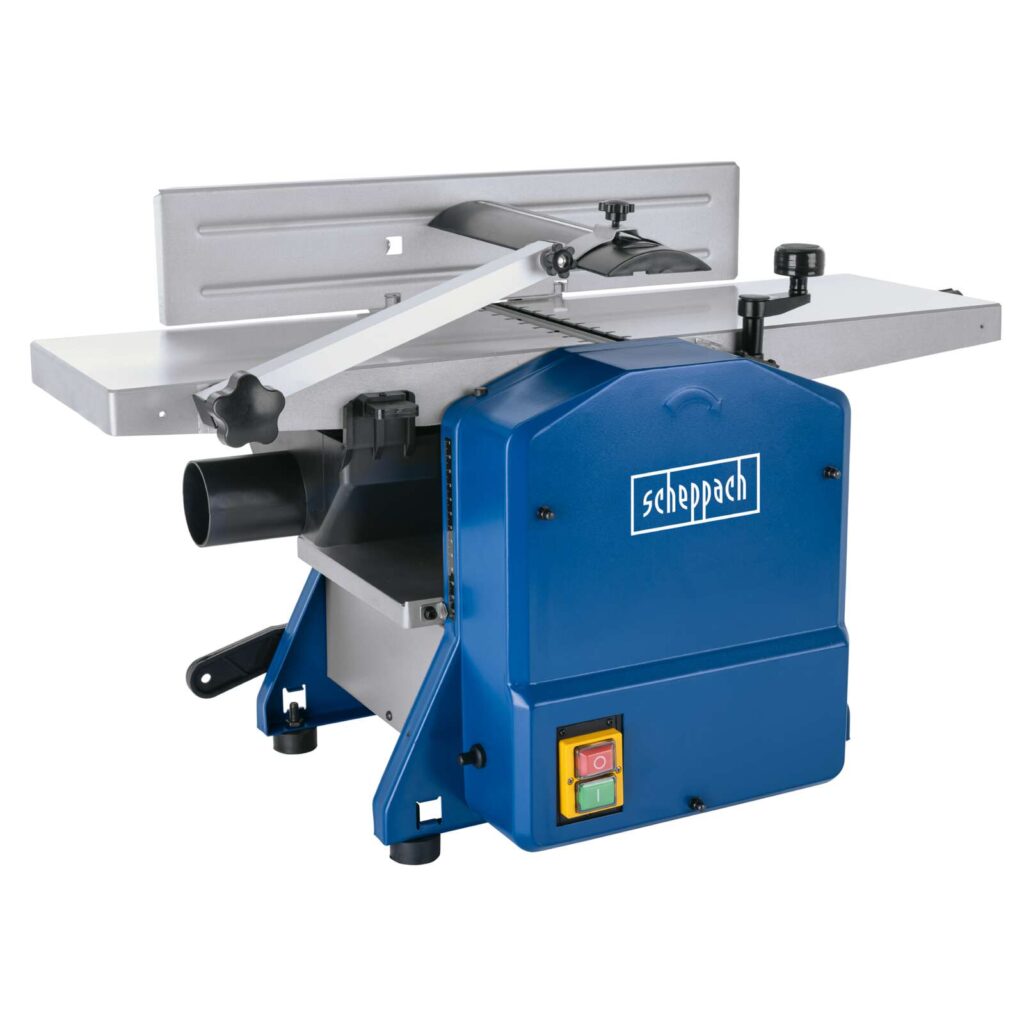
Scheppach HMS850: small and light, with limits
According to the manufacturer, this benchtop machine planes up to 204 mm wide and 120 mm high, with a maximum of 2 mm per pass. The dust port has an outer diameter of 63 mm. For moldings, small furniture and occasional work, that fits. For long, warped boards, the short 737 mm table is too tight.
Scheppach HMS1500: the big sister
According to Scheppach, it comes with a 260 mm width, 160 mm height capacity, 2200 watts, a die-cast aluminum jointer table, a cast-iron planer table and a mobile stand. The key specs match the Metabo down to a few details. When choosing between the two, scope of delivery, service and replacement knives decide.
Metabo HC 260 C 2,2 WNB: our benchmark for 230 volts
Metabo specifies 1040 × 280 mm jointer tables, a cast-iron planer table, a feed rate of 5 m/min and restart protection after a power failure. The manual is unusually specific, from the push sled for parts under 250 mm to the extraction figures. At 71 kg, it stays just about mobile. That makes it our recommendation for the typical hobby workshop.
Holzmann HOB260ABS: extraction built right in
The jointer table swings away for thickness planing, the extraction with collection bag sits in the base, and according to Holzmann a mobility kit is included from model year 2021. The port measures 75 mm. It makes sense for anyone who doesn’t want to set up a separate extraction system and mainly does jointing.
Holzmann HOB260ECOSMW2: quieter thanks to inserts
The manufacturer lists cast-iron tables 1085 mm long, a 195 mm height capacity and the helical cutterhead at 4000 revolutions per minute. At 146 kg, it is heavy. For permanent workshops near neighbors, we consider it a well-founded choice.
Holzmann HOB310ECO 400V: when boards are wide
Holzmann states a 310 mm knife length, a 225 mm height capacity and up to 4 mm depth of cut when thickness planing. Plus a counter on the height adjustment. The machine needs a 400-volt connection with a CEE outlet, extraction of at least 1000 m³/h and permanent space.
Hands off the cutterhead: what the statutory accident insurers say
The DGUV, Germany’s statutory accident insurance umbrella body, analyzed accidents on jointers. 63 percent happened during jointing. The bridge guard, which covers the cutterhead above the workpiece and is adjusted to its width and height, is considered the most effective safety device. The BG BAU advises keeping your hands flat, not spreading your fingers and guiding parts shorter than about 40 cm only with a push stick. Very short offcuts are better cut on the band saw (in German) anyway. And if you only need to fit a door edge or a beam on a job site, you don’t need a stationary machine; an electric hand planer (in German) is enough.
When thickness planing, anti-kickback fingers prevent the cutterhead from throwing a workpiece back. They must move freely. Holzmann recommends checking them every work shift: lift them, let go, and they must fall back on their own. If you buy used, you should know that in the DGUV analysis, machines built before 1995 caused 76 percent of accident costs.
How we would decide
- Occasional moldings and small parts, little space: Scheppach HMS850.
- Furniture making in a hobby workshop with 230 volts: Metabo HC 260 C 2,2 WNB, alternatively the Scheppach HMS1500.
- No extraction system and none planned: Holzmann HOB260ABS, with compromises in thickness planing.
- Workshop in a residential area, noise is an issue: Holzmann HOB260ECOSMW2.
- Wide planks, permanent workshop with extraction and three-phase power: Holzmann HOB310ECO 400V.
If you work with sheet material as well as solid wood, you will find edging length, scoring blades and three-phase power covered in our guide to the panel saw (in German).
Frequently asked questions
What is the difference between jointing and thickness planing?
Jointing creates a flat surface on the underside, after which the edge is planed at a right angle to it. Only then does the thickness planer come in: it makes the top face parallel to the underside. A warped board does not come out straight in a thickness planer, only thinner. That is why Holzmann says to only thickness-plane workpieces that have already been jointed.
Why is the length of the jointer table so important?
A jointer table can only make a board as straight as the table is long. If a two-meter plank lies on 74 centimeters of table, the overhanging part follows its own curvature. The Scheppach HMS850 has 737 mm, the Metabo 1040 mm, the HOB310ECO 1285 mm. For workpieces from 1500 mm in length, Metabo recommends an extra support or a helper.
What dust collection does a jointer-planer need?
A chip extractor, not a small shop vac. For the HC 260 C, Metabo requires at least 550 m³/h, 740 Pa and 20 m/s; for its ECO models, Holzmann requires at least 1000 m³/h. According to Metabo, dust from oak, beech and ash can cause cancer when inhaled. The Holzmann HOB260ABS comes with its own extraction.
Is a helical cutterhead worth it?
Above all for noise. Holzmann states a sound power level of 83 dB(A) for the helical version and 93 dB(A) for the otherwise identical machine with three knives. Each insert has four cutting edges; after hitting a nail, only the damaged one is rotated. For a garage in a residential area, that is a serious argument; the surcharge is noticeable.
How do you work safely on a jointer?
According to the DGUV, Germany's statutory accident insurance umbrella body, 63 percent of accidents happened during jointing; the bridge guard is considered the most effective safety device. The BG BAU advises keeping your hands flat and guiding parts shorter than about 40 cm only with a push stick. The anti-kickback fingers must move freely, and hearing protection is a must.
Sources
- Metabo: HC 260 C 2,2 WNB, technical data (German)
- Metabo: HC 260 C operating manual (PDF, multilingual)
- Scheppach: HMS850 (German)
- Scheppach: HMS1500 (German)
- Holzmann: HOB260ABS 230V (German)
- Holzmann: HOB260ECOSMW2 230V (German)
- Holzmann: HOB260ECO 230V (German)
- Holzmann: HOB310ECO 400V (German)
- Holzmann: HOB310ECO manual (PDF, German/English/French)
- Holzmann: HOB260ECO/HOB260ECOSMW2 manual (PDF, German/English/Czech)
- DGUV: Fachbereich AKTUELL FBHM-105, Jointers (PDF, German)
- BG BAU: Baustein B 256, Planing machines (PDF, German)
Where to buy
- Metabo HC 260 C 2,2 WNBCheck price at Amazon.deAvailable in Germany: Amazon.de
- Scheppach HMS850View at scheppachAvailable in Germany: scheppachCheck price at Amazon.deAvailable in Germany: Amazon.de
- Scheppach HMS1500Check price at Amazon.deAvailable in Germany: Amazon.deView at scheppachAvailable in Germany: scheppach
- Holzmann HOB260ABS 230VCheck price at Amazon.deAvailable in Germany: Amazon.de
- Holzmann HOB260ECOSMW2 230VCheck price at Amazon.deAvailable in Germany: Amazon.de
- Holzmann HOB310ECO 400VCheck price at Amazon.deAvailable in Germany: Amazon.de