Contents13 sections
This guide was first published in German on handgetestet.de.
With a table saw, the wattage rarely decides between joy and frustration. What does is the rip fence, the capacity to the right of the blade and whether the riving knife and blade guard stay on in everyday use. For furniture made from sheet material, we consider the DeWalt DWE7492 the most fitting choice; if you only cut strips and boards now and then, the lightweight Einhell TE-TS 254 T will do. A look at the technology explains why.
What blade diameter tells you about cutting depth
Cutting depth depends almost directly on the saw blade. Bosch fits the GTS 635-216 with a 216 mm blade and, according to the spec sheet, reaches 70 mm at 90 degrees. The machines with 250 to 260 mm blades manage 77 to 93 mm. That sounds like a minor detail. But you won’t cut through an 8 cm thick timber in one pass with the Bosch, whereas with the Makita MLT100N (93 mm) you will.
The difference becomes even clearer with bevel cuts. When the blade tilts to 45 degrees, 48 to 64 mm remain depending on the model. If you plan miters on baseboards, frames or boxes, compare exactly this second figure, not the first.
The power rating also deserves a second look. Metabo states 1,500 W in continuous operation (S1) for the TS 254 M. Einhell states 1,800 W for the TE-TS 254 T and 2,000 W only in intermittent operation at a 25 percent duty cycle. The bigger number on the box is therefore not automatically the more powerful machine. You’ll notice it most with beech or oak at full cutting depth.
Fence, rip capacity and the sliding carriage
A table saw is above all a tool for straight, repeatable rip cuts. What counts is how far the rip fence travels to the right. DeWalt states 825 mm, Bosch 635 mm, Scheppach 540 mm and Metabo 520 mm. So you can’t cleanly rip a 60 cm deep cabinet side from particleboard with 520 mm. With 635 mm you can.
The guidance is just as important. A fence that locks at the front and gives a little at the back produces crooked cuts and pinched workpieces. DeWalt guides the fence on both sides via racks and locks it with a cam lever; Einhell also relies on a cam lock. That doesn’t replace a test cut, but it makes setup more predictable.
There are two ways to make crosscuts. Most machines come with a miter gauge that runs in a slot in the table. On the GTS 635-216, Bosch has integrated a sliding carriage on which the workpiece glides past the blade. With wider boards this is more comfortable, because your hand doesn’t have to push the wood and press it against the fence at the same time. One rule from the DeWalt manual applies to all of them: never use the rip fence and the miter gauge to guide the workpiece at the same time, because otherwise it can jam between the two.
Portable on a sawhorse or fixed in the workshop?
The lightest saw in this comparison is the Einhell at 17.5 kg. The Bosch comes in at 22 kg, the Metabo at 24.4 kg, the DeWalt at 26.5 kg. According to the manufacturer, the Makita MLT100N weighs around 35 kg and is supplied with a stand. That’s not something you just carry between the garage and the job site.
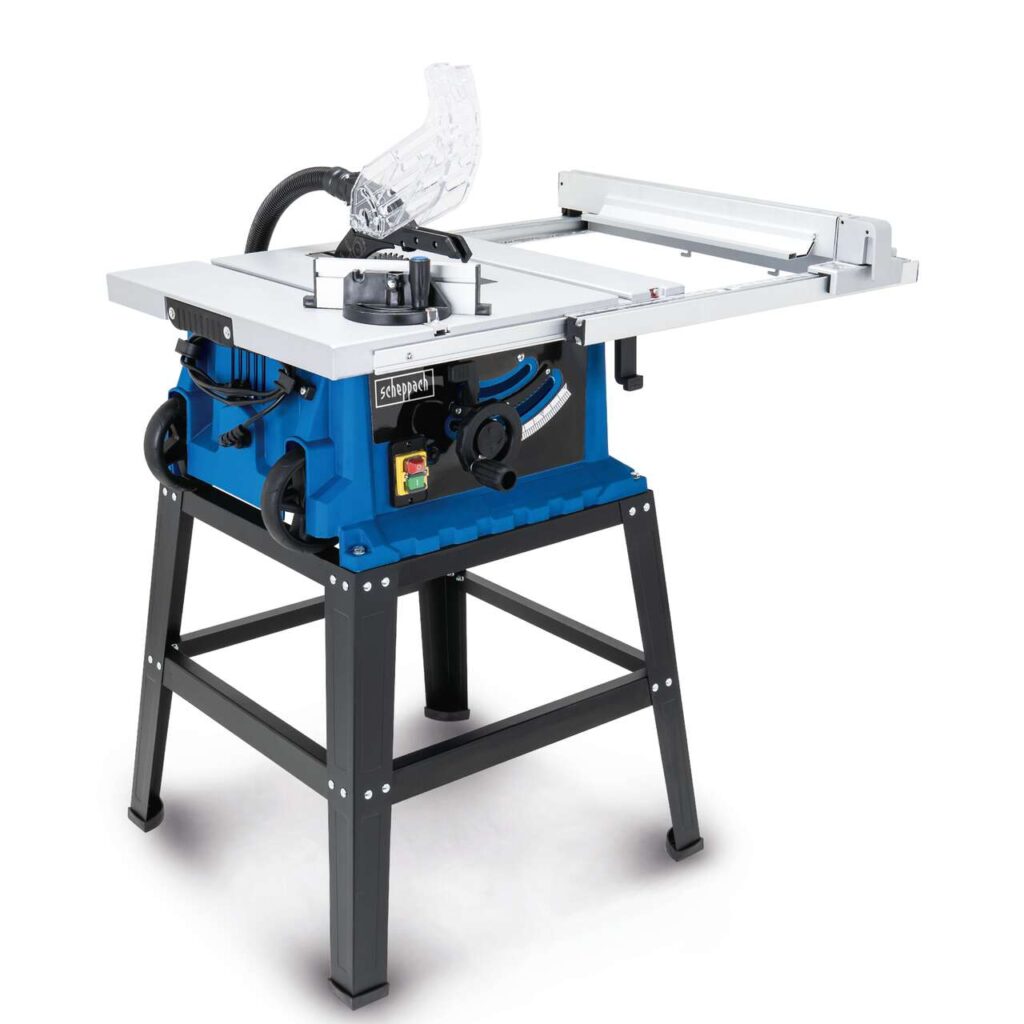
Benchtop machines without a stand need a solid base at the right height. A wobbly surface is more dangerous than a small table. If you set the saw on a workbench (in German), check first whether long workpieces can be supported at the back and sides. Scheppach supplies the HS105 with a stand and states a working height of 910 mm. That’s convenient for a permanent spot in the basement, less so for the trunk of a car.
A middle ground is a riving knife that can be lowered without tools. Metabo and Einhell offer this for transport. But this is exactly where the topic begins that decides the accident figures.
Riving knife, push stick, kickback: what the German accident insurers say
In its publication FBHM-104 (as of 2019), the German Social Accident Insurance (DGUV) analyzed 177 reportable accidents on table and panel saws from 2014 to 2016. Almost always a hand was hit. 47 percent of the accidents were so severe that they left permanent damage. And in 59 percent of the cases examined more closely, the upper blade guard was not fitted at all. A good one in five accidents happened only after the actual cut, for example when removing offcuts next to the running blade.
The riving knife is the most important kickback protection. It keeps the kerf open behind the blade so that the wood doesn’t close and press against the rising teeth. If it does, the blade can lift the workpiece and hurl it forward at high speed, as DeWalt describes in the manual for the DWE7492. According to the DGUV, the knife must be at least as thick as the blade body but no thicker than the kerf. The gap to the tooth rim is at most 8 mm, and the tip sits about 2 mm below the highest tooth.
This leads to a typical bad buy that only shows up later. Anyone buying an inexpensive replacement blade rarely checks the thickness. On the DeWalt, the riving knife measures 2.3 mm according to the spec sheet, the blade body 2.0 mm. A thin fine-cut blade with a narrow kerf then no longer fits. The knife jams in the cut, and that is exactly what should never happen.
The rules for push sticks are surprisingly specific. In its module B 252, the BG BAU (the German statutory accident insurer for the construction industry) defines a danger zone of 120 mm around the blade and requires a push stick for narrow workpieces under 120 mm wide that pushes the wood past the riving knife. The DeWalt manual puts it similarly: a push stick as soon as the fence is less than 150 mm from the blade, and below 50 mm a push block. Stand to the side of the blade, keep your hands flat, don’t spread your fingers.
That costs a few seconds. Nothing more.
Three features help on top of that. A motor brake shortens the run-down time; Metabo states 3 seconds, Scheppach 4 seconds, and Makita also has a brake. The DGUV considers a brake necessary as soon as the blade runs down unbraked for longer than 10 seconds. Restart protection prevents the saw from starting by itself after a power failure; Bosch and Metabo list it. And a rip fence that can be pulled back far enough to end roughly at the front edge of the riving knife reduces the risk of kickback, according to the DGUV. On many older saws this isn’t possible due to their design, so a look at the manual before buying pays off. According to the manufacturers, a push stick is included with the DeWalt, Metabo and Scheppach.
Six table saws and their key specs
| Model | Cutting depth 90° / 45° | Rip capacity right of blade | Weight | Best for |
|---|---|---|---|---|
| DeWalt DWE7492 | 77 / 55 mm | 825 mm | 26.5 kg | Furniture making with sheet material |
| Bosch Professional GTS 635-216 | 70 / 50 mm | 635 mm | 22 kg | Panels and crosscuts, portable |
| Metabo TS 254 M | 80 / 48 mm | 520 mm | 24.4 kg | DIYers who value a brake and portability |
| Makita MLT100N | 93 / 64 mm | not specified | approx. 35 kg | Fixed spot, thick timber |
| Scheppach HS105 | 80 / 50 mm | 540 mm | approx. 29 kg with stand | Entry level with a fixed location |
| Einhell TE-TS 254 T | 89 / 63 mm | Table 540 × 505 mm | 17.5 kg | Occasional users, small workshop |
DeWalt DWE7492
The DeWalt has the largest capacity to the right of the blade in this comparison, 825 mm according to the spec sheet, plus the rack-guided fence. With 77 mm of cutting depth, it sits in the middle of the field. A push stick and workpiece stop are included, and a stand is available as a set. Price-wise, it sits in the mid-range.
Bosch Professional GTS 635-216
Bosch combines 635 mm of rip capacity with an integrated sliding carriage and storage right on the machine. In return, the 216 mm blade tops out at 70 mm. For panels up to 40 mm that hardly matters; for construction lumber it does. According to the manufacturer, soft start and restart protection are on board.
Metabo TS 254 M
Metabo cites a motor brake that stops the blade in 3 seconds, plus restart protection and overload protection. The riving knife can be lowered without tools. With 520 mm of rip capacity, however, the fence is the shortest in this lineup, which rules out large panels.
Makita MLT100N
With its 260 mm blade, the Makita reaches 93 mm at 90 degrees and 64 mm at 45 degrees, the highest figures in this comparison. A motor brake and soft start are present. At around 35 kg and with a stand, it belongs in a fixed spot. It is at the upper end in terms of price.
Scheppach HS105
The HS105 comes in the version with stand and table extension, riving knife, push stick and crosscut gauge. Scheppach states 80 mm of cutting depth, 540 mm of rip capacity and a braking time of 4 seconds. Pay attention to the exact variant; the manufacturer offers several versions with differing specs.
Einhell TE-TS 254 T
At 17.5 kg, the Einhell is the lightest saw here and still cuts 89 mm deep according to the spec sheet. The aluminum table measures 540 × 505 mm, with an 80 mm extension on the right. That isn’t enough for large panels. For strips, battens and boards in a hobby basement, it certainly is.
How we would decide
- Cabinets, shelves, carcasses from panels: DeWalt DWE7492, because of the 825 mm and the fence guidance.
- Lots of crosscuts, frequent transport: Bosch GTS 635-216 with sliding carriage, as long as 70 mm of cutting depth is enough.
- Thick construction lumber and a fixed spot: Makita MLT100N.
- Occasional cuts in a small workshop: Einhell TE-TS 254 T, knowing that the table stays small.
If the saw mainly needs to cut panels to length on the job site, you may not need a table saw at all. A track saw with a guide rail can do that just as well; our guide to track saws and circular saws (in German) shows the differences. For crosscuts and miters on strips, a miter saw or sliding miter saw (in German) is often the better addition. For every model: the blade guard stays fitted, and the push stick stays within reach. For panel cutting with a sliding table and scoring blade, see our panel saw guide (in German).
Frequently asked questions
What cutting depth does a table saw need?
Cutting depth depends almost directly on the blade diameter. The Bosch GTS 635-216 with a 216 mm blade reaches 70 mm; machines with 250 to 260 mm blades manage 77 to 93 mm. You won't cut through an 8 cm thick timber in one pass with the Bosch. For miters, the second figure at 45 degrees is what counts.
Why is the capacity to the right of the blade so important?
It determines how wide you can rip panels. DeWalt states 825 mm, Bosch 635 mm, Scheppach 540 mm and Metabo 520 mm. You can't cleanly rip a 60 cm deep cabinet side from particleboard with 520 mm, but you can with 635 mm. A fence guide that doesn't give is also important.
Is higher wattage better on a table saw?
Not automatically. Metabo states 1,500 W in continuous operation for the TS 254 M. Einhell states 1,800 W for the TE-TS 254 T and 2,000 W only in intermittent operation at a 25 percent duty cycle. The bigger number on the box is therefore not necessarily the more powerful machine; you'll notice it most with hardwood at full cutting depth.
What is the riving knife on a table saw for?
It is the most important kickback protection and keeps the kerf open behind the blade. According to the DGUV, it must be at least as thick as the blade body but no thicker than the kerf. Be careful with replacement blades: a thin fine-cut blade with a narrow kerf no longer fits, and the knife jams in the cut.
When do you need a push stick on a table saw?
The BG BAU defines a danger zone of 120 mm around the blade and requires a push stick that pushes past the riving knife for narrower workpieces. DeWalt calls for one as soon as the fence is less than 150 mm from the blade. According to the DGUV, the upper blade guard was not fitted in 59 percent of the accidents examined more closely.
What safety features make sense on a table saw?
A motor brake shortens the run-down time; Metabo states 3 seconds, Scheppach 4 seconds. Restart protection prevents the saw from starting by itself after a power failure; Bosch and Metabo list it. According to the DGUV, a rip fence that can be pulled back to the front edge of the riving knife reduces the risk of kickback.
Sources
- DGUV, Fachbereich AKTUELL FBHM-104: table and panel sawing machines (2019)
- BG BAU, module B 252: table and panel saws
- DeWalt: DWE7492, product page
- DeWalt: DWE7492, instruction manual with technical data
- Bosch Professional: GTS 635-216
- Metabo: TS 254 M
- Makita: MLT100N
- Scheppach: HS105 with stand
- Einhell: TE-TS 254 T, data sheet
Where to buy
- DeWalt DWE7492Check price at Amazon.deAvailable in Germany: Amazon.de
- Einhell TE-TS 254 TCheck price at Amazon.deAvailable in Germany: Amazon.de
- Bosch Professional GTS 635-216Check price at Amazon.deAvailable in Germany: Amazon.de
- Metabo TS 254 MCheck price at Amazon.deAvailable in Germany: Amazon.de
- Makita MLT100NCheck price at Amazon.deAvailable in Germany: Amazon.de
- Scheppach HS105View at scheppachAvailable in Germany: scheppachCheck price at Amazon.deAvailable in Germany: Amazon.de