Contents9 sections
This guide was first published in German on handgetestet.de.
A power station with a solar panel is a small power plant for the road. Manufacturers often sell the combination as a solar generator. That sounds like unlimited power. In practice, the yield depends heavily on sun, angle and season. If you know that, you can plan properly.
Why the panel rarely delivers its rated output
A 100-watt panel only delivers 100 watts under laboratory conditions. Jackery explains this itself: light intensity and angle of incidence change constantly, and as the sun moves, so does its angle to the panel. For everyday use, that means expecting significantly less, and very much less on overcast days.
How to get more out of it
- Angle the panel toward the sun and turn it to follow the sun over the course of the day. Lying flat on the ground, it gives away yield.
- Avoid shade: even a branch over one corner costs output.
- Keep cables short and connect the panel to the right input.
- Put the power station itself in the shade; heat slows down charging.
How long charging takes
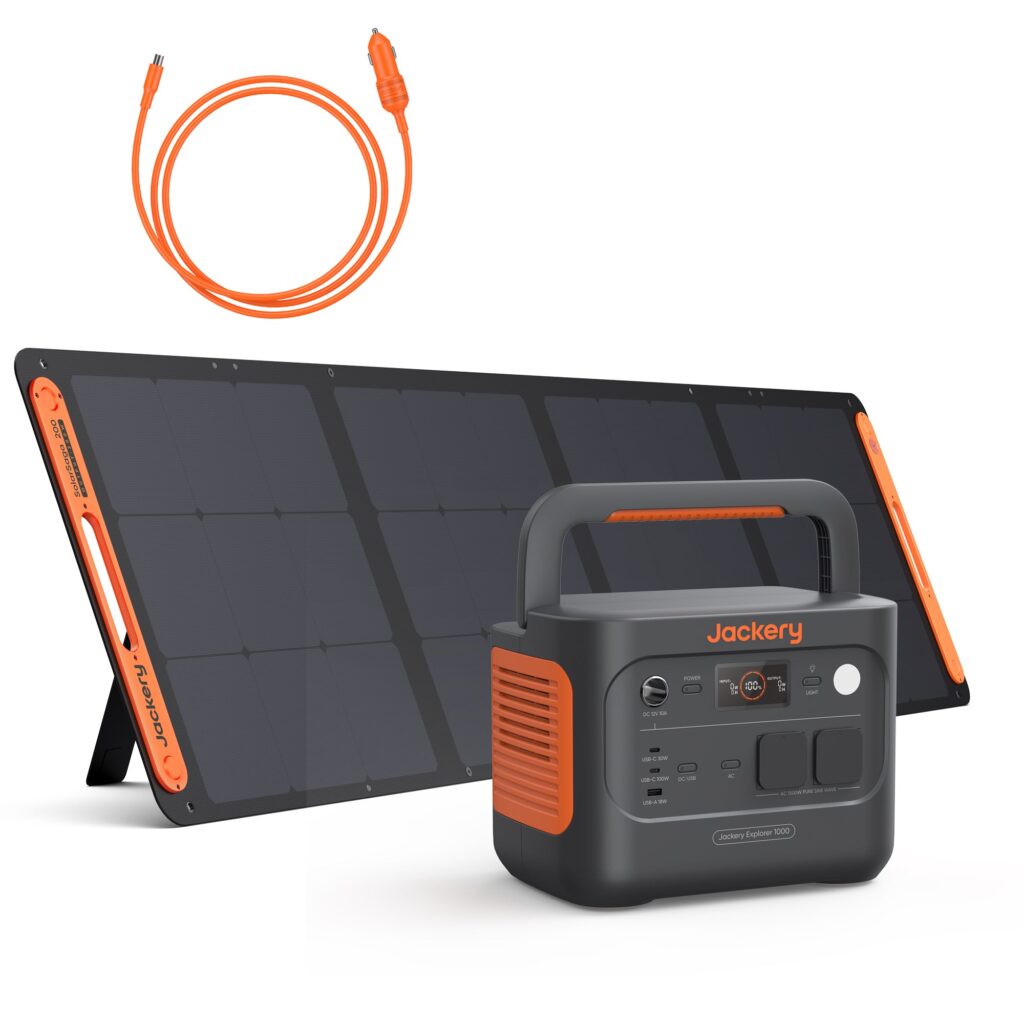
The manufacturer figures are best-case values. For the Explorer 1000 v2 with two 200-watt panels, Jackery states 3.8 hours for a full charge; for the Explorer 500 v2 with one 200-watt panel, 2.8 hours. According to the manufacturer, a single 100-watt panel charges an Explorer 500 in 9.5 hours. That is more than a full day of sunshine. So if you use a lot of power every day, you need more panel area.
| Combination | According to manufacturer | Suitable for |
|---|---|---|
| Jackery SolarSaga 100W solar panel | 100 W, monocrystalline, IP68, 3.6 kg | small stations, weekends |
| Jackery Explorer 2000 v2 with SolarSaga 200W | 2,042 Wh, 5.5 hours with two 200 W panels | backup power, longer stays |
| Recommendation: Jackery Explorer 500 v2 with SolarSaga 100W | 512 Wh, 1 hour with wall outlet and panel combined | camping with a cooler |
We have deliberately stopped listing the Jackery Explorer 1000 v2 as a recommendation here. In spring 2025, the German automobile club ADAC downgraded it to „poor“ because its two DC inputs are not decoupled: if it is charged via a solar module and the car socket at the same time, damage to the vehicle’s 12-volt electrical system is possible. The same applies to other stations: only use solar and the car socket together if the manual explicitly allows it.
What yield you can expect
The German consumer advice center (Verbraucherzentrale) provides a ballpark figure. A module with 400 watts of peak output, facing south at a 30-degree tilt and without shade, generates around 400 kilowatt hours a year (as of March 2026). Applied to a 100-watt panel, that would be about 100 kilowatt hours a year. Divided by 365 days, that comes to an average of just under 275 watt hours a day. This is an example calculation for the annual average, not for any single day. In summer the figure is higher, in winter far lower.
And not all of that energy arrives. In spring 2025, the ADAC measured eight power stations. Usable capacity was on average 10 to 15 percent below the manufacturer’s figure. According to the ADAC, the inverter alone can consume 30 watts when switched on, and the display, Bluetooth and Wi-Fi draw power too. So switch off the 230-volt output when you don’t need it. Otherwise, if you only charge a phone and a lamp via USB, you give away a good part of the day’s harvest.
An example calculation from the ADAC helps put this in perspective: a station with 1,000 watt hours runs a 50-watt cooler for about 20 hours. If such a cooler runs around the clock in midsummer, a single 100-watt panel is not enough to recharge it. Which coolers run economically is covered in the guide to the compressor cooler.
Does the panel match the station?
Before you buy a panel from another brand, read the power station’s data sheet. What matters is the voltage and power at the solar input. According to the ADAC, the inputs of the tested devices are designed for up to 30 volts (200 watts) or up to 60 volts (400 watts). A panel with more output delivers no more yield at the input than the station accepts. Also check the connector. Without the right adapter, the new panel will sit unused in the trunk for the time being.
For the battery, the Verbraucherzentrale recommends lithium iron phosphate, abbreviated LFP or LiFePO4. It considers lead-acid batteries outdated. And one more bottleneck: the inverter. For a TV drawing 30 to 100 watts, it is usually sufficient on small stations; for a coffee machine with 1,000 to 2,000 watts, it is not.
Foldable or rigid?
Foldable panels such as the SolarSaga 100W fold up and stand on a kickstand; according to the manufacturer, it is waterproof to IP68. Rigid modules for the roof or balcony are heavier but cheaper per watt. For balconies and house roofs there are dedicated solutions, described in the guide to the balcony power plant with storage. The guide to the foldable solar panel compares foldable panels from different brands.
For fixed mounting on a flat roof or in the garden, there is the guide to bifacial solar modules, covering albedo and mounting racks.
Whether a power station and panel are cheaper as a bundle, and what is left of their output in winter, is covered in the guide to the solar generator set.
Two mistakes that cost yield
First: taking the rated output at face value. Plan with the average, not with the data sheet. Second: connecting solar and the car socket at the same time even though the manual does not provide for it. That is exactly what led the ADAC to downgrade two devices.
Frequently asked questions
Do I have to register a power station with a panel?
No. As long as nothing is fed into the home grid, no registration is required according to the Verbraucherzentrale. Different rules apply to electricity fed in from the balcony, described in the guide to the yield of a balcony power plant.
Is one panel enough for a camping vacation?
For a phone, lamps and a camera, mathematically yes: according to the ADAC, a smartphone battery holds around 15 watt hours. For a cooler running continuously, probably not; see the example calculation above. More on planning can be found in the guide to the power station for camping (in German).
Can I run the station down to empty?
According to the ADAC, a residual charge always remains in the battery for protection. A complete discharge harms its service life.
Does the combination help during a power outage?
For individual devices yes, for the whole house no. What is realistic is explained in the guide to the power station as backup power.
Frequently asked questions
Why doesn't my 100-watt solar panel deliver 100 watts?
The rated output only applies under laboratory conditions. Jackery itself explains that light intensity and angle of incidence change constantly, and as the sun moves, so does its angle to the panel. In everyday use, expect significantly less output, and very much less on overcast days.
How long does it take to charge a power station with solar?
The manufacturer figures are best-case values. According to Jackery, a single 100-watt panel charges an Explorer 500 in 9.5 hours, which is more than a full day of sunshine. With a 200-watt panel, Jackery states 2.8 hours for the Explorer 500 v2. If you use a lot of power, you need more panel area.
How do I get more power out of my solar panel?
Angle the panel toward the sun and turn it to follow the sun over the course of the day; lying flat on the ground, it gives away yield. Avoid shade: even a branch over one corner costs output. Keep cables short and put the power station itself in the shade.
Can I charge via solar and the car socket at the same time?
Only if the manual explicitly allows it. In spring 2025, the German automobile club ADAC downgraded the Jackery Explorer 1000 v2 to "poor" because its DC inputs are not decoupled. When charging via a solar module and the car socket at the same time, damage to the 12-volt vehicle electrical system is possible.
Foldable or rigid solar panel for the power station?
Foldable panels such as the SolarSaga 100W fold up and stand on a kickstand; according to the manufacturer, it is waterproof to IP68 and weighs 3.6 kg. Rigid modules for the roof or balcony are heavier but cheaper per watt. For use on the go, the foldable panel fits; for fixed mounting, the module.
Sources
- Jackery: SolarSaga 100W, technical data
- Jackery: Explorer 500 v2, technical data
- Jackery: Explorer 1000 v2, technical data
- ADAC: Portable power stations tested (spring 2025)
- Verbraucherzentrale: FAQ on plug-in solar devices
- Verbraucherzentrale: Off-grid photovoltaic systems
Where to buy
- Jackery SolarSaga 100W SolarpanelView at JackeryAvailable in Germany: Jackery
- Jackery Explorer 2000 v2 mit SolarSaga 200WView at JackeryAvailable in Germany: Jackery
- Jackery Explorer 500 v2 mit SolarSaga 100WView at JackeryAvailable in Germany: Jackery