Contents13 sections
This guide was first published in German on handgetestet.de.
August, a campsite, over thirty degrees Celsius in the shade. The butter in the cooler has turned to liquid. Compressor coolers exist for exactly this moment, because they work like a small refrigerator and can even freeze, no matter how hot it is outside. Decide on the size first, to fit your trunk, and then on the power supply. If you are often without a car or an outlet, a battery or a power station belongs in the package.
Does it really have to be a compressor?
In summer, yes. According to the ADAC (German automobile club), thermoelectric coolers, often called Peltier coolers, only cool about 20 degrees below the outside temperature, and on a hot day that is not enough. According to the ADAC, compressor models reach down to about −18 °C, and some go even lower. In return, these coolers weigh more and cost more.
How big should the cooler be?
For couples and weekend trips, 30 to 40 liters is enough. Families and longer trips tend to end up at 45 to 55 liters. At least as important as the volume is a mundane question: do 1.5-liter bottles stand upright inside? And does the cooler even fit in the trunk? Measure. A folding ruler costs less than a return.
Two zones are worth it when drinks and frozen food travel at the same time, because one side chills while the other freezes. The divider does cost some interior space, though; on some coolers it can be removed.
Can I just hook the cooler up to the car battery?
Briefly, yes; for long periods, better not. Almost all models run on 12 and 24 volts in the car, a 230-volt power supply helps at the campsite and in a vacation home, and some coolers even accept solar power directly. What you should never do without is a multi-stage low-voltage cutoff. It switches the cooler off before the starter battery is drained.
That is because the cooler draws power from the starter battery even with the engine off. If the car is parked for several days, set the battery protection to the highest level. For longer stops, a separate power source works better, meaning a swappable battery or a power station. Check whether the battery is included or costs extra. We explain which power station size makes sense in our power station buying guide.
One simple trick saves power. Pack the cooler as full as possible and pre-chill it on mains power at home, because full, cold contents hold the temperature longer.
Do I need an app?
It is convenient. Nothing more. Via Bluetooth or Wi-Fi, you can see the temperature, change it from your tent and in some cases get alerts, for example when the lid is open. Weight is the more underestimated factor: empty 40-liter coolers often weigh more than 18 kilograms. If you carry the cooler around a lot, you will be glad of wheels and a telescopic handle.
Six compressor coolers from 38 to 50 liters
| Model | Volume and zones | Power and control | Best for |
|---|---|---|---|
| Dometic CFX3 45 | 46 l, one zone, +20 to −22 °C | 12/24 V, 100–240 V; app via Bluetooth and Wi-Fi | Frequent travelers who want durability |
| EcoFlow Glacier Classic 45L | 45 l, two zones | 12/24 V, mains, solar, USB-C; optional 298 Wh battery; app | Campers without power on site |
| BODEGA 50 L Dual-Zone | 50 l, two zones, removable divider | 12/24 V, 100–240 V; app | Families on a smaller budget |
| Alpicool EZGW41 | 40 l, two zones, −20 to +20 °C | 12/24 V, 100–240 V; app | Beginners who want two zones |
| Mobicool MCF40 | 38 l, one zone, +20 to −10 °C | 12/24 V, 100–240 V; no app | Occasional campers, simple operation |
| Engel MT45F-S | 40 l, one zone, +10 to −18 °C | 12/24/230 V; digital display, no app | Anglers and long-term users |
Dometic CFX3 45: the benchmark for frequent travelers
46 liters, and according to the manufacturer it cools from +20 to −22 °C. The cooler runs on 12 and 24 volts as well as on mains power. With the CFX3 app, you control the temperature via Bluetooth or Wi-Fi and can see its history. A three-stage battery protection is built in, and it weighs 18.7 kilograms empty. Upper price range, and you notice that in the feature set.
EcoFlow Glacier Classic 45L: independent of the car
Available in 35, 45 and 55 liters. The 45-liter version has two zones, with a difference of up to 22 degrees possible between them according to the manufacturer. With the separately sold 298 Wh battery, EcoFlow says it should run for up to 43 hours without mains power. It can be charged from the car, from the mains, via solar up to 110 watts or via USB-C. However, it weighs 23.2 kilograms empty, and it too sits at the top of the price range.
BODEGA 50 L Dual-Zone: lots of space for the money
Two zones, each adjustable from about −20 to +20 °C. Without the divider, they become one large zone. Power comes from 12 and 24 volts or from the mains, and you control it on the unit or via the app. Mid-range price.
Alpicool EZGW41: two zones at a low price
40 liters, two independently adjustable zones from −20 to +20 °C, operation via the display or the app, power from 12/24 volts or the mains. Wheels and a handle make it easier to carry. In price, the cooler sits in the low to middle range. Read the retailer’s warranty terms carefully before ordering.
Mobicool MCF40: chilling yes, long-term freezing not so much
According to the manufacturer, 38 liters and a setting range of +20 to −10 °C. That covers drinks and food for the weekend well, frozen goods over several days less so. It runs on 12/24 volts and mains power; there is no app. On the plus side, 1.5-liter bottles stand upright. Among compressor coolers, it is one of the inexpensive ones.
Engel MT45F-S: steel instead of comfort
Engel builds a Sawafuji swing compressor into a housing of baked-enamel sheet steel. According to the data sheet, the MT45F-S holds 40 liters and cools from +10 to −18 °C; a digital display shows the interior temperature, and there is no app. 24 kilograms, upper price range. It is designed for long use in tough conditions, for example when fishing. If you go camping twice a year, you do not need it.
Which cooler suits my trip?
On the road a lot, maybe in a van? Then the Dometic CFX3 45 with app and a wide temperature range. When camping without a power hookup, the EcoFlow Glacier Classic 45L with battery and solar input plays to its strengths. Families who transport chilled and frozen food at the same time will find two zones in the BODEGA 50 L or the Alpicool EZGW41. For occasional outings, the simple and inexpensive Mobicool MCF40 is enough, and for anglers and tough use there is the Engel MT45F-S with its steel housing.
If you are heading off on a longer trip with luggage on the roof, our roof box buying guide (in German) helps with packing.
A compressor cooler runs best directly on 12 volts. For devices that need 230 volts, our guide to the 12 V to 230 V power inverter explains what matters.
How long the cooler runs on the road without a vehicle is calculated for three weather scenarios in the guide power station for a cooler.
What a cash register, refrigeration and coffee need over a day is shown in the wattage calculation for market stalls and food trucks.
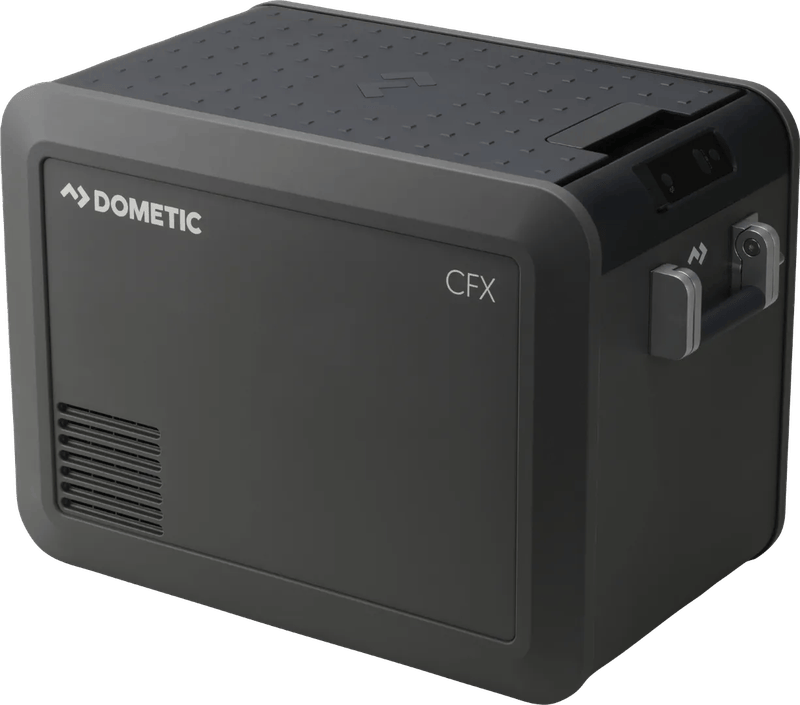
According to the manufacturer, the Dometic CFX5 45 holds 46 liters in one zone, cools adjustably from +20 to −22 °C, runs on 12/24 V and 100–240 V, can be controlled via app and weighs 18.3 kg.
Frequently asked questions
Compressor cooler or thermoelectric cooler?
In summer, the compressor cooler. According to the ADAC (German automobile club), thermoelectric coolers only cool about 20 degrees below the outside temperature, which is not enough on hot days. According to the ADAC, compressor models reach down to about −18 °C, but they weigh more and cost more.
How big should a cooler be?
For couples and weekend trips, 30 to 40 liters is enough; families and longer trips tend to end up at 45 to 55 liters. At least as important: do 1.5-liter bottles stand upright inside, and does the cooler fit in the trunk? Measure beforehand.
Can you leave the cooler connected to the car battery?
Briefly, yes; for long periods, better not, because the cooler draws power from the starter battery even with the engine off. A multi-stage low-voltage cutoff switches it off before the battery is drained. For longer stops, a separate power source such as a swappable battery or a power station works better.
When is a dual-zone cooler worth it?
When drinks and frozen food travel at the same time, because one side chills while the other freezes. The divider costs some interior space; on some coolers, such as the BODEGA 50 L, it can be removed. The Alpicool EZGW41 and EcoFlow Glacier Classic 45L also offer two zones.
How does a cooler save power?
Pack the cooler as full as possible and pre-chill it on mains power at home, because full, cold contents hold the temperature longer. If the car is parked for several days, set the battery protection to the highest level.
Does a cooler need an app?
It is convenient, nothing more. Via Bluetooth or Wi-Fi, you can see the temperature, change it from your tent and in some cases get alerts when the lid is open. Weight is the more underestimated factor: empty 40-liter coolers often weigh more than 18 kilograms, so wheels and a telescopic handle help.
Sources
- Dometic: CFX3 45
- EcoFlow: Glacier Classic
- BODEGA: 50 L cooler T50
- Mobicool: MCF40
- Engel: MT45F-S data sheet (PDF)
- ADAC Skipper: Coolers on board
- Dometic CFX5 45: product information
Where to buy
- Dometic CFX3 45Check price at Amazon.deAvailable in Germany: Amazon.de
- EcoFlow Glacier Classic 45LCheck price at Amazon.deAvailable in Germany: Amazon.de
- BODEGA 50 L Dual-ZoneCheck price at Amazon.deAvailable in Germany: Amazon.de
- Alpicool EZGW41Check price at Amazon.deAvailable in Germany: Amazon.de
- Mobicool MCF40Check price at Amazon.deAvailable in Germany: Amazon.de
- Engel MT45F-SCheck price at Amazon.deAvailable in Germany: Amazon.de
- Dometic CFX5 45View at CoolblueAvailable in Germany: Coolblue