Contents16 sections
This guide was first published in German on handgetestet.de.
At a market stall, the register, lights and cooler box run well off a battery. When it comes to boiling water, the math quickly runs out. Which station fits therefore depends entirely on your load. For brewing filter coffee on site, the math leads to the 3 kWh class, which in this list means the Jackery Explorer 3000 v2; stalls with just a register get by with a tenth of that, and none of the stations is suitable for an espresso machine. We do not name a clear favorite, because there is no independent measurement for the large units. We rank them based on calculations and manufacturer data.
Two numbers decide the market day
Watts tell you whether a device will start at all. Watt-hours tell you whether it will last until you pack up. So note the power rating of every device from its type plate and estimate how many hours a day it actually draws power. Deduct 15 percent from the printed capacity, because the ADAC, the German automobile club, measured on average a good 10 to 15 percent less usable energy than specified across eight stations. The calculation is explained in detail in our guide to power station runtime (in German).
Our examples assume eight hours at the stall. The device power ratings in them are assumptions unless stated otherwise.
Register and lights: 360 watt-hours, with a catch
We assume 15 watts for a tablet with a card reader and 30 watts for the LED lighting. That makes 45 watts times eight hours, or 360 watt-hours. After deductions, the Explorer 500 v2 delivers about 435. That works.
Until someone switches on the 230-volt outlet. In the ADAC test, the active inverter alone sometimes consumed 30 watts. Over the day, that is another 240 watt-hours, the requirement rises to 600, and the small station shuts down in the afternoon. So connect the tablet and lamps to USB-C and 12 volts wherever possible.
Cooling: calculate with the average
The ADAC assumes 50 watts for a cooler box. That would come to 400 watt-hours on a market day. Register, lights and box together need 760, which a 1 kWh station with just under 900 usable watt-hours can just about manage, as long as the box is plugged into the 12-volt socket. If everything runs on 230 volts, it is about 1,000 watt-hours, and the BLUETTI AC180P is the smallest station in this list that is enough for that. Which box runs economically is covered in our guide to the compressor cooler box (in German).
One thing many people overlook. On the Explorer 3000 v2, the energy-saving mode is on out of the box. If the load on the outlet stays at 25 watts or less, it switches off all outputs after twelve hours. If you keep things cool overnight in a food truck, you are better off disabling it so that nothing is warm in the morning.
Coffee: the water eats the battery
According to the retailer, a 15-liter coffee urn for market stalls draws 1.5 kilowatts. A station with 500 watts can never handle that; one with 1,800 watts can just about manage it. The energy is what gets expensive. Heating fifteen liters from 15 to 95 degrees works out to 1.4 kilowatt-hours (15 kg × 4.19 kJ × 80 K ÷ 3,600), and that is without heat loss. At 0.2 liters per cup, that is about 19 watt-hours per coffee.
The Explorer 3000 v2 provides about 2,600 watt-hours. After one fill and the basic load of 760, about 450 are left for keeping warm, for which the retailer gives no figure. A second fill is not possible. With the Explorer 2000 v2, after the first fill there is not even quite enough left for the register and lights: of around 1,740 usable watt-hours, about 340 remain after 1,400 for the coffee, but 360 are needed.
Our advice is therefore old-fashioned: brew at home on grid power and bring the coffee in pump pots. That costs zero watt-hours at the stall. What matters with temperature and the carafe is covered in our guide to the drip coffee maker.
Espresso machine, deep fryer, crêpe griddle: better not
According to the retailer, a two-group espresso machine draws 3.7 kilowatts. That is more than the 3,600 watts of the largest unit here, and the peak output of 7,200 watts only helps for moments. A heating appliance, however, draws power continuously. Even a 2,000-watt griddle drains the Explorer 3000 v2 at full load in about 1.3 hours, even if the thermostat stretches that a little. For stalls like these, the options remain gas, a fixed connection or a generator.
Loud generator, quiet station?
In principle, yes, but in detail it pays to take a second look at the manual. In its online shop, Scheppach advertises 66 dB(A) for the SG3500i inverter. The manual gives 74.6 dB as the sound pressure level and 96 dB as the sound power. It also states that the units are not designed for commercial use, which is a problem of its own for stall operators. Then there are the exhaust fumes next to uncovered food. The detailed comparison is in our guide power station or generator (in German).
Stations are still not silent. According to the ADAC, all of them get loud at maximum output, and manufacturers‘ decibel figures usually refer only to the base load. A quiet mode is important for the stall. Whether a combustion generator would be allowed at all is something to clarify in advance with the market regulations or the organizer.
Six stations for stalls and trucks
| Model | Capacity, continuous output | Weight | Enough for |
|---|---|---|---|
| Jackery Explorer 3000 v2 | 3,072 Wh, 3,600 W | 27 kg | coffee urn, one fill, plus cooling |
| Jackery Explorer 2000 v2 | 2,042 Wh, 2,200 W | 17.5 kg | refrigerator and register, heating only briefly |
| BLUETTI AC180P | 1,440 Wh, 1,800 W | no verified figure | register, lights, cooler box on 230 V |
| Anker SOLIX C1000 | 1,056 Wh, 1,800 W | 12.9 kg | register, lights, cooler box on 12 V |
| EcoFlow DELTA 3 Plus | 1,024 Wh, 1,800 W | 12.5 kg | pitches where it has to stay quiet |
| Jackery Explorer 500 v2 | 512 Wh, 500 W | 5.7 kg | register and lights |
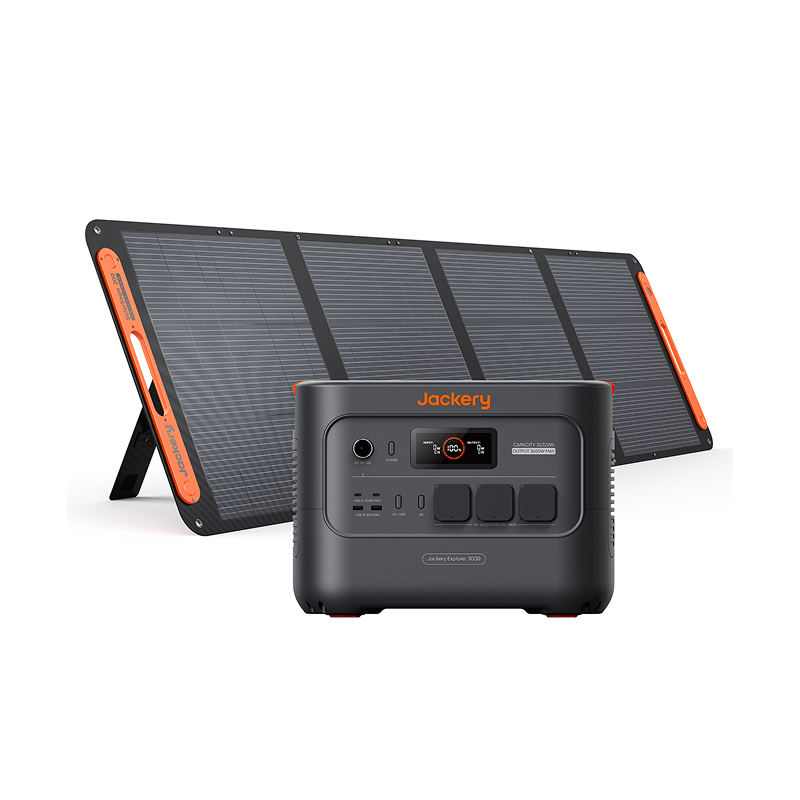
Jackery Explorer 3000 v2
The manual lists 3,072 watt-hours, 3,600 watts and three outlets, plus a quieter charging mode. At 27 kilograms, however, the unit is a nuisance for one person, especially on cobblestones. There is no ADAC test of this model, so all figures are manufacturer specifications.
Jackery Explorer 2000 v2
Almost ten kilos lighter and, according to Jackery, still powerful enough for a coffee urn at 2,200 watts. Just without any reserve for the rest of the day.
BLUETTI AC180P
Best overall grade in the 2025 ADAC test with a 2.0 (on the German scale, where 1 is best), praised for its features and usable energy. For the stall, the testers‘ objection counts: under full load, the fan is relatively loud, though it can be toned down via the app.
Anker SOLIX C1000
According to the manual, the capacity can be doubled to 2,112 watt-hours, which speaks for it in a season with growing demand. The SurgePad function powers heating appliances up to 2,400 watts, but Anker explicitly excludes devices with strict voltage requirements. In that case, the register system does not belong on the same station. More on this in our guide to the power station with expansion battery (in German).
EcoFlow DELTA 3 Plus
The ADAC awarded it a 2.1 and explicitly mentions the quiet fan. Next to the reading tent at a crafts market, that can be worth more than extra watt-hours. No solar cable came with the test unit.
Jackery Explorer 500 v2
At 5.7 kilos, you carry it to the stall without a second thought. For cooling appliances on 230 volts, however, 500 watts and 435 usable watt-hours are not much. In terms of price, it is the entry point among the Jackery units here.
What the fine print says
According to its manual, Jackery grants the manufacturer’s warranty for normal consumer purposes and excludes everything else. A unit that works at a stall six days a week may not fit that description. Ask the seller in writing before you buy, regardless of the brand.
Rain and sun are the next issue. Jackery requires a dry, ventilated spot and warns against direct sunlight and hot vehicles. So the station does not belong under the counter next to the deep fryer, and the ventilation slots must stay clear. If you have staff, have a qualified electrician check the electrical setup; the rules for construction sites are summarized in our guide power station for the construction site (in German).
That leaves recharging in the food truck. On the vehicle outlet, the Explorer 3000 v2 accepts a maximum of 8 amps. At 12 volts, that is about 96 watts, so a full battery would take about 32 hours of driving. On bumpy roads, Jackery even prohibits charging via the car socket. So plan on using the outlet at home. Also, never charge via solar and the vehicle’s electrical system at the same time: the ADAC downgraded the Explorer 1000 v2 to „poor“ for exactly that reason, because its DC inputs are not decoupled. The 3000 v2 also has two of them, but it was not tested.
Which stall needs what?
- Crafts, books, fruit without cooling: Explorer 500 v2, as long as the outlet stays off.
- Cheese, drinks, cooler box: a station in the 1 kWh class; for 230-volt operation, the AC180P.
- Filter coffee on site: Explorer 3000 v2, and plan for one fill, not two.
- Espresso, waffles, fried food: here we leave out the battery.
Frequently asked questions
Which power station is enough for a register and lights at a market stall?
Assuming 45 watts for a tablet with a card reader and LED lights, eight hours add up to 360 watt-hours. After deductions, the Jackery Explorer 500 v2 delivers about 435. But that only works if the tablet and lamps run on USB-C and 12 volts, because in the ADAC test the inverter alone sometimes consumed 30 watts.
Can a power station run a coffee urn?
According to the retailer, a 15-liter coffee urn draws 1.5 kilowatts, which a station with 1,800 watts can just about handle. One fill works out to 1.4 kilowatt-hours. The Explorer 3000 v2 manages one fill plus the basic load, but not a second. The guide recommends brewing at home on grid power and bringing pump pots.
Is a power station worth it for an espresso machine, deep fryer or crêpe griddle?
No, the guide advises against it. According to the retailer, a two-group espresso machine draws 3.7 kilowatts, which is more than the 3,600 watts of the largest unit. Even a 2,000-watt griddle drains the Explorer 3000 v2 in about 1.3 hours. For stalls like these, the options remain gas, a fixed connection or a generator.
Is a power station quieter than a generator?
In principle, yes, but stations are not silent. According to the ADAC, all of them get loud at maximum output, and manufacturer figures usually refer only to the base load. A quiet mode is important. The ADAC explicitly mentions the quiet fan of the EcoFlow DELTA 3 Plus, while the BLUETTI AC180P's fan is relatively loud under full load.
What should I watch for with the warranty and setup at the stall?
According to its manual, Jackery grants the manufacturer's warranty for normal consumer purposes. Before buying, ask the seller in writing whether use at a stall is covered, regardless of the brand. The station belongs in a dry, ventilated spot, out of direct sunlight and not next to the deep fryer.
Can I charge the station in a food truck while driving?
It hardly makes sense. On the vehicle outlet, the Explorer 3000 v2 accepts a maximum of 8 amps, about 96 watts, so a full battery would take about 32 hours of driving. Plan on using the outlet at home. Also, never charge via solar and the vehicle's electrical system at the same time.
Sources
- Jackery: Explorer 3000 manual (JE-3000B, PDF)
- Jackery: Explorer 500 v2 manual (PDF)
- Jackery: Explorer 2000 v2, technical data
- Anker: SOLIX C1000 manual (PDF)
- ADAC (German automobile club): Portable power stations tested (spring 2025)
- Scheppach: SG3500i manual (PDF)
- Scheppach: SG3500i
- Gastro Stark (German retailer, retailer information): 15-liter filter coffee machine
- GGM Gastro (retailer information): Espresso machine, two groups
Where to buy
- Jackery Explorer 3000 v2View at JackeryAvailable in Germany: JackeryCheck price at Amazon.deAvailable in Germany: Amazon.de
- Jackery Explorer 2000 v2View at JackeryAvailable in Germany: JackeryCheck price at Amazon.deAvailable in Germany: Amazon.de
- Jackery Explorer 500 v2View at JackeryAvailable in Germany: JackeryCheck price at Amazon.deAvailable in Germany: Amazon.de
- BLUETTI AC180PCheck price at Amazon.deAvailable in Germany: Amazon.de
- Anker SOLIX C1000Check price at Amazon.deAvailable in Germany: Amazon.de
- EcoFlow DELTA 3 PlusCheck price at Amazon.deAvailable in Germany: Amazon.de