Contents13 sections
This guide was first published in German on handgetestet.de.
Friday evening, the engine is off, and suddenly the cooler in the trunk is hooked up to nothing. A power station solves that, and it can be smaller than most people think: for a 40-liter compressor cooler, we consider the Jackery Explorer 500 v2 the right size, because its 512 watt-hours last about a day and a half in mild weather. The condition is the 12-volt socket. If you plug the cooler into the station’s 230-volt AC outlet, you can quickly throw away two thirds of the runtime.
Why the rating plate gets the runtime wrong
The cooler says 32 to just over 50 watts. Depending on the model, Engel states 32 or 52 watts at 12 volts, Dometic 48 watts, and the ADAC, Germany’s largest automobile club, calculates with a 50-watt cooler. But that only applies while the compressor is running. And it does not run all the time.
Dometic assumes a duty cycle of about 22 percent for a cooler in the 40-liter class, which comes to under 24 amp-hours a day. On average, that is about 12 watts. What is remarkable is how well other figures match. For its PLB40 lithium battery with 40 amp-hours, Dometic states up to 40 hours on a CFX 40W at an interior temperature of 5 degrees Celsius, again about 12 watts. Jackery states 23 hours on a cooler in eco mode for the Explorer 300D with 288 watt-hours. And a buyer reports on the manufacturer’s site that his 40-watt cooler drained the 300D halfway in twelve hours. Do the math: it still comes to just over 12 watts.
The ADAC arrives at a much lower 20 hours on 1,000 watt-hours, because it assumes 50 watts as a continuous load. That is not wrong. It is the worst case: a heated-up car, warm drinks.
The calculation for three weather scenarios
The formula has two steps. Capacity times 0.85, divided by the average power draw. The deduction is backed up: in the ADAC test, the usable energy was on average 10 to 15 percent below the manufacturer’s figure. The basics are in our guide to power station runtime; here it is only about the cooler.
- Mild, cooler in the shade: 12 watts on average, just under 290 watt-hours a day. The Explorer 500 v2 lasts 36 hours.
- High summer: we assume the compressor kicks in twice as often. 24 watts, just over 570 watt-hours a day, 18 hours.
- Continuous operation: 48 watts, about 1,150 watt-hours a day, 9 hours.
The middle line is our assumption, not a measurement. If you want to know exactly, check the percentage display before and after a night. In freezer mode, the bottom line is the more likely one. Dometic recommends 4 degrees Celsius for cooling and minus 15 degrees for freezing and points out that even small changes shift consumption. Pre-cool the cooler at home on mains power, so the station does not have to generate the initial cold. An hour without power is no drama: at an ambient temperature of 21 degrees, with 24 cans in a CFX3 55, Dometic measured a rise of about 1.8 degrees per hour.
12 volts instead of the AC outlet
Most compressor coolers have both, a car plug and a mains cable. On the power station, the car plug goes into the socket. The ADAC found that a switched-on inverter can draw as much as 30 watts by itself and advises switching it off when the AC outlets are not needed. A 12-watt demand thus becomes up to 42 watts. With the Explorer 500 v2, the 36 hours shrink to about 10.
There are two settings you should know. The energy-saving mode of the Explorer 500 v2 switches outputs off after six hours of low load, below 2 watts on the car socket. A cooler whose compressor is currently pausing can fall below that, so the mode stays off for the night. And the cooler’s battery protection is designed for the starter battery. For auxiliary batteries, Dometic recommends the „Low“ setting. If the cooler does not start even though the station is full, going one level lower often does the trick.
So how big does the station need to be?
Days without recharging times daily demand, divided by 0.85. For one night and one day in early summer, that is about 340 watt-hours, in high summer just under 670. Three hot days without recharging come to about 2,000 watt-hours, and then the station weighs more than the cooler. At that point, looking at recharging helps more than looking at the next size up.
Do you drive every day anyway? On the vehicle’s electrical system, the Explorer 500 v2 is full after six hours, according to Jackery, and the car then no longer has to carry the cooler at night. If you stay put longer, a little sun is enough for a small demand. For its coolers, Dometic recommends at least a 100-watt panel together with a battery of 40 amp-hours or more, which works out to just over 480 watt-hours. That fits our choice. More on this in charging a power station with a solar panel (in German).
Please take one point seriously. Never charge from solar and the car socket at the same time. In spring 2025, the ADAC found DC inputs that were not decoupled on the Jackery Explorer 1000 v2 and the Ective BlackBox 10, and said damage to the car’s 12-volt electrical system was possible. Both devices were therefore rated „poor.“ That is why the Explorer 1000 v2 is missing here. For the Explorer 500 v2, Jackery explicitly states that both inputs do not work simultaneously.
Six solutions, calculated for a 40-liter cooler
| Model | Capacity, weight | Mild 12 W | Summer 24 W | Continuous 48 W | Best for |
|---|---|---|---|---|---|
| Jackery Explorer 500 v2 | 512 Wh, 5.7 kg | 36 h | 18 h | 9 h | Weekend with driving |
| Jackery Explorer 300D | 288 Wh, 2.5 kg | 20 h | 10 h | 5 h | Day trip, one night |
| BLUETTI Elite 30 V2 | 288 Wh, 4.3 kg | 20 h | 10 h | 5 h | like the 300D, plus 230 V |
| Jackery Explorer 1000 Plus v2 | 1,024 Wh, 10.8 kg | 72 h | 36 h | 18 h | three days, even in frost |
| BLUETTI AC180 | 1,152 Wh, 16 to 17 kg | 81 h | 40 h | 20 h | long-term campsite, lots of 230 V |
| EcoFlow Glacier Classic 45L | Cooler with 298 Wh battery, 23.2 kg empty | 39 to 43 h according to the vendor | not stated | not stated | no cooler yet |
Calculated values: capacity times 0.85 divided by the average power draw, on the 12-volt socket. Capacity and weight according to the manufacturer, for the 1000 Plus v2 according to retailer information. The choice of coolers themselves is covered in our guide to the compressor cooler (in German).
Jackery Explorer 500 v2
At 5.7 kilograms, it fits next to the cooler without you having to rearrange anything. According to Jackery, the 12-volt socket delivers up to 10 amps, more than twice what a 48-watt cooler draws. Add to that 6,000 cycles to 70 percent remaining capacity and charging from minus 20 to 45 degrees Celsius. The 500 watts on the AC outlet are enough for a laptop and lights, not for a hair dryer or electric kettle. For two hot days without recharging, it is too small.
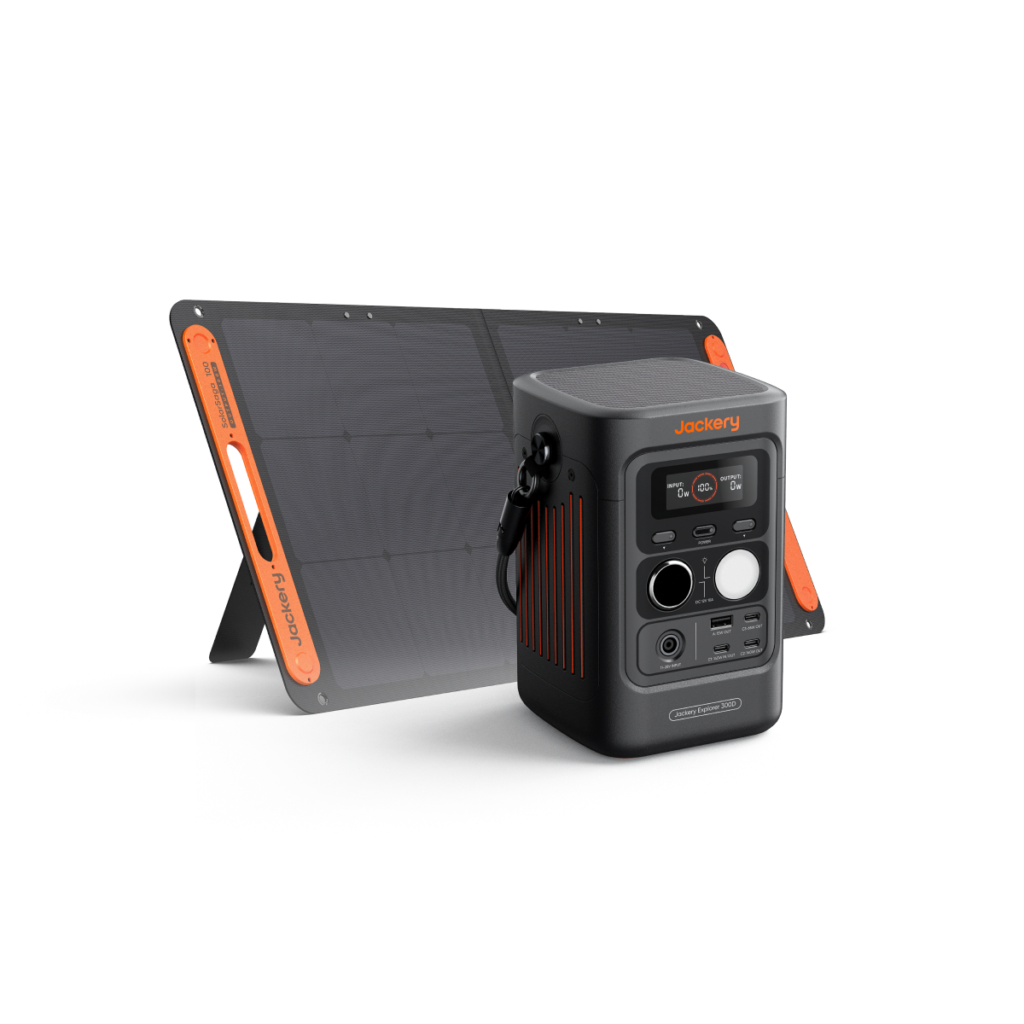
Jackery Explorer 300D
No AC outlet, so no inverter running along either. 2.5 kilograms and a 12-volt socket are enough for the swimming lake or a night in the van. Jackery states 4,000 cycles; charging only works from zero degrees. In high summer, it is done after ten hours, and anything with a German Schuko plug stays out.
BLUETTI Elite 30 V2
Same capacity, but with 600 watts on the AC outlet. BLUETTI states an idle consumption from 4.5 watts and more than 3,000 cycles. In return, it weighs 1.8 kilograms more than the 300D. The inverter stays off as long as only the cooler is running.
Jackery Explorer 1000 Plus v2
For three mild days or for winter, since according to retailer information it charges from minus 10 degrees Celsius. With 10.8 kilograms and 1,800 watts, it also powers the coffee maker. Whether the cooler alone justifies this class, we doubt. If you also cook and charge laptops, you will find the right calculation in our guide to the power station in a motorhome.
BLUETTI AC180
BLUETTI explicitly specifies the 12-volt socket with 10 amps as regulated. The sister model AC180P did best in the ADAC test with a grade of 2.0 (German grading scale, lower is better). At 16 to 17 kilograms, though, this is no longer a station you casually carry to the tent.
EcoFlow Glacier Classic 45L
The alternative for anyone who does not own a cooler yet: a compressor cooler with a slide-in battery, so no cable and no station. The battery holds only 298 watt-hours, and depending on the version, it is not included. Check that before buying. Empty, the cooler already weighs 23.2 kilograms.
How we would decide
- You drive every day and stay put for one night at most: Explorer 500 v2.
- Only the swimming lake, a day trip, fishing during the day: Explorer 300D.
- The same class with an AC outlet: BLUETTI Elite 30 V2.
- Three days without recharging, or frost in the picture: Explorer 1000 Plus v2.
- Fixed campsite, many 230-volt devices: BLUETTI AC180.
- You are buying cooler and power in one: Glacier Classic, keeping an eye on whether the battery is included.
Frequently asked questions
How long does a power station last with a cooler?
Multiply the capacity by 0.85 and divide by the average power draw. In mild weather, a 40-liter cooler needs about 12 watts on average, and the Explorer 500 v2 then lasts 36 hours. In high summer, with an assumed 24 watts, it is 18 hours, and in continuous operation at 48 watts only 9 hours.
Why does the cooler use less than the rating plate says?
The stated 32 to just over 50 watts only apply while the compressor is running, and it does not run all the time. Dometic assumes a duty cycle of about 22 percent for a cooler in the 40-liter class. That works out to about 12 watts on average, and several manufacturer figures match that value.
Should the cooler go on 12 volts or on the power station's AC outlet?
On the 12-volt socket. The ADAC, Germany's largest automobile club, found that a switched-on inverter can draw as much as 30 watts by itself. A 12-watt demand thus becomes up to 42 watts, and with the Explorer 500 v2 the 36 hours shrink to about 10. Leave the inverter off when the AC outlets are not needed.
Why does the power station switch off at night?
Often it is the energy-saving mode. On the Explorer 500 v2, it switches outputs off after six hours of low load, below 2 watts on the car socket. A cooler whose compressor is currently pausing can fall below that. Leave the mode off for the night. If the cooler does not start, a lower battery protection setting often helps.
How big does the power station need to be for three days?
Multiply the days without recharging by the daily demand and divide by 0.85. Three hot days without recharging come to about 2,000 watt-hours, and then the station weighs more than the cooler. Looking at recharging gets you further. For its coolers, Dometic recommends at least a 100-watt solar panel together with a suitable battery.
Can the power station charge from solar and the car at the same time?
Not at the same time. In spring 2025, the ADAC found DC inputs that were not decoupled on the Jackery Explorer 1000 v2 and the Ective BlackBox 10, and said damage to the 12-volt vehicle electrical system was possible. Both were therefore rated "poor." For the Explorer 500 v2, Jackery explicitly states that both inputs do not work simultaneously.
Sources
- ADAC: Portable power stations tested (spring 2025)
- Dometic: CFX3 45, consumption, battery protection and battery operation
- Engel: Compressor cooler data sheet (PDF)
- Product information from Jackery on the Explorer 300D, 500 v2 and 1000 Plus v2
- GreenDrive (authorized Jackery retailer): Explorer 1000 Plus v2
- BLUETTI: Elite 30 V2
- Product information from BLUETTI on the AC180
- Product information from EcoFlow on the Glacier Classic
Where to buy
- Jackery Explorer 500 v2View at JackeryAvailable in Germany: JackeryCheck price at Amazon.deAvailable in Germany: Amazon.de
- Jackery Explorer 300DView at JackeryAvailable in Germany: JackeryCheck price at Amazon.deAvailable in Germany: Amazon.de
- Jackery Explorer 1000 Plus v2View at JackeryAvailable in Germany: JackeryCheck price at Amazon.deAvailable in Germany: Amazon.de
- BLUETTI Elite 30 V2Check price at Amazon.deAvailable in Germany: Amazon.de
- BLUETTI AC180Check price at Amazon.deAvailable in Germany: Amazon.de
- EcoFlow Glacier Classic 45LCheck price at Amazon.deAvailable in Germany: Amazon.de