Contents14 sections
This guide was first published in German on handgetestet.de.
An RV pitch by the dike, three days without a hookup post, and on the second evening the cooler reports low voltage. This is exactly where a power station helps: it takes the continuous load off the leisure battery, but only replaces it in exceptional cases. For the typical camper van, we consider the EcoFlow DELTA 3 Plus the right choice, because 12.5 kilograms is still manageable, around 1,000 watt-hours will carry you through a long weekend, and ADAC, the German automobile club, gave it a rating of 2.1 in spring 2025 (on the German school grading scale, where 1 is best). If you often camp in winter, look at the Explorer 1000 Plus v2, which according to the retailer charges from minus 10 °C.
Supplement or replace?
Supplement, almost always. In a conversion, lights, water pump and heater fan are permanently wired to the 12-volt system of the house battery. A power station, by contrast, only powers what is plugged into its outlets.
It can replace the leisure battery in one case: in a van or mini camper without a house battery, where only a cooler, a lamp and chargers are running anyway. A quick calculation helps when comparing sizes. Dometic assumes around 50 percent of rated capacity is usable for lead-acid batteries, and almost all of it for lithium iron phosphate. A 100 Ah lead-acid battery stores 1,200 watt-hours at 12 volts, but only about 600 of those remain usable. A station in the 1 kWh class therefore brings almost twice as much, just separate from the vehicle’s electrical system. If the station is to be permanently connected to the conversion’s 230-volt system, that is a job for a specialist.
What a day at the pitch really costs
The cooler is the deciding factor. For a compressor cooler in the 40-liter class, Dometic calculates 48 watts while the compressor is running and about 22 percent run time. That comes to less than 24 amp-hours per day, so a maximum of around 290 watt-hours. With an absorption cooler running on 12 volts, the same table gives 168 amp-hours, well over 2,000 watt-hours. That drains even large stations within a day, so absorption coolers stay on gas. In hot weather or if the lid is opened frequently, the compressor cooler’s consumption rises noticeably; the models to choose from are in our guide to compressor coolers (in German).
Our assumed example for two people: cooler 290 watt-hours, a 60-watt laptop for three hours 180, two phones 30, four capsule coffees around 100. That makes about 600 watt-hours per day. The DELTA 3 Plus lasts just under a day and a half with that, if you factor in the usual 15 percent deduction. Without the coffee machine, the Explorer 500 v2 lasts just under one day.
Plug the cooler directly into the 12-volt socket. On Jackery units, it delivers up to 10 amps, and the detour via the 230-volt outlet only costs conversion losses. With the Explorer 500 v2, you should also know about the energy-saving mode. It switches off outputs after six hours of low load: below 2 watts on the car socket and below 25 watts on the AC outlet. For overnight operation, it is better left off. If you would rather draw 230 volts from the leisure battery permanently, read on in our guide to power inverters.
Recharging: shore power, driving, sun
It is fastest on shore power. The station then simply plugs into an outlet in the vehicle. According to EcoFlow, the DELTA 3 Plus should be full in about 56 minutes at 1,500 watts, and according to Jackery, the Explorer 2000 v2 in 1.7 hours. If the heating is running off the hookup post at the same time, its fuse may trip. The right cable is covered in our guide to motorhome accessories (in German).
While driving, the cigarette lighter socket is the slow route: around twelve hours for the Explorer 1000 Plus v2, 24 for the 2000 v2. According to retailer information, the Jackery DC-DC alternator charger charges the 1000 Plus v2 in about 2 hours 35 minutes. Installation should be done by a specialist workshop. What to keep in mind with Euro 6 and a smart alternator is explained in our guide to charging boosters (in German). For days parked without a hookup, there is the solar panel; see Charging a power station with a solar panel (in German).
Strap it down before the engine starts
A power station is cargo. Section 22 of the German Road Traffic Regulations (StVO) requires that cargo does not slide or tip over even during emergency braking or an evasive maneuver. For a collision at 50 km/h, ADAC cites forces of 30 to 50 times the object’s own weight. Mathematically, 12.5 kilograms thus becomes 375 to 625 kilograms pushing forward.
In ADAC’s crash test with a camper van, the kitchen unit tore out of its anchoring, while the lashing eyes in the rear held. That determines where the station belongs: low down, ideally in the rear storage compartment, with tie-down straps attached to the lashing eyes and wrapped around the housing. The carrying handle is not a fastening point, and neither is the onboard shelf. Keep the ventilation slots clear. And the weight counts toward the payload: 17.5 kilograms for the 2000 v2.
Heat and cold inside the vehicle
In summer, heat is the limit. BLUETTI states a maximum of 40 °C during operation for the AC180. Expect values like this for every station and do not place it behind the windshield. In winter, charging is the limit. According to retailer information, the 1000 Plus v2 charges from minus 10 °C, and according to Jackery, the Explorer 500 v2 even down to minus 20 °C.
Six stations for vans and motorhomes
| Model | Capacity, continuous output | Weight | Charging in the vehicle | Who it is for |
|---|---|---|---|---|
| Jackery Explorer 300D | 288 Wh, 300 W, USB and 12 V only | 2.5 kg | Car socket 4.1 h | Cooler in a mini camper |
| Jackery Explorer 500 v2 | 512 Wh, 500 W | 5.7 kg | Car socket 6 h | Weekends, winter camping |
| EcoFlow DELTA 3 Plus | 1,024 Wh, 1,800 W | 12.5 kg | Time on the car socket not documented | Camper van, coffee machine |
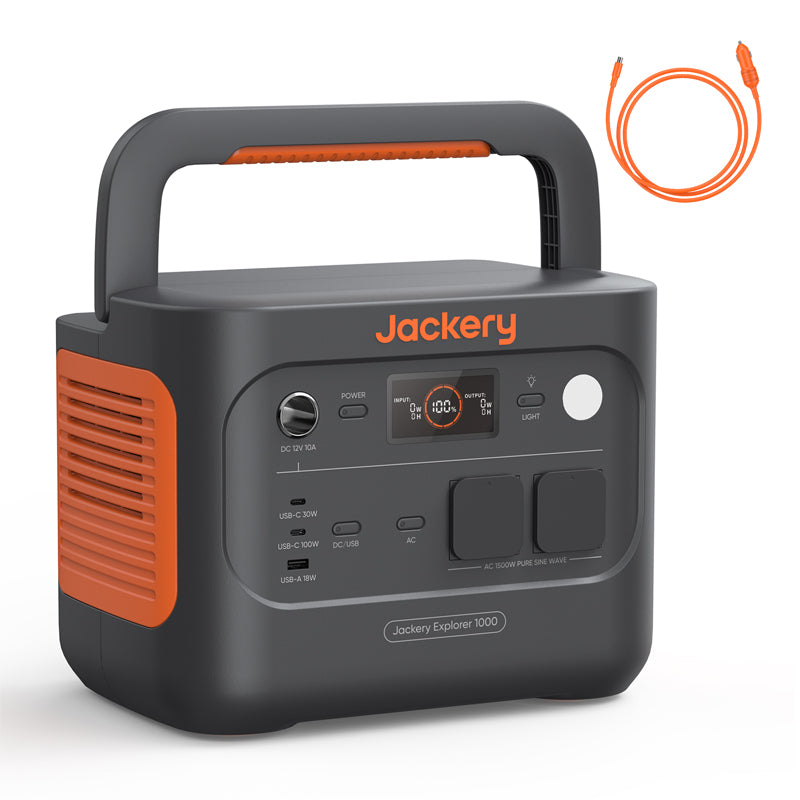
| Jackery Explorer 1000 Plus v2 | 1,024 Wh, 1,800 W | 10.8 kg | Car socket 12 h, DC-DC about 2:35 h | Heavy users, cold weather |
| Jackery Explorer 2000 v2 | 2,042 Wh, 2,200 W | 17.5 kg | Car socket 24 h | Long stays, fixed spot |
| BLUETTI AC180 | 1,152 Wh, 1,800 W | 16 to 17 kg | Car socket around 12 h | Comparison with Jackery |
Specifications according to the manufacturers; DC-DC times for the 1000 Plus v2 according to an authorized Jackery retailer.
EcoFlow DELTA 3 Plus
For the camper van, we consider it the right choice. 1,800 watts will run a capsule coffee machine. In spring 2025, ADAC gave it a rating of 2.1 (good) and highlighted the many ports, the performance and the quiet fan. It found no safety defects. Drawbacks according to ADAC: the charging cable for solar panels is not included, and the control buttons are a bit fiddly. At 12.5 kilograms, it also weighs more than the lightest stations in this class.
We no longer list the Jackery Explorer 1000 v2, which we used to have at the top here. ADAC downgraded it to „poor“ because its two DC inputs are not decoupled: if you charge via a solar panel and the car socket at the same time, the voltage of one source can pass over to the other, and damage to the vehicle’s 12-volt system is possible. In a vehicle, that is exactly the scenario that matters. With any other station, the rule is therefore: only use both routes together if the manual explicitly allows it.
Jackery Explorer 1000 Plus v2
The same 1,024 watt-hours and 1,800 watts as the DELTA 3 Plus, plus three AC outlets, 6,000 cycles and charging from minus 10 °C. At 10.8 kilograms, the station weighs almost two kilos less. Jackery presented the series at IFA 2026, and sales were due to start in mid-October. If you travel year-round, you get more device here; with an expansion battery (in German) it grows further, but then quickly becomes too heavy for the rear.
Jackery Explorer 500 v2
The lightweight solution for two nights, with 6,000 cycles and charging down to minus 20 °C. For a hair dryer and coffee machine, 500 watts is not enough, but for a cooler, laptop and lights it is.
Jackery Explorer 300D
No AC outlet, but only 2.5 kilograms. Three USB-C ports and the 12-volt socket are enough in a mini camper. For a cooler, Jackery cites 23 hours in eco mode. Anything with a Schuko plug (the standard German mains plug) stays out.
Jackery Explorer 2000 v2
Twice the energy for several days without a hookup. At 17.5 kilograms, however, it becomes a built-in device that stays strapped down in the rear, and a charge on the car socket takes 24 hours. Alongside it, Jackery has announced the Explorer 2000 Plus v2: 2,048 watt-hours, 2,400 watts, expandable up to 12 kWh, but weighing 18.8 kilograms. It was recently unavailable on Amazon, which is why it is missing from the table.
BLUETTI AC180
The alternative with 1,800 watts and a 2,700-watt peak. BLUETTI states an operating range of minus 20 to 40 °C, and according to the manufacturer, the 12-volt socket is regulated. At 16 to 17 kilograms, it is around a third heavier than the DELTA 3 Plus. ADAC’s comparison from spring 2025 was led by its sibling, the AC180P, with a rating of 2.0; the AC180 itself was not included.
How we would decide
- Camper van with leisure battery, cooler and coffee: EcoFlow DELTA 3 Plus.
- On the road year-round, often below zero: Explorer 1000 Plus v2.
- Weekends, little space: Explorer 500 v2.
- Mini camper without a house battery: Explorer 300D or 500 v2, depending on whether you need an AC outlet.
- Several days off-grid with solar: Explorer 2000 v2, strapped down securely.
For three weeks in summer, the class below is often enough; see Power stations for camping (in German).
The calculation for your own devices is in the guide Calculating power station run time (in German).
Power consumption, voltage and weight on the wall mount are compared in our guide to the 12-volt TV for motorhomes.
What 22 kilos mean on station stairs and in a motorhome is worked out in our guide to the folding e-bike (in German).
Power station or permanently installed house battery: the trade-offs for a DIY build are covered in our guide to power in a camper conversion (in German).
What a compressor start demands and how long the battery lasts is shown in the guide Running an air conditioner on a power station (in German).
Frequently asked questions
Can a power station replace the house battery in a motorhome?
Usually not. Lights, water pump and heater fan are permanently wired to the 12-volt system of the house battery; the station only powers what is plugged into its outlets. It can replace the leisure battery in a van or mini camper without a house battery, where only a cooler, a lamp and chargers are running.
How much power does a cooler need per day?
Dometic calculates a maximum of around 290 watt-hours per day for a compressor cooler in the 40-liter class. According to the same table, an absorption cooler running on 12 volts would come to well over 2,000 watt-hours and drains even large stations within a day. Absorption coolers therefore stay on gas.
How do you charge the power station while driving?
Via the cigarette lighter socket, it takes a long time: around twelve hours for the Explorer 1000 Plus v2, 24 for the 2000 v2. According to retailer information, the Jackery DC-DC alternator charger charges the 1000 Plus v2 in about 2 hours 35 minutes. Installation should be done by a specialist workshop.
Why is the Jackery Explorer 1000 v2 no longer listed?
ADAC, the German automobile club, downgraded it to "poor" because its two DC inputs are not decoupled. If you charge via a solar panel and the car socket at the same time, the voltage of one source can pass over to the other, and damage to the vehicle's 12-volt system is possible. With other stations, only use both routes if the manual allows it.
How do you secure a power station in a motorhome?
As cargo under Section 22 of the German Road Traffic Regulations (StVO): it must not slide even under emergency braking. According to ADAC, a collision at 50 km/h generates forces of 30 to 50 times its own weight. It is safest low down in the rear storage compartment, with tie-down straps attached to the lashing eyes and the ventilation slots kept clear.
What applies in heat and cold inside the vehicle?
BLUETTI states a maximum of 40 degrees during operation for the AC180, so no station belongs behind the windshield. In winter, charging is the limit: according to retailer information, the 1000 Plus v2 charges from minus 10 degrees, and according to Jackery, the Explorer 500 v2 even down to minus 20 degrees.
Sources
- Product information from Jackery on the Explorer 300D, 500 v2, 1000 v2, 1000 Plus v2, 2000 v2 and the DC-DC alternator charger
- GreenDrive (authorized Jackery retailer): Explorer 1000 v2
- GreenDrive: Explorer 1000 Plus v2
- BLUETTI: AC180
- Dometic: CFX3 45, consumption and cooling technologies
- German Road Traffic Regulations (StVO), Section 22: Cargo
- ADAC: Motorhome crash test
- ADAC: How to load your vacation car properly
- ADAC: Portable power stations tested (spring 2025)
- pv magazine: Jackery press release on IFA 2026
- EcoFlow: DELTA 3 Plus
Where to buy
- EcoFlow DELTA 3 PlusCheck price at Amazon.deAvailable in Germany: Amazon.de
- Jackery Explorer 500 v2View at JackeryAvailable in Germany: JackeryCheck price at Amazon.deAvailable in Germany: Amazon.de
- Jackery Explorer 1000 Plus v2View at JackeryAvailable in Germany: Jackery
- Jackery Explorer 300DView at JackeryAvailable in Germany: Jackery
- Jackery Explorer 2000 v2View at JackeryAvailable in Germany: Jackery
- Jackery DC-DC-LichtmaschinenladegerätView at JackeryAvailable in Germany: Jackery
- BLUETTI AC180Check price at Amazon.deAvailable in Germany: Amazon.de