Contents13 sections
This guide was first published in German on handgetestet.de.
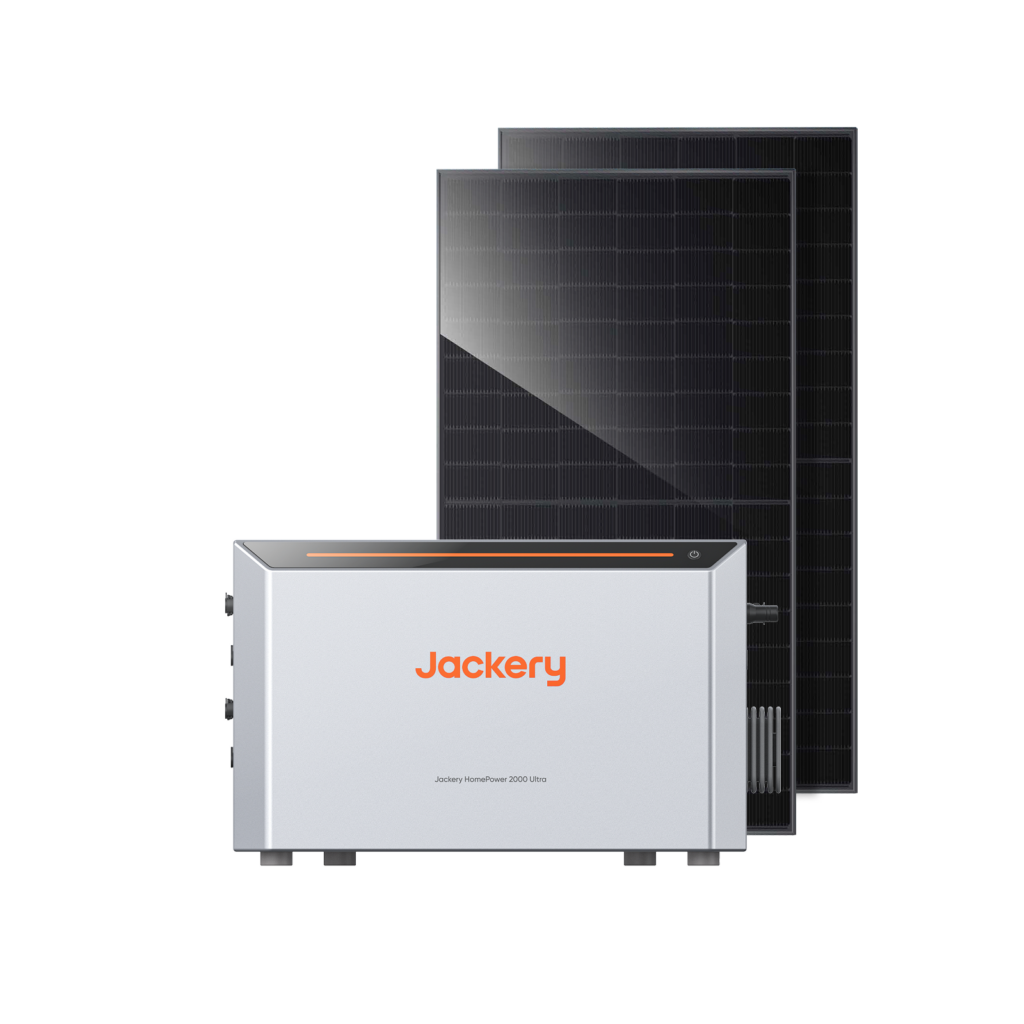
An 800-watt-peak balcony solar system in Germany produces around 550 to 900 kilowatt hours a year, depending on whether it hangs vertically on the railing or sits tilted in the sun. Without a battery, however, a two-person apartment only uses about 300 to 400 of them, because what counts is what is consumed at the same moment. If you want to raise that limit and have the floor space, in our assessment the Jackery HomePower 2000 Ultra set with 2×450 Wp is a good choice, though with more effort and a considerably higher cost than a system without a battery.
What location makes a difference
We ran the numbers for three locations using PVGIS, the solar calculator of the EU Joint Research Centre. The basis is 800 watts peak, the default 14 percent system losses and irradiation data from 2005 to 2023. Facing south at a 30-degree tilt, the result is 783 kilowatt hours a year for Hamburg, 807 for Kassel and 904 for Munich. Mounted vertically facing south, it is 570, 576 and 650.
So there is a good 15 percent between northern and southern Germany. That is less than many people assume. Then there is the weather: according to PVGIS, the annual figure in Kassel typically varies by around 45 kilowatt hours. A weaker year is therefore not a sign of a defect.
Orientation and tilt: where the percentages get lost
Let’s stay with Kassel and 800 watts peak. This is how much the mounting position matters:
- South, 30 degrees: 807 kWh
- South, 15 degrees (flat garage roof): 766 kWh
- South, 70 degrees (panel on the railing angled out by 20 degrees): 722 kWh
- South, vertical: 576 kWh
- East, 30 degrees: 657 kWh
- West or east, vertical: around 400 kWh
- North, vertical: 153 kWh
At 45 instead of 30 degrees, almost nothing changes (809 kWh). It gets interesting on the railing: angling the panel out by just 20 degrees yields a quarter more on paper than vertical mounting. Whether the railing and the property management will go along with it is another question. Mounts and wind load are covered in our guide to balcony solar mounts (in German). North-facing sides are out; the German consumer advice center (Verbraucherzentrale) advises against all surfaces between northeast and northwest.
Bifacial panels are not factored in here. What the rear side contributes on a railing is usually little, as our guide to bifacial solar panels explains.
Twelve months, two mounting types
Split the annual figure into months and the picture changes. The months for Kassel, each for 30 degrees south and vertical south:
- January: 24 and 27 kWh
- February: 40 and 40 kWh
- March: 72 and 61 kWh
- April: 95 and 64 kWh
- May: 102 and 56 kWh
- June: 103 and 51 kWh
- July: 102 and 54 kWh
- August: 93 and 58 kWh
- September: 78 and 61 kWh
- October: 52 and 50 kWh
- November: 27 and 30 kWh
- December: 20 and 24 kWh
From October to March, both variants deliver practically the same, 235 versus 232 kilowatt hours. The tilted panel’s entire lead builds up from April to September, which is exactly when there is a midday surplus anyway. That is why the consumer advice center considers vertical mounting on an unshaded railing facing between southeast and southwest particularly sensible. In December, either way only 20 to 24 kilowatt hours come together, less than one a day.
Shading: the item no calculator knows about
PVGIS takes hills and mountains on the horizon into account, but not the building across the street. The plug-in solar simulator from HTW Berlin (Berlin University of Applied Sciences) makes this easier: depending on the setting, direct sunlight is blocked up to a sun elevation of 25, 35 or 45 degrees. For 800 watts mounted vertically facing south, the yield drops from 552 to 442, 382 and 311 kilowatt hours.
In December, the midday sun in Kassel only rises a little over 15 degrees. A neighboring building to the south that rises 25 degrees above the horizon as seen from your balcony therefore blocks all direct sunlight in the dark months.
Small shadows directly on the panel are worse. According to the consumer advice center, shading just a few percent of the surface can cut output by more than half. A lamppost is enough, or the edge of the balcony above. Look at the spot on a clear day in the morning, at midday and in the afternoon before you order.
Why half the power often does not end up with you
A household using 2,100 kilowatt hours a year, which according to HTW is the average for two people in an apartment building, draws an average of 240 watts on paper. At midday, two panels deliver many times that. The rest goes into the grid without compensation. The simulator calculates with 41 load profiles; here for vertical, facing south:
- 400 watts, 2,100 kWh consumption: 276 kWh yield, of which 209 kWh used (76 percent)
- 800 watts, 2,100 kWh consumption: 552 kWh yield, of which 311 kWh used (56 percent)
- 800 watts, 1,500 kWh consumption: 255 kWh used (46 percent)
- 800 watts, 3,000 kWh consumption: 381 kWh used (69 percent)
- 800 watts, 4,000 kWh consumption: 442 kWh used (80 percent)
Double the panel output, but only just under 50 percent more electricity saved. And the tilted setup? At 30 degrees, the yield rises from 552 to 791 kilowatt hours, but only 384 instead of 311 are used. A 43 percent higher yield turns into a 23 percent benefit. So never multiply the yield by your electricity price, always the portion you actually use.
What helps? Running the washing machine and dishwasher during sunny hours, which costs nothing. Or a battery: with a 2-kilowatt-hour battery, the simulator shows 505 instead of 311 kilowatt hours used in the 2,100 kWh household. HTW assumes a system efficiency of 82.5 percent, so some of the stored power is lost along the way. Whether it pays off depends on the extra cost. More on this in our buying guide to balcony solar with battery storage (in German).
If you do not want a battery at all and want to feed little into the grid, follow the consumer advice center’s advice: 450 to 500 watts, in other words one standard panel, is usually enough.
Five components and what they yield on paper
| Model | Panel output | Inverter, battery | Yield vertical south, calculated | Best for |
|---|---|---|---|---|
| Jackery HomePower 2000 Ultra with 2×450 Wp | 900 Wp | 800 W, 2,048 Wh | around 620 kWh | low daytime consumption, floor space available |
| Jackery HomePower 2000 Ultra with 4×450 Wp | 1,800 Wp | 800 W, 2,048 Wh | around 1,140 kWh | garden or garage roof, high consumption |
| Jackery 450Wp Bifaziales Solarmodul | 450 Wp per panel | none, needed separately | around 310 kWh per panel | putting your own system together |
| Jackery 4x 245W leichte stabile Solarmodule | 980 Wp | none, needed separately | around 680 kWh | railings with little load reserve |
| Hoymiles HMS-800W-2T | up to two panels | 800 VA, no battery | depends on panels | balcony solar without a battery |
Yield figures from the simulator, without shading and without rear-side gain. Technical data according to the manufacturer.
Jackery HomePower 2000 Ultra with 2×450 Wp
The inverter and battery sit in a single 2,048-watt-hour unit that, according to Jackery, feeds 800 watts into the household circuit by default and has two solar inputs. At 900 watts peak, the set stays below the 960-watt-peak threshold that applies in Germany to systems without a battery connected via a standard Schuko plug. According to the consumer advice center, this standard does not apply to battery systems, and the grid operator must also be notified unless it waives this. On top of that come 26.4 kilograms of weight and a considerably higher cost.
Jackery HomePower 2000 Ultra with 4×450 Wp
Four panels almost double the yield, while the output stays at 800 watts. According to the consumer advice center, the advantage shows mainly in cloudy weather and in the morning and evening. For a rented balcony, the set is simply too big. From 960 watts peak, the consumer advice center also lists a dedicated feed-in socket installed by a qualified electrician as mandatory.
Jackery 450Wp Bifaziales Solarmodul
A glass-glass panel with 108 n-type cells and, according to Jackery, a 25-year warranty. Without an inverter, it does not supply household power. Weight and dimensions are missing from the product information; according to the consumer advice center, standard panels weigh a good 20 kilograms.
Jackery 4x 245W leichte stabile Solarmodule
Four thin panels, each weighing 8.3 kilograms and 4 millimeters thick according to Jackery. In return, you need four shade-free surfaces instead of two, and at 980 watts peak you are just above the Schuko plug limit.
Hoymiles HMS-800W-2T
The route without a battery: a microinverter rated at 800 volt-amperes with two independent inputs for 320 to 540 watts each, according to the datasheet. If one panel is temporarily in shade, the second keeps working unaffected. Wi-Fi is built in; you buy the panels separately. Check the current and voltage of your panels against the datasheet, and ask about the new product standard, since the datasheet dates from 2023.
How to go about it
First the location, then the purchase. Enter orientation, tilt, shading and annual consumption in the HTW simulator; for the exact location, use PVGIS and set the azimuth to 0 for south, minus 90 for east or 90 for west. The two programs calculate somewhat differently, so small deviations are normal.
Once the system is up, an energy meter or a smart plug (in German) with a measuring function shows whether reality matches the calculation.
Registration, meters and landlords are covered in our guide to registering a balcony solar system.
Whether a portable station can make sensible use of the surplus is calculated in our guide to the power station on a balcony solar system.
Frequently asked questions
How much power does an 800-watt balcony solar system produce?
According to PVGIS, facing south at a 30-degree tilt, 783 kilowatt hours in Hamburg, 807 in Kassel and 904 in Munich. Mounted vertically facing south, it is 570, 576 and 650. So there is a good 15 percent between northern and southern Germany, and the figure varies from year to year with the weather.
Is a vertically mounted panel on the balcony railing worth it?
Yes, if the railing faces between southeast and southwest without shade. From October to March, vertical and tilted panels deliver practically the same. The tilted panel's lead builds up from April to September, when there is a midday surplus anyway. Angling it out by just 20 degrees yields a quarter more on paper.
How much of the solar power do I use myself?
Often only a little over half. With 800 watts mounted vertically facing south, a household with an annual consumption of 2,100 kilowatt hours uses 311 of 552 kilowatt hours according to the HTW simulator. So never multiply the yield by the electricity price, always the portion you actually use. Running the washing machine during sunny hours helps.
What does a battery add to a balcony solar system?
With a 2-kilowatt-hour battery, the simulator shows 505 instead of 311 kilowatt hours used in the 2,100 kWh household. Some of the stored power is lost along the way; HTW assumes a system efficiency of 82.5 percent. Whether it pays off depends on the extra cost.
How much does shading hurt the yield?
Considerably. According to the German consumer advice center (Verbraucherzentrale), shading just a few percent of the surface can cut output by more than half; a lamppost or the edge of the balcony above is enough. A neighboring building to the south that rises 25 degrees above the horizon blocks all direct sunlight in the dark months.
Which orientation is unsuitable?
North-facing sides are out. Mounted vertically facing north, only 153 kilowatt hours a year come together in Kassel; facing east or west vertically, around 400. The consumer advice center advises against all surfaces between northeast and northwest. Look at the spot on a clear day in the morning, at midday and in the afternoon.
Sources
- European Commission, Joint Research Centre: PVGIS 5.3 (our own calculation, SARAH3 irradiation data, 2005–2023, as of 04.11.2026)
- PVGIS: user manual
- HTW Berlin: plug-in solar simulator (our own inputs, as of 04.11.2026)
- HTW Berlin: documentation of the calculation basis (PDF, May 2024, in German)
- Verbraucherzentrale: Plug-in solar, solar power from the balcony (as of 24.07.2026)
- Hoymiles: HMS-W series datasheet (PDF, Europe V202308)
- Product information from Jackery on the HomePower 2000 Ultra and solar panels
Where to buy
- Jackery HomePower 2000 Ultra mit 2×450 WpView at JackeryAvailable in Germany: Jackery
- Jackery HomePower 2000 UltraCheck price at Amazon.deCheck price at Amazon.co.ukCheck price at Amazon.nlCheck price at Amazon.com.beCheck price at Amazon.frCheck price at Amazon.itCheck price at Amazon.esCheck price at Amazon.plCheck price at Amazon.seAvailable in Germany: Amazon.de
- Jackery HomePower 2000 Ultra mit 4×450 WpView at JackeryAvailable in Germany: Jackery
- Jackery 450Wp Bifaziales SolarmodulView at JackeryAvailable in Germany: Jackery
- Jackery 4x 245W leichte stabile SolarmoduleView at JackeryAvailable in Germany: Jackery
- Hoymiles HMS-800W-2TCheck price at Amazon.deCheck price at Amazon.co.ukCheck price at Amazon.nlCheck price at Amazon.com.beCheck price at Amazon.frCheck price at Amazon.itCheck price at Amazon.esCheck price at Amazon.plCheck price at Amazon.seAvailable in Germany: Amazon.de