Contents14 sections
This guide was first published in German on handgetestet.de.
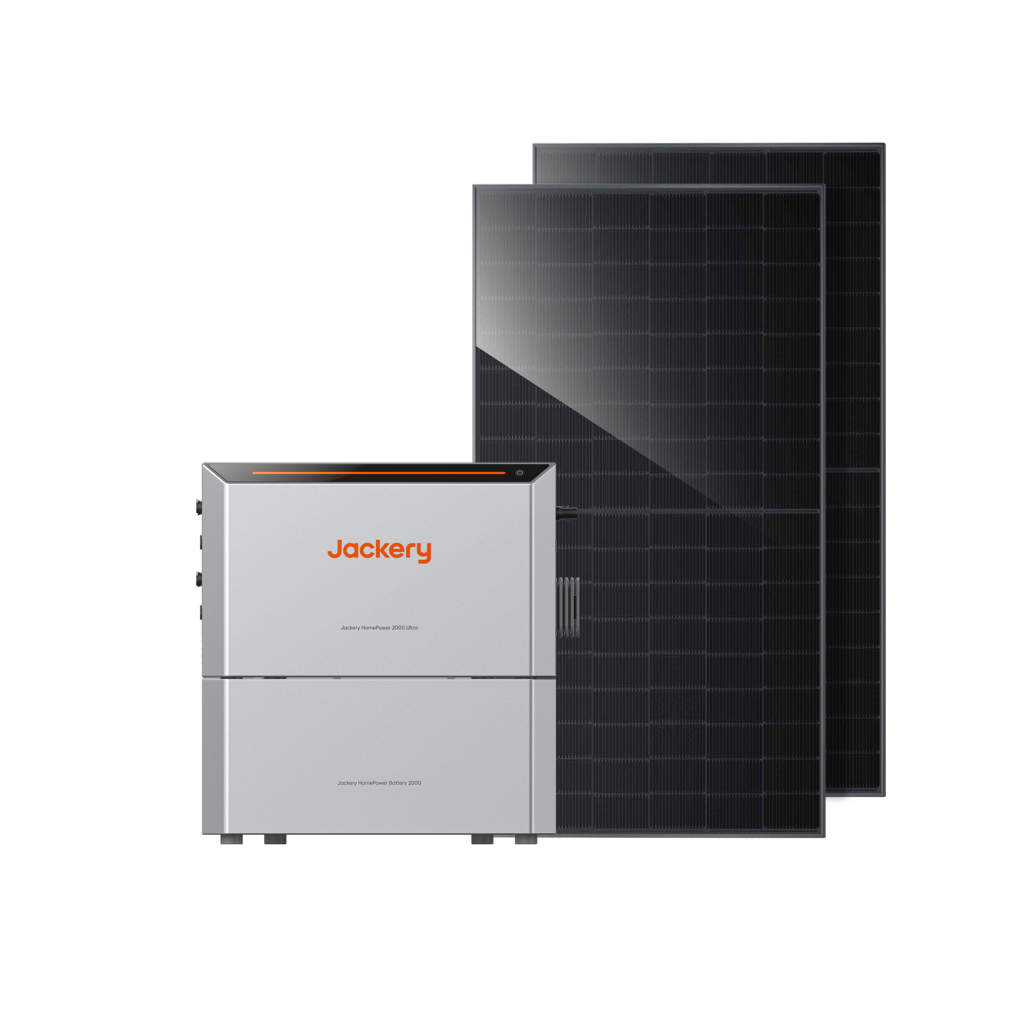
Since May 2024, registering a balcony solar system in Germany mainly means one thing: an entry in the Market Master Data Register (Marktstammdatenregister), within one month of first plugging it in. A separate notification to the grid operator is not required for devices without a battery, and you do not have to wait for a new meter. If a battery is added, for example with the Jackery HomePower 2000 Ultra set with 2×450 Wp, which we consider a sensible entry into systems with storage, there is one more step. The legal status of this guide is as of November 4, 2026; it does not replace legal advice.
Step 1: Check whether your device counts as a plug-in solar device
The simplified rules are set out in Section 8 (5a) of the German Renewable Energy Sources Act (Erneuerbare-Energien-Gesetz, EEG). They apply up to 2,000 watts of module output and 800 volt-amperes of inverter output, and only if you waive a feed-in tariff. Everything connected behind the same point of consumption is added together, which usually means behind your meter. According to the German Federal Network Agency (Bundesnetzagentur), two devices with 600 volt-amperes each in one apartment do not qualify.
There is a trap in the datasheet. What counts is the highest selectable output, not the one that is set. According to the Bundesnetzagentur, a device capable of 900 volt-amperes that is throttled to 600 does not get the special rules. The datasheet lists the Jackery SolarVault 3 Pro in two versions, with 800 and with 1,200 volt-amperes. Check the model number before you order.
Then the plug. Under the German product standard DIN VDE V 0126-95, the standard household Schuko plug is intended for up to 960 watts peak if the device meets the standard’s protection requirements. Above that, you need a dedicated feed-in socket installed by a qualified electrician. According to the German consumer advice center (Verbraucherzentrale), however, the standard applies to devices without a battery. For battery systems, ask the manufacturer and the electrician which connection is intended.
Step 2: Ask your landlord or homeowners‘ association
If the module hangs on the outside of the balcony, you need consent. Under Section 554 of the German Civil Code (BGB), however, tenants are entitled to permission. It may only be refused if it cannot reasonably be expected of the landlord, even taking your interests into account, and any clause in the lease that deviates from this to your disadvantage is invalid. According to the Verbraucherzentrale, a refusal without reasons or purely on visual grounds is no longer enough.
Apartment owners rely on Section 20 (2) of the German Condominium Act (WEG). The owners‘ association decides on the how within the framework of proper management, so it may have a say in the type of mounting. Include the datasheet and the mount right away; the options are shown in our guide to balcony solar mounts (in German). In historic town centers, heritage protection may also apply; in that case, ask the local building authority.
Step 3: Notify your insurer
A separate policy is not necessary. The Verbraucherzentrale NRW writes that a plug-in solar device can sometimes be added to building, contents and liability insurance at no extra cost. For that, it has to be reported. Keep the confirmation. Ask specifically whether a falling module is covered.
Step 4: Plug in and note the date
The deadline starts when you first plug it in. According to the registration guide, commissioning is the moment the device first feeds alternating current into the household grid. A power strip is off-limits. If you have doubts about the condition of the wiring, for example in an older building, have the circuit checked by a qualified electrician beforehand. VDE FNN recommends this as well.
Step 5: Register in the Market Master Data Register
The Bundesnetzagentur offers a simplified wizard for private individuals. Have this information ready:
- Total output of the modules in watts
- Inverter output according to the manual
- Commissioning date
- Location, usually your home address
- Meter number from your electricity bill
- For a battery: its technical data, including capacity
Go to marktstammdatenregister.de and create a user account. You will receive an email that you confirm. Then you register as a system operator and enter the balcony solar system. All modules connected at the same time count as one unit; entering them individually is not possible. According to the registration guide, the meter number is not published.
At the end, download the registration confirmation. If the grid operator check says „nicht vorgesehen“ (not intended), everything is fine: the system still counts as registered.
According to the Bundesnetzagentur, whoever submits the entry remains responsible for its accuracy and for the deadline. And if you miss the deadline? That is an administrative offense, and the range of fines under the German Energy Industry Act (EnWG) extends into five figures. So catch up on a forgotten entry.
Step 6: Leave the meter to the metering point operator
You do not have to do anything here. Under Section 10a EEG, the device may run on the existing meter immediately, even if an old rotating-disc meter temporarily runs backward. The grid operator learns about your device through the register, and the metering point operator replaces an unsuitable meter without being asked with a bidirectional meter or a smart metering system (in German). According to the Bundesnetzagentur, the period until then is a matter of weeks, at most a few months.
According to the Verbraucherzentrale, the installation itself costs you nothing extra. The annual metering costs may, however, rise up to the statutory cap. It only gets expensive if an old meter cabinet has to be rebuilt: that cost is borne by the connection user, so in rental buildings, talk to your landlord first.
Special case battery: what else applies
According to the Verbraucherzentrale, the EEG makes no exception for batteries on plug-in solar devices. Two things therefore change.
In the register, two units are created: the solar system and the battery. You answer the battery question in the form with „ja“ (yes) and enter both in one go. If the battery is added later, select „Registrierung anderer Anlagen“ (registration of other systems) after logging in, and then the battery icon. If the capacity is expanded with an additional battery, you update the entry for the existing unit, also within one month.
According to the Verbraucherzentrale, the grid operator still receives a notification for systems with a battery, though some waive it. A short inquiry before plugging in clarifies this. How the battery can be regulated at the meter is covered in the guide on zero feed-in (in German). Buying criteria are collected in the buying guide to balcony solar with battery storage (in German).
That leaves the portable power station. According to the registration guide, portable batteries are not stationary and are not registered. If you only run devices directly from it and feed nothing into the household grid, there is no entry to make. This is shown in the guide charging a power station with a solar panel (in German).
Five devices and their paperwork
| Model | Modules | Grid output | Register entry | Grid operator |
|---|---|---|---|---|
| Jackery HomePower 2000 Ultra with 2×450 Wp | 900 Wp | 800 VA | Solar and battery | ask about the battery |
| Jackery HomePower 2000 Ultra with expansion battery and 2×450 Wp | 900 Wp | 800 VA | Solar and battery | ask about the battery |
| Jackery SolarVault 3 Pro + 4 x 245W | 980 Wp | 800 or 1,200 VA depending on version | Solar and battery | ask; mandatory above 800 VA |
| Jackery Solargenerator 1000 v2 | 200-watt panel | no grid operation | none | no notification |
| Hoymiles HMS-800W-2T | up to two modules | 800 VA | solar only | no notification |
Technical data according to the manufacturer. The registration requirement depends on your setup, not on the product name.
Jackery HomePower 2000 Ultra with 2×450 Wp
Jackery specifies the maximum apparent power in grid operation as 800 volt-amperes. That fits the limit, and at 900 watts peak, the module figure stays small as well. We did not find a set without a battery from Jackery, so the extra steps always apply. In return, you get 2,048 watt-hours of storage. Clarify the connection in advance; see Step 1.
Jackery HomePower 2000 Ultra with expansion battery and 2×450 Wp
The same technology with a second battery. For registration, what counts is the usable total capacity, which you can find in the manual.
Jackery SolarVault 3 Pro + 4 x 245W
Four lightweight modules and a 2.52 kilowatt-hour battery. At 980 watts peak, you are above the Schuko threshold. The 1,200 volt-ampere version falls outside the special rules: according to VDE FNN, the route via the grid operator then becomes mandatory as well. We would not choose it for a rented apartment.
Jackery Solargenerator 1000 v2
A power station with 1,070 watt-hours and a solar panel, with no connection to the household grid. Nothing to register as long as nothing flows into the household grid. In return, you plug devices in by hand, and your electricity bill barely drops as a result. In spring 2025, the German automobile club ADAC downgraded the Explorer 1000 v2 included in it to „poor“ because its two DC inputs are not decoupled. Therefore, never charge it via solar and the car socket at the same time, or damage to the 12-volt vehicle electrical system is possible.
Hoymiles HMS-800W-2T
If you are looking for the shortest route, choose a device without a battery. This 800 volt-ampere microinverter lists the German grid code VDE-AR-N 4105 in its datasheet. The datasheet is from 2023, so ask about the new product standard. Modules and connection cable are sold separately.
Frequently asked questions
Do I have to register my balcony solar system with the grid operator?
Not for devices without a battery. Since May 2024, the entry in the German Market Master Data Register is sufficient, and the grid operator learns about your device through it. According to the German consumer advice center (Verbraucherzentrale), the grid operator still receives a notification for systems with a battery, though some waive it. A short inquiry before plugging in clarifies this.
Up to what output do the simplified rules apply?
Up to 2,000 watts of module output and 800 volt-amperes of inverter output, and only without a feed-in tariff. Everything behind your meter is added together. What counts is the highest selectable output: according to the German Federal Network Agency (Bundesnetzagentur), a device capable of 900 volt-amperes that is throttled to 600 does not qualify.
Can my landlord prohibit a balcony solar system?
Only within narrow limits. Under Section 554 of the German Civil Code (BGB), tenants are entitled to permission; it may only be refused if it cannot reasonably be expected of the landlord. According to the Verbraucherzentrale, a refusal without reasons or purely on visual grounds is no longer enough. Apartment owners rely on Section 20 of the German Condominium Act (WEG).
What information do I need for the Market Master Data Register?
The total module output, the inverter output according to the manual, the commissioning date, the location and the meter number from your electricity bill, plus the capacity for a battery. If the grid operator check says "nicht vorgesehen" (not intended), everything is fine. The meter number is not published.
Do I have to wait for a new electricity meter?
No. Under Section 10a of the German Renewable Energy Sources Act (EEG), the device may run on the existing meter immediately, even if an old rotating-disc meter temporarily runs backward. The metering point operator replaces an unsuitable meter without being asked. According to the Verbraucherzentrale, installation costs nothing extra, but the annual metering costs may rise.
Does a portable power station have to be registered?
According to the registration guide, portable batteries are not stationary and are not registered. If you only run devices directly from the power station and feed nothing into the household grid, there is no entry to make. A permanently connected balcony battery, by contrast, appears in the register as a separate unit alongside the solar system.
Sources
- Bundesnetzagentur: Registration guide for balcony solar systems (PDF, as of April 1, 2024, in German)
- Market Master Data Register: Frequently asked questions
- Market Master Data Register: Which systems must be registered?
- Bundesnetzagentur: Solar systems, questions and answers
- Section 8 EEG (German Renewable Energy Sources Act)
- Section 10a EEG
- Section 5 MaStRV (German Market Master Data Register Ordinance)
- Section 95 EnWG (German Energy Industry Act)
- Section 554 BGB (German Civil Code)
- Section 20 WEG (German Condominium Act)
- Verbraucherzentrale: Plug-in solar (as of July 24, 2026)
- Verbraucherzentrale NRW: Frequently asked questions about plug-in solar devices
- VDE FNN: Connecting and registering plug-in PV systems
- Jackery: SolarVault 3 Pro technical data (PDF)
- Hoymiles: HMS-W series datasheet (PDF, English)
- Product information from Jackery on the HomePower 2000 Ultra, Solargenerator 1000 v2 and 4×245 W modules
- ADAC: Portable power stations tested (spring 2025)
Where to buy
- Jackery HomePower 2000 Ultra mit 2×450 WpView at JackeryAvailable in Germany: Jackery
- Jackery HomePower 2000 UltraCheck price at Amazon.deAvailable in Germany: Amazon.de
- Jackery HomePower 2000 Ultra mit Zusatzakku und 2×450 WpView at JackeryAvailable in Germany: Jackery
- Jackery SolarVault 3 Pro + 4 x 245WView at JackeryAvailable in Germany: Jackery
- Jackery SolarVault 3 ProView at JackeryAvailable in Germany: JackeryCheck price at Amazon.deAvailable in Germany: Amazon.de
- Jackery Solargenerator 1000 v2View at JackeryAvailable in Germany: Jackery
- Hoymiles HMS-800W-2TCheck price at Amazon.deAvailable in Germany: Amazon.de