Contents15 sections
This guide was first published in German on handgetestet.de.
A bifacial panel is not a miracle panel. Its rear side only produces power if light actually reaches it, and that is decided by the mounting, not the data sheet. For a plug-in balcony solar system on a standard household plug, we consider two Jackery 450Wp Bifacial Solar Panels the most sensible choice: together they reach 900 watts peak and thus stay below the limit up to which the new German standard permits the normal household plug. If, on the other hand, you mount the panels flat against a dark wall, you are paying for glass on the rear that barely sees any light.
Where does the power from the rear come from?
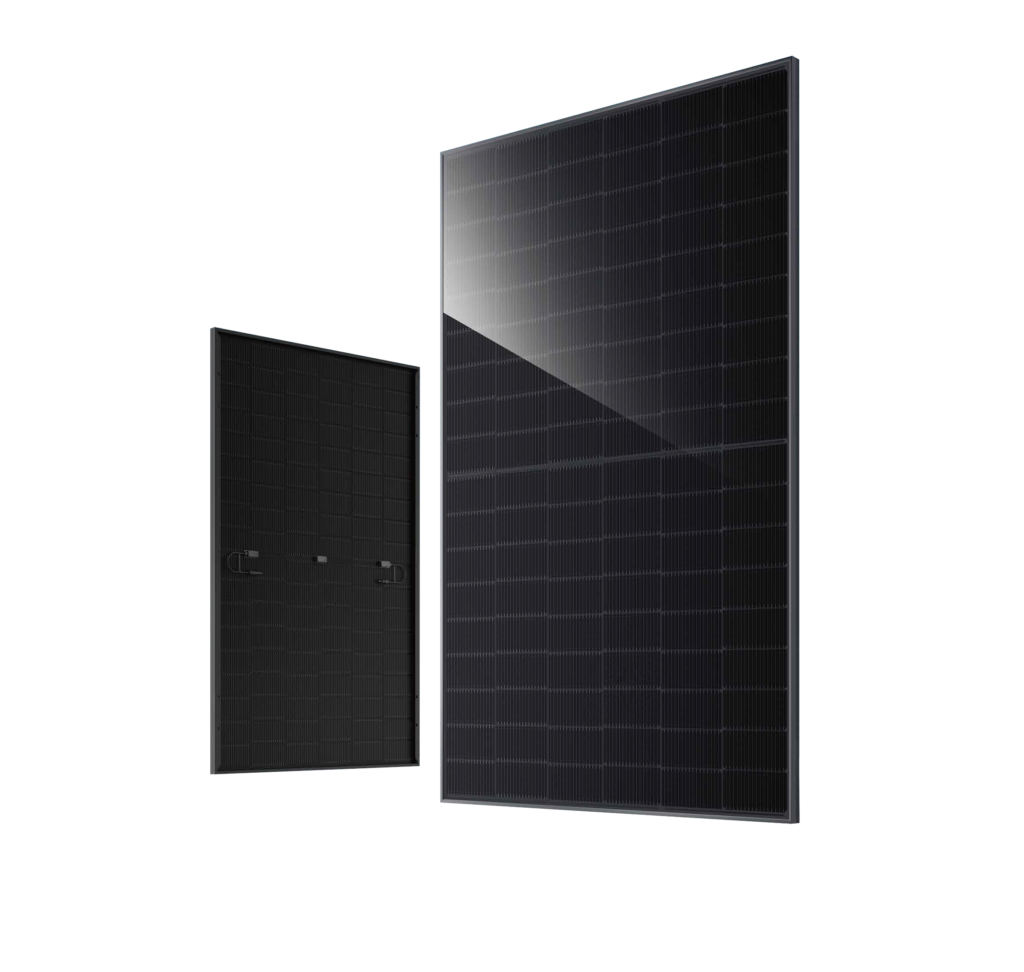
A conventional panel has an opaque backsheet behind the cells. In a bifacial panel, there is glass instead, and the cells absorb light from both sides. The sun hits the front. The rear receives whatever the ground, the roof or a wall reflects, plus diffuse light from the sky.
How well the rear side performs is described by the bifaciality factor. In its data sheet, JA Solar defines it as the ratio of rear-side output to the rated output of the front side and specifies 80 percent for the JAM54D40 LB series, with a tolerance of ten percentage points. Trina Solar states 80 percent plus or minus five for the Vertex S+. The factor is an upper limit, not a yield promise.
You get the extra yield by multiplying the factor by the share of light that reaches the rear. JA Solar’s data sheet does the math: if the rear side receives ten percent of the front side’s irradiance, the output of the 450-watt panel rises to 486 watts. That is eight percent. Whether your mounting even reaches those ten percent depends on two things: the surface underneath and the clearance.
Albedo: why lawn, gravel and a white roof are so different
Albedo indicates what share of sunlight a surface reflects. In its fact collection on photovoltaics, the Fraunhofer Institute for Solar Energy Systems ISE cites literature values that vary widely: farmland 7 to 17 percent, grassland 12 to 30 percent, roof tiles 10 to 35 percent, but a roof with a light-colored coating 60 to 70 percent.
In practice, this means that on a garage roof with a light coating, the rear side receives several times what it sees above dark soil. A bright surface can sometimes be created afterward, for example with light-colored paving under a raised mount in the garden. Even a high bifaciality factor cannot make up for a dark surface.
How much clearance does the rear side need?
More than most people think. A panel lying close to the ground shades exactly the area that is supposed to reflect light to the rear. The higher and steeper it stands, the more illuminated ground the rear side sees. The German consumer advice center (Verbraucherzentrale) sums up the case briefly: as soon as the rear side is visible after mounting, for example with a raised panel on a garage roof, a bifacial panel delivers the most.
For this purpose, Jackery offers its solar panel mount for flat roofs and gardens, a steel frame for one panel with a fixed 20-degree tilt. It is weighed down with ballast. How much weight your location requires is not stated in the product information; on a roof in an exposed position, you should clarify this with the retailer or a specialist installer. The Verbraucherzentrale explicitly points out that a panel must neither come loose in the wind nor fall down because of its weight.
Vertical on a fence or balcony railing: does the rear side still count?
On a garden fence with an east-west orientation, yes. There, each side gets direct sun once a day, one in the morning, the other in the afternoon. Fraunhofer ISE describes exactly this pattern: vertically mounted bifacial panels deliver significantly more power in the morning and afternoon than at midday. For large-scale systems of this type, the institute names a high bifaciality factor above 90 percent as a prerequisite. A panel with 80 percent still works on a fence, just with a weaker second side.
On a balcony railing, things look different. There, the rear side faces the balcony floor and the house wall, in other words, the shade. A vertical south-facing spot is still good: according to the Verbraucherzentrale, a 400-watt panel without shading on a south-facing balcony delivers about 280 kilowatt hours a year, producing more in the winter half of the year and less at the summer peaks. That is down to the front side, though. The Verbraucherzentrale lists mounting spots behind the railing in the balcony recess and surfaces facing between northeast and northwest as unsuitable.
Glass on both sides: what that means for weight and mounting
For glass-glass panels, manufacturers point to higher resistance to weathering and aging. They are not light, though. According to the data sheet, JA Solar’s JAM54D40-450/LB weighs 22 kilograms at 1,762 by 1,134 millimeters, and the Trina Vertex S+ weighs 21 kilograms. Both have 1.6 millimeters of glass on the front and on the back. JA Solar specifies a static load of 5,400 pascals on the front, but only 2,400 pascals on the rear, and suction from behind is the critical case in wind.
Before you hang two of these panels on a balcony railing, check whether the railing and mounting can carry them. Be careful with Jackery’s mounting bracket for four lightweight solar panels: according to the manufacturer, it is designed for light, rigid panels, not for heavy glass-glass panels. For a bifacial panel on a balcony, there is Jackery’s aluminum balcony mount with a tilt of 10 to 30 degrees.
800 watts, 2,000 watts peak, 960 watts peak: which limit applies to what?
Since Germany’s Solar Package I (Solarpaket I), plug-in solar devices are limited to a maximum of 800 watts of inverter output and a maximum of 2,000 watts peak of panel output. Registration now only takes place in the core energy market data register (Marktstammdatenregister) of the German Federal Network Agency, within one month of commissioning according to VDE FNN. Many people overlook the third number: under the German product standard DIN VDE V 0126-95, connection via a standard Schuko plug is only intended for up to 960 watts peak of panel output. Above that, you need a dedicated feed-in socket installed by a qualified electrician.
Two 500-watt panels add up to 1,000 watts peak. That is just too much for the Schuko plug. Two 450-watt panels stay below it. With a battery, the situation is different: the Verbraucherzentrale writes that the new standard applies to devices without storage and that a battery must still be reported to the grid operator. Since October 2024, landlords or homeowners‘ associations in Germany may only refuse a plug-in solar device if it is unreasonable for them. More on batteries is in our buying guide to balcony solar systems with storage (in German); how much your device actually feeds in is shown by an energy meter (in German).
Six building blocks for bifacial solar power
| Model | Output | Design according to manufacturer | Bifaciality | Best for |
|---|---|---|---|---|
| Jackery 450Wp Bifacial Solar Panel | 450 Wp, 108 n-type cells | Glass-glass, 1.6 mm each | up to 80 % | Balcony solar system with two panels on a Schuko plug |
| Jackery 500Wp Bifacial Solar Panel | 500 Wp, 22.6 % efficiency | Glass-glass, 2.0 mm each | up to 80 % | Flat roof, garden, systems with storage |
| Jackery HomePower 2000 Ultra with 2×450 Wp | 800 W AC, 2,048 Wh storage | Set with two bifacial 450 Wp panels | same as 450 Wp panel | Using solar power in the evening too |
| JA Solar JAM54D40-450/LB | 450 W, 22.5 % efficiency | Glass-glass, 1.6/1.6 mm, 22 kg | 80 % ± 10 % | DIY builds with your own inverter |
| Trina Solar Vertex S+ TSM-440NEG9RC.27 | 440 W | Glass-glass, 1.6/1.6 mm, 21 kg | 80 % ± 5 % | DIY builds, slightly lighter |
| Jackery solar panel mount for flat roofs and gardens | 1 panel, 20° tilt | Steel, 5.76 kg, with ballast | creates clearance for the rear side | Raised mounting on a garage roof or lawn |
Jackery 450Wp Bifacial Solar Panel
According to Jackery, an n-type panel with 108 cells, 1.6 millimeters of glass on both sides, a temperature coefficient of minus 0.29 percent per degree and a 25-year warranty. The claim „bifacial gain of up to 80 percent“ refers to the bifaciality factor, not the extra yield. Two of them fit under the 960-watt-peak limit. Downsides: weight and dimensions are missing from the product information, the Y-cable is not included with the 450-watt version, and delivery is on a pallet.
Jackery 500Wp Bifacial Solar Panel
More output, 22.6 percent efficiency according to Jackery, and thicker glass at 2.0 millimeters per side. With two panels on a Schuko plug, however, things get tight, see above. It makes sense on a flat roof or in the garden, where a feed-in socket is planned anyway or a battery takes in the panels‘ output.
Jackery HomePower 2000 Ultra with 2×450 Wp
A battery with 2,048 watt hours of LiFePO4 that delivers 800 watts to the household grid by default and, according to Jackery, accepts up to 2,000 watts of solar input via two inputs. The set includes two bifacial 450-watt panels. The unit weighs 26.4 kilograms. You should clarify the connection of a battery with a qualified electrician and the grid operator.
JA Solar JAM54D40-450/LB
The panel with the most detailed data sheet in this list: 22 kilograms, 108 half-cells, double glass and a 25-year product warranty according to JA Solar. It comes without an inverter; you need one that matches the panel’s voltage values. For experienced DIY builders.
Trina Solar Vertex S+ TSM-440NEG9RC.27
One kilogram lighter than the JA Solar, also double glass at 1.6 millimeters. Trina states 80 percent bifaciality. The series comes in several output classes; before buying, compare the type designation in the listing with the data sheet.
Jackery solar panel mount for flat roofs and gardens
Not a panel, but often the part that decides the rear-side yield. The mount sets up a rigid panel at 20 degrees and lifts it off the ground. According to Jackery, it weighs 5.76 kilograms; the ballast comes on top of that.
How we would decide
- Balcony solar system on a Schuko plug: two Jackery 450Wp Bifacial Solar Panels, raised or with an unobstructed rear side.
- Flat garage roof with a light-colored surface: the 500-watt version on mounts with clearance, connected via a feed-in socket.
- Power in the evening too: the HomePower set, after consulting the grid operator and an electrician.
- Vertical on a south-facing railing: a bifacial panel does no harm, but the rear contributes hardly anything. Here, price decides.
- Portable instead of permanently mounted: rigid glass panels are too heavy for that; a foldable solar panel or a set of power station and solar panel (in German) is a better fit.
How to mount panels securely is explained in the guide to balcony solar mounts (in German).
Calculated values for south, east, west and vertical mounting are in the guide balcony solar yield (in German).
Frequently asked questions
How much extra yield does a bifacial solar panel deliver?
Less than the bifaciality factor suggests. You get the extra yield by multiplying the factor by the share of light that reaches the rear side. According to JA Solar, a 450-watt panel rises to 486 watts when the rear receives ten percent of the irradiance. That is eight percent.
On what kind of surface is a bifacial panel worth it?
On a bright one. Fraunhofer ISE gives 12 to 30 percent albedo for grassland and 7 to 17 percent for farmland, but 60 to 70 percent for a roof with a light-colored coating. Even a high bifaciality factor cannot make up for a dark surface.
Does a bifacial panel on a balcony railing make sense?
Hardly at the rear, because there the back faces the balcony floor and the house wall. A vertical south-facing spot is still good: according to the German consumer advice center (Verbraucherzentrale), a 400-watt panel without shading delivers about 280 kilowatt hours a year. On a garden fence with an east-west orientation, on the other hand, each side gets its turn once a day.
How many watts peak are allowed on a standard household plug?
In Germany, plug-in solar devices may have a maximum of 800 watts of inverter output and 2,000 watts peak of panel output. Under the German standard DIN VDE V 0126-95, however, the standard Schuko plug is only intended for up to 960 watts peak. Two 500-watt panels, at 1,000 watts peak, are just above that; two 450-watt panels stay below it.
Are glass-glass panels heavy?
Yes. According to the data sheet, the JA Solar JAM54D40-450/LB weighs 22 kilograms and the Trina Vertex S+ 21 kilograms. At JA Solar, the rear side only withstands 2,400 pascals, and suction from wind is the critical case. Check beforehand whether the railing and mounting can carry that.
Sources
- Fraunhofer ISE: Current facts on photovoltaics in Germany (PDF, version 20.08.2026)
- Verbraucherzentrale: Plug-in solar, solar power from the balcony straight into the socket (as of 24.07.2026)
- VDE FNN: Plug-in generation systems
- JA Solar: JAM54D40 LB data sheet (PDF, German)
- Trina Solar: Vertex S+ NEG9RC.27 data sheet (PDF, English)
- Product information from Jackery on the bifacial panels, mounts and the HomePower 2000 Ultra
Where to buy
- Jackery 450Wp Bifaziales SolarmodulView at JackeryAvailable in Germany: Jackery
- Jackery 500Wp Bifaziales SolarmodulView at JackeryAvailable in Germany: Jackery
- Jackery HomePower 2000 Ultra mit 2×450 WpView at JackeryAvailable in Germany: Jackery
- Jackery Solarpanelhalterung für Flachdach und GartenView at JackeryAvailable in Germany: Jackery
- Jackery Solarpanelhalterung für BalkonView at JackeryAvailable in Germany: Jackery
- JA Solar JAM54D40-450/LBCheck price at Amazon.deAvailable in Germany: Amazon.de
- Trina Solar Vertex S+ TSM-440NEG9RC.27Check price at Amazon.deAvailable in Germany: Amazon.de
- Jackery HomePower 2000 UltraCheck price at Amazon.deAvailable in Germany: Amazon.de