Contents8 sections
This guide was first published in German on handgetestet.de.
When the power goes out, it usually lasts only a few hours. Germany’s Federal Office of Civil Protection and Disaster Assistance (BBK), however, points out that with widespread damage, it can also take days. Then your phone, router, lights and refrigerator are suddenly without power. A power station, in other words a large battery with outlets, bridges such gaps quietly and without exhaust fumes. You can calculate the size you need in advance.
What the BBK advises for a power outage
The basic kit is simple. Charged batteries or a power bank, a battery-powered or hand-crank radio, some cash and food that can be eaten cold. A carbon monoxide detector increases safety, and grilling is done outdoors only. A power station does not replace this; it complements it.
How to calculate the size
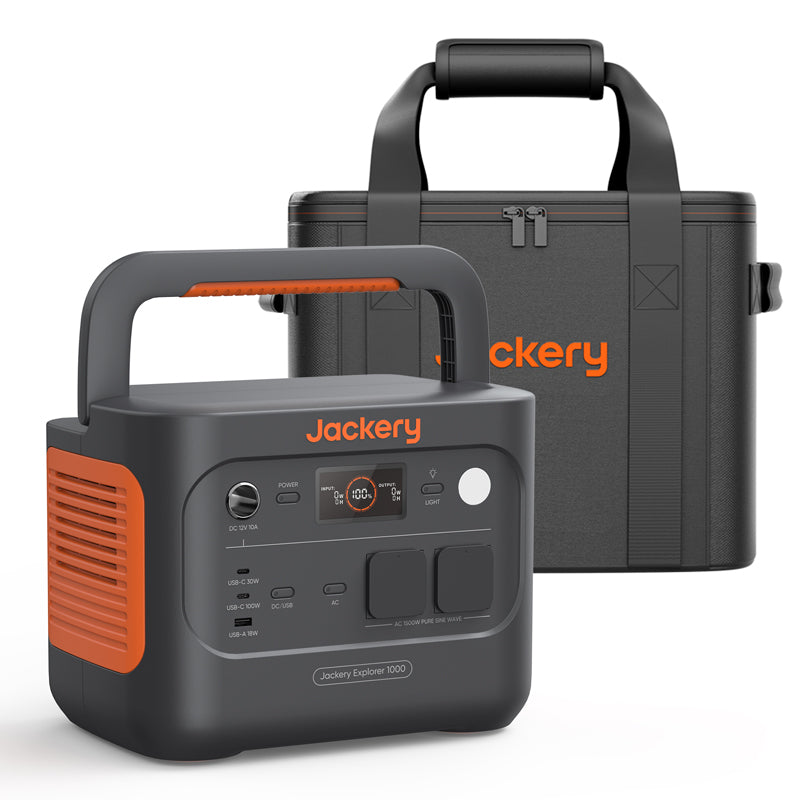
Capacity is stated in watt-hours (Wh). Divide it by the device’s power in watts, and you get a rough runtime in hours. Some energy is lost in conversion. For the Explorer 1000 v2 with 1,070 Wh, for example, Jackery states that a 60-watt cooler box runs for about 15 hours. A router with modem needs significantly less, an electric kettle significantly more.
Also pay attention to the continuous output. It determines which devices will start at all.
Factor in some deductions while you are at it. In spring 2025, the German automobile club ADAC measured eight stations. On average, the usable capacity was 10 to 15 percent below the manufacturer’s figure, and the inverter alone, when switched on, can draw 30 watts. Over a whole day, that would mathematically add up to 720 watt-hours, more than the entire battery of the Explorer 500 v2. So switch off the 230-volt output as soon as no device is connected to it, and charge phones via USB.
| Model | Capacity and output according to the manufacturer | Suitable for |
|---|---|---|
| Jackery Explorer 500 v2 | 512 Wh, 500 W, 5.7 kg | Phone, router, lights, laptop for one evening |
| Recommendation: EcoFlow DELTA 3 Plus | 1,024 Wh, 1,800 W, 12.5 kg | In addition, a refrigerator or coffee maker for hours |
| Jackery Explorer 2000 v2 | 2,042 Wh, 2,200 W, 17.5 kg | Longer outages, several devices at once |
We deliberately no longer list the Jackery Explorer 1000 v2 as a recommendation here. In spring 2025, the ADAC downgraded it to “poor” because its two DC inputs are not decoupled: if it is charged via a solar panel and the car socket at the same time, damage to the vehicle’s 12-volt electrical system is possible. The EcoFlow DELTA 3 Plus received a grade of 2.1 (good) in the same test.
The UPS function: the underrated advantage
If the power station sits permanently between the wall outlet and the device, it takes over during an outage. According to Jackery, the Explorer 500 v2 switches over in less than 10 milliseconds, and according to EcoFlow, the same applies to the DELTA 3 Plus. For a router, computer or hard drive, that means no crash and no data loss.
One outlet or the whole house?
This is where the biggest misunderstanding lies. A portable power station supplies the devices you plug directly into it. The ceiling light, the heating pump or the stove will not run on it. For home battery systems, the German consumer advice center Verbraucherzentrale distinguishes two levels: an emergency power outlet can run only a few devices. With backup power, the entire home circuit is supplied, limited by the output of the inverter. Stove, oven, toaster or hair dryer can limit use, and tankless water heaters usually do not run (as of July 2026).
According to the Verbraucherzentrale, such solutions are standard only on some storage systems; they often cost extra, and some providers do not offer them at all. So if you are planning a solar system with storage and want backup power, state that explicitly in your inquiry. For renters without their own system, the portable station remains the realistic route.
Three mistakes that hurt in an emergency
First: buying the station and forgetting it in the basement. If it does not hold a charge when you need it, it is no help. Recharge it at regular intervals as the manual specifies. Second: cooking indoors with gas or charcoal because the station is not enough for the stove. The BBK explicitly warns of the risk of suffocation; grilling is done outdoors only. Third: wiring the power station into the home installation yourself. That is a job for a licensed electrical contractor.
What else to look out for
- Battery type: According to the manufacturers, all three models use lithium iron phosphate (LiFePO4), which tolerates many charge cycles.
- Weight: From 2 kWh on, it gets heavy. Plan a permanent spot for it.
- Charging: Keep the power station charged. A solar panel makes it independent during long outages; more on that in the guide Charging a power station with a solar panel (in German).
- Home circuit: A portable power station supplies individual devices via cables. Only a licensed electrical contractor may connect it to the home installation.
Other manufacturers such as EcoFlow, Anker or Bluetti are compared in the guide Buying a power station.
If the capacity is not enough for several days, some devices can be expanded with battery packs; which ones go together is covered in the guide Power stations with extra batteries.
How long a device really runs is shown in the guide Calculating power station runtime, and stations for several days in the guide on the large power station.
How much power a boiler and pump need, and why connecting them is a job for professionals, is explained in the guide Heating during a power outage.
Preparedness as a whole, from water to radio, is laid out in the guide Power outage preparedness.
Three individual questions are covered in depth in separate guides: Chest freezer and refrigerator on a power station, Power station or generator and Protecting a PC and NAS.
For tanks and terrariums, there is a dedicated plan in the guide Aquariums during a power outage.
Frequently asked questions
Does the station deliver the stated output?
In the ADAC test, all eight devices confirmed their continuous output. On capacity, they fell short by 10 to 15 percent on average.
How do I stay informed when everything is down?
With a battery-powered or hand-crank radio. The BBK explicitly names it as a way to receive announcements from the authorities.
Isn’t a power bank enough?
For phones, yes; the BBK lists power banks and solar chargers as helpful. For a router, laptop or cooler box, you need an outlet, which means a power station. Small storage units are compared in the guide Power banks.
Is the station loud?
Under full load, yes. According to the ADAC, all tested devices are loud at maximum output; manufacturers’ figures usually refer only to the base load. For a night in the bedroom, a quiet mode is what counts.
Frequently asked questions
How big does a power station for a power outage need to be?
Divide the capacity in watt-hours by the device’s power in watts, and you get a rough runtime in hours. Some energy is lost in conversion. According to Jackery, a 60-watt cooler box runs for about 15 hours on 1,070 Wh. Also pay attention to the continuous output; it determines which devices will start at all.
What does the UPS function of a power station do?
If the power station sits permanently between the wall outlet and the device, it takes over during an outage. According to the manufacturers, the Explorer 500 v2 and the DELTA 3 Plus switch over in less than 10 milliseconds. For a router, computer or hard drive, that means no crash and no data loss.
Why is the Jackery Explorer 1000 v2 no longer recommended?
In spring 2025, the German automobile club ADAC downgraded it to “poor” because its two DC inputs are not decoupled. If it is charged via a solar panel and the car socket at the same time, damage to the vehicle’s 12-volt electrical system is possible. The EcoFlow DELTA 3 Plus received a grade of 2.1 in the same test.
Can I connect a power station to my home’s electrical system?
A portable power station supplies individual devices via cables. Only a licensed electrical contractor may connect it to the home installation. Also keep the station charged; a solar panel makes it independent during long outages.
What does the BBK recommend for power outage preparedness?
Charged batteries or a power bank, a battery-powered or hand-crank radio, some cash and food that can be eaten cold. A carbon monoxide detector increases safety, and grilling is done outdoors only. A power station does not replace this basic kit; it complements it.
Sources
- BBK: Preparing for and responding to a power outage
- Jackery: Explorer 500 v2, technical specifications
- Jackery: Explorer 1000 v2, technical specifications
- Jackery: Explorer 2000 v2, technical specifications
- ADAC: Portable power stations tested (spring 2025)
- EcoFlow: DELTA 3 Plus
- Verbraucherzentrale: Are battery storage systems worth it?
Where to buy
- Jackery Explorer 500 v2View at JackeryAvailable in Germany: Jackery
- EcoFlow DELTA 3 PlusCheck price at Amazon.deCheck price at Amazon.co.ukCheck price at Amazon.nlCheck price at Amazon.com.beCheck price at Amazon.frCheck price at Amazon.itCheck price at Amazon.esCheck price at Amazon.plCheck price at Amazon.seAvailable in Germany: Amazon.de
- Jackery Explorer 2000 v2View at JackeryAvailable in Germany: Jackery