Contents15 sections
This guide was first published in German on handgetestet.de.
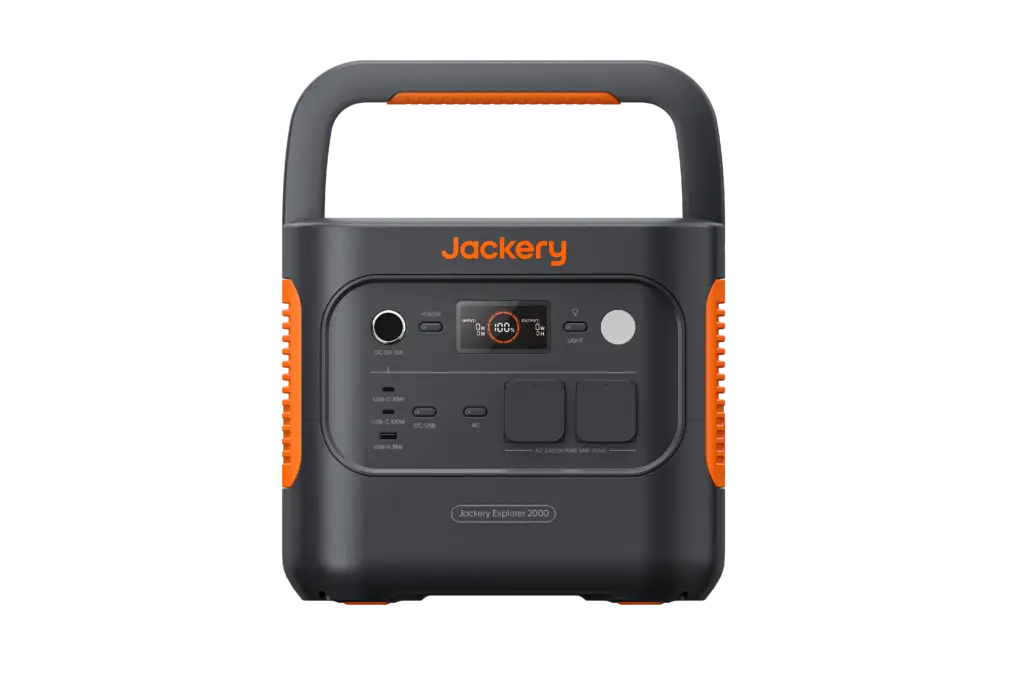
A gas boiler burns gas and still stays cold as soon as the power is gone. Controls, burner and pump all stop, even when the oil tank is full to the brim. The technology does not need much power: a study commissioned by the German Federal Office of Civil Protection and Disaster Assistance (BBK) calculates 159 watts. We consider the Jackery Explorer 2000 v2 a sensible reserve, because on paper it manages around 18 hours of winter operation. The bottleneck, however, is rarely the battery. It is the connection.
This guide covers only the heat generator. The refrigerator, lights and router are covered in the guide backup power with a power station (in German). A classic UPS for PC and NAS only bridges minutes and is of little help to the boiler.
How much power does the heating really draw?
The BBK study assumes 80 watts for the circulation pump and another 79 watts for the controls, including the oil pump for oil boilers. On a very cold day, that adds up to 2,313 watt-hours, in summer only around 160. That is a cautious calculation. According to the study, balanced systems need an average of 35 watts for the pump, and modern high-efficiency pumps need 10 watts.
Your system may therefore run more economically, but with additional pumps and actuators it may also draw more. So it is better to measure. If the heating is connected by plug, an energy meter shows the consumption on a cold day. With a hard-wired connection, the electrician takes the measurement.
What output does the power station need to deliver?
Viessmann advises adding up all loads running at the same time and planning for two to three times that amount because of inrush currents. That turns 159 watts into just under 500 watts. Every device in our table can handle that. What really matters is therefore the capacity.
Here is how to calculate it: capacity times 0.85 for conversion losses (the deduction cited by the Jackery retailer GreenDrive), divided by the daily demand. For the Explorer 2000 v2, that is 2,042 Wh times 0.85, or about 1,740 Wh. Divided by 2,313 Wh, that gives three quarters of a day. A fan heater, by contrast, would be the wrong idea. According to the BBK, heating appliances quickly draw 1,500 to 2,000 watts and drain the same battery in about an hour.
Does it have to be a pure sine wave?
Yes. Viessmann warns against simple construction-site generators whose voltage fluctuates strongly and calls for „clean power“ for the sensitive controls. The BBK also calls for stable voltage and frequency for sensitive electronics. That rules out cheap inverters with a modified sine wave; our guide to the power inverter explains the difference. The housings of the Jackery models 1000 v2, 2000 v2 and 3000 v2 are labeled „Pure Sine Wave“, and BLUETTI also specifies a pure sine wave for the AC200L.
Plug or hard-wired: what may I do myself?
Go down to the boiler room and follow the cable. If it ends in a Schuko plug (the standard German plug), you simply plug it over in an emergency. Many boilers, however, are hard-wired, often behind the emergency switch in the boiler room. Then do-it-yourself is over, because according to the BBK only licensed electrical contractors may work on the building’s electrical installation. The contractor can check whether a dedicated feed-in point with a transfer switch can be set up for the heating circuit.
Also clarify the grounding with them. For emergency generators on its heating systems, Viessmann requires grounding and refers you to its specialist partner. Nobody can tell you remotely whether your boiler will ignite properly on a power station. So have it demonstrated in a test run at the next service appointment, not only on a winter night.
Why must the power not flow back into the household grid?
Because it can be fatal. It is tempting to connect the power station to a wall outlet with a cable that has a plug on both ends and power the whole house that way. Never do that. The BBK explicitly warns of danger to life, for people in the house and for technicians working outside on the supposedly dead grid.
The guideline for emergency generators from the German Association of Network Operators (VDN) therefore requires that any backfeeding be ruled out. Switching over requires forced all-pole disconnection, and the electrician confirms the installation in writing. According to the BBK, you should inform the grid operator in advance.
And if there is a heat pump in the basement?
Then a portable power station is usually too small. Viessmann puts air-source heat pumps at 25 to 40 kilowatt-hours per day in winter. The Explorer 2000 v2 would be empty after one to almost two hours. Even the large 3000 v2 lasts barely two and a half hours. Viessmann also describes the backup power required for heat pumps and pellet systems as quite high.
Only a planned solution from a specialist contractor helps here. A battery storage system on the household grid does not automatically replace it, because inverters shut down when the grid fails, as our guide retrofitting battery storage explains.
What does the BBK advise when it gets cold?
Warm clothing, blankets and a single living area with the doors closed, while airing it regularly. If you have a fireplace, keep a supply of wood or briquettes. Gas-powered heat sources need an oxygen depletion sensor and flame failure protection, and a carbon monoxide detector adds safety. Gasoline and diesel generators never belong indoors because of the exhaust fumes. In severe frost, water pipes can freeze and burst.
Batteries self-discharge over time. So check the power station regularly and top it up. Do not count on solar power in winter: the BBK study calls heating an anticyclical load, since it needs the most when the sun delivers the least. What a solar panel on the power station (in German) still contributes is explained there.
Five power stations for the boiler room
The last column shows the calculated runtime based on the generous winter day from the BBK study.
| Model | Capacity, continuous output | Weight | Winter runtime |
|---|---|---|---|
| Jackery Explorer 2000 v2 | 2,042 Wh, 2,200 W | 17.5 kg | about 18 hours |
| Jackery Explorer 1000 v2 | 1,070 Wh, 1,500 W | 10.8 kg | about 9 hours |
| Jackery Explorer 1000 Plus v2 | 1,024 Wh, 1,800 W | 10.8 kg (retailer information) | about 9 hours, expandable |
| Jackery Explorer 3000 v2 | 3,072 Wh, 3,600 W | 27 kg | about 27 hours |
| BLUETTI AC200L | 2,048 Wh, 2,400 W | 28.3 kg | about 18 hours |
Jackery Explorer 2000 v2
For gas and oil heating systems, we consider it the most fitting size. At 17.5 kilos, it remains portable, and the capacity is enough for a long night and part of the following day. According to Jackery, the battery lasts 4,000 cycles. It cannot be expanded, and according to the retailer it may only be charged at 0 degrees Celsius or above.
Jackery Explorer 1000 v2
The BBK writes that most outages are resolved after a few hours. This model is enough for that. For an overnight outage, it gets tight if the pump is old. In spring 2025, the German automobile club ADAC downgraded the Explorer 1000 v2 to „poor“ because its two DC inputs are not decoupled. So never charge it via solar and the car socket at the same time, otherwise damage to the 12-volt vehicle electrical system is possible.
Jackery Explorer 1000 Plus v2
Start small, expand later: the expansion battery (in German) turns it into a larger reserve. The Plus v2 pairs with the Battery Pack 2000 Plus V2, not the older 1000 Plus.
Jackery Explorer 3000 v2
More than 24 hours of reserve, but at 27 kilos. Stairs become a chore, so the unit should have a permanent spot.
BLUETTI AC200L
The alternative to the 2000 v2, with somewhat more output and, according to the manufacturer, support for up to two expansion batteries. At 28.3 kilos, however, it is considerably heavier.
How we would decide
- Heating with a plug, outages lasting hours: Jackery Explorer 1000 v2, stationary use only and with the ADAC caveat from above.
- Gas or oil, reserve for the night and the morning: Jackery Explorer 2000 v2, with a test run with the specialist contractor.
- Heating hard-wired: first the electrician, then the device.
- Heat pump: no portable solution, planning by a specialist contractor.
Water, light and radio for longer outages are covered in the guide preparing for a power outage.
Frequently asked questions
How much electricity does a heating system need during a power outage?
The BBK study assumes 80 watts for the circulation pump and 79 watts for the controls. On a very cold day, that adds up to 2,313 watt-hours, in summer around 160. Modern high-efficiency pumps need only 10 watts. It is better to measure your own system on a cold day with an energy meter.
Does the power station for the heating need to deliver a pure sine wave?
Yes. Viessmann warns against construction-site generators with strongly fluctuating voltage and calls for clean power for the controls; the German Federal Office of Civil Protection (BBK) calls for stable voltage and frequency. Inverters with a modified sine wave are ruled out. The Jackery models 1000 v2, 2000 v2 and 3000 v2 as well as the BLUETTI AC200L deliver a pure sine wave.
May I connect the heating to the power station myself?
If the cable ends in a Schuko plug (standard German plug), you simply plug it over in an emergency. Many boilers, however, are hard-wired. According to the BBK, only licensed electrical contractors may work on the building's electrical installation. The contractor checks whether a feed-in point with a transfer switch can be set up and clarifies the grounding.
Can I feed the power station into the household grid through an outlet?
Never. The BBK warns of danger to life for people in the house and for technicians working on the supposedly dead grid. The German VDN guideline for emergency generators requires forced all-pole disconnection when switching over, and the electrician confirms the installation in writing. You should inform the grid operator in advance.
Is a power station enough for a heat pump?
Usually not. Viessmann puts air-source heat pumps at 25 to 40 kilowatt-hours per day in winter. The Explorer 2000 v2 would be empty after one to almost two hours, and even the 3000 v2 lasts barely two and a half hours. Only a planned solution from a specialist contractor helps here.
Sources
- BBK (German Federal Office of Civil Protection): Self-sufficient emergency power supply for the population (PDF)
- BBK: Power outage, preparedness and self-help (PDF)
- BBK: Power outage
- VDN (German Association of Network Operators): Guideline for emergency generators (PDF)
- Viessmann: Heating failure, operation with an emergency generator
- Viessmann: Heat pump power consumption
- GreenDrive: Jackery Explorer 2000 v2 (retailer information)
- GreenDrive: Jackery Explorer 3000 v2 (retailer information)
- GreenDrive: Jackery Explorer 1000 Plus v2 (retailer information)
- BLUETTI: AC200L
- Product information from Jackery on the Explorer models
- ADAC (German automobile club): Mobile power stations tested (spring 2025)
Where to buy
- Jackery Explorer 2000 v2View at JackeryAvailable in Germany: JackeryCheck price at Amazon.deAvailable in Germany: Amazon.de
- Jackery Explorer 1000 v2View at JackeryAvailable in Germany: JackeryCheck price at Amazon.deAvailable in Germany: Amazon.de
- Jackery Explorer 1000 Plus v2View at JackeryAvailable in Germany: JackeryCheck price at Amazon.deAvailable in Germany: Amazon.de
- Jackery Explorer 3000 v2View at JackeryAvailable in Germany: JackeryCheck price at Amazon.deAvailable in Germany: Amazon.de
- BLUETTI AC200LCheck price at Amazon.deAvailable in Germany: Amazon.de