Contents16 sections
This guide was first published in German on handgetestet.de.
A winter evening, a row house, no power for an hour. A gasoline generator would now have to go out into the garden, the cable through the tilted window, and the neighbors get to listen in. For outages lasting a few hours to about a day, and for anything that needs to run indoors, we therefore consider a power station the better choice; among the devices compared, that means the Jackery Explorer 2000 Plus v2. If it lasts several days or the load runs outdoors from morning to night, the fuel tank wins. And often, combining the two is the smartest solution.
A tank versus a battery
Let’s start with the number that speaks for the gasoline generator. The Scheppach SG3500i holds 6.3 liters and, according to the manufacturer, lasts 3.6 hours at 3,000 watts. That is almost 11 kilowatt hours from one fill. The Explorer 2000 Plus v2 stores 2,048 watt hours; after deducting conversion losses with a factor of 0.85, around 1.7 kilowatt hours remain. So one tank holds a good six battery charges. It is refilled in minutes, while the station needs over an hour on grid power, and the grid is exactly what is missing right now.
Even so, the gasoline supply is not unlimited. According to the German Federal Office of Civil Protection (BBK), no more than ten kilograms of gasoline in suitable canisters may be kept in a basement, roughly 13 liters or two fills. The BBK also advises thinking about how you will get fuel during an outage when you buy. Without power, some gas stations cannot pump either. For longer storage, Scheppach says the gasoline must be drained from the unit.
Small load, big thirst
At full load, the SG3500i uses 1.78 liters per hour according to the manufacturer, which works out to 0.6 liters per kilowatt hour. With no load, it is still 0.46 liters per hour. If all that is connected during a power outage is the refrigerator, router and a few lamps, perhaps 100 watts in total, the engine burns around 11 liters over the day for 2.4 kilowatt hours. Eight times as much per kilowatt hour. Almost the entire basement supply, in a single day.
The power station does not have this problem. At 100 watts, its 1.7 kilowatt hours last around 17 hours, and it uses nothing but its battery. The Scheppach also has an eco switch, but it has to stay off for devices with high starting current. If you want to know the runtime exactly, use our guide to power station runtime (in German).
Both together: the underrated solution
The generator charges the station, and the station supplies the house. Our rough calculation goes like this: at about 1.6 kilowatts of charging power, consumption calculated linearly is just over one liter per hour, and one charge costs around 1.5 liters. For 24 hours at 100 watts, that would be just over 2 liters instead of 11. The engine then runs only one to two hours a day, during the daytime, and the nights stay quiet. Try out the combination before you need it. For this, the generator has to keep voltage and frequency stable.
Noise: two numbers and one regulation
Scheppach advertises 66 dB(A), measured at seven meters at a quarter load. The manual lists 96 dB sound power and 74.6 dB sound pressure. Güde gives a sound power of 92 dB for the ISG 3200-2, Honda 83 to 87 dB for the EU10i. Only like can be compared with like, as our generator guide explains in more detail. The retailer GreenDrive lists the Explorer at under 30 dB in quiet charging mode. It can stand in the bedroom. The gasoline generator cannot even stand in the yard if someone next door is asleep.
Then there is the law. Under the German Equipment and Machinery Noise Protection Ordinance (Geräte- und Maschinenlärmschutzverordnung), power generators operated outdoors in residential areas may not run at all on Sundays and public holidays, and not between 8 p.m. and 7 a.m. on weekdays. Operation that averts a danger to people, the environment or property is exempt. That can apply to a genuine outage. It does not apply to a barbecue evening with a refrigerator in the garden.
Exhaust: the line there is no way around
According to the BBK, generators must not be run indoors because of the risk of asphyxiation. Scheppach warns of toxic engine exhaust and gives 889 grams of CO₂ per kilowatt hour. Only a well-ventilated, dry spot outdoors is suitable. The cable then needs an opening in the building, and the BBK points out what open windows mean in winter: the building cools down and is poorly protected against burglary. In an apartment building without a garden, that practically rules out the gasoline generator. A power station, on the other hand, can be used inside the home, but it has to be kept dry. It cannot handle rain, and according to the retailer the Plus models only operate from minus 10 to 45 degrees Celsius.
Power: which one starts the motor?
On paper, the Scheppach’s 3,000 watts are ahead of the Explorer’s 2,400 watts. At startup, the picture reverses. Jackery gives 4,800 watts peak, the Scheppach 3,500 watts for two seconds. For generators, the DGUV (German Social Accident Insurance) recommends limiting surge loads to 50 to 60 percent of rated output. A submersible pump or a compressor is therefore something to try out with either one, as our guide for construction sites (in German) shows. For a gas boiler, something else counts. It needs stable voltage; more on that in the guide on heating during a power outage (in German). With either solution, feeding power into the house wiring may only be set up by a qualified electrical contractor.
What a kilowatt hour costs
Grid electricity at 33 cents becomes around 39 cents in the station due to losses. The gasoline generator needs 0.6 liters per kilowatt hour at best, and a liter costs several times as much as a kilowatt hour from the grid. In an emergency, that does not matter; for a garden shed, it does. The station, on the other hand, costs more to buy: in the manufacturer’s online store, the SG3500i is well below the Explorer 2000 Plus v2.
Then there is maintenance. Scheppach calls for the first oil change after 20 operating hours and then every 50 hours or every three months, plus the air filter and spark plug. According to the BBK, the station needs to be checked and recharged regularly; more on that in the guide on storing a power station (in German).
Six devices compared head to head
| Model | Energy | Continuous / peak according to supplier | Weight | Best for |
|---|---|---|---|---|
| Jackery Explorer 2000 Plus v2 | 2,048 Wh, up to 12.3 kWh | 2,400 / 4,800 W | 19.1 kg | House and apartment, hours up to a day |
| Jackery Explorer 1000 v2 | 1,070 Wh | 1,500 / 3,000 W | 10.8 kg | Router, lights, refrigerator |
| Anker SOLIX C1000 Gen 2 | 1,024 Wh | 2,000 / 3,000 W | 11.3 kg | short, heavy loads |
| Scheppach SG3500i | 6.3 l tank | 3,000 / 3,500 W | 22.5 kg | several days, outdoors |
| Güde ISG 3200-2 | 7.8 l tank | 3,200 / 3,500 W | 32 kg | long runtime, fixed location |
| Honda EU10i | 3.9 to 8 h runtime | 1.0 kVA maximum | 13 kg | small loads, quiet gasoline generator |
Jackery Explorer 2000 Plus v2
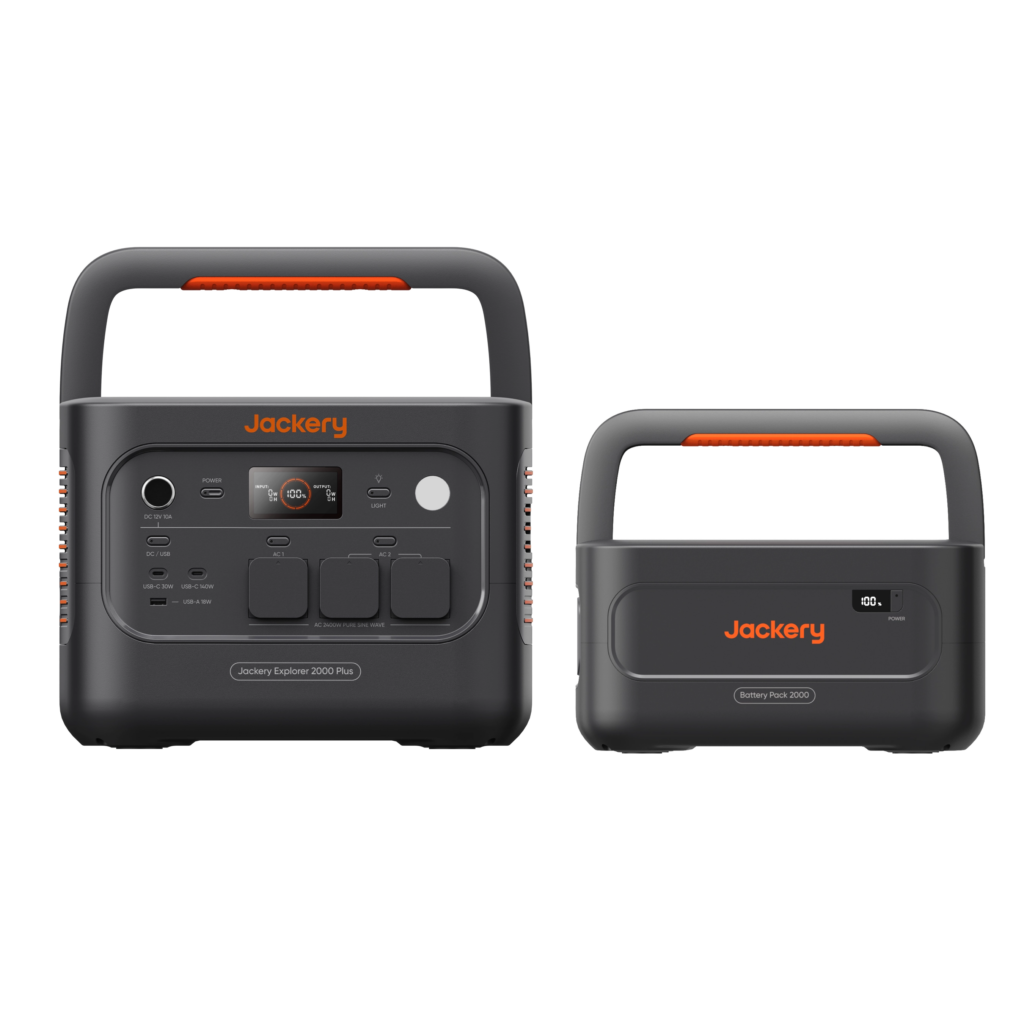
It closes the power station’s biggest gap, endurance, at least partially. According to Jackery, up to five expansion batteries (in German) can be connected, and Jackery gives 6,000 cycles to 70 percent. At 19.1 kilograms, you can still carry it yourself. Expansion batteries, however, quickly make the package more expensive than any gasoline generator.
Jackery Explorer 1000 v2
The cheaper station. According to the retailer, 1,070 watt hours, 4,000 cycles, chargeable from zero degrees, not expandable. That is enough for a night with router, lights and refrigerator, but not for an electric kettle in continuous use. In spring 2025, the ADAC (German automobile club) downgraded the Explorer 1000 v2 to „poor“ because its two DC inputs are not decoupled. So never charge it via solar and the car socket at the same time.
Anker SOLIX C1000 Gen 2
Lots of power for 1 kilowatt hour, so it empties quickly. It suits short loads, less so a long night. Anker does not provide for expansion.
Scheppach SG3500i
The gasoline inverter generator from our generator guide. Scheppach specifies protection class IP23M and a maximum installation altitude of 1,000 meters; according to the manual, it is not intended for commercial use. It runs on Super E10 gasoline.
Güde ISG 3200-2
7.5 hours at half load according to the catalog, plus a trolley function. Despite its 32 kilograms, a candidate if the unit stays at the house.
Honda EU10i
The quiet exception among gasoline generators, with an eco mode. With 1 kVA, it is enough for lights and a laptop, not for much more. According to the price list, it costs more than the SG3500i and is therefore close to the Explorer 2000 Plus v2.
How we would decide
- Rented apartment or close neighbors: power station; there is hardly any other choice. Explorer 2000 Plus v2 or, for modest needs, Anker SOLIX C1000 Gen 2.
- Detached house, worried about several days without power: Explorer 2000 Plus v2 plus SG3500i, with fuel stored according to BBK rules. What else belongs in your preparations is collected in the guide on preparing for power outages (in German).
- Camping: power station. See power stations for camping (in German).
- Woodworking outdoors, days without grid power: gasoline generator, the Güde if in doubt.
- Only once every few years for an hour: a station is ready to go, while a forgotten gasoline generator may not start.
What a cash register, cooling and coffee need over a day is shown in the wattage calculation for a market stall and food truck.
Frequently asked questions
Which lasts longer, a power station or a generator?
The tank. The Scheppach SG3500i gets almost 11 kilowatt hours out of 6.3 liters, while the Explorer 2000 Plus v2 delivers around 1.7 kilowatt hours. So one tank holds a good six battery charges and is refilled in minutes. According to the BBK (German Federal Office of Civil Protection), however, no more than ten kilograms of gasoline may be stored in a basement.
Is a generator worth it for small loads like the refrigerator?
Hardly. With no load, the SG3500i still consumes 0.46 liters per hour, according to the manufacturer. At 100 watts for refrigerator, router and lamps, it burns around 11 liters over the day for 2.4 kilowatt hours. At 100 watts, the power station lasts around 17 hours and uses nothing but its battery.
Can you combine a power station and a generator?
Yes: the generator charges the station, and the station supplies the house. For 24 hours at 100 watts, that would be just over 2 liters instead of 11; the engine runs only one to two hours a day, and the nights stay quiet. Try out the combination before you need it.
Can a generator run at night in a residential area?
Under German regulations, generators operated outdoors in residential areas may not run at all on Sundays and public holidays, and not between 8 p.m. and 7 a.m. on weekdays. Operation that averts a danger is exempt, which can apply to a genuine outage. According to the retailer, the Explorer runs at under 30 dB in quiet charging mode.
Can a generator be used indoors?
No. According to the BBK (German Federal Office of Civil Protection), generators must not be run indoors because of the risk of asphyxiation. Only a well-ventilated, dry spot outdoors is suitable. In an apartment building without a garden, that practically rules out the gasoline generator. A power station can be used inside the home, but it has to be kept dry.
Sources
- BBK: Power outage, preparation and self-help (PDF)
- Gesetze im Internet: 32nd BImSchV (German noise protection ordinance), § 7
- Gesetze im Internet: 32nd BImSchV, annex
- DGUV: Selecting and operating generators on construction and assembly sites (PDF)
- Scheppach: SG3500i
- Scheppach: SG3500i manual (PDF)
- Güde: Generator catalog (PDF)
- Honda: Generator price list 2024/2025 (PDF)
- GreenDrive (retailer information): Explorer 2000 Plus v2
- GreenDrive (retailer information): Explorer 1000 v2
- Anker SOLIX: C1000 Gen 2
- ADAC: Portable power stations tested (spring 2025)
Where to buy
- Jackery Explorer 2000 Plus v2View at JackeryAvailable in Germany: JackeryCheck price at Amazon.deAvailable in Germany: Amazon.de
- Jackery Explorer 1000 v2View at JackeryAvailable in Germany: JackeryCheck price at Amazon.deAvailable in Germany: Amazon.de
- Anker SOLIX C1000 Gen 2Check price at Amazon.deAvailable in Germany: Amazon.de
- Scheppach SG3500iView at scheppachAvailable in Germany: scheppachCheck price at Amazon.deAvailable in Germany: Amazon.de
- Güde ISG 3200-2Check price at Amazon.deAvailable in Germany: Amazon.de
- Honda EU10iCheck price at Amazon.deAvailable in Germany: Amazon.de