Contents9 sections
This guide was first published in German on handgetestet.de.
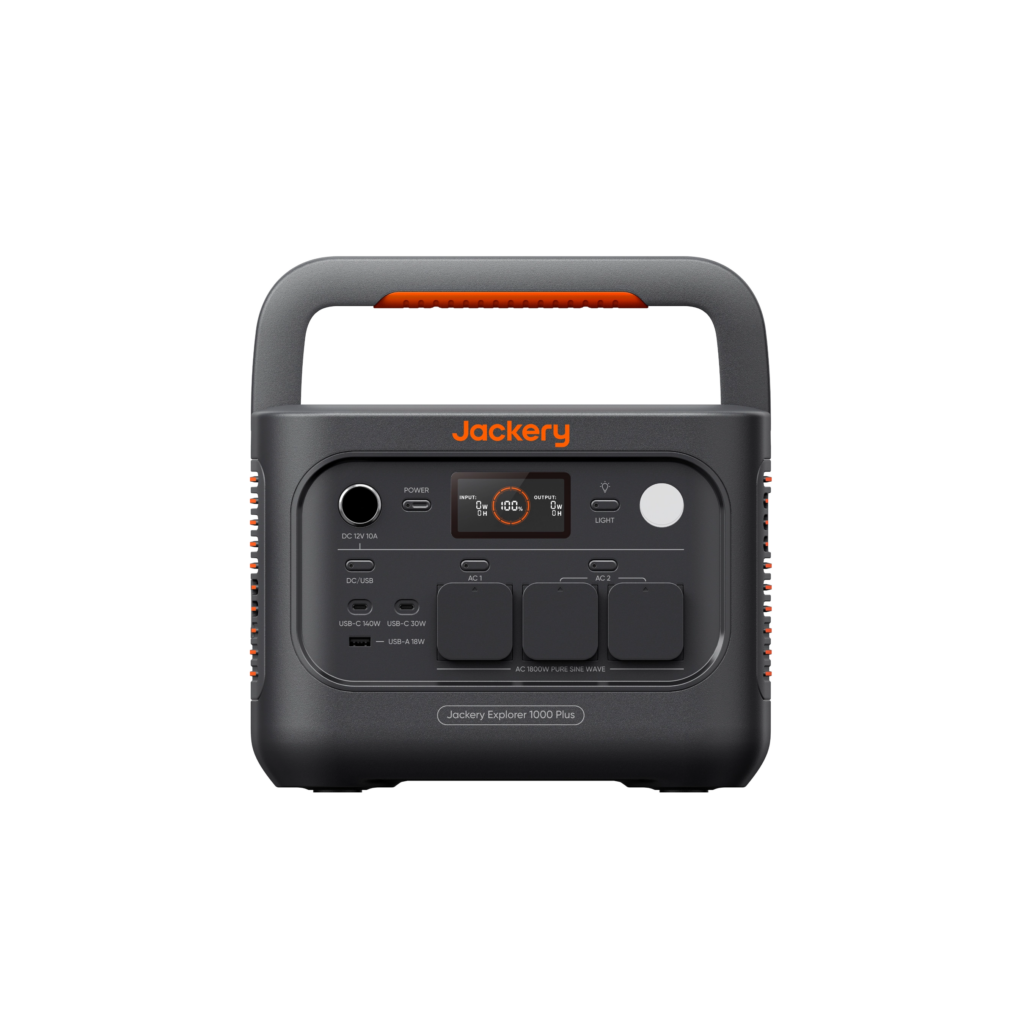
An expansion battery makes a power station last longer, but not more powerful. Keep that sentence in mind before you order your first battery pack. For most households that want to start small and add capacity later, we consider the Jackery Explorer 1000 Plus v2 the most sensible entry point: 10.8 kilograms, 1,024 watt-hours and, according to Jackery, up to five Batteriepack 2000 Plus V2 units (battery pack) on top. If you already know today that you want to run a hot plate and an electric kettle at the same time, you are better off starting one size up. One caveat up front: the Explorer 1000 Plus v2 is new, and all we had were specifications from Jackery and from one retailer, no data sheet and no independent measurement. Read its figures with appropriate caution.
What an expansion battery can and cannot do
The battery pack is pure storage. With Jackery, it has no outlets and no charging input of its own; according to the manufacturer, it can only be charged while it is connected to the matching Explorer station. That applies to the power cord as well as to the solar panel. The station manages both batteries as a single one. That leads to three limits no data sheet prints in bold.
First, the output stays the same. An Explorer 1000 Plus v2 delivers 1,800 watts of continuous output, and it still does with five expansion batteries. Second, the solar input stays the same. On the 1000 Plus v2, that is no more than 400 watts, according to the retailer. Filling the full 11,264 watt-hours through this input takes around 28 hours of blazing sun on paper, which means more like a week in a German spring. Third, the weight grows with it. According to the retailer, each Batteriepack 2000 Plus V2 weighs 14.8 kilograms.
And then there is the risk of mixing things up. Jackery still sells the Batteriepack 1000 Plus and the older Batteriepack 2000 Plus. Both only fit the predecessors without “v2” in the name. According to the manufacturer, they do not work with the new Plus v2 units. So look closely at the model designation.
Six units and batteries that go together
| Model | Capacity / output | Weight | Expansion according to the manufacturer |
|---|---|---|---|
| Jackery Explorer 1000 Plus v2 | 1,024 Wh, 1,800 W | 10.8 kg | up to 5 × Batteriepack 2000 Plus V2, 11,264 Wh in total |
| Jackery Batteriepack 2000 Plus V2 | 2,048 Wh | 14.8 kg | only with Explorer 1000 Plus v2 and 2000 Plus v2 |
| Jackery Explorer 2000 Plus v2 | 2,048 Wh, 2,400 W | 19.1 kg | up to 5 × Batteriepack 2000 Plus V2, 12,288 Wh in total |
| Jackery Explorer 3600 Plus | 3,584 Wh, 3,600 W | 35 kg | up to 5 × Batteriepack 3600 Plus, 21,504 Wh in total |
| Jackery Batteriepack 3600 Plus | 3,584 Wh | 25 kg | only with Explorer 3600 Plus |
| BLUETTI AC200L | 2,048 Wh, 2,400 W | 28.3 kg | up to 2 × B300, 8,192 Wh in total |
Weights and charging times of the Jackery units come from the specifications of an authorized Jackery retailer; capacity and compatibility come from Jackery’s product information.
You want to take it with you and have a reserve at home
Then the Jackery Explorer 1000 Plus v2 is the right fit. At 10.8 kilograms, it remains a unit you can still lift into the car yourself. The battery pack stays in the basement and only gets plugged in when the grid goes down or a long evening in the garden is coming up. According to the retailer, the station charges from the grid in about 1 hour 15 minutes, and in around 49 minutes in the app’s emergency charging mode. According to the same specifications, charging is possible from minus 10 degrees Celsius.
Our reservations: a pairing of station and one Batteriepack 2000 Plus V2 comes to 3,072 watt-hours at 25.6 kilograms, split across two boxes. That is more storage than an Explorer 2000 Plus v2 on its own, but with only 1,800 watts of output and 400 watts of solar input. For a refrigerator, router and lights during a power outage, that is plenty. For a 2,000-watt electric kettle, it is not.
The matching storage
The Jackery Batteriepack 2000 Plus V2 brings 2,048 watt-hours with lithium iron phosphate cells; Jackery specifies 6,000 charge cycles down to 70 percent remaining capacity. A small display shows the charge level. It has a handle and weighs as much as a full crate of drinks. We would not want to move more than one of them on a regular basis.
You need more power, not just more hours
Here the Jackery Explorer 2000 Plus v2 is the more honest choice. 2,400 watts of continuous output can handle a microwave or a hot plate, and the solar input accepts up to 800 watts. With four 200-watt panels, the retailer gives around three and a half hours for a full charge. It uses the same battery packs as its smaller sibling. However, it weighs 19.1 kilograms, which already makes it a two-handed job.
This is exactly the trade-off many people get the wrong way around. If you start with the 1000 Plus v2 and realize after a year that 1,800 watts is not enough, expansion batteries will not change that. So before you buy, check which device draws the most power. Our guide to buying a power station explains how.
You are planning for the whole house
The Jackery Explorer 3600 Plus is no longer a case but a wheeled unit weighing 35 kilograms, with a telescoping handle. In return, it delivers 3,600 watts, accepts up to 1,000 watts of solar power and, according to the retailer, even charges at minus 20 degrees Celsius. There is no 12-volt car socket. If you want to bridge a power outage lasting several days, first use our guide to backup power with a power station (in German) to work out what size your household needs.
Its storage is the Jackery Batteriepack 3600 Plus with 3,584 watt-hours and 25 kilograms, with two handles. It fits the Explorer 3600 Plus exclusively. With five of them, the system reaches 21.5 kilowatt-hours, but also 160 kilograms in total on the basement floor. At this size, you should seriously compare whether a permanently installed storage unit on a balcony solar system with storage would suit your everyday life better.
You want a different brand
The BLUETTI AC200L, with 2,048 watt-hours and 2,400 watts, is positioned similarly to the Explorer 2000 Plus v2, but according to BLUETTI it weighs 28.3 kilograms. It can be expanded to 8,192 watt-hours with two B300 units; according to BLUETTI, it does not support batteries from other manufacturers. At 1,200 watts, the solar input is generous. One drawback for the garden shed: according to the manufacturer, charging is only intended between 0 and 40 degrees Celsius.
Expansion battery or a bigger unit right away? How we would decide
- You carry the station often: Explorer 1000 Plus v2, with one battery pack staying at home.
- You need more than 1,800 watts at a stretch: Explorer 2000 Plus v2, expansion batteries later.
- Backup power for several days, with the unit staying put: Explorer 3600 Plus with one or two Batteriepack 3600 Plus units.
- You charge almost exclusively with sunlight: check the size of the solar input before the number of batteries. More on that in the guide Charging a power station with a solar panel (in German).
Our rule of thumb: an expansion battery makes sense when output and solar input are already sufficient today and you are only short on hours. If you are short on power, only the larger base unit helps. And if you are only planning for the campsite, you can usually do without any expansion at all; the guide to power stations for camping (in German) shows what size is enough there.
What refurbished units are worth is covered in the guide Refurbished power stations.
Frequently asked questions
Does an expansion battery increase a power station's output?
No, only its runtime. An Explorer 1000 Plus v2 delivers 1,800 watts of continuous output, and it still does with five expansion batteries. The solar input stays the same too; on the 1000 Plus v2 it is no more than 400 watts, according to the retailer. If you are short on power, only a larger base unit helps.
Can a Jackery battery pack be charged on its own?
Not according to Jackery. The battery pack has no outlets and no charging input of its own; it only charges while it is connected to the matching Explorer station, whether via the power cord or a solar panel. The station then manages both batteries as a single one.
Does the Batteriepack 2000 Plus fit the v2 units?
No. The Batteriepack 1000 Plus and the older Batteriepack 2000 Plus only fit the predecessors without v2 in the name. The Explorer 1000 Plus v2 and 2000 Plus v2 need the Batteriepack 2000 Plus V2. Check the exact model designation carefully when you order.
How heavy does a power station get with an expansion battery?
According to the retailer, each Batteriepack 2000 Plus V2 weighs 14.8 kilograms. The station and one pack come to 25.6 kilograms together, split across two boxes. With the Explorer 3600 Plus, five battery packs add up to 160 kilograms on the basement floor.
When does an expansion battery make sense?
When output and solar input are already sufficient today and you are only short on hours. A typical case is a portable station whose battery pack stays at home and is plugged in during a power outage. If you charge almost exclusively with sunlight, check the size of the solar input first.
Sources
- Jackery product information on the Explorer 1000 Plus v2, 2000 Plus v2, 3600 Plus and the battery packs
- GreenDrive (authorized Jackery retailer): Explorer 1000 Plus v2
- GreenDrive: Explorer 2000 Plus v2
- GreenDrive: Battery Pack 2000 Plus v2
- GreenDrive: Explorer 3600 Plus
- GreenDrive: Battery Pack 3600 Plus
- BLUETTI: AC200L, data sheet and FAQ
Where to buy
- Jackery Explorer 1000 Plus v2View at JackeryAvailable in Germany: JackeryCheck price at Amazon.deAvailable in Germany: Amazon.de
- Jackery Batteriepack 2000 Plus V2View at JackeryAvailable in Germany: Jackery
- Jackery Explorer 2000 Plus v2View at JackeryAvailable in Germany: JackeryCheck price at Amazon.deAvailable in Germany: Amazon.de
- Jackery Explorer 3600 PlusView at JackeryAvailable in Germany: Jackery
- Jackery Batteriepack 3600 PlusView at JackeryAvailable in Germany: Jackery
- BLUETTI AC200LCheck price at Amazon.deAvailable in Germany: Amazon.de