Contents12 sections
This guide was first published in German on handgetestet.de.
A balcony solar system delivers most of its power at midday. It is needed in the evening. A battery bridges exactly those hours and saves the day’s solar power for later. In Germany, a plug-in solar device may feed in up to 800 W via the inverter, registration in the Marktstammdatenregister (German core energy market data register) is mandatory, and separate rules apply to the battery. When buying, what counts are LiFePO4 cells, expandability and control via a smart meter.
We compare six storage units based on the manufacturers‘ specifications. We have not operated the devices ourselves.
Step one: what is allowed?
The inverter may output a maximum of 800 W, and the panels together may total no more than 2,000 Wp. It is easy to overlook that the 800 W apply per electricity meter, not per device (Verbraucherzentrale, German consumer advice center; Bundesnetzagentur, German Federal Network Agency).
Since the German Solar Package (May 16, 2024), plug-in solar devices no longer have to be reported to the grid operator. Registration in the Marktstammdatenregister remains mandatory, but it was considerably simplified in 2024 (Bundesnetzagentur).
With battery storage, things get more complicated. The EEG (German Renewable Energy Sources Act) has no exemption for batteries attached to plug-in solar devices. According to the Verbraucherzentrale, the rules for battery storage systems therefore apply, which also means notifying the grid operator and stating the storage capacity in the register. Some grid operators waive this. A phone call beforehand clarifies it.
- Schuko plug: The German standard DIN VDE V 0126-95 (December 2025) permits the Schuko plug, the standard German household plug, for devices with up to 960 Wp of panel output, subject to technical requirements. Devices with battery storage are explicitly excluded; the DKE (German standards commission for electrical engineering) is working on a separate part of the standard for them (VDE).
- Meter: An old electromechanical Ferraris meter is tolerated until it is replaced. The switch to a bidirectional meter is handled by the metering point operator (Verbraucherzentrale).
- Renting and owning: Since October 2024, landlords and homeowners‘ associations may only refuse consent if it would be unreasonable (Verbraucherzentrale).
This overview is not legal advice. The linked sources and your grid operator are authoritative.
Step two: how much storage do you need?
That depends on your consumption in the evening and at night. If you do not know it exactly, a small base battery that can grow later is usually smarter than a large battery that stays half empty. What matters then is how many add-on batteries the manufacturer allows and up to what total capacity.
In terms of cell chemistry, the six candidates do not differ. According to the manufacturers, all of them use LiFePO4 (lithium iron phosphate).
Step three: how is it connected?
AC-coupled batteries plug into the outlet; DC-coupled ones sit between the panel and the inverter. If the system already has a built-in inverter, no additional device is needed. How many panels can be connected is determined by the number of MPPT inputs and the maximum panel output.
Without a smart meter, a battery wastes much of its benefit. A meter at the meter cabinet, for example from Shelly, tells it how much power the house is drawing at the moment, and it only releases what is actually being used. A German-language app should be included. According to the manufacturers, some systems support dynamic electricity tariffs.
And once more, the limit. In Germany, the grid output must be capped at 800 W. With several devices, the total counts.
Six batteries from 1.92 to 5.12 kWh
| Model | Capacity | Expandable to | Grid output | Special feature |
|---|---|---|---|---|
| Anker SOLIX Solarbank 3 E2700 Pro | 2.69 kWh | 16.13 kWh | 800 W | 4 MPPT, up to 3,600 W solar input |
| Zendure SolarFlow 800 Pro | 1.92 kWh | 11.52 kWh | 800 W | 4 MPPT, 1,000 W off-grid output |
| EcoFlow STREAM Ultra | 1.92 kWh | 11.52 kWh | 800 W | Two outlets on the device |
| Growatt NOAH 2000 | 2.05 kWh | 8.19 kWh | Via microinverter | DC-coupled, IP66 |
| Marstek Venus E Gen 3.0 | 5.12 kWh | 15.36 kWh | 800 W (default) | AC-coupled, large base battery |
| Jackery SolarVault 3 Pro Max | 2.52 kWh | 15.12 kWh | 800 W (default) | 4 MPPT, up to 4,000 W solar input |
All figures according to the manufacturers, as of October 2026.
Anker SOLIX Solarbank 3 E2700 Pro
Anker describes the Solarbank 3 Pro as an all-in-one battery with a built-in inverter. The base battery has 2.688 kWh; with up to five add-on batteries, the system reaches 16.128 kWh. Four MPPT inputs handle up to 3,600 W of solar power. Anker also lists smart meter integration and support for dynamic tariffs via the app. Plenty of headroom, though at a premium-class price.
Zendure SolarFlow 800 Pro
Zendure also combines battery and inverter in one device. The battery has 1.92 kWh, expandable to 11.52 kWh. 800 W go into the grid. In off-grid mode, Zendure gives 1,000 W as the upper limit, which can become interesting during a power outage. Four MPPT inputs take up to 2,640 W combined. Among the compatible meters, Zendure lists the Shelly Pro 3EM and Shelly 3EM. Zendure now offers the successor SolarFlow 800 Pro 2, according to the listing also with 800 W grid output, 2,640 W solar input and 1.92 kWh, expandable to 11.52 kWh. The first model is now only available to a limited extent (as of November 9, 2026).
EcoFlow STREAM Ultra
According to EcoFlow, the STREAM Ultra contains an inverter with 800 W grid output. The battery starts at 1.92 kWh, expandable to 11.52 kWh. Four MPPT inputs take up to 2,000 W. Practical: two outlets directly on the device that power connected appliances directly. According to the manual, the system works with smart meters from EcoFlow and Shelly as well as with the Tibber Pulse IR.
Growatt NOAH 2000
A battery for retrofitting. Growatt builds the NOAH 2000 as a DC-coupled unit, so it sits between the panels and a separate microinverter such as the NEO 800M-X. One module has 2.048 kWh, four modules make 8.192 kWh. Two MPPT inputs handle up to 1,800 W, and the housing is rated IP66. According to Growatt’s instructions, it is paired via the app with a Shelly 3EM or Shelly Pro 3EM. If your balcony solar system is already in place, you do not have to buy everything new.
Marstek Venus E Gen 3.0
Marstek builds the Venus E Gen 3.0 as an AC-coupled battery and packs 5.12 kWh into the base unit alone. In single-phase operation, several units can be combined up to a maximum of 15.36 kWh. Out of the box it feeds in 800 W; the manufacturer only allows more if the grid operator’s requirements are met. The weight is a problem. The data sheet lists around 60 kg. For a balcony on the third floor, that is a real hurdle.
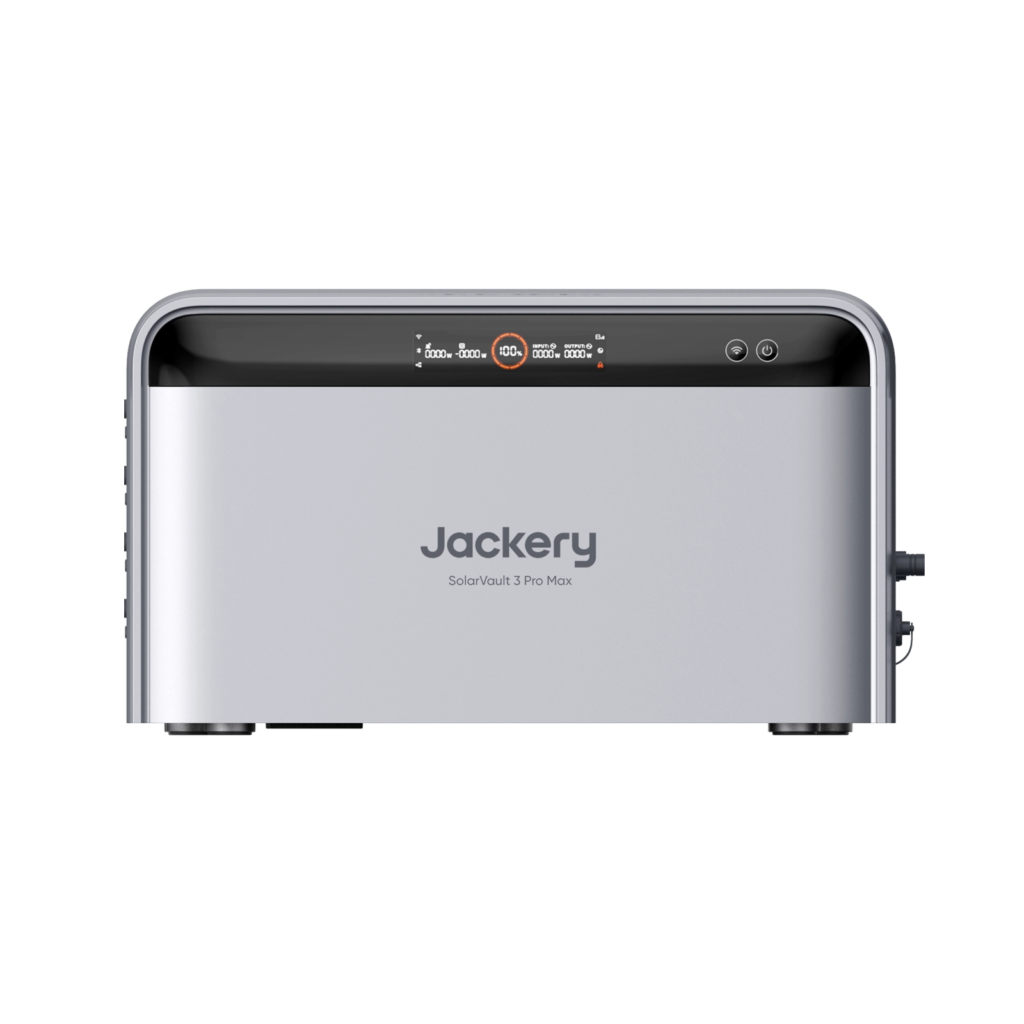
Jackery SolarVault 3 Pro Max
According to Jackery, the base unit holds 2.52 kWh, and with up to five add-on batteries 15.12 kWh per system are possible. Four MPPT inputs take up to 4,000 W. None of the other five batteries manages that much. Grid feed-in is set to 800 W out of the box. Among the compatible meters, Jackery lists the Shelly Pro 3EM and Shelly Pro EM-50.
Step four: which battery suits which system
Many panels, major expansion planned? Then the Anker SOLIX Solarbank 3 E2700 Pro and the Jackery SolarVault 3 Pro Max are worth considering, both with the highest solar input and plenty of room for expansion according to the manufacturers. For a compact start, the Zendure SolarFlow 800 Pro or EcoFlow STREAM Ultra are a good fit; they start at 1.92 kWh and grow with add-on batteries.
You can retrofit an existing balcony solar system on the DC side with the Growatt NOAH 2000, provided your microinverter is on Growatt’s compatibility list. The Marstek Venus E Gen 3.0 offers the most storage from the first unit, with 5.12 kWh. Plan a fixed location for it.
For each of these solutions: a smart meter is part of the package, and you should clarify the battery and the connection with your grid operator in advance.
If you know your consumption, you should also check the price per kilowatt hour. Notice periods, special termination rights and the typical bonus traps are explained in our guide switching electricity providers (in German).
If you are also thinking about the climate when switching, our guide to green electricity tariffs (in German) shows which labels really make a difference.
For individual devices during a power outage, a portable power station is often enough; see our guide backup power with a power station (in German).
If you already have panels and only want to add a battery, you will find AC coupling, capacity and registration covered in our guide retrofitting battery storage.
Which mount suits a railing, flat roof or tiled roof, and who has to give consent, is covered in our guide to balcony solar mounts.
What yield is realistic is calculated in our guide balcony solar yield; the formalities are in our guide registering a balcony solar system, and the economics in our guide balcony battery: a sample calculation.
Two specific questions are covered in separate guides: the comparison of SolarVault 3 Pro, Pro Max and Pro Max AC and the HomePower 2000 Ultra profile.
Frequently asked questions
How much power may a balcony solar system feed in in Germany?
The inverter may output a maximum of 800 W, and the panels together may total no more than 2,000 Wp. It is easy to overlook that the 800 W apply per electricity meter, not per device. With several devices, the total counts.
Does a balcony solar system with battery storage have to be reported to the grid operator?
For plug-in solar devices alone, notification has no longer been required since the German Solar Package; registration in the Marktstammdatenregister (German core energy market data register) remains mandatory. With battery storage, according to the Verbraucherzentrale (German consumer advice center), the rules for battery storage systems apply, which also means notifying the grid operator and stating the storage capacity. Some grid operators waive this; a phone call beforehand clarifies it.
How large should the battery be?
That depends on your consumption in the evening and at night. If you do not know it exactly, a small base battery that can grow later is usually smarter than a large battery that stays half empty. What matters then is how many add-on batteries the manufacturer allows and up to what total capacity.
Does a balcony battery need a smart meter?
Without a smart meter, a battery wastes much of its benefit. A meter at the meter cabinet, for example from Shelly, tells it how much power the house is drawing at the moment, and it only releases what is actually being used. According to the manufacturers, some systems also support dynamic electricity tariffs.
What is the difference between AC-coupled and DC-coupled storage?
AC-coupled batteries such as the Marstek Venus E Gen 3.0 plug into the outlet. DC-coupled ones such as the Growatt NOAH 2000 sit between the panel and the inverter and are suitable for retrofitting an existing system. Systems with a built-in inverter need no additional device.
May a balcony solar system with battery storage run via a Schuko plug?
The German standard DIN VDE V 0126-95 of December 2025 permits the Schuko plug (the standard German household plug) for devices with up to 960 Wp of panel output, subject to technical requirements. Devices with battery storage are explicitly excluded; the DKE (German standards commission for electrical engineering) is working on a separate part of the standard for them.
Sources
- Verbraucherzentrale (German consumer advice center): plug-in solar – solar power from the balcony
- Bundesnetzagentur (German Federal Network Agency): balcony solar systems
- Bundesnetzagentur: simplified registration of balcony solar systems
- Marktstammdatenregister: registration help for solar systems
- VDE: product standard for plug-in solar devices
- Anker: SOLIX Solarbank 3 E2700 Pro
- Zendure: SolarFlow 800 Pro
- EcoFlow: STREAM Ultra
- EcoFlow: STREAM Ultra and Pro manual
- Growatt: NOAH 2000
- Growatt: NOAH 2000 with Shelly meters
- Marstek: Venus E Gen 3.0
- Jackery: SolarVault 3 Pro Max
Where to buy
- Anker SOLIX Solarbank 3 E2700 ProCheck price at Amazon.deAvailable in Germany: Amazon.de
- Zendure SolarFlow 800 Pro 2Check price at Amazon.deAvailable in Germany: Amazon.de
- Zendure SolarFlow 800 ProCheck price at Amazon.deAvailable in Germany: Amazon.de
- EcoFlow STREAM UltraCheck price at Amazon.deAvailable in Germany: Amazon.de
- Growatt NOAH 2000Check price at Amazon.deAvailable in Germany: Amazon.de
- Marstek Venus E Gen 3.0Check price at Amazon.deAvailable in Germany: Amazon.de
- Jackery SolarVault 3 Pro MaxView at JackeryAvailable in Germany: Jackery