Contents10 sections
This guide was first published in German on handgetestet.de.
Modules and inverters are ordered in no time. When it comes to the mount, things go quiet, even though it decides whether the balcony solar system stays put in an autumn storm. For the most common situation, a single module on the balcony railing of a rented apartment, we consider the Jackery balcony mount for one module the sensible choice, because it can be installed both vertically and tilted. If you only want the module flat against the railing and want to spend little, the Technaxx TX-249 set from ELV (German retailer) will do. Garage roofs, gardens and tiled roofs have their own solutions, and that is exactly how this guide is structured: by the place where your modules are meant to hang.
Before you buy: who has to consent, and what can the railing hold?
Since October 2024, plug-in solar devices have enjoyed privileged status under German tenancy law and condominium law. Under Section 554 of the German Civil Code (BGB), a tenant can demand that the landlord permit the structural alteration for a plug-in solar device; the landlord may only refuse if it cannot reasonably be expected of them, even taking the tenant’s interests into account. For condominium owners, Section 20 of the German Condominium Act (WEG) provides the same. The German consumer advice center (Verbraucherzentrale) points out that a refusal without justification or purely for visual reasons is no longer permitted.
You still have to ask. And this is where the mount comes into play. The Condominium Act explicitly states that the implementation is decided within the framework of proper administration. In other words, the owners‘ association has a say in how the module is attached. So include the data sheet and scope of delivery of the planned mount with your request right away. That saves a second round.
When it comes to structural load, there is no rule of thumb that fits every railing. A masonry parapet carries loads differently than a thin steel railing with glass panels or a thirty-year-old wooden railing. And a module is not just weight; above all, it is a surface that the wind pulls on. If you have doubts about the condition of your railing, have your landlord, property management or a metalworker confirm it. In terms of building regulations, things have become simpler: according to the Verbraucherzentrale NRW, the German Institute for Building Technology (Deutsches Institut für Bautechnik) determined in September 2023 that plug-in solar devices are not construction products; the former special requirements for glass modules installed higher than four meters therefore no longer apply.
Also report the device to your liability or household contents insurance. The Verbraucherzentrale NRW advises doing so and recommends keeping the confirmation. If a module ever does fall off the balcony, that is the insurance that counts.
Vertical or tilted? What the angle gets you
Most buyers want to tilt their modules because it sounds like more yield. That is true, but less dramatically than you might think. According to figures from the Verbraucherzentrale, a 400-watt module tilted at 30 degrees facing south produces around 400 kilowatt hours a year. Mounted vertically on an unshaded south-facing balcony, it is around 280 kilowatt hours. Vertical mounting, however, has an advantage many people overlook: it cuts off the midday peaks in summer, which you hardly consume yourself anyway, and delivers more usable power in the winter half of the year.
A tilted module also sticks out farther from the railing and offers the wind more surface to grab. On a fourth-floor balcony, that is no minor detail. Something else speaks against a flat angle: according to the Verbraucherzentrale, 15 degrees is enough for rain to rinse off the usual dirt. A module lying horizontally, on the other hand, stays dirty.
And where should it never go? The Verbraucherzentrale names the recess behind the parapet, the wall under the balcony above and surfaces facing between northeast and northwest. Even a small permanent shadow on one corner of a module can more than halve its output.
Five mounts by installation location
| Mount | Location | Tilt | Material, weight | Best for |
|---|---|---|---|---|
| Jackery balcony mount for 1 module | Balcony railing | 0° or 10–30° | Aluminum, 2.4 kg | Rented apartment, one rigid module |
| Technaxx TX-249 | Balcony railing | No tilt frame | Aluminum hooks, stainless steel cable ties | Two modules flat on the railing |
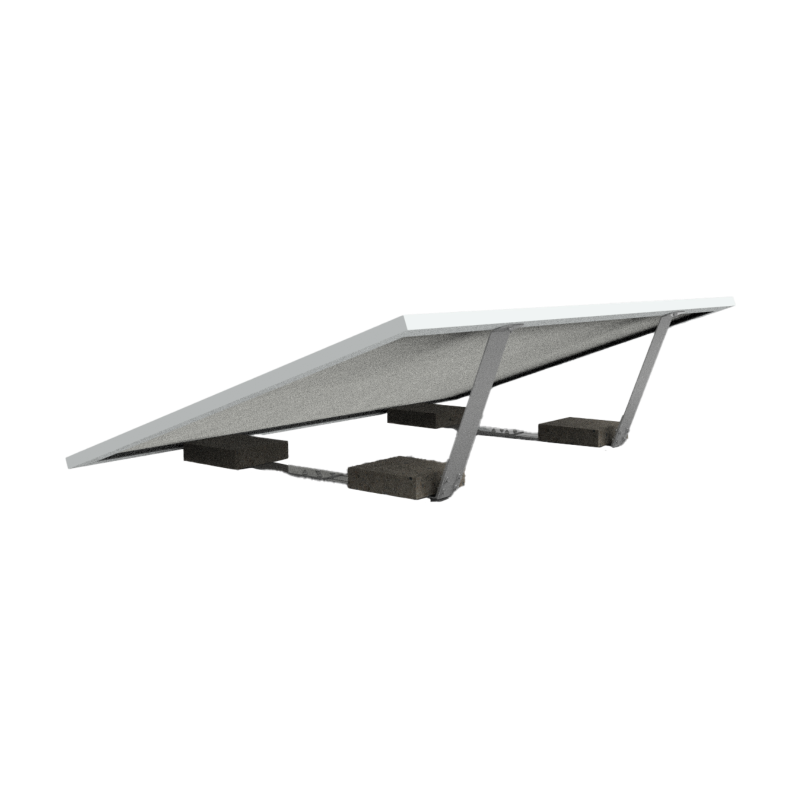
| Jackery flat roof and garden mount for 1 module | Flat roof, lawn | 20° fixed | Steel, 5.76 kg | Garage roof, garden |
| Jackery pitched roof mount for 2 modules | Tiled roof | Follows the roof | Aluminum, 10.21 kg | Garden shed, carport with tiles |
| Jackery mounting bracket for 4 lightweight modules | Balcony, courtyard, flat roof, wall | 30° or 60° | Steel, 26.5 kg | Four lightweight modules, with storage |
All specifications according to Jackery or ELV. The manufacturers do not state a wind load or a maximum load per module for these mounts online. Ask before you buy if your module is significantly larger or heavier than a common 400- to 450-watt module.
On the railing: Jackery balcony mount for 1 module
Hooks, two rails, two adjustable legs and end clamps, all made of aluminum and weighing 2.4 kilograms in total. According to Jackery, the module can hang vertically or be tilted at 10 to 30 degrees; in the product image, the legs range from 300 to 530 millimeters. That keeps both options open in case the property management later only accepts the vertical version. The warranty is 18 months. The mount is designed for one rigid framed module; for two modules, you need two sets.
Flat and affordable: Technaxx TX-249
The set from ELV is more of a safety attachment than a frame. Four aluminum hooks measuring 4 × 40 × 220 millimeters hang the module over the railing, four 300-millimeter stainless steel cable ties pull it tight, and rubber strips protect the paint and frame. According to ELV, the hooks are meant to prevent the modules from falling and the cable ties to stop them from flapping in the wind. A tilt is not provided for. For two modules on a sturdy bar railing, that is enough. For glass parapets or railings with a wide handrail, check beforehand whether the hooks can grip at all.
Garage roof and garden: Jackery flat roof and garden mount
A steel frame with a fixed 20-degree angle, weighing 5.76 kilograms, intended by Jackery for lawns and flat roofs. The frame rests on ballast. The weights themselves are not included; Jackery only supplies the fastening parts for the feet. The manufacturer does not state online how much ballast is needed; ask before the frame goes onto an exposed garage roof. Plan for concrete slabs and place a protective mat underneath on roofing felt or membrane.
Tiled roof: Jackery pitched roof mount for 2 modules
Four rails, six roof hooks, middle and end clamps, 10.21 kilograms of aluminum. The modules lie parallel to the roof surface. This is a mount for a garden shed or outbuilding with tiles that you can reach safely. In our opinion, it only belongs on the roof of a residential house with a roofer. Working up there without fall protection is saving in the wrong place.
Four modules: Jackery mounting bracket for 4 lightweight modules
The heaviest system here: 26.5 kilograms of steel, eight metal hooks, a choice of 30 or 60 degrees. Jackery names balconies, courtyards, flat roofs and walls as places of use, but only for lightweight, rigid modules. The inverter may still only output 800 watts. The Verbraucherzentrale sees the advantage of four modules mainly in cloudy weather and in the morning and evening, and considers more than two modules usually worthwhile for a system with storage. We cover the storage itself in our buying guide to balcony solar systems with storage (in German). From 960 watts of module output, according to the Verbraucherzentrale, you also need a dedicated feed-in socket installed by a qualified electrician.
How we would decide
- Rented apartment, one module, metal railing: Jackery balcony mount, vertical to start with.
- Two modules, small budget, tilt does not matter: Technaxx TX-249.
- Garage roof or lawn: Jackery flat roof and garden mount, plan for ballast.
- Garden shed with tiles: Jackery pitched roof mount.
- Four lightweight modules with storage: Jackery mounting bracket for 4 modules.
Check the mounting after every storm. Screws settle, and cable ties age in the sun. If you would rather stay mobile than have a fixed balcony solar system, the guide to the foldable solar panel and the guide to charging a power station with a solar panel (in German) offer solutions with no mount at all and no request to the property management.
If the railing is too weak for glass, the designs in the guide to lightweight solar modules (in German) can help.
How much tilt and orientation make a difference over the year is shown in the guide balcony solar yield. Registration is explained in the guide registering a balcony solar system.
Frequently asked questions
Can my landlord prohibit a balcony solar system?
Hardly anymore. Under Section 554 of the German Civil Code (BGB), a tenant can demand that the landlord permit a plug-in solar device; the landlord may only refuse if it would be unreasonable. For condominium owners, Section 20 of the German Condominium Act (WEG) provides the same. You still have to ask, so include the data sheet and the scope of delivery of the mount right away.
Does a tilted balcony module produce much more power?
Less than you might think. According to figures from the German consumer advice center (Verbraucherzentrale), a 400-watt module tilted at 30 degrees facing south produces around 400 kilowatt hours a year, and around 280 when mounted vertically on an unshaded south-facing balcony. In return, vertical mounting cuts off the summer peaks and offers the wind less surface to grab.
Where should a balcony module not go?
The Verbraucherzentrale names the recess behind the parapet, the wall under the balcony above and surfaces facing between northeast and northwest. Even a small permanent shadow on one corner of a module can more than halve its output. A module lying horizontally also stays dirty; a 15-degree tilt is enough for rain to rinse it off.
Can my balcony railing hold a solar module?
There is no rule of thumb that applies to every railing. A masonry parapet carries loads differently than a thin steel railing with glass or an old wooden railing, and a module is above all a surface that the wind pulls on. If in doubt, have your landlord, property management or a metalworker confirm its condition.
Which mount suits a garage roof or a garden?
The Jackery flat roof and garden mount, a steel frame with a fixed 20-degree angle. It rests on ballast, but the weights are not included, and Jackery does not state online how much ballast is needed. Ask before the frame goes onto an exposed garage roof.
Do I have to report the balcony solar system to my insurance?
The Verbraucherzentrale NRW advises reporting the device to your liability or household contents insurance and keeping the confirmation. If a module ever does fall off the balcony, that is the insurance that counts. Also check the mounting after every storm.
Sources
- Product information from Jackery on the four mounts
- ELV: Technaxx TX-249 mount (retailer information)
- Verbraucherzentrale: Plug-in solar, solar power from the balcony
- Verbraucherzentrale NRW: Frequently asked questions about plug-in solar devices
- Section 554 BGB (German Civil Code): Accessibility, e-mobility, burglary protection and plug-in solar devices
- Section 20 WEG (German Condominium Act): Structural alterations
Where to buy
- Jackery Balkonhalterung für 1 ModulView at JackeryAvailable in Germany: Jackery
- Technaxx TX-249View at ELVAvailable in Germany: ELVCheck price at Amazon.deAvailable in Germany: Amazon.de
- Jackery Flachdach- und Gartenhalterung für 1 ModulView at JackeryAvailable in Germany: Jackery
- Jackery Schrägdachhalterung für 2 ModuleView at JackeryAvailable in Germany: Jackery
- Jackery Montagehalterung für 4 leichte ModuleView at JackeryAvailable in Germany: Jackery