Contents13 sections
This guide was first published in German on handgetestet.de.
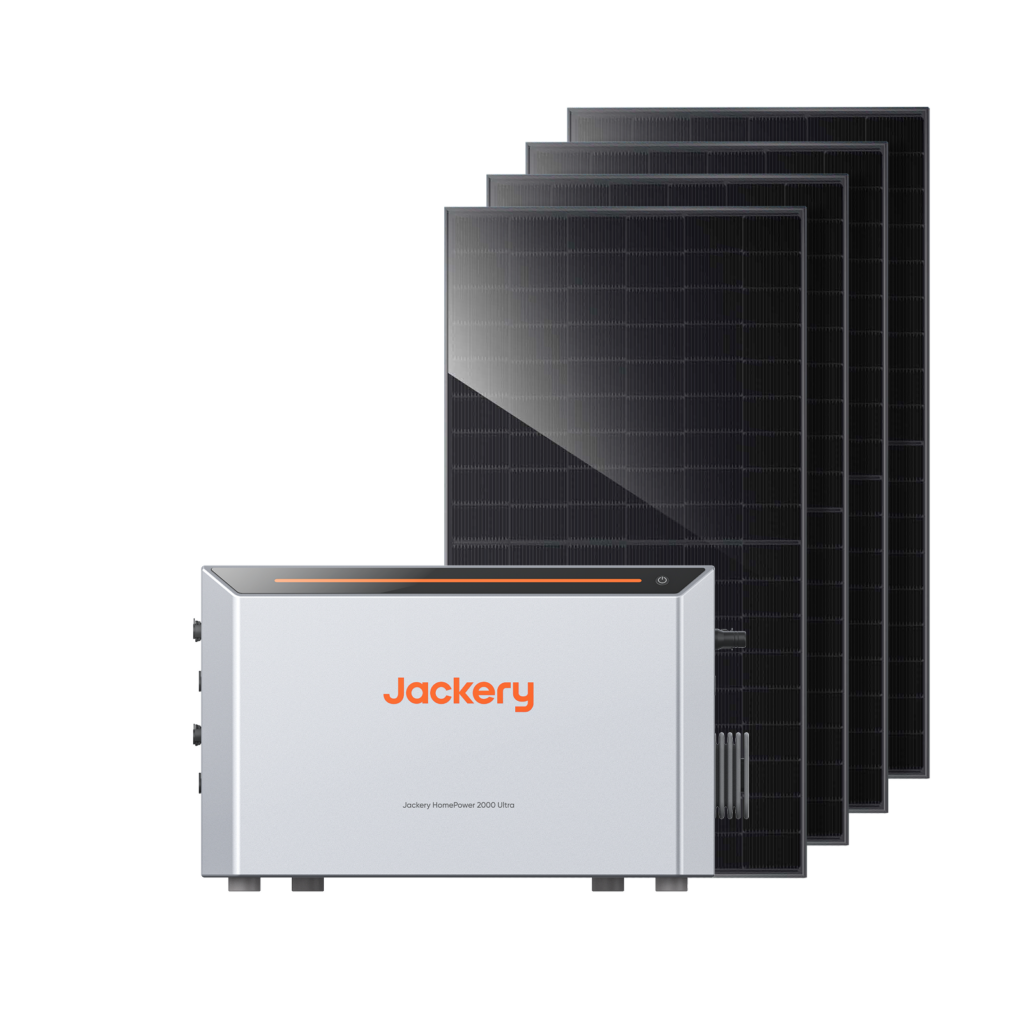
The name is misleading. The Jackery HomePower 2000 Ultra does not power a house; it is a balcony battery, that is, a storage unit for a plug-in balcony solar system, with a built-in inverter that feeds 800 watts into the home grid and keeps exactly one output running during a power outage. For a row house or an apartment with room for four panels, we consider the set with 4×450 Wp the most sensible version; if you already own panels, buy only the main unit. Through a long power outage, it will carry the refrigerator and router, not the heating plus the kitchen.
What’s inside the gray box
Battery, charge controller and inverter sit in a 270 × 445 × 270 millimeter housing that weighs 26.4 kilos. Jackery states 2,048 watt-hours of total energy and 1,945 watt-hours of rated energy, and the cells are lithium iron phosphate. Two solar inputs with MC4 connectors each accept up to 1,000 watts. From the wall socket, the unit charges at up to 2,300 watts, and 800 watts go into the home grid by default. On top of that, there is a separate load output with 1,500 watts that, according to Jackery, takes over within 20 milliseconds if the grid fails.
Up to three expansion batteries can be stacked, giving 8 kilowatt-hours. According to Jackery, they only fit this series. The manufacturer states IP65, operation from minus 20 to plus 55 degrees Celsius with reduced output from 45 degrees, 6,000 charge cycles and a 10-year warranty. New on this unit is an aerosol extinguishing system that triggers automatically in the event of a fire. We are not aware of any independent testing of this system. Treat it as a manufacturer claim, not as a reason to set up the unit in an escape route.
Which home is it suitable for?
Rented apartment with a balcony. Technically, everything works; the math is the problem here. With two vertically hung panels, a battery usually does not pay for itself within ten years, according to our sample calculation for balcony batteries. In this case, only buy it if you really want the backup power output.
Row house or single-family home without a solar system, with a garage roof or garden. This is its territory. Four panels at 450 Wp each add up to 1,800 Wp and stay below the 2,000 Wp that German law permits for plug-in solar devices. According to the German consumer advice center (Verbraucherzentrale), four panels deliver twice as much as two in cloudy weather, in the morning and in the evening. That fills the battery even on mediocre days.
According to Jackery, single-family homes usually have three phases. So that the battery can follow consumption, the manufacturer names the Shelly Pro 3EM for this, and the Shelly Pro EM 50 for single-phase apartments. Both are installed in the meter cabinet, so call a qualified electrician for this. What the control does is explained in our guide to zero feed-in (in German).
House with a rooftop system. Wrong device. The solar inputs top out at 60 volts. For an existing system, a battery that couples via the home grid is the option, and that is covered in our article on retrofitting a home battery.
House with a heat pump or electric car. Not here either. Two kilowatt-hours and 800 watts are simply too little for such loads.
Four limits you should know before buying
The first is called 800 watts. If a 2,000-watt electric kettle runs in the evening, 1,200 watts still come from the grid, no matter how full the battery is. The base load looks better: at 150 watts and, conservatively calculated, 85 percent of usable energy, one charge lasts around eleven hours. That is one night.
The second limit is backup power. It is only available at the load output, not at the sockets in the house. According to the Verbraucherzentrale, that applies to most balcony batteries. A refrigerator using 0.8 kilowatt-hours a day, plus a router and some lighting, around 1.15 kilowatt-hours in total: a full HomePower lasts about a day and a half with that, longer with sunshine, because the panels keep recharging. But the unit stands where the panels are. So a refrigerator in the kitchen needs a cable running through the house. What happens when compressors start up is covered in our runtime calculation, and more on planning in our guide backup power with a power station (in German).
Third, the big number in the advertising. The 2,800 watts of solar power are made up of 2,000 watts at the inputs and 800 watts via an additional microinverter, and that goes beyond the 2,000 Wp that apply to plug-in solar. The annual savings Jackery cites do not hold up well either: they apply to three expansion batteries and 40 cents per kilowatt-hour, and assume that almost all of the 3,360 kilowatt-hours are consumed in the house. Hardly any household manages that.
Fourth, the formalities. According to the Verbraucherzentrale, the German standard for plug-in solar devices with a Schuko plug (the standard German plug), in force since December 2025, only covers devices without storage up to 960 watts of panel output. Batteries are subject to the same rules as other battery storage systems, including registration in the official register and, depending on the grid operator, a notification. Clarify this beforehand. The steps are described in our guide registering a balcony power plant.
What independent testers say
Nothing about the HomePower itself. In issue 4/26, Stiftung Warentest, the German consumer testing organization, tested five balcony batteries, none of them from Jackery. The ratings ranged from Satisfactory to Poor, and three units failed due to electromagnetic interference. With four models, water got into the sockets during heavy rain, even though they are approved for outdoor use. How the HomePower would fare is unknown. So it is better to place it under a canopy, IP65 or not.
Versions and alternatives side by side
| Model | Storage, expansion | Grid and backup power according to manufacturer | Best for |
|---|---|---|---|
| Jackery HomePower 2000 Ultra with 4×450 Wp | 2.05 kWh, up to 8 kWh | 800 W, load output 1,500 W | Homes without a solar system, room for four panels |
| Jackery HomePower 2000 Ultra | 2.05 kWh, up to 8 kWh | 800 W, load output 1,500 W | Panels already in place |
| Jackery SolarVault 3 Pro | 2.52 kWh, up to 15.12 kWh | 800 or 1,200 W, device socket 1,200 W | Panels facing several directions |
| EcoFlow STREAM AC Pro | 1.92 kWh, up to 11.52 kWh | 800 W, backup power not clearly specified | Balcony power plant stays as it is |
| Anker SOLIX Solarbank 3 E2700 Pro | 2.69 kWh, up to 16.2 kWh | up to 1,200 W, off-grid socket | many panels on a large area |
| Anker SOLIX Solarbank 4 E5000 Pro | 5 kWh, up to 30 kWh | 800 W, off-grid output 2,500 W | high evening consumption, more powerful devices in an emergency |
Jackery HomePower 2000 Ultra with 4×450 Wp
The set for homes with open space. It puts the battery where, according to our calculation, it is most likely to earn something, and stays within the legal limits. Four glass panels do, however, need space and a load-bearing base. Check the offer to see whether the mounting bracket and energy meter are included with the version you choose.
Jackery HomePower 2000 Ultra
The main unit on its own suits existing panels. Jackery requires an open-circuit voltage of 17.5 to 60 volts and no more than 26 amps per input. Several panels may be connected in parallel to one input, but normally not in series. Add up the current before you order.
Jackery SolarVault 3 Pro
Four separate solar inputs instead of two. That helps if the panels face east, south and west or are partly in shade. At 25.5 kilos, it weighs almost the same, but stores 2.52 kilowatt-hours and can be expanded further. For grid failures, the manual states the same 20 milliseconds, but with 1,200 instead of 1,500 watts at the device socket.
EcoFlow STREAM AC Pro
This battery has no solar inputs and connects to the home grid. That is why an existing microinverter simply stays where it is. The 21.5 kilos are easier to carry, and EcoFlow also gives a 10-year warranty. Whether the two sockets keep running during a grid failure is not clearly stated in the data sheet. Ask if that matters to you.
Anker SOLIX Solarbank 3 E2700 Pro
Anker states 2,688 watt-hours, four solar inputs and up to eight panels. The unit was part of the Warentest lineup; its individual rating is in the paid report. With 3,600 watts of input power, it is aimed at large panel areas. For plug-in solar, it still stays at 2,000 Wp.
Anker SOLIX Solarbank 4 E5000 Pro
The alternative if 1,500 watts is not enough in an emergency. The off-grid output delivers 2,500 watts, and the unit starts at 5 kilowatt-hours. But it weighs 50 kilos, and above 800 watts of grid output, Anker requires a qualified electrician. Our balcony calculation clearly argues against this size, but in a house with high evening consumption, things look different.
How we would decide
Among the devices compared here, our ranking looks like this.
- Home without a solar system, room for four panels, backup power wanted: HomePower 2000 Ultra with 4×450 Wp.
- Suitable panels already in place: just the main unit; check the current limit beforehand.
- Panels spread across several directions: SolarVault 3 Pro.
- Balcony power plant with its own inverter should remain untouched: STREAM AC Pro.
- Two vertical panels and savings as the only goal: better no battery at all.
Frequently asked questions
Can the Jackery HomePower 2000 Ultra power an entire house?
No. It feeds 800 watts into the home grid; during a power outage, only the separate load output keeps supplying 1,500 watts, not the sockets in the house. A full charge keeps a refrigerator, router and some lighting going for about a day and a half, but not the heating and kitchen.
How long does one battery charge last for the base load?
At a base load of 150 watts and a conservative 85 percent of usable energy, one charge lasts around eleven hours, so one night. If, on the other hand, a 2,000-watt electric kettle is running, 1,200 watts still come from the grid, no matter how full the battery is.
Is the HomePower 2000 Ultra compatible with an existing rooftop system?
No. The solar inputs top out at 60 volts. For an existing rooftop system, a battery that couples via the home grid is the option. For homes with a heat pump or electric car, two kilowatt-hours and 800 watts are simply too little as well.
Is a balcony battery worth it with just two panels?
With two vertically hung panels, a battery usually does not pay for itself within ten years, according to our sample calculation. In that case, only buy it if you really want the backup power output. According to the German consumer advice center (Verbraucherzentrale), four panels deliver twice as much as two in cloudy weather, in the morning and in the evening.
Which energy meter goes with the HomePower 2000 Ultra?
For three-phase single-family homes, Jackery names the Shelly Pro 3EM, and for single-phase apartments the Shelly Pro EM 50. Both are installed in the meter cabinet, so call a qualified electrician. Check the offer to see whether the mounting bracket and energy meter are included with the version you choose.
Which alternative fits with panels facing several directions?
The Jackery SolarVault 3 Pro, with four separate solar inputs instead of two. It stores 2.52 kilowatt-hours and weighs almost the same. If an existing balcony power plant with its own inverter is to remain untouched, the EcoFlow STREAM AC Pro fits; it has no solar inputs and connects to the home grid.
Sources
- Jackery: HomePower 2000 Ultra product information
- Jackery: Press release on the HomePower 2000 Ultra
- Jackery: SolarVault 3 Pro technical data (PDF)
- EcoFlow: STREAM AC Pro data sheet (PDF)
- Anker SOLIX: Solarbank 4 Pro with comparison to the Solarbank 3
- Verbraucherzentrale: Plug-in solar, solar power from the balcony
- Stiftung Warentest: Batteries for balcony power plants (issue 4/26)
Where to buy
- Jackery HomePower 2000 Ultra mit 4×450 WpView at JackeryAvailable in Germany: Jackery
- Jackery HomePower 2000 UltraView at JackeryAvailable in Germany: JackeryCheck price at Amazon.deAvailable in Germany: Amazon.de
- Jackery SolarVault 3 ProView at JackeryAvailable in Germany: JackeryCheck price at Amazon.deAvailable in Germany: Amazon.de
- EcoFlow STREAM AC ProCheck price at Amazon.deAvailable in Germany: Amazon.de
- Anker SOLIX Solarbank 3 E2700 ProCheck price at Amazon.deAvailable in Germany: Amazon.de
- Anker SOLIX Solarbank 4 E5000 ProCheck price at Amazon.deAvailable in Germany: Amazon.de