Contents13 sections
This guide was first published in German on handgetestet.de.
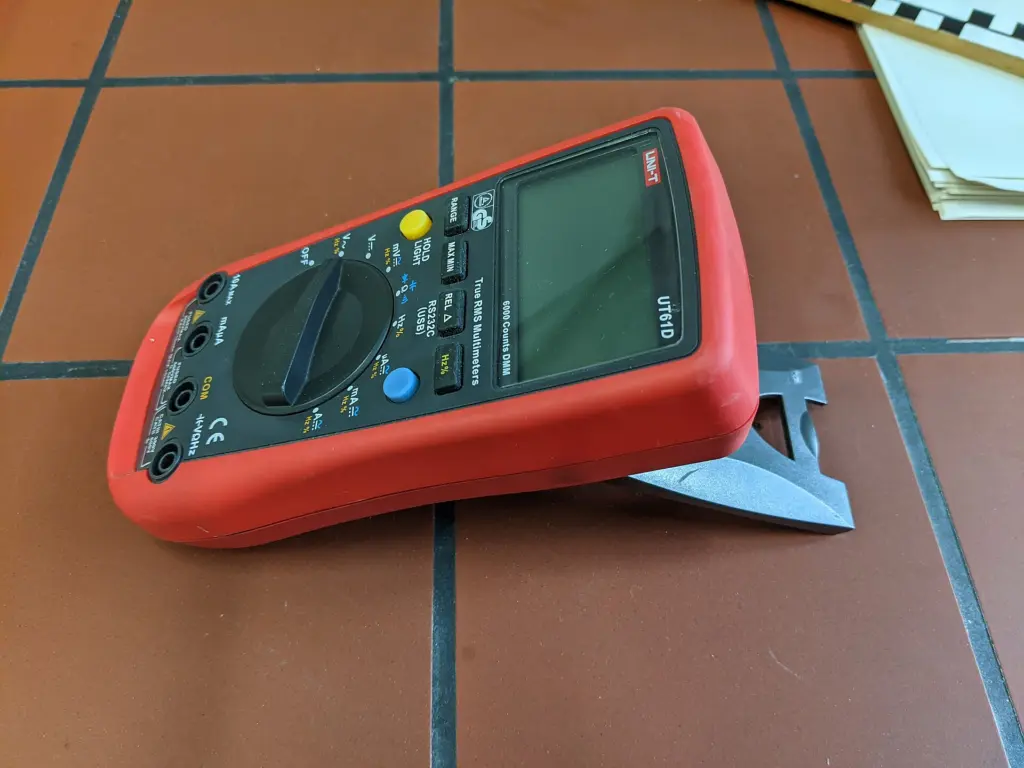
A multimeter does not answer the question of whether a line is de-energized. That is what two-pole voltage testers according to DIN EN 61243-3 are for, and work on the household electrical installation belongs in the hands of a qualified electrician. As a measuring instrument for everyday work in buildings, we recommend the Fluke 117 with CAT III 600 V, True RMS and a LoZ input against ghost voltages. For electronics, batteries and a car’s electrical system, the UNI-T UT61E+ is enough and even offers finer resolution.
On the hobby bench, the multimeter usually sits next to the soldering iron; which station goes with it is covered in our soldering station guide (in German). And before anyone drills into a wall, a cable detector helps. You will find the right one in the wall scanner guide (in German).
First clarify where you measure, then choose the device
Three questions sort the range. Where do you measure: on a circuit board, on a car battery, on plug-connected equipment or in the distribution board? Besides voltage and resistance, do you also need current? And how fine does the display resolution have to be? A device with 22,000 counts shows one digit more than one with 6,000. On a 12 V battery, that does not matter. For sensor signals or reference voltages, it does.
A typical bad buy looks like this: 1000 V on the rotary switch, but no measurement category next to the jacks.
What CAT II, III and IV mean
The measurement category according to DIN EN 61010-1 indicates the place of use a measuring instrument is designed for. The German employers‘ liability insurance association BG ETEM assigns them as follows: CAT I applies to circuits without a connection to the mains. CAT II stands for equipment connected to the mains via a plug, such as household appliances and power tools. CAT III covers the building installation with distribution boards, circuit breakers, wiring and permanently connected machines. CAT IV begins at the service connection point, that is, at the meter and the upstream overcurrent protection device.
Category and voltage belong together. For the Fluke 117, CAT III 600 V means an impulse withstand voltage of 6 kV peak, according to the data sheet. The test leads count too: according to BG ETEM, they must be labeled in accordance with DIN EN 61010-031 with the category, rated voltage and permissible current. The same principle applies to the fuses in the device. In measurement circuits with 1000 V CAT III or 600 V CAT IV, more than 10,000 A can flow in the event of a fault, which is why BG ETEM requires high-breaking-capacity fuses with the breaking capacity printed on them. Fuses without this information are not suitable there.
True RMS and LoZ, briefly explained
Simple devices convert AC voltage on the assumption of a clean sine wave. Switch-mode power supplies, dimmers and variable frequency drives, however, distort the waveform. The displayed value is then off. A True RMS device captures the actual RMS value; Fluke explicitly mentions this for nonlinear loads on the 117.
LoZ stands for an input with low impedance. It places a slight load on the line and thus makes voltages collapse that are merely coupled in from neighboring conductors. Fluke describes the function as protection against false readings caused by ghost voltage. Benning solves the same problem on its voltage tester with a switchable load that, according to the manufacturer, suppresses inductive and capacitive phantom voltages.
Clamp meter: measuring without breaking the circuit
Measuring current with a multimeter means connecting the device into the circuit. A clamp instead encloses the conductor and measures via the magnetic field. That only works on a single conductor. If the outgoing and return conductors are both inside the jaws, their fields cancel each other out and the reading stays close to zero. Getting a single conductor free usually means an open distribution board. A job for professionals.
Absence of voltage is verified by a different device
The five safety rules according to the German standard DIN VDE 0105-100 are: disconnect, secure against reconnection, verify the absence of voltage, earth and short-circuit, and cover or fence off adjacent live parts. For the third step, BG ETEM names two-pole voltage testers according to VDE 0682-401, the German version of DIN EN 61243-3. Multimeters are not among them.
Nor is the screwdriver with a neon lamp. The Swiss professional association Electrosuisse considers the phase tester impermissible for this task and gives reasons: a defective neon lamp often goes unnoticed, it sometimes only glows faintly, and anyone standing on an insulated surface sees no indication despite dangerous voltage.
Who is actually allowed to work on the installation? Under Section 13 of the German Low Voltage Connection Ordinance (Niederspannungsanschlussverordnung), the electrical installation downstream of the service fuse may only be installed, extended and modified by the grid operator or by an electrical contractor listed in a grid operator’s register of installers. In companies, the German accident prevention regulation DGUV Vorschrift 3 stipulates that electrical installations may only be installed, modified and maintained by a qualified electrician or under their direction and supervision. The devices below intended for the distribution board are therefore tools for professionals.
Five measuring instruments compared
| Model | Type and measurement category | Key data according to manufacturer | Best for |
|---|---|---|---|
| Fluke 117 | Multimeter, CAT III 600 V | 6,000 counts, True RMS, LoZ, non-contact voltage detection, 10 A | Electricians in residential and commercial buildings |
| UNI-T UT61E+ | Multimeter, category not stated on the product page | 22,000 counts, True RMS, 1000 V, 20 A, USB | Electronics, batteries, car electrical system |
| Gossen Metrawatt Metrahit World | Multimeter, CAT III 1000 V and CAT IV 600 V | 6,000 counts, TRMS, socket lock, IP40, DAkkS calibration certificate | Companies with test equipment management |
| Fluke 323 | Clamp meter, CAT III 600 V and CAT IV 300 V | 400 A AC, 600 V AC/DC, True RMS, conductors up to 30 mm | Current draw of machines and outgoing circuits |
| Benning Duspol digital | Two-pole voltage tester, CAT IV 600 V | DIN EN 61243-3, 1 to 1000 V AC TRMS, 1200 V DC, IP 65, load switching | Verifying the absence of voltage |
Fluke 117: the measuring instrument for buildings
Fluke describes the 117 as a device for commercial buildings, hospitals and schools. In addition to True RMS and LoZ, it has non-contact voltage detection and a white LED backlight. It measures current up to 10 A, and 20 A for 30 seconds; according to Fluke, the 9 V battery typically lasts 400 hours without the backlight. Its territory ends at the meter, because it has no CAT IV rating.
UNI-T UT61E+: high resolution for the lab bench
With 22,000 counts and an AC voltage bandwidth of 40 Hz to 10 kHz, the UT61E+ resolves more finely than the other two multimeters in the comparison. UNI-T states 1000 V and 20 A as upper limits, plus a USB connection, non-contact voltage detection and four AAA cells. The manufacturer does not state a measurement category on the product page. Our place for this device is therefore the lab bench, the workshop and the car.
Gossen Metrawatt Metrahit World: calibrated at the factory
The Metrahit World comes with a DAkkS calibration certificate (issued under the German accreditation body), which gives companies with regular inspection of measuring equipment a clean starting point. According to the manufacturer, an automatic socket lock prevents incorrectly inserted test leads and selecting the wrong measured quantity. It is rated for CAT III 1000 V and CAT IV 600 V, and the housing meets IP40 and sits in a rubber sleeve. Gossen grants a 36-month manufacturer’s warranty on defects in material and workmanship.
Fluke 323: the no-frills clamp
The 323 is the entry-level model of the 320 series. It measures True RMS up to 400 A AC, AC and DC voltage up to 600 V, and resistance up to 4 kΩ with continuity testing. It has no backlight; only the 324 and 325 have one. DC current, for example on battery storage systems, is only measured by the 325 in this series.
Benning Duspol digital: the tester before every intervention
Benning specifies testing according to DIN EN 61243-3 (VDE 0682-401) for the Duspol digital. It shows AC voltage from 1 to 1000 V as a true RMS value and DC voltage up to 1200 V. According to the manufacturer, the LED stages from 50 V also work with dead batteries. Two large push buttons switch in a load that can also be used to deliberately trip a 30 mA residual current device; a vibration alarm in the handle additionally signals voltage.
Which device suits which task
For circuit boards, model building, battery packs and the 12 V vehicle electrical system, the UNI-T UT61E+ is enough. These are circuits without a mains connection, for which BG ETEM specifies CAT I, and there the resolution matters more than the category.
Electricians working in buildings are well served by the Fluke 117 and the Benning Duspol digital. One measures, the other verifies the absence of voltage. They cannot replace each other.
If the measuring instrument has to go into test equipment management or be used at the service connection, the CAT IV 600 V rating speaks for the Metrahit World. The Fluke 323 captures currents on machines and outgoing circuits; if you need DC current, take the 325.
There is one device we would advise against: the phase tester screwdriver as proof of the absence of voltage.
Where a multimeter only shows an average value, an oscilloscope makes the signal waveform visible. How much bandwidth is enough to get started is covered in the guide to the oscilloscope for beginners (in German).
If you want to measure radiation rather than voltage, you will find the basics in the Geiger counter guide.
Frequently asked questions
What do CAT II, CAT III and CAT IV mean on a multimeter?
The measurement category according to DIN EN 61010-1 indicates the place of use. CAT II applies to plug-connected equipment, CAT III to the building installation with distribution boards and wiring, and CAT IV begins at the service connection point at the meter. Category and voltage belong together, and the test leads must also be labeled.
Do I need a multimeter with True RMS?
For switch-mode power supplies, dimmers and variable frequency drives, yes. Simple devices convert AC voltage on the assumption of a clean sine wave, so with distorted waveforms the value is off. A True RMS device captures the actual RMS value; Fluke explicitly mentions this for nonlinear loads on the 117.
What is a ghost voltage and what helps against it?
This refers to voltages that are merely coupled in from neighboring conductors and lead to false readings. A LoZ input with low impedance places a slight load on the line and makes them collapse. Benning solves the same problem on its voltage tester with a switchable load.
Can I verify the absence of voltage with a multimeter?
No. For this step of the five safety rules, the German employers' liability insurance association BG ETEM names two-pole voltage testers according to VDE 0682-401, such as the Benning Duspol digital. According to Electrosuisse, a screwdriver with a neon lamp is not permitted for this either. Work on the household electrical installation belongs in the hands of a qualified electrician.
Why does the clamp meter read zero?
Most likely the outgoing and return conductors are both inside the jaws. Their magnetic fields then cancel each other out. A clamp meter only works on a single conductor, and getting one free usually means an open distribution board, so a job for professionals.
Sources
- Fluke: Fluke 117 specifications (PDF)
- Fluke: 320 series True RMS clamp meters, specifications (PDF)
- UNI-T: UT61+ Series (UT61E+)
- Gossen Metrawatt: Metrahit World data sheet (PDF)
- Benning: Voltage testers and continuity testers, Duspol (PDF)
- BG ETEM: Selecting handheld multimeters, S027 (PDF)
- BG ETEM: Safety reference, electrical engineering (PDF)
- Electrosuisse: Safety risk of phase testers (PDF)
- German Low Voltage Connection Ordinance (NAV), Section 13 Electrical installation
Where to buy
- Fluke 117Check price at Amazon.deAvailable in Germany: Amazon.de
- UNI-T UT61E+Check price at Amazon.deAvailable in Germany: Amazon.de
- Gossen Metrawatt Metrahit WorldCheck price at Amazon.deAvailable in Germany: Amazon.de
- Fluke 323Check price at Amazon.deAvailable in Germany: Amazon.de
- Benning Duspol digitalCheck price at Amazon.deAvailable in Germany: Amazon.de