Contents12 sections
This guide was first published in German on handgetestet.de.
A Geiger counter answers a single question: how many radiation particles are hitting the tube right now? Everything else the display shows is a conversion. Knowing that makes buying one a lot more relaxed. For getting started, we consider the Joy-IT JT-RAD01 with a Geiger-Müller tube a sensible choice, because it can be operated in German, has alarms and shows readings as a history. If you want to look more closely or detect alpha radiation, you need a different device. And if you are worried about radon in the basement, you do not need a Geiger counter at all.
What actually happens in the tube
Inside is a gas-filled tube under high voltage. When a gamma quantum or a beta particle passes through and ionizes the gas, a short current pulse occurs. The device counts these pulses and reports them as counts per minute (CPM) or per second (CPS). A simple tube does not know what type of radiation it was or how much energy it carried.
The reading in microsieverts per hour only comes about through a conversion factor. For the JT-RAD01, Joy-IT specifies a sensitivity of 80 counts per minute per microsievert per hour, based on cobalt-60. Let us scale that down to a typical value in Germany: at 0.1 µSv/h, the device counts around eight pulses per minute on average. That is not much. A single reading therefore fluctuates considerably, and a usable average takes patience. At least ten minutes in the same spot is not a luxury.
What is more, the factor is only correct for the radiation source used for calibration. Gamma-Scout openly states that its conversion assumes cesium-137; for other nuclides, you should read the counts directly and convert them yourself. For laypeople, that means the sievert figure on a handheld device is an estimate, not an official value.
What readings are normal?
Radioactive substances are everywhere. According to the German Federal Office for Radiation Protection (BfS), the natural ambient dose rate in Germany is between 0.05 and 0.2 microsieverts per hour, depending on location. In the Black Forest and the Ore Mountains, it is higher than in northern Germany because of older rock. When it rains, radon decay products are washed out of the air, and according to the BfS the value can briefly rise to about three times as much. A closed snow cover, on the other hand, pushes it down. Both are normal physics.
A higher reading after a thunderstorm is therefore no cause for alarm. The BfS operates around 1,700 fixed measuring probes and publishes the values at odlinfo.bfs.de. If you want to put your own reading into context, the best way is to compare it with the nearest probe.
According to the BfS, natural radiation adds up to an average of 2.1 millisieverts over a full year, and 1 to 10 millisieverts depending on where you live and how you live. For comparison: according to the BfS, a one-way flight from Frankfurt to New York adds 32 to 75 microsieverts. With a Geiger counter, you can watch this increase at cruising altitude.
Radon: here the Geiger counter is the wrong tool
In Germany, most natural radiation exposure is caused by the noble gas radon. The BfS attributes about six percent of lung cancer deaths to radon and its decay products in buildings. It becomes dangerous because the decay products, once inhaled, decay in the lungs and emit alpha radiation there.
The German statutory reference value is 300 becquerels per cubic meter of indoor air, averaged over a year. That is exactly the quantity a Geiger counter does not display. It measures the dose rate from outside, not a gas concentration. The BfS recommends passive detectors that stay in the living room and bedroom for three to twelve months and are then analyzed in a lab. If you can only measure briefly, the BfS says winter is the better time, because people ventilate more in summer and the value comes out too low. In the office’s assessment, electronic radon meters are suitable for a first overview, not for a reliable statement about the annual average. How indoor air quality is monitored electronically is described in our guide to the CO2 meter with NDIR sensor (in German); radon does not belong there either, though.
Five devices, three designs
| Model | Detector | Radiation types | Measuring range according to manufacturer | Best for |
|---|---|---|---|---|
| Joy-IT JT-RAD01 | Geiger-Müller tube | Gamma, beta, X-ray | up to 10 mSv/h, 48 keV to 1.5 MeV | Getting started, curiosity, travel |
| GQ GMC-320 Plus | Geiger-Müller tube M4011 | Gamma, beta, X-ray | 0.1 to 3.0 MeV | Data collectors at the PC |
| GQ GMC-500 Plus | two tubes | Gamma, beta, X-ray | up to 42,500 µSv/h | Continuous measurement with Wi-Fi |
| Radiacode 103 | CsI(Tl) scintillator | Gamma, X-ray | 0.01 to 1,000 µSv/h | Spectrum and nuclides |
| Gamma-Scout Alert | End-window tube | Alpha, beta, gamma | 0.1 to 1,000 µSv/h calibrated | Collectors, minerals, long-term use |
Joy-IT JT-RAD01
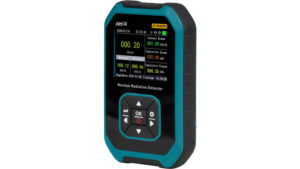
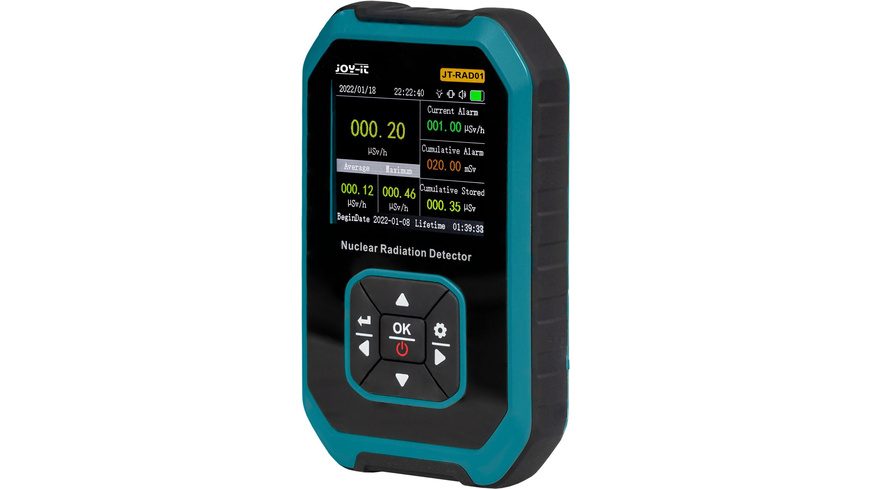
The compact device (122 × 77 × 27 mm) has a backlit color display, German-language menus and two views: real time with average and maximum values, and a history graph. It signals alarms for dose rate and accumulated dose by LED, vibration or sound. It charges via USB-C, and the battery has 1,100 mAh. Joy-IT itself states the limits clearly: the device is not a medical device or protective equipment and only provides a rough indication. The tube is made of glass and does not tolerate drops. It does not detect alpha radiation, and the manufacturer does not mention any software for reading out the data on a PC.
GQ GMC-320 Plus
This hobbyist device stores readings in internal flash memory and passes them via USB to free Windows software. GQ gives 20 to 40 counts per minute as background, and the M4011 tube can be replaced. Next to the Joy-IT’s color screen, a dot-matrix display looks old-fashioned. If you want to collect measurement series, though, you get more tools here.
GQ GMC-500 Plus
According to GQ, two tubes cover up to 42,500 µSv/h, and the built-in Wi-Fi can send values to a server every minute if you wish. A device for continuous operation. It is designed to run on a USB power supply on the windowsill. For people who only measure once on vacation, that is too much technology.
Radiacode 103
Strictly speaking, not a Geiger counter. A cesium iodide crystal converts gamma radiation into flashes of light whose brightness reveals the energy. This lets the device show a spectrum via the app, from which nuclides can be narrowed down. Radiacode specifies 30 counts per second per µSv/h for cesium-137, many times the count rate of a small Geiger tube. On top of that come Bluetooth, IP64 protection and up to 200 hours of runtime. The manufacturer does not list beta radiation, and the tiny display is only good for numbers.
Gamma-Scout Alert
This device from Germany uses an end-window tube and therefore also detects alpha radiation. According to the manufacturer, every unit is checked against a reference source, the battery lasts for years, and up to 32,000 readings are stored. The Alert version warns at limit values and ticks audibly. It is not cheap. In price, it sits far above the other devices in this overview, and if you only measure occasionally, you are mainly paying for capabilities you will never need. For mineral collectors and long-term measurements, that is justifiable.
What a handheld device can and cannot do
A Geiger counter is well suited to satisfying curiosity: uranium glass, old luminous dials, granite, air travel. The BfS, for example, examined an „energy“ pendant bought online and measured around 160 nanosieverts per hour at the surface, or 0.16 µSv/h. A low-cost tube can hardly distinguish that from background. According to the BfS, such pendants have no benefit, but they do cause an unnecessary skin dose.
For vintage watches, the BfS recommends a simple test: wrap them so no light gets in for two to three days, then check them in the dark. If the dial still glows, a radioactive luminous paint is likely, and the responsible body is your German state authority, not your own meter. According to the BfS, items containing radium do not belong in household waste.
Deciding whether a place is dangerous is not a job for private devices. According to the BfS, limit values are not a dividing line between safe and dangerous, and there is no statutory dose limit at all for natural radiation. In an emergency, the official monitoring networks and the authorities‘ instructions apply. If you mostly use measuring equipment to check voltage, the difference between a reading and measurement uncertainty is also explained well in our multimeter guide (in German). And if you would rather build a counter yourself, take a look at our overview of electronics kits (in German).
Which device suits which question
- You want to understand how much radiation surrounds you and measure while traveling: Joy-IT JT-RAD01.
- You want to analyze measurement series on a PC: GQ GMC-320 Plus.
- The device should run continuously and report values online: GQ GMC-500 Plus.
- You want to know which nuclide is emitting: Radiacode 103.
- Alpha emitters such as minerals should be detected too: Gamma-Scout Alert.
- You are worried about radon: a passive detector from a lab recognized by the BfS, not a Geiger counter.
Frequently asked questions
What does a Geiger counter actually measure?
It counts current pulses that occur when a gamma quantum or beta particle ionizes the gas in the tube, and reports them as counts per minute or per second. A simple tube does not know what type of radiation it was or what energy it carried. The sievert figure is an estimate, not an official value.
What radiation levels are normal in Germany?
According to the German Federal Office for Radiation Protection, the natural ambient dose rate is between 0.05 and 0.2 microsieverts per hour depending on location, higher in the Black Forest and the Ore Mountains than in the north. After rain, the value can briefly rise to about three times as much. For context, use the nearest probe on odlinfo.bfs.de.
Can you measure radon with a Geiger counter?
No, because it measures the dose rate from outside, not a gas concentration in becquerels per cubic meter. The BfS recommends passive detectors that stay in the living room and bedroom for three to twelve months and are then analyzed in a lab. For short measurements, winter delivers more reliable values than summer.
How long should you measure with a Geiger counter?
At least ten minutes in the same spot. At a typical value of 0.1 µSv/h, the JT-RAD01 counts around eight pulses per minute on average, so a single reading fluctuates considerably. A usable average takes patience.
What is the difference between a Geiger counter and a scintillator?
The Radiacode 103 uses a cesium iodide crystal that converts gamma radiation into flashes of light whose brightness reveals the energy. This lets it show a spectrum from which nuclides can be narrowed down, and it achieves many times the count rate of a small Geiger tube. The manufacturer does not list beta radiation.
How can I tell whether an old watch is radioactive?
The BfS advises wrapping the watch so no light gets in for two to three days and then checking it in the dark. If the dial still glows, a radioactive luminous paint is likely, and the responsible authority is then your German state authority. According to the BfS, items containing radium do not belong in household waste.
Sources
- ELV (German retailer): Joy-IT JT-RAD01 radiation meter
- Joy-IT: JT-RAD01 data sheet (PDF)
- Joy-IT: JT-RAD01 user manual (PDF)
- GQ Electronics: GMC-320 Plus
- GQ Electronics: GMC-500 Plus
- Radiacode: Technical specifications
- Gamma-Scout: Alert
- BfS: Gamma ambient dose rate
- BfS: Radioactivity in the environment
- BfS: What is radon?
- BfS: How can I measure radon (or have it measured)?
- BfS: Radon regulations and reference value
- BfS: Limit values in radiation protection
- BfS: Cosmic radiation when flying
- BfS: Amulets with supposed radiation effects
- BfS: Radioactive substances in watches
Where to buy
- Joy-IT JT-RAD01View at ELVAvailable in Germany: ELVCheck price at Amazon.deAvailable in Germany: Amazon.de
- GQ GMC-320 PlusCheck price at Amazon.deAvailable in Germany: Amazon.de
- GQ GMC-500 PlusCheck price at Amazon.deAvailable in Germany: Amazon.de
- Radiacode 103Check price at Amazon.deAvailable in Germany: Amazon.de
- Gamma-Scout AlertCheck price at Amazon.deAvailable in Germany: Amazon.de