Contents14 sections
This guide was first published in German on handgetestet.de.
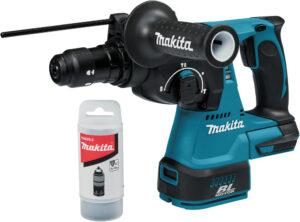
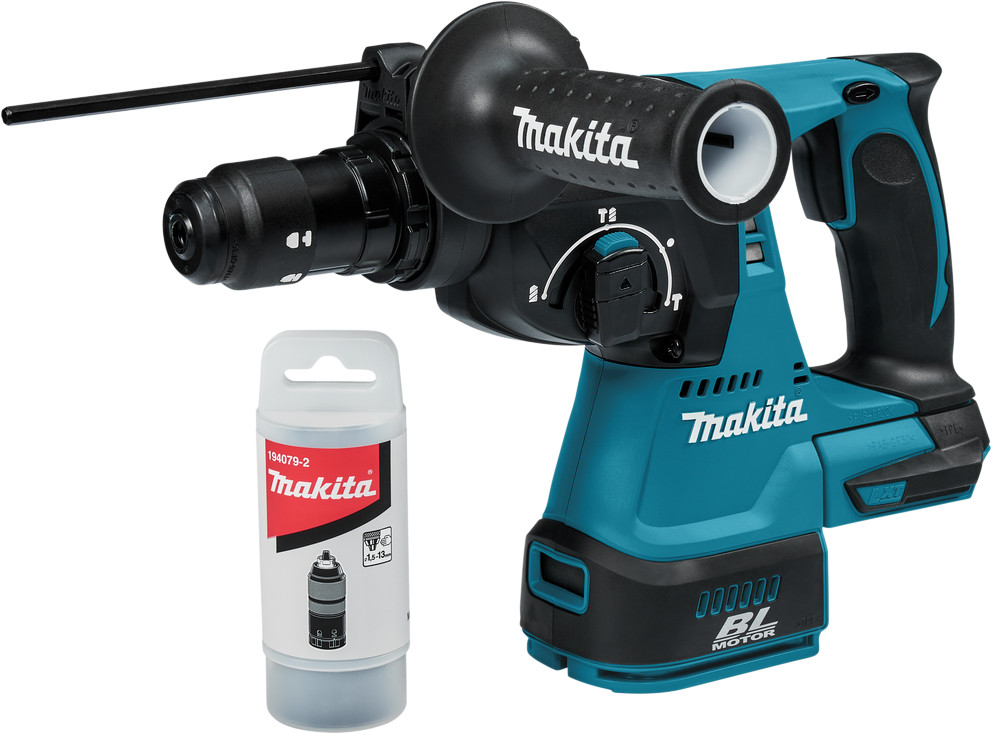
Most people buy too much machine. Shelves, lamps, curtain rods: if you anchor things like these in concrete, you drill almost nothing but holes between 6 and 10 mm. For that, an 18-volt cordless rotary hammer with around 2 joules of impact energy is enough, such as the Makita DHR243, which we recommend for most households. A corded tool with more than 3 joules only pays off for regular wall openings, tiles or large anchors.
Why a rotary hammer works differently
A hammer drill vibrates. A rotary hammer strikes. Its pneumatic hammer mechanism drives the bit into the material with powerful individual blows, and in concrete that is exactly what makes the difference between a clean hole in seconds and a hot, blunt drill tip.
How much force is behind it is indicated by the impact energy in joules, the most important figure on the data sheet. If „EPTA“ appears next to it, it was measured using the method of the European Power Tool Association, and the numbers from different brands can be compared reasonably well. Without that note, caution is advised. As a rough guide: around 1.5 J for anchor holes, 2 to 2.6 J for all-round use around the home, and 3 J or more for larger diameters and frequent chiseling.
Besides the maximum, manufacturers often state an optimal drilling range. That figure is more honest. According to Makita, a tool rated „up to 24 mm“ works most efficiently between 4 and 16 mm.
Chuck and chiseling
SDS-plus is the standard chuck on compact rotary hammers, and all the tools below use it. The bits are pushed in and lock into place. Regular round-shank bits only fit with an adapter or an interchangeable chuck; which bits you need is covered in our article on drill bit sets (in German).
With rotation stop, the tool only hammers. That is enough to remove individual tiles or chase a channel for a cable. Not all of them can do it. The Hilti TE 2-22, for example, does not have this function.
Cordless or corded?
For drilling anchor holes, cordless has won. No cable dangling over the ladder, no extension cord running through three rooms. Brushless 18-volt tools now deliver 2 to 2.6 joules, right where the small corded tools used to be.
There is no way around a cord when you work for long stretches at a time: stripping a bathroom, lots of holes of 14 mm and more, core bits for electrical boxes. Or if there is no battery system in the house yet. Batteries and a charger make up a large part of the price of cordless rotary hammers, and if you already own batteries from one brand, a bare-tool version is almost always the cheaper option. Which brands share batteries and how the systems fit together is explained in our article on battery systems.
Dust and noise are underestimated
Drilling concrete produces fine mineral dust that, according to BG BAU, the German statutory accident insurer for the construction industry, usually contains quartz on construction sites. For dusts like these, BG BAU requires construction dust extractors of dust class M; ordinary household vacuums are explicitly not among them. Applied to the home, that means an extraction module right at the drill keeps the dust away from your lungs and your carpet. Makita offers such a unit as an accessory for the DHR243, and Hilti offers the DRS-D and DRS-S dust modules for the TE 2-22.
Then there is the noise. For the TE 2-22, Hilti specifies a sound pressure level of 95 dB(A). In the workplace, the German Noise and Vibration Occupational Safety Ordinance requires hearing protection from a daily noise exposure level of 85 dB(A). That is an average over eight hours and not directly comparable to the tool’s rating. Still, the order of magnitude speaks for itself: earmuffs or earplugs belong in your bag for home renovations, too.
Seven rotary hammers currently on the market
| Model | Impact energy according to the manufacturer | Max. drilling Ø in concrete | Power source | Best for |
|---|---|---|---|---|
| Hilti TE 2-22 | 1.5 J | 22 mm | Battery, Nuron 22 V | Anchor holes without chiseling, trade businesses with Hilti batteries |
| Bosch GBH 18V-22 Professional | 1.9 J | 22 mm | Battery, Bosch Professional 18 V | Lightweight tool for lots of small holes |
| Makita DHR243 | 2.0 J | 24 mm | Battery, Makita LXT 18 V | Home and renovation work with occasional chiseling |
| DeWalt DCH273 | 2.1 J | 24 mm | Battery, DeWalt XR 18 V | Owners of DeWalt batteries, light chiseling |
| Metabo KH 18 LTX BL 24 | 2.2 J | 24 mm | Battery, CAS 18 V | CAS batteries on hand, interchangeable chuck in the Q version |
| Einhell TP-HD 18/26 D Li BL | 2.6 J | 26 mm | Battery, Power X-Change 18 V | Lots of impact force in a more affordable battery system |
| Bosch GBH 2-28 F Professional | 3.2 J | 28 mm | Corded, 880 W | Large holes, removing tiles, no battery system |
Hilti TE 2-22
Hilti’s smallest rotary hammer runs on the 22-volt Nuron batteries and weighs 2.3 kg without a battery per EPTA. Its 1.5 joules make clear what it is built for: anchor holes between 4 and 14 mm. Hilti does not list a chiseling function. Without Hilti batteries already on hand, it hardly makes sense for private users.
Bosch GBH 18V-22 Professional
1.9 joules of rated impact energy, 2.3 kg without a battery, optimal range 4 to 12 mm, according to Bosch. According to Bosch, it can also chisel. With lots of small holes overhead, the low weight pays off. It is powered by the 18-volt batteries of the blue Bosch Professional system.
Makita DHR243
A classic in the LXT system. Makita specifies 2.0 joules; according to the data sheet, it drills up to 24 mm in concrete and handles drilling, hammer drilling and chiseling. With a battery, it weighs 3.2 to 3.7 kg depending on the configuration, and the DX07 dust extraction unit can be added later. Record-setting figures? No. But it has enough reserve for everything that comes up in a home, and that is why we recommend it for the vast majority of households.
DeWalt DCH273
A brushless combination hammer with 2.1 joules and 24 mm. According to DeWalt, a setting with rotation and hammer stop is intended for light chiseling in plaster and tile. It is primarily interesting for owners of XR batteries.
Metabo KH 18 LTX BL 24
Metabo’s data sheet lists 2.2 joules, 24 mm in concrete and three operating modes. Without a battery, the hammer weighs about 2.7 kg, and it takes any 18-volt battery from the CAS alliance. The Q version adds a keyless chuck for round-shank bits. If you often switch between concrete and wood, you then do not need an adapter.
Einhell TP-HD 18/26 D Li BL
According to its data sheet, the most powerful cordless rotary hammer here: 2.6 joules, 26 mm in concrete, four functions including chiseling with and without chisel lock. The D-handle helps when drilling vertically into the floor. Einhell recommends batteries of 3.0 Ah or more, so with small batteries, performance is left on the table. Without an existing battery system, this is the more affordable way in.
Bosch GBH 2-28 F Professional
880 watts, 3.2 joules, up to 28 mm according to Bosch, optimal between 8 and 16 mm, and up to 68 mm with a core bit. An interchangeable SDS-plus chuck and a 13 mm keyless chuck are included. At 3.1 kg, it is no lightweight. In return, it strips an entire bathroom with considerably more stamina than any cordless tool on this list.
Which tool suits which project
For anchoring things around the home with occasional chiseling, we recommend the Makita DHR243, provided LXT works for you. Otherwise, go with the tool from the battery system that is already in your basement. No system yet and a tight budget? Then the Einhell TP-HD 18/26 D Li BL with a battery of 3.0 Ah or more.
Lots of overhead work with small holes speaks for the Bosch GBH 18V-22 Professional. For renovations involving tiles and large diameters, take the corded Bosch GBH 2-28 F.
And if you only drive screws and occasionally drill into brick, you do not need a rotary hammer at all. A hammer drill/driver is enough; suitable models are listed in our guide to cordless drill/drivers (in German).
Whichever of these tools you choose, it is best to budget for dust extraction and hearing protection right away. Compared with the price of the tool, they cost little.
Frequently asked questions
What is the difference between a hammer drill and a rotary hammer?
A hammer drill vibrates; a rotary hammer strikes. Its pneumatic hammer mechanism drives the bit into the material with powerful individual blows. In concrete, that makes the difference between a clean hole in seconds and a hot, blunt drill tip. If you mostly drive screws and only occasionally drill into brick, you do not need a rotary hammer.
How many joules does a rotary hammer need for home use?
As a rough guide: around 1.5 J for anchor holes, 2 to 2.6 J for all-round use around the home, and 3 J or more for larger diameters and frequent chiseling. If "EPTA" appears next to the figure, values from different brands can be compared reasonably well.
Cordless rotary hammer or corded?
For drilling anchor holes, cordless has won; brushless 18-volt tools now deliver 2 to 2.6 joules. A cord pays off for long stretches of continuous work such as stripping a bathroom, lots of holes of 14 mm and up, or core bits. If you already own batteries from one brand, a bare-tool version is almost always the cheaper option.
Which rotary hammer suits a small budget without an existing battery system?
According to its data sheet, the Einhell TP-HD 18/26 D Li BL is the most powerful cordless rotary hammer in this comparison, with 2.6 joules, 26 mm in concrete and a chiseling function. Einhell recommends batteries of 3.0 Ah or more; with small batteries, performance is left on the table.
Can every rotary hammer chisel?
No. With rotation stop, the tool only hammers, which is enough to remove individual tiles or chase a channel for a cable. The Hilti TE 2-22, for example, does not have this function. According to the manufacturers, the Makita DHR243, Bosch GBH 18V-22 and Einhell TP-HD 18/26 can chisel.
Do I need dust extraction and hearing protection when drilling concrete?
Both make sense. According to BG BAU, the German statutory accident insurer for the construction industry, concrete dust usually contains quartz; an extraction module right at the drill keeps it away from your lungs and your carpet. For the Hilti TE 2-22, the manufacturer specifies a sound pressure level of 95 dB(A), so earmuffs or earplugs belong in your kit for home renovations, too.
Sources
- Hilti: TE 2-22 cordless rotary hammer
- Bosch Professional: GBH 18V-22
- Makita: DHR243 cordless combination hammer
- DeWalt: DCH273NT
- Metabo: KH 18 LTX BL 24
- Einhell: TP-HD 18/26 D Li BL
- Bosch Professional: GBH 2-28 F
- BG BAU: Construction dust extractors
- German Noise and Vibration Occupational Safety Ordinance (LärmVibrationsArbSchV), Section 6: action values and Section 8: hearing protection
Where to buy
- Makita DHR243 (DHR243Z, ohne Akku)Check price at Amazon.deAvailable in Germany: Amazon.de
- Einhell TP-HD 18/26 D Li BL (Solo, ohne Akku)Check price at Amazon.deAvailable in Germany: Amazon.de
- Bosch GBH 18V-22 ProfessionalCheck price at Amazon.deAvailable in Germany: Amazon.de
- Metabo KH 18 LTX BL 24Check price at Amazon.deAvailable in Germany: Amazon.de
- DeWalt DCH273Check price at Amazon.deAvailable in Germany: Amazon.de
- Hilti TE 2-22Check price at Amazon.deAvailable in Germany: Amazon.de
- Bosch GBH 2-28 F ProfessionalView at CoolblueAvailable in Germany: CoolblueCheck price at Amazon.deAvailable in Germany: Amazon.de