Contents14 sections
This guide was first published in German on handgetestet.de.
Jackery offers around a dozen Explorer models, and the number in the name tells you less than it promises. If you are looking for a Jackery, do not start with the watt-hours but with the most powerful appliance you want to run. For camping, a garden shed and power outages at home, we consider the Explorer 1000 Plus v2 the most sensible buy: it weighs as much as the 1000 v2 but delivers more power and can be expanded later. If a laptop, lights and a router are all you need, the 500 v2, at half the weight, is enough. One caveat up front: the Explorer 1000 Plus v2 is new, and all we had to go on was information from Jackery and one retailer, no data sheet and no independent measurement. Treat its figures with appropriate caution.
v2 or Plus v2: what separates the two series?
The suffix matters more than the number in front of it. According to retailer information, the basic v2 units, meaning the 500, 1000, 2000 and 3000, stay the size they are. Extra batteries do not fit them. The Plus series, with the 1000 Plus v2, 2000 Plus v2 and 3600 Plus, on the other hand, grows with battery packs, switches over in 10 instead of 20 milliseconds during a power outage and also charges below freezing. The 1000 v2 and the 2000 v2 need at least 0 degrees Celsius to do so.
The twins in the 1 kWh class show this most clearly. Both weigh 10.8 kilos. The Plus version has 46 watt-hours less, but 300 watts more continuous output and a third AC outlet. It costs one tier more.
That leaves the cycle count, a favorite in advertising: 6,000 versus 4,000, each down to 70 percent remaining capacity. If you fully charge on 40 weekends a year, you will never reach either figure. Only with daily charging from a solar panel does it become an argument. Why are Anker and BLUETTI not directly comparable? They calculate down to 80 percent, so the column in our table does not measure the same thing everywhere. More on cell chemistry is in our guide to LiFePO4.
The first limit is set by output, not by the battery
A 1,300-watt capsule coffee machine will not run on the 500 v2, even with a full battery. From the 1000 v2 upward, it works. A 2,000-watt electric kettle is too much for both of Jackery’s 1 kWh units and needs the 2000 Plus v2 with 2,400 watts. The retailer only lists an oven or a portable air conditioner for the 3,600-watt class, and the 3600 Plus weighs 35 kilos.
So walk through your home once and read the rating plates. The most powerful appliance you actually want to plug in determines the class. Motors need considerably more than their rated output when starting up; our guide to runtime explains by how much.
After that, what counts is how long it has to last
The retailer GreenDrive calculates with 85 percent of the rated capacity, because energy is lost during conversion. Jackery itself does not publish an efficiency figure. Take a fridge-freezer that uses 0.8 kilowatt-hours a day. The 500 v2 keeps it running for half a day, the 1000 Plus v2 for a good day, the 2000 Plus v2 for a good two days and the 3600 Plus for just under four days. With a Battery Pack 2000 Plus V2, the 1000 Plus v2 reaches 3,072 watt-hours, which on paper is enough for a good three days.
This is exactly where its appeal lies. Only 10.8 kilos ride along in the trunk, while the 14.8-kilo pack stays in the basement for the winter. A 2000 Plus v2, at 19.1 kilos, you would have to carry in its entirety every time.
Seven power stations side by side
| Model | Capacity, continuous output | Weight | Cycles according to manufacturer | Expansion | Best for |
|---|---|---|---|---|---|
| Jackery Explorer 500 v2 | 512 Wh, 500 W | 5.7 kg | 6,000 to 70 % | no | Laptop, lights, router |
| Jackery Explorer 1000 v2 | 1,070 Wh, 1,500 W | 10.8 kg | 4,000 to 70 % | no | at home, no expansion plans |
| Jackery Explorer 1000 Plus v2 | 1,024 Wh, 1,800 W | 10.8 kg | 6,000 to 70 % | up to 11,264 Wh | on the go and as backup power |
| Jackery Explorer 2000 Plus v2 | 2,048 Wh, 2,400 W | 19.1 kg | 6,000 to 70 % | up to 12,288 Wh | Electric kettle, fixed location |
| Jackery Explorer 3600 Plus | 3,584 Wh, 3,600 W | 35 kg | 6,000 to 70 % | up to 21,504 Wh | House, cabin, cold garage |
| Anker SOLIX C1000 Gen 2 | 1,024 Wh, 2,000 W | 11.3 kg | 4,000 to 80 % | no | Power tools, more solar |
| BLUETTI AC180 | 1,152 Wh, 1,800 W | 16 to 17 kg | 3,500 to 80 % | not specified | a little more capacity |
Jackery Explorer 500 v2
The smallest current station with two AC outlets and, in our view, the underrated one. According to the retailer, it is fully charged from the grid in 1 hour 20 minutes, takes over after 10 milliseconds and operates from minus 20 to 45 degrees Celsius. At 500 watts, though, the limit comes early: hair dryer, coffee maker and electric kettle are out. If you only need USB and 12 volts, our guide to small power stations (in German) covers the Explorer 300D and 100D, which do without an AC outlet entirely.
Jackery Explorer 1000 v2
The cheapest way to get to one kilowatt-hour with this brand. Drawbacks: no charging in freezing temperatures, no expansion, longer switchover time. If you know for certain that you will never add more, you save a tier here. In spring 2025, the ADAC (German automobile club) downgraded the Explorer 1000 v2 to „poor“ because its two DC inputs are not decoupled. So never charge it via solar and the car socket at the same time.
Jackery Explorer 1000 Plus v2
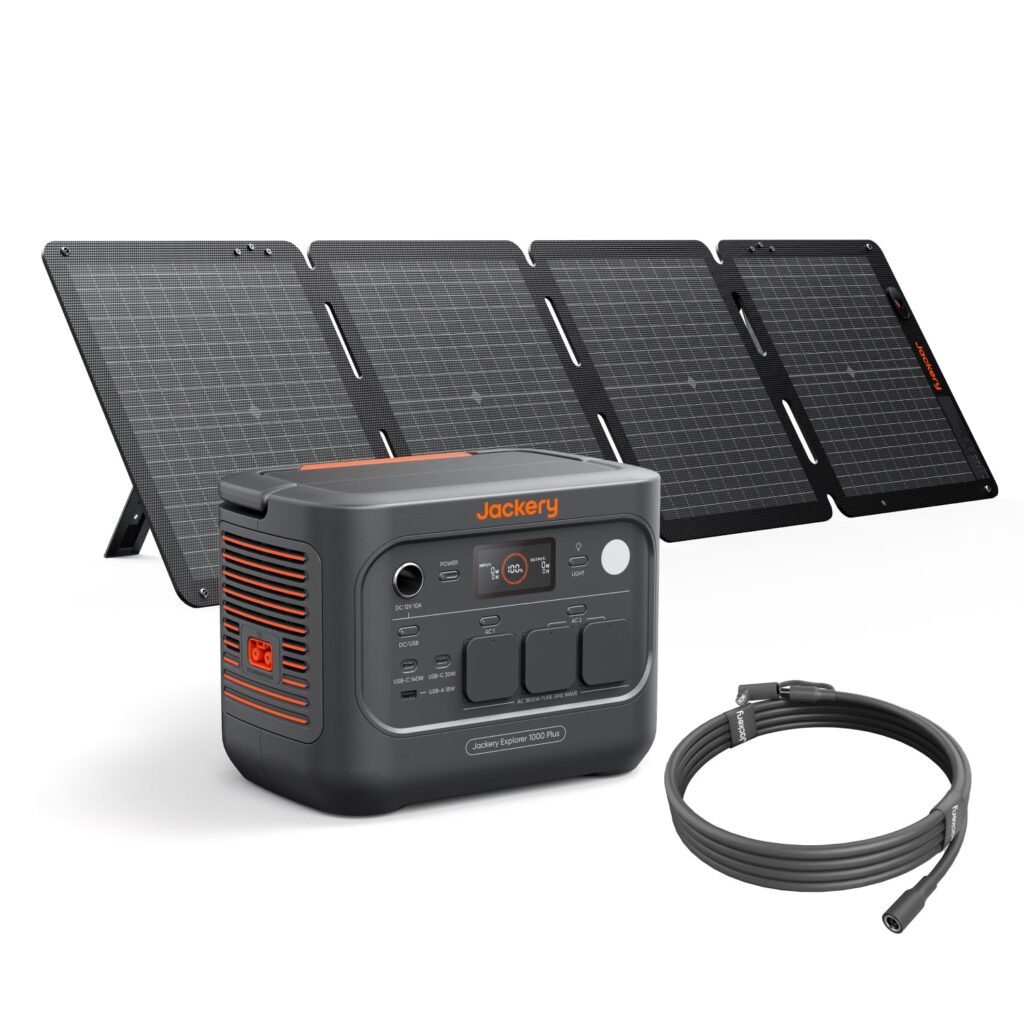
Our main recommendation. According to Jackery, it delivers 1,800 watts, the outlets can be switched separately, and in emergency charging mode it is full in 49 minutes, according to the retailer. At 400 watts, however, the solar input tops out at just two large folding panels. And among the 1 kWh units in this comparison, the Anker delivers more continuous output.
Jackery Explorer 2000 Plus v2
With 2,400 watts, the kettle barrier falls. The 800-watt solar input suits four 200-watt panels, which according to the retailer fill it in about three and a half hours. Weight is the price you pay. You carry almost 20 kilos down to the basement once, not to the campsite every weekend.
Jackery Explorer 3600 Plus
The top end, with wheels and a telescopic handle, expandable to 21.5 kilowatt-hours. According to the retailer, charging and discharging are possible from minus 20 to 45 degrees Celsius. It lacks a 12-volt socket, so a compressor cooler has to run off the AC outlet. Everything else about this class is in our guide to large power stations (in German).
Anker SOLIX C1000 Gen 2
The counterpart to the Plus version. Anker specifies 2,000 watts of continuous output, 600 watts of solar input and 49 minutes of fast charging, at 11.3 kilos. For power tools or lots of sun, it is the stronger choice. It cannot be expanded, and it may only be charged from 0 degrees Celsius.
BLUETTI AC180
A little more capacity, but five to six kilos heavier than the Jackery of the same class. BLUETTI specifies a five-year warranty and 3,500 cycles to 80 percent. Fine for a fixed location. For carrying around, there is little in its favor.
What you can safely leave out
The bundle with a solar panel, as long as you have no concrete plan for solar. Otherwise the panel just sits in the closet. You should not count emergency charging as a reason to buy either, because it only matters when you are really in a hurry. Hardly anyone needs the 2000 v2 and the 3000 v2 either: the first saves a good kilo and a half compared with the 2000 Plus v2 but gives up expansion and charging in freezing temperatures; the second weighs 27 kilos and is likewise stuck at its size.
Be careful with older names. The Battery Pack 1000 Plus does not fit the 1000 Plus v2, as our guide to extra batteries (in German) explains. Retailers also still offer the old Explorer 2000 Plus without v2, according to the Amazon listing with 2,042.8 watt-hours and 3,000 watts. So check the name down to the last character. And refurbished units are not automatically cheaper, as our guide on the subject (in German) shows.
How we would decide
- Just a laptop, lights, router and phone: Explorer 500 v2.
- Budget matters, never more battery, use at home only: Explorer 1000 v2. Because of the ADAC finding, we advise against it in a camper.
- In use on the go and at home, maybe more later: Explorer 1000 Plus v2.
- Electric kettle or microwave, fixed location: Explorer 2000 Plus v2.
- Powering a house or cabin for days: Explorer 3600 Plus.
- Power tools and lots of solar, no need for expansion: Anker SOLIX C1000 Gen 2.
Frequently asked questions
What is the difference between Jackery v2 and Plus v2?
According to retailer information, the basic v2 units stay the size they are; extra batteries do not fit. The Plus series grows with battery packs, switches over in 10 instead of 20 milliseconds during a power outage and also charges below freezing. The 1000 v2 and the 2000 v2 need at least 0 degrees Celsius to charge.
Which Jackery can run an electric kettle?
A 2,000-watt kettle is too much for both of Jackery's 1 kWh units and needs the Explorer 2000 Plus v2 with 2,400 watts. A 1,300-watt capsule coffee machine runs from the 1000 v2 upward, but not on the 500 v2. The most powerful appliance on its rating plate determines the class.
How long can a Jackery run a refrigerator?
For a fridge-freezer using 0.8 kilowatt-hours a day, the 500 v2 lasts half a day, the 1000 Plus v2 a good day, the 2000 Plus v2 a good two days and the 3600 Plus just under four days. The calculation uses 85 percent of the rated capacity.
Is an extra battery worth it for the Explorer 1000 Plus v2?
For varied use, yes. With a Battery Pack 2000 Plus V2, it reaches 3,072 watt-hours, enough on paper for a good three days of running a refrigerator. Only 10.8 kilos ride along in the trunk, while the 14.8-kilo pack stays in the basement. The older Battery Pack 1000 Plus does not fit.
Who is the Jackery Explorer 1000 v2 for?
For use at home only, on a tight budget and with no plans to expand. It does not charge in freezing temperatures and switches over more slowly. In spring 2025, the ADAC (German automobile club) downgraded it to "poor" because its DC inputs are not decoupled. We therefore advise against it in a camper.
What should you look out for when buying an older Jackery?
The name, down to the last character. Retailers still offer the old Explorer 2000 Plus without v2. A bundle with a solar panel is only worth it once you have a concrete plan for solar, and emergency charging should not be a reason to buy.
Sources
- Product information from Jackery on the Explorer 500 v2, 1000 v2, 1000 Plus v2, 2000 Plus v2, 3600 Plus and battery packs
- Jackery: Explorer 1000 v2
- Jackery: Explorer 500 v2
- GreenDrive: Explorer 1000 Plus v2 (retailer information)
- GreenDrive: Explorer 2000 Plus v2 (retailer information)
- GreenDrive: Explorer 3600 Plus (retailer information)
- GreenDrive: Explorer 1000 v2 (retailer information)
- GreenDrive: Explorer 500 v2 (retailer information)
- GreenDrive: Explorer 2000 v2 (retailer information)
- GreenDrive: Explorer 3000 v2 (retailer information)
- Anker SOLIX: C1000 Gen 2
- BLUETTI: AC180
- ADAC: Portable power stations tested (spring 2025)
Where to buy
- Jackery Explorer 1000 Plus v2View at JackeryAvailable in Germany: JackeryCheck price at Amazon.deAvailable in Germany: Amazon.de
- Jackery Explorer 500 v2View at JackeryAvailable in Germany: JackeryCheck price at Amazon.deAvailable in Germany: Amazon.de
- Jackery Explorer 1000 v2View at JackeryAvailable in Germany: JackeryCheck price at Amazon.deAvailable in Germany: Amazon.de
- Jackery Explorer 2000 Plus v2View at JackeryAvailable in Germany: JackeryCheck price at Amazon.deAvailable in Germany: Amazon.de
- Jackery Explorer 3600 PlusView at JackeryAvailable in Germany: JackeryCheck price at Amazon.deAvailable in Germany: Amazon.de
- Anker SOLIX C1000 Gen 2Check price at Amazon.deAvailable in Germany: Amazon.de
- BLUETTI AC180Check price at Amazon.deAvailable in Germany: Amazon.de