Contents14 sections
This guide was first published in German on handgetestet.de.
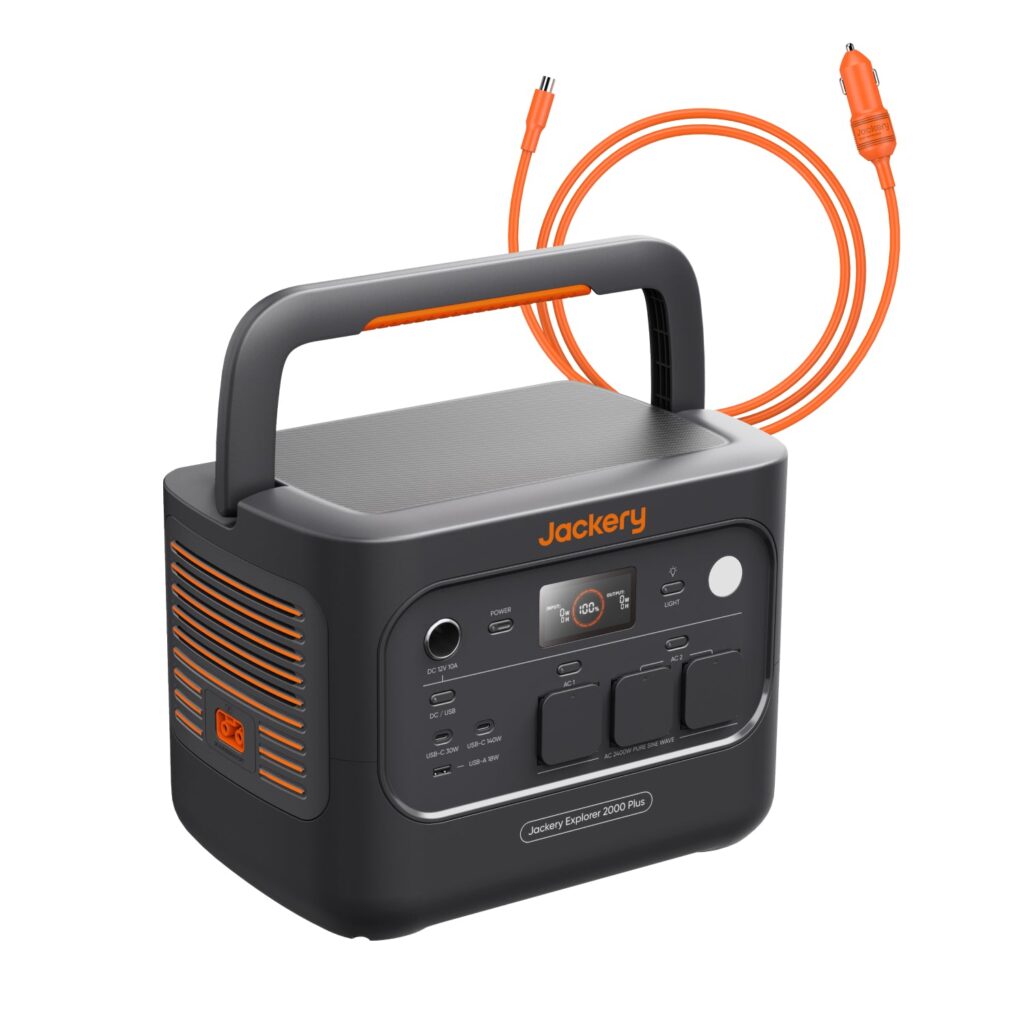
Technically it sometimes works; in practice it gets you around ten kilometers. A power station with 2 kilowatt hours fills a Renault 5 by about three percent, and whether the car accepts the power at all only becomes clear once it is plugged in. So do not buy a station for your electric car. If you need one for other reasons and want to take the emergency reserve along, the Jackery Explorer 2000 Plus v2 is the smallest class we consider sensible, because its 2,400 watts can also sustain 10 amps.
How many kilometers are there in a kilowatt hour?
Between three and seven and a half. The German automobile club ADAC measures 13.4 to 29.7 kilowatt hours per 100 kilometers for current electric cars, charging losses included. The economical Mercedes CLA 250+ therefore gets 7.5 kilometers out of one kilowatt hour, a large electric van 3.4. The Renault 5 with a 52 kWh battery sits in between at 17.3 kilowatt hours: 5.8 kilometers.
Now the station. Of 2,048 watt hours, after a deduction of 15 percent, the upper value from the ADAC power station test, a good 1.7 kilowatt hours remain at the outlet. In the Renault, that is around 10 kilometers, 13 in the Mercedes, 6 in the van. On the highway, the Renault uses about 21 kilowatt hours according to the ADAC, which would make it 8. The calculation becomes even more honest when you consider charging losses: the ADAC measures them at 11 kilowatts and writes that they are higher at a household outlet. So better to count on a little less.
A full charge of the Renault takes 59.6 kilowatt hours. That would be 34 stations.
Is the output even enough to start charging?
That is the first hurdle. For the household outlet, the ADAC states 6 to 10 amps, i.e., 1.3 to 2.3 kilowatts. Below 6 amps, nothing works in practice, which rules out all small stations. An Explorer 500 v2 with 500 watts does not even deliver half of that. The Explorer 1000 v2 with 1,500 watts would have hardly any headroom.
You also need a charging cable with adjustable current. The model with a fixed 10 amps from our guide to charging from a Schuko outlet (the standard German household socket) overloads a station with 2,200 watts. Set the box to 6 or 8 amps, never more than the station can deliver continuously. At 6 amps, it takes a good hour for 1.7 kilowatt hours to go through. Which cables are available is covered in our charging cable guide.
Why can charging from the station abort?
Because of grounding. Many portable chargers check before starting whether the connection is properly grounded. According to its manual, the go-e Charger prevents charging if grounding is inadequate and reports a grounding error. On the NRGkick, a protective earth warning flashes, and the Juice Booster 3 has its own earth conductor monitoring.
But a power station is not a household grid. DGUV Information 203-032, a publication of the German Social Accident Insurance that explicitly counts battery storage among power generators, describes devices without a grounding connection in which the protective equipotential bonding is not connected to an active conductor. A charger may then see exactly what it is supposed to warn about. Jackery does not say which design type the Explorer stations correspond to. So the result can hardly be predicted; it depends on the pairing of station and charger.
Anker addressed the issue openly with the F3800 and advertised a dedicated 3,000-watt EV port for which no grounded accessories were needed. This station currently cannot be ordered in the German shop, which is why it is missing from the comparison.
The check can sometimes be switched off. But that is not what it is intended for. go-e only allows it for a qualified electrician who knows for certain that the grid has no grounding, as in Norway, for example. Juice writes that the mode may only be used if grounding and installation are correctly connected. Adapter plugs that bridge the neutral and protective earth conductors are circulating in forums. We advise against them. They change the protection concept, and that is for a qualified electrician to assess, not an online post.
Do large stations work as a charging point on the go?
No. More capacity hardly helps, because the jump from 2 to 3 kilowatt hours gives the Renault five kilometers and adds eight kilograms of weight. And be careful when reading product pages. At BLUETTI, „EV Chargers“ appear among the charging options for the Apex 300. That refers to the direction from the charging station into the power station, not into your car.
Does solar help?
For the station, yes; for the car, not much. According to Jackery, four 200-watt panels charge the Explorer 3000 v2 in around four to six hours of full sun. A whole bright day thus yields about 15 kilometers in the Renault. For commuters, that is nothing. For a parking spot without a charger, it at least covers the trip to the bakery.
Six components, in case you want to do it anyway
| Model | Specs according to manufacturer | Calculated at the outlet | Renault 5 (17.3 kWh/100 km) | Highest sensible charging current |
|---|---|---|---|---|
| Jackery Explorer 2000 Plus v2 | 2,048 Wh, 2,400 W, 19.1 kg | 1.7 kWh | 10 km | 10 A |
| Jackery Explorer 2000 v2 | 2,042 Wh, 2,200 W, 17.5 kg | 1.7 kWh | 10 km | 8 A |
| Jackery Explorer 3000 v2 | 3,072 Wh, 3,600 W, 27 kg | 2.6 kWh | 15 km | 10 A (Schuko limit) |
| BLUETTI Elite 300 | 3,014 Wh, 2,400 W, 26.3 kg | 2.6 kWh | 15 km | 10 A |
| go-e Charger Gemini flex 2.0 11 kW | Charging box, Schuko adapter at 6 A out of the box | n/a | n/a | adjustable |
| EVDANCE Schuko-Ladekabel 16 A | Mode 2 cable, 6 to 16 A according to the seller | n/a | n/a | adjustable |
Calculated values: capacity times 0.85, then divided by 17.3 kWh per 100 kilometers. Weight of the 2000 Plus v2 according to the retailer. This does not tell you whether a combination will actually charge.
Jackery Explorer 2000 Plus v2
With 2,400 watts, it just about covers 10 amps; we would still set 8. According to Jackery, it expands to 12 kilowatt hours with five add-on batteries, and according to the retailer, it is good for 6,000 cycles. Its real use is in the house, at the campsite and during power outages. Even so, you will not want to drive 19.1 kilograms around in the trunk all the time.
Jackery Explorer 2000 v2
A good kilo and a half lighter and one price tier cheaper. At 2,200 watts, however, the reserve ends below 10 amps, and Jackery states 4,000 cycles. If you buy it for a laptop, cooler box and lighting, you get the kilometers as a bonus.
Jackery Explorer 3000 v2
Five kilometers more at 27 kilograms. According to the retailer, it rolls on wheels with a telescopic handle. The 3,600 watts do little for the car, because a Schuko connection should not carry more than 10 amps over several hours anyway. For the workshop it makes sense; see Large power station (in German).
BLUETTI Elite 300
Almost the same energy as the 3000 v2, but 2,400 watts. According to BLUETTI, 6,000 cycles. For use with the car, it has no advantage over Jackery; in an RV, the 12-volt output with 30 amps is more interesting.
go-e Charger Gemini flex 2.0 11 kW
Its manual is the clearest here. Single-phase adapters start at 6 amps out of the box, which suits the station. The grounding check is active, however, and only a qualified electrician is supposed to switch it off. If you already own the box as a portable wallbox, expect an error message at the station.
EVDANCE Schuko-Ladekabel 16 A
According to the seller, this Schuko charging cable is adjustable from 6 to 16 amps. That suits the station as long as you stay at the low end. We do not have the manual or data sheet, so we do not know whether and how the cable checks grounding. Look at the documentation before buying.
When it makes no sense, and when it does
- Daily charging: pointless. The outlet the station is plugged into can charge the car directly, just without the detour and the losses.
- Reserve for long trips: hardly sensible. Ten kilometers only save you if the next charger is that close.
- Vacation without a charger: plan your charging stops; see Charging an EV on vacation.
- You already have a station and a charging cable: try it out once at home without time pressure before relying on it on the road.
- You want charging at home to be cheaper or faster: that is a job for a wallbox, not a power station.
Frequently asked questions
How many kilometers does a power station give an electric car?
Not many. Of 2,048 watt hours, a good 1.7 kilowatt hours remain at the outlet after conversion losses. In a Renault 5 using 17.3 kilowatt hours per 100 kilometers, that is around 10 kilometers, 13 in the economical Mercedes, 6 in a large van. A full charge of the Renault would take 34 stations.
Which power station is enough to charge an electric car?
The station has to sustain the charging current continuously. The German automobile club ADAC states 6 to 10 amps for a household outlet; below 6 amps, nothing works in practice. Small stations such as the Explorer 500 v2 are ruled out. With 2,400 watts, the Explorer 2000 Plus v2 just about covers 10 amps.
Why does charging from a power station abort?
Because of grounding. Many portable chargers check the protective earth before starting, and the go-e Charger then reports a grounding error. A power station is not a household grid, and Jackery does not say which design type the Explorer stations correspond to. Whether it works depends on the pairing of station and charger.
Which charging cable do I need for a power station?
One with adjustable current. A cable with a fixed 10 amps overloads a station with 2,200 watts. Set 6 or 8 amps, never more than the station can deliver continuously. At 6 amps, it takes a good hour for 1.7 kilowatt hours to go through.
Can I switch off the grounding check on the charger?
We advise against it. go-e only allows this for a qualified electrician who knows for certain that the grid has no grounding. Adapter plugs from forums that bridge the neutral and protective earth conductors change the protection concept. That is for a qualified electrician to assess, not an online post.
Does solar help with charging an EV from a power station?
For the station, yes; for the car, not much. According to Jackery, four 200-watt panels charge the Explorer 3000 v2 in around four to six hours of full sun. A whole bright day thus yields about 15 kilometers in the Renault. For commuters, that is nothing.
Sources
- ADAC: power consumption of electric cars tested (July 2026)
- ADAC car test: Renault R5 E-Tech Electric 150 (PDF)
- ADAC: portable power stations tested
- DGUV Information 203-032: power generators on construction and assembly sites (PDF)
- go-e: Gemini flex manual (PDF)
- NRGkick: operating manual (PDF)
- Juice Technology: Juice Booster 3 manual
- Jackery product information on the Explorer 2000 v2, 2000 Plus v2 and 3000 v2
- GreenDrive (authorized Jackery retailer): Explorer 2000 Plus v2
- BLUETTI product information on the Elite 300 and Apex 300
- Anker SOLIX: F3800 product page
Where to buy
- Jackery Explorer 2000 Plus v2View at JackeryAvailable in Germany: JackeryCheck price at Amazon.deCheck price at Amazon.co.ukCheck price at Amazon.nlCheck price at Amazon.com.beCheck price at Amazon.frCheck price at Amazon.itCheck price at Amazon.esCheck price at Amazon.plCheck price at Amazon.seAvailable in Germany: Amazon.de
- Jackery Explorer 2000 v2View at JackeryAvailable in Germany: JackeryCheck price at Amazon.deCheck price at Amazon.co.ukCheck price at Amazon.nlCheck price at Amazon.com.beCheck price at Amazon.frCheck price at Amazon.itCheck price at Amazon.esCheck price at Amazon.plCheck price at Amazon.seAvailable in Germany: Amazon.de
- Jackery Explorer 3000 v2View at JackeryAvailable in Germany: JackeryCheck price at Amazon.deCheck price at Amazon.co.ukCheck price at Amazon.nlCheck price at Amazon.com.beCheck price at Amazon.frCheck price at Amazon.itCheck price at Amazon.esCheck price at Amazon.plCheck price at Amazon.seAvailable in Germany: Amazon.de
- EVDANCE Schuko-Ladekabel 16 AView at EVDANCEAvailable in Germany: EVDANCECheck price at Amazon.deCheck price at Amazon.co.ukCheck price at Amazon.nlCheck price at Amazon.com.beCheck price at Amazon.frCheck price at Amazon.itCheck price at Amazon.esCheck price at Amazon.plCheck price at Amazon.seAvailable in Germany: Amazon.de
- BLUETTI Elite 300Check price at Amazon.deCheck price at Amazon.co.ukCheck price at Amazon.nlCheck price at Amazon.com.beCheck price at Amazon.frCheck price at Amazon.itCheck price at Amazon.esCheck price at Amazon.plCheck price at Amazon.seAvailable in Germany: Amazon.de
- go-e Charger Gemini flex 2.0 11 kWCheck price at Amazon.deCheck price at Amazon.co.ukCheck price at Amazon.nlCheck price at Amazon.com.beCheck price at Amazon.frCheck price at Amazon.itCheck price at Amazon.esCheck price at Amazon.plCheck price at Amazon.seAvailable in Germany: Amazon.de