Contents14 sections
This guide was first published in German on handgetestet.de.
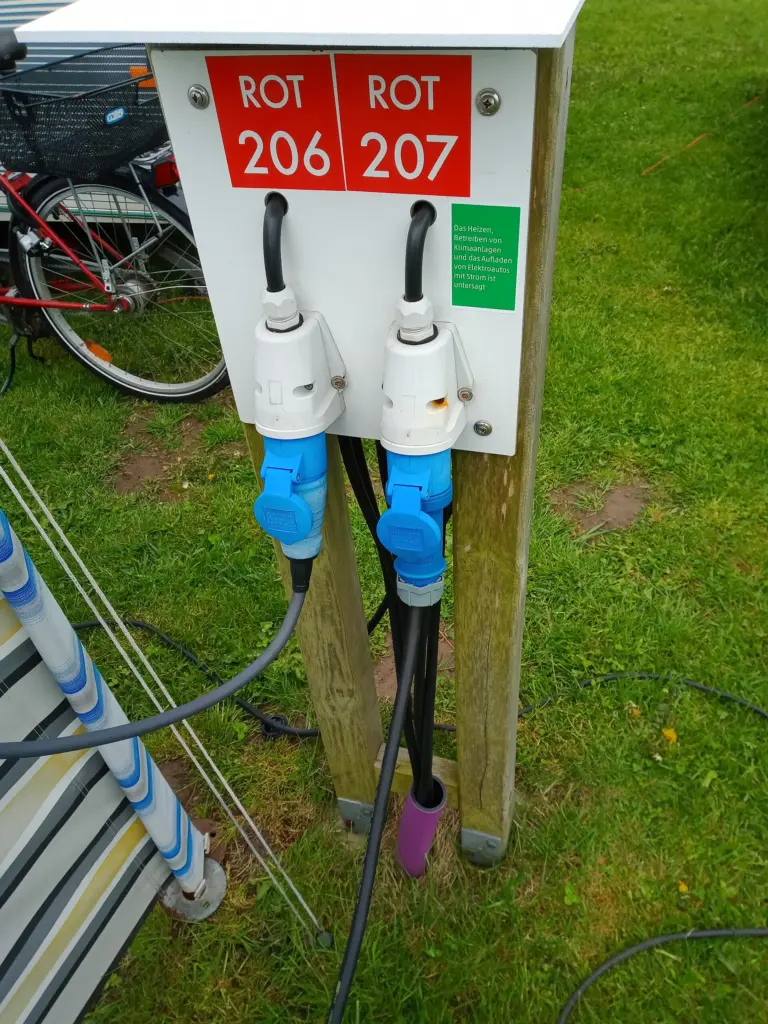
The sign at the power post in the cover photo hangs at a campsite in Büsum, Germany, and it’s clear: charging electric cars is prohibited there. So ask before booking, not when you arrive with twelve percent left in the battery. Three things then belong in the car: a Type 2 cable for charging stations, two charging access options with roaming and, if there is no charging station at your destination, a portable wallbox with adjustable current. For that role, we consider the NRGkick 16A the most sensible choice, because it has country-specific plug attachments that limit the charging current themselves.
What distinguishes Mode 2 from Mode 3 and how long a cable should be is covered in our guide to charging cables (in German).
Charging card, app, credit card: how do you pay abroad?
With more than one method. The ADAC, Germany’s largest automobile club, advises travelers to stay flexible, because not every payment method works everywhere. According to the German consumer advice center (Verbraucherzentrale), EU law only requires card payment at new charging stations with more than 50 kilowatts; at smaller ones, online payment options are enough. It usually works without a contract, just often in a roundabout way.
According to an ADAC study, ad hoc charging can cost up to 62 percent more than a contract without a base fee. A roaming plan, on the other hand, unlocks other operators‘ charging stations for you, and the bill comes from your own provider, even from abroad. Ask about the price abroad in advance, because roaming and session fees may be added. ADAC e-Charge works in numerous European countries and is available to members without a base fee.
The Verbraucherzentrale recommends a two-pronged approach and short contract terms. In other words, a nationwide plan plus a second access option as a backup. If the car stays at the charging station overnight, check the idle fee; it often starts after four hours. In Italy, only vehicles that are actually charging may park at charging stations. Otherwise you risk a fine.
Ad hoc or app: what a charging session really costs
Spontaneous charging without a contract is not a courtesy from the operator. It’s mandatory. According to the German Federal Network Agency (Bundesnetzagentur), ad hoc charging without registration must be possible at public charging points, and since April 13, 2024, the European Alternative Fuels Infrastructure Regulation, AFIR for short, has applied directly. Charging points of 50 kW or more that have gone into operation since then must offer payment via a card reader or contactless via NFC. Below 50 kW, an online payment option without registration is enough, for example via a QR code. According to the Federal Network Agency, older charging points on the Trans-European Transport Network (TEN-T) have until January 1, 2027.
The price must not be a surprise either. The operator must display the ad hoc price per kilowatt-hour, possibly with a fixed amount per session, so that you know it before you start. If a per-minute price is added, that must also be made clear, writes the Verbraucherzentrale.
What makes up the amount
It always starts with the operator of the charging station. The operator sets what energy, time, session start and idling cost. If you charge with the card or app of another provider, that provider bills you and adds its costs for roaming and processing. Some plans also charge a monthly base fee, and after a certain parking time an idle fee may kick in. A low price per kilowatt-hour therefore says little as long as you don’t know what else gets added.
Example calculation: 30 kWh at a fast charger
The price list of IONITY, a large fast-charging network along highways, shows how much the payment route changes the price. For Germany, the operator lists these minimum prices (price list dated July 22, 2026, as shown on the operator’s site on November 10, 2026). According to IONITY, individual stations may be more expensive. The calculation assumes one stop with 30 kWh in a month:
- Direct, ad hoc without registration: €0.72 per kWh, no base fee. 30 kWh cost €21.60.
- Go, via the app without a subscription: €0.68 per kWh, no base fee. 30 kWh cost €20.40.
- Motion, monthly subscription: €0.51 per kWh plus €5.99 a month. One stop with 30 kWh costs €21.29 including the base fee.
- Power, monthly subscription: €0.41 per kWh plus €11.99 a month. One stop with 30 kWh costs €24.29 including the base fee.
For a single stop, no subscription pays off. The cheapest option here is the app without a base fee; the pricey Power subscription is almost four euros more. The math flips with volume. If you divide the base fee by the savings per kilowatt-hour, Power pays off against direct payment from about 39 kWh a month, and against the app only from 45 kWh. Motion breaks even with direct payment at 29 kWh and with the app at 36 kWh. With two such stops, i.e. 60 kWh, both subscriptions cost €36.59, the app €40.80 and direct payment €43.20. According to IONITY, both monthly subscriptions can be canceled monthly. So for a long vacation drive, you can book one specifically, as long as you don’t forget to cancel.
The pattern also applies to other networks, but the numbers don’t. Every operator and every charging card provider calculates differently, so the example can’t simply be transferred.
How to check the price before you start
- The charging station itself shows the ad hoc price, on its display or on the page behind the QR code. Compare it with the price in your charging app for exactly this charging point.
- In other providers‘ apps, what counts is the total amount including roaming and service costs, not the price per kilowatt-hour alone.
- Ask about session, per-minute and idle fees before leaving the car at the station overnight.
- If you have several charging cards, you can use services such as Chargeprice to compare in advance which plan costs the least at a specific station. The Austrian automobile club ÖAMTC uses this calculator for its charging guide. The binding price remains the one shown by the station or the operator’s app at the start.
Vacation home: is the outlet behind the house okay?
If you have to. The ADAC calls the Schuko outlet (the standard European household socket) a stopgap and advises limiting the current to 10 amps or less, because aged contacts and terminals can get hot during hours of charging. You won’t get more than 1.8 to 3 kW there anyway.
The unknown is what makes it tricky. NRGkick requires an installation inspected by a qualified electrician, with its own residual current device and circuit breaker for the circuit. Who knows that about a vacation home in Istria? Ask the landlord in writing about the circuit protection, the residual current device and how the electricity is billed. If you don’t get an answer, the rule from NRGkick and go-e applies: lowest charging current. If the outlet gets hot, stop.
Campsite: blue outlet, few amps
The blue CEE outlet is standard. With 16-amp protection, it charges at 3.7 kW according to the ADAC, provided the operator allows it. According to the German magazine promobil, German campsites fuse their outlets at 10 to 16 amps, while some small campsites in southern Europe are fused so tightly that the breaker trips from as little as 3 amps. At 6 amps, that leaves 1.38 kW. Mathematically, 40 kWh then takes 29 hours, or eleven at 16 amps, not counting charging losses.
Hardly anyone plans for the distance. For motorhomes, a cable reel and CEE extension of up to 25 meters are considered normal, and according to PiNCAMP the reel must be fully unwound. With the charger, it’s a different matter: NRGkick explicitly prohibits additional extensions. If you want to charge at campsites, take the longest cable version and book a pitch close to the power post. Drivers of the Renault ZOE, Twingo and Kangoo should also know that NRGkick only allows these cars at CEE outlets with a dedicated residual current device. Our guide to motorhome accessories (in German) explains which CEE cable is suitable for the motorhome itself.
Different countries, different outlets: what fits where?
According to PiNCAMP, Switzerland has its own standard, the United Kingdom often the outlet with three rectangular holes, and smaller campsites in Italy and Spain often only household outlets. The surprise, however, is in NRGkick’s manual. It limits the current at the Schuko attachment depending on the country:
- France and Norway: at most 10 amps
- Finland and Switzerland: at most 8 amps
- Denmark: at most 6 amps
These are the manufacturer’s specifications for its device. go-e also refers to national regulations and ships single-phase adapters set to 6 amps from the factory; the country setting is made in the app. According to the manual, the go-e adapter cables may not be used in Switzerland, and according to the data sheet, the Gemini flex 2.0 may not be used in Norway.
According to the ADAC, a portable wallbox remains useful in places such as Croatia or southern Italy, where the charging network still has gaps. Our guide to renting a car in Croatia (in German) covers tolls and ferries there. Ferries have their own rules in general. According to the ADAC, Greek ferry companies have only allowed EVs on board with a state of charge of no more than 40 percent since 2024.
Six travel companions
| Model | Type and power | Outlets abroad | Who it’s for |
|---|---|---|---|
| NRGkick 16A | portable wallbox, up to 11 kW, cable 5 / 7.5 / 10 m | attachments for IT, UK, CH, DK, FR and others | Vacation home, camping, long-distance trips |
| Juice Booster 3 air | portable wallbox, up to 11 kW (ADAC) | 30 adapter variants (ADAC) | many countries, big budget |
| go-e Charger Gemini flex 2.0 11 kW | box with Type 2 socket, up to 11 kW, cable sold separately | CEE, Schuko via adapter; not CH, not NO | charging at home with occasional travel |
| Mennekes 36247 | Mode 3 cable, 7.5 m, up to 22 kW | charging stations and wallboxes only | a must in the trunk |
| EVDANCE Mobile Wallbox 11 kW | according to the seller, red CEE 16 A, 5.5 or 7.8 m | no country attachments known | travelers who check the documentation beforehand |
| EVDANCE Schuko charging cable 3.68 kW | according to the seller, Schuko, 6–16 A, 6.1 m | Schuko only | rare emergencies, set low |
NRGkick 16A
According to the manufacturer, the Austrian device recognizes the attachment and limits the current to its rating. There are attachments for the blue and the red CEE outlet, Type L for Italy at 10 amps, Type G for the United Kingdom at 13, Type K for Denmark at 6 and Type J for Switzerland at 8. Residual current protection for AC and DC is built in, and the housing achieves IP67 and IP69K. In the 2024 ADAC test, the box from DiniTech scored a grade of 1.8. What counts against it are the accessories: every attachment costs extra, and the one for charging stations, of all things, is the most expensive.
Juice Booster 3 air
In the ADAC test, it came out on top with a grade of 1.6 and was the most expensive device in the field. The testers praised its dimensions, operation, app and range of adapters. Our assessment here is based solely on the ADAC test, so we’ll leave it at a mention. Ask about the adapters for your destination country before buying.
go-e Charger Gemini flex 2.0 11 kW
At home, the box hangs on the wall; on vacation, it comes along. According to go-e, TÜV Rheinland has verified conformity with IEC 62752. A Type 2 cable is not included, and neither are adapters for blue CEE and Schuko.
Mennekes 36247
A cable of this kind belongs on every trip. You often have to bring your own to the charging station, says the Verbraucherzentrale, and the ADAC specifically points this out for Slovenia. At 7.5 meters and designed for three-phase charging, it also reaches awkwardly placed stations. It does, however, weigh 4.43 kilograms.
EVDANCE Mobile Wallbox 11 kW
According to the seller, it charges at up to 11 kW from the red CEE outlet, some versions come with a Schuko adapter, and the seller also cites protection against 6 mA DC residual current. You should look at the manual, test marks and declaration of conformity before buying, because for lesser-known brands the ADAC advises checking the manufacturer’s address on the rating plate and the declaration of conformity. We were unable to reliably confirm an adapter for the blue campsite outlet or country attachments. For a trip with changing outlets, that is the crucial gap.
EVDANCE Schuko charging cable 3.68 kW
The seller specifies 6 to 16 amps and advertises 3.68 kW at the Schuko outlet. That is exactly what the ADAC and device manufacturers advise against. If you use it at all, use the lower settings. Customer reviews on Trustpilot are mixed and, besides shipping complaints, mention isolated cases of failures.
What we would pack depending on the destination
- A charging-station trip through Austria, northern Italy or France: Mennekes 36247 and two charging access options. A portable wallbox stays at home.
- Vacation home or campsite where charging is allowed: additionally the NRGkick 16A with a ten-meter cable and the attachments for your destination.
- Looking for a wallbox for home, travel only rarely: go-e Charger Gemini flex 2.0, if neither Switzerland nor Norway is on the itinerary. More on the permanent solution in our guide to buying a wallbox.
- Money is no object and you want adapters for almost everything: Juice Booster 3 air, after a look at the adapter list.
One more obligation for Germany: according to the ADAC, portable wallboxes must also be reported to the grid operator, and above 12 kVA, Section 19 of the German Low Voltage Connection Ordinance (NAV) requires its approval.
What is permitted at the charger is explained in our guide CEE adapters for EVs (in German).
Frequently asked questions
How do I pay for charging an EV abroad?
With more than one method, advises the ADAC (Germany's largest automobile club). A roaming plan unlocks other operators' charging stations, and the bill comes from your own provider. According to the ADAC, ad hoc charging can cost up to 62 percent more. The German consumer advice center (Verbraucherzentrale) recommends a nationwide plan plus a second access option as a backup.
Can I charge from the standard outlet at a vacation home?
Only as a stopgap. The ADAC advises limiting the current to 10 amps or less, because aged contacts can get hot. Ask the landlord in writing about the circuit protection and residual current device. Without an answer, the rule is: lowest charging current, and if the outlet gets hot, stop.
How long does charging take at a campsite?
At the blue CEE outlet with 16 amps, the car charges at 3.7 kW according to the ADAC, if the operator allows it. At 6 amps, that leaves 1.38 kW. Mathematically, 40 kWh then takes 29 hours, or eleven at 16 amps, not counting charging losses.
What charging current limits apply in other countries?
NRGkick's manual limits the current at the Schuko (standard European) attachment depending on the country: France and Norway at most 10 amps, Finland and Switzerland at most 8, Denmark at most 6. These are manufacturer specifications. According to the manual, the go-e adapter cables may not be used in Switzerland.
Can I use an extension cord with a portable wallbox?
NRGkick explicitly prohibits additional extensions. At campsites, it therefore helps to get the longest cable version and a pitch close to the power post. For motorhomes, CEE extensions of up to 25 meters are considered normal, but that does not apply to the charger.
Do I have to register a portable wallbox with the grid operator?
In Germany, yes. According to the ADAC, portable wallboxes must also be reported to the grid operator, and above 12 kVA, Section 19 of the German Low Voltage Connection Ordinance (NAV) requires its approval. Even if you only use the box when traveling, you should still clear this at home before using it for the first time.
Sources
- Section 19 of the German Low Voltage Connection Ordinance (NAV)
- Trustpilot: Reviews of EVDANCE
- ADAC: Seven portable wallboxes tested
- ADAC: Charging stations in Europe
- ADAC: Charging plans and roaming
- ADAC: Questions about charging electric cars
- Verbraucherzentrale: Charging on the road
- Federal Network Agency: Questions and terms on e-mobility (AFIR, ad hoc charging)
- IONITY: Access and payment, prices for Germany
- IONITY: Prices for spontaneous charging (press release)
- Chargeprice: Charging plan calculator
- PiNCAMP: CEE plugs when camping
- promobil: Power and fuses in the motorhome
- NRGkick: Operating manual (PDF)
- NRGkick: Data sheet (PDF)
- NRGkick: Plug attachments
- go-e: Gemini flex manual (PDF)
- go-e: Gemini flex 2.0 data sheet (PDF)
- Mennekes: 36247 data sheet (PDF)
Where to buy
- NRGkick 16ACheck price at Amazon.deAvailable in Germany: Amazon.de
- Juice Booster 3 airCheck price at Amazon.deAvailable in Germany: Amazon.de
- go-e Charger Gemini flex 2.0 11 kWCheck price at Amazon.deAvailable in Germany: Amazon.de
- Mennekes 36247Check price at Amazon.deAvailable in Germany: Amazon.de
- EVDANCE Mobile Wallbox 11 kWView at EVDANCEAvailable in Germany: EVDANCE
- EVDANCE Schuko-Ladekabel 3,68 kWView at EVDANCEAvailable in Germany: EVDANCE