Contents14 sections
This guide was first published in German on handgetestet.de.
If you choose an audio interface by the number of its jacks, you will often wonder later why your broadcast microphone sounds so thin and quiet. For one or two microphones in a home studio, a compact USB device such as the Focusrite Scarlett 2i2 (4th Gen), the SSL 2 MKII or the MOTU M2 is entirely sufficient. What matters is gain. All the more so when a quiet dynamic microphone such as the Shure SM7B is plugged in.
Podcasts with guests and phone call-ins run more comfortably with a small studio such as the RØDECaster Duo than with any pure interface. The Apollo Twin X Gen 2 from Universal Audio plays in a league of its own. It is designed for people who want to work with real-time effects while recording.
Why does my microphone sound so quiet?
Because dynamic broadcast microphones deliver little output. For the SM7B, Shure recommends a preamp with more than 60 dB of gain, or otherwise an additional inline booster. Condenser microphones are louder but require 48-volt phantom power. So: read the gain column in the table below first. Design and software come after that.
How many inputs do I really need?
Count what needs to record at the same time. Solo podcast or vocals with guitar? Two combo jacks for XLR and quarter-inch jack are enough. A typical home studio rarely needs more.
What is loopback, and do I need it?
Loopback sends the computer’s audio back into the recording. That is useful for streams, video calls with guests and jingles played in; if you only record vocals, you will not miss it.
USB-C or Thunderbolt, with or without a power supply?
Entry-level devices usually run on a USB-C cable without their own power supply. Professional devices with their own signal processor often require Thunderbolt and a power supply, which is why you should know the ports on your own computer before ordering, so the new device does not end up staying in its box. If two people are speaking, two headphone outputs are worth their weight in gold. Studio monitors, on the other hand, need balanced line outputs.
Bundled recording software and plug-ins save money when you are starting out. They are not a reason to buy.
Suitable microphones are covered in our buying guide for podcast microphones (in German). In our comparison Shure SM7B vs. Neumann TLM 103, both microphones ran through a Universal Audio Apollo Twin.
Seven interfaces and their gain reserves
| Model | Microphone inputs | Max. gain according to the manufacturer | Connection | Best for |
|---|---|---|---|---|
| Focusrite Scarlett 2i2 (4th Gen) | 2 | 69 dB | USB-C, no power supply | Beginners, vocals, podcasts |
| Universal Audio Volt 2 | 2 | 55 dB | USB-C, no power supply | Musicians with a taste for tube sound |
| Universal Audio Apollo Twin X Gen 2 | 2 | 65 dB | Thunderbolt, power supply | Advanced users, producers |
| RØDE RØDECaster Duo | 2 | 76 dB | 2 × USB-C | Podcasters, streamers |
| Steinberg UR22C | 2 | 60 dB | USB-C (USB 3) | Cubase users, iPad |
| MOTU M4 (and M2) | 2 | 60 dB | USB-C, no power supply | Home studio with monitors |
| SSL 2 MKII | 2 | 64 dB | USB-C, no power supply | Speech and vocals, two headphones |
Focusrite Scarlett 2i2 (4th Gen)
Focusrite quotes 69 dB of gain. That gives the 2i2 enough reserve even for quiet dynamic microphones, and it does so as an entry-level class device. It has two microphone inputs and two instrument inputs. Auto Gain sets the level itself, Clip Safe is designed to prevent clipping, and the Air function boosts presence. You control loopback in Focusrite Control 2. If only one microphone is connected, the smaller Scarlett Solo is enough as well.
Universal Audio Volt 2
Two inputs, 24 bit and 192 kHz, plus MIDI ports. What makes it interesting is the Vintage mode: at the push of a button, it switches in an analog circuit that, according to Universal Audio, emulates the 610 tube preamp. For very quiet microphones, however, 55 dB of gain is tight. Universal Audio has since introduced a Volt 2 Gen 2 with three tone modes and 60 dB of gain. Look closely at which version an offer refers to.
Universal Audio Apollo Twin X Gen 2
Thunderbolt, two Unison preamps, and together with UAD plug-ins they emulate classic gear from the likes of Neve or API. And they do so while you are recording. The DUO and QUAD versions differ in the number of signal processors. A talkback microphone and monitor control are built in. The device runs on Mac and Windows PCs, but requires the included power supply. For pure voice recordings, that is considerably more device than necessary.
RØDE RØDECaster Duo
More podcast studio than interface. Two Revolution preamps with 76 dB of gain, four faders, six pads for jingles and a touchscreen. It records to a microSD card, USB storage or the computer, as multitrack if you wish. Two USB-C ports, Bluetooth for phone guests and two headphone outputs show what it is built for: group conversations. If four people regularly sit at the table, the larger RØDECaster Pro II is the better fit.
Steinberg UR22C
Two D-PRE preamps with +6 to +60 dB of gain, 32-bit/192 kHz conversion, MIDI on board. A built-in signal processor provides reverb and a channel strip, so you can monitor with effects without latency. According to the manual, the UR22C also supports loopback. Cubase AI is included, and the device also works with the iPad.
MOTU M4 and M2
The M4 has two combo inputs, two additional line inputs and four balanced outputs. Its color display shows the levels of all channels, and in everyday use that helps more than many an extra feature. MOTU quotes 120 dB of dynamic range at the main outputs and a maximum of 60 dB of gain, and loopback is included. The M2 shares the two microphone inputs with its big brother but has only two outputs. For many home studios, that is exactly enough.
SSL 2 MKII
The MKII replaces the SSL 2 and has two microphone inputs with 64 dB of gain. Each channel has a Legacy 4K switch that adds analog coloration in the style of SSL consoles. For interviews with two people, the two headphone outputs are worth noting. According to SSL, three stereo loopback inputs are available after a firmware update. An extensive software bundle is included.
So which one should I get?
Beginners doing podcasts or vocals do well with the Focusrite Scarlett 2i2 (4th Gen) or the SSL 2 MKII, because both offer enough gain for dynamic microphones. Guests, phone calls and jingles at the same time? Then the RØDE RØDECaster Duo, or with more than two speakers, the RØDECaster Pro II.
For a home studio with monitors and level meters, the MOTU M4 makes sense, or the M2 if you want to spend less. If you work in Cubase and want to integrate the iPad, you will end up with the Steinberg UR22C. And if you want to shape the tone while recording, start with the Universal Audio Volt 2 or, with professional ambitions, go straight to the Apollo Twin X Gen 2.
One last thought. If your room is echoey, a vocal booth often achieves more than a more expensive interface. That is the subject of our article on the Vocal Head Booth from t.akustik.
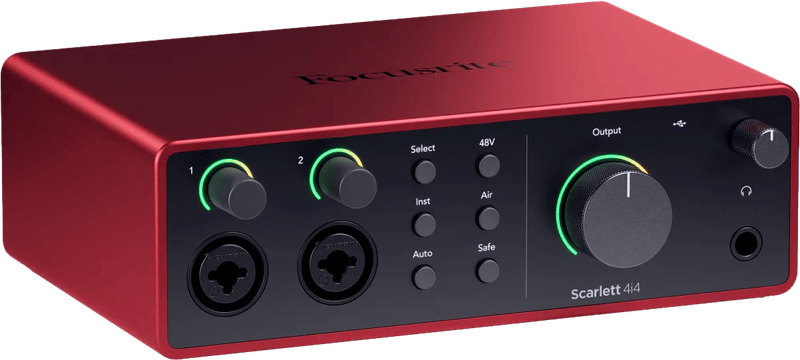
According to Focusrite, the fourth-generation Scarlett 4i4 has two microphone preamps with 69 dB of gain, two additional line inputs, four balanced outputs, and Auto Gain as well as Clip Safe; it runs via USB-C, and according to the manufacturer a power supply is included.
Whether a USB microphone can replace the interface is shown in our review of the RØDE PodMic USB in comparison with the Neumann TLM 103.
Frequently asked questions
Why does my microphone sound so quiet on the audio interface?
Dynamic broadcast microphones deliver little output. For the SM7B, Shure recommends a preamp with more than 60 dB of gain, or otherwise an additional inline booster. According to Focusrite, the Scarlett 2i2 offers 69 dB, and the RØDECaster Duo 76 dB. Condenser microphones are louder but need 48-volt phantom power.
How many inputs does an audio interface need?
As many as will record at the same time. For a solo podcast or vocals with guitar, two combo jacks for XLR and quarter-inch jack are enough. A typical home studio rarely needs more.
What is loopback on an audio interface?
Loopback sends the computer's audio back into the recording. That is useful for streams, video calls with guests and jingles played in. If you only record vocals, you will not miss it. The Scarlett 2i2, MOTU M4, Steinberg UR22C and SSL 2 MKII support it.
USB-C or Thunderbolt, which is better?
Entry-level devices usually run on a USB-C cable without their own power supply. Professional devices with their own signal processor, such as the Apollo Twin X Gen 2, often require Thunderbolt and a power supply. So check the ports on your own computer before ordering.
Audio interface or podcast studio for group conversations?
For guests, phone calls and jingles at the same time, a podcast studio such as the RØDECaster Duo fits: four faders, six pads, Bluetooth for phone guests and two headphone outputs. For regularly four speakers, the larger RØDECaster Pro II is the better fit.
What should you watch for with the Universal Audio Volt 2?
According to Universal Audio, the Vintage mode emulates the 610 tube preamp. For very quiet microphones, however, 55 dB of gain is tight. There is now a Volt 2 Gen 2 with 60 dB of gain, so check carefully which version an offer refers to.
Sources
- Focusrite: Scarlett 2i2 (4th Gen)
- Focusrite: Loopback on the Scarlett 4th Gen
- Universal Audio: Volt 2
- Universal Audio: Volt 2 Gen 2
- Universal Audio: Apollo Twin X
- Universal Audio: Apollo X system requirements
- RØDE: RØDECaster Duo
- Steinberg: UR22C
- MOTU: M4
- MOTU: M2
- Solid State Logic: SSL 2 MKII
- Shure: SM7B user guide
- Focusrite Scarlett 4i4: product information
Where to buy
- Focusrite Scarlett 2i2 4th GenCheck price at Amazon.deAvailable in Germany: Amazon.de
- Universal Audio Volt 2Check price at Amazon.deAvailable in Germany: Amazon.de
- Universal Audio Apollo Twin X Gen 2Check price at Amazon.deAvailable in Germany: Amazon.de
- RØDE RØDECaster DuoCheck price at Amazon.deAvailable in Germany: Amazon.de
- Steinberg UR22CCheck price at Amazon.deAvailable in Germany: Amazon.de
- MOTU M4Check price at Amazon.deAvailable in Germany: Amazon.de
- MOTU M2Check price at Amazon.deAvailable in Germany: Amazon.de
- SSL 2 MKIICheck price at Amazon.deAvailable in Germany: Amazon.de
- Focusrite Scarlett4-4I4View at CoolblueAvailable in Germany: Coolblue