Contents13 sections
This guide was first published in German on handgetestet.de.
Put the brochures from Jackery and Bluetti side by side and it looks like a tie: the same cell chemistry, similar watt-hours, both with an app and a backup power function. The differences lie elsewhere. In the Plus series, Jackery can be expanded later and weighs less; Bluetti accepts more solar power and gives a five-year warranty without registration. Among the units compared here, we recommend the Jackery Explorer 2000 Plus v2 to most households, because it lets you start small and grow later. If, on the other hand, you want to connect fixed panels and will never need more capacity, Bluetti is a good choice.
Six units, three size classes
A brand comparison only makes sense within one class. That is why two units of similar size are listed one below the other here. The Jackery figures come from Jackery’s product descriptions, with weights and solar input according to the retailer GreenDrive.
| Model | Capacity / continuous output | Weight | Solar input / add-on batteries | Best for |
|---|---|---|---|---|
| Jackery Explorer 1000 Plus v2 | 1,024 Wh / 1,800 W | 10.8 kg | 400 W / up to 11 kWh | Taking along, expanding later |
| BLUETTI Elite 100 V2 | 1,024 Wh / 1,800 W | 11.5 kg | 1,000 W / only via cable with B80 | Solar at a fixed location |
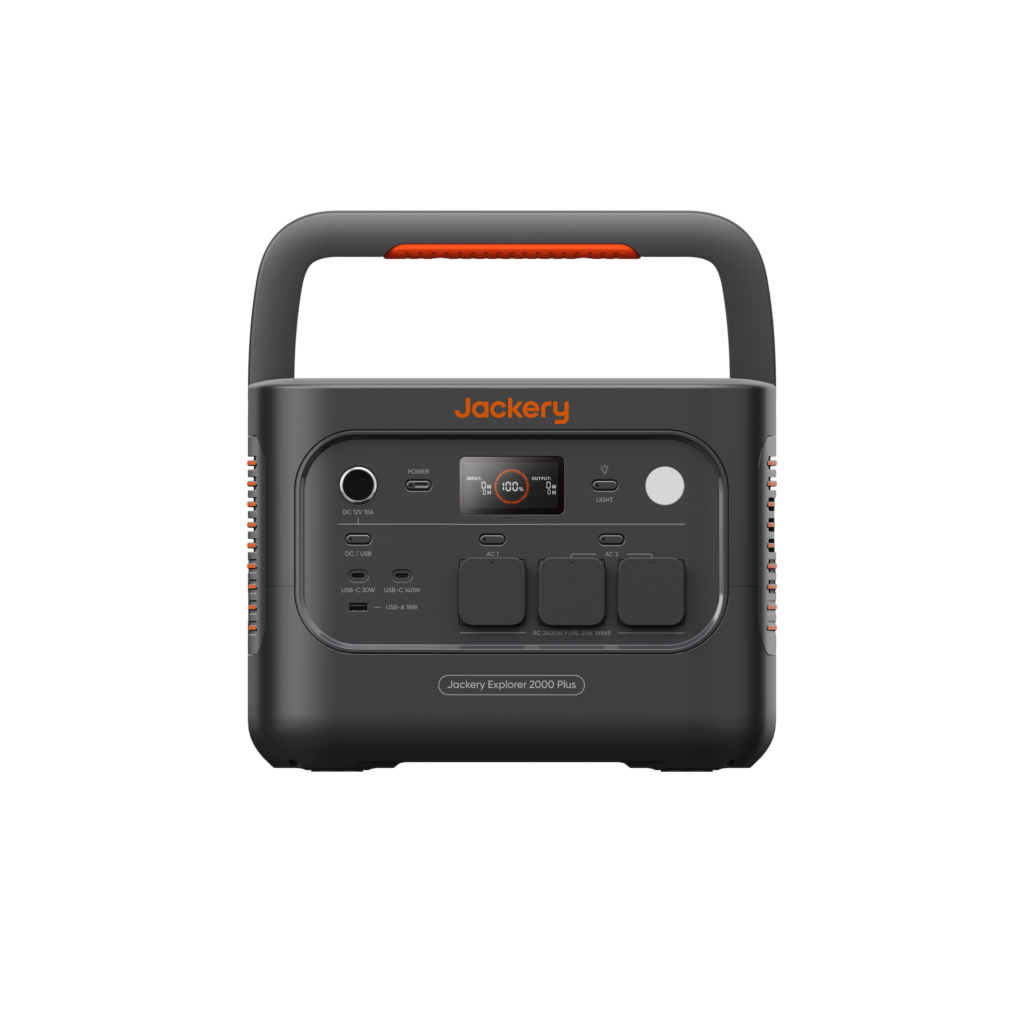
| Jackery Explorer 2000 Plus v2 | 2,048 Wh / 2,400 W | 19.1 kg | 800 W / up to 12 kWh | Backup power and RVs |
| BLUETTI Elite 200 V2 | 2,073.6 Wh / 2,600 W | 24.2 kg | 1,000 W / not expandable | Fixed size, lots of power |
| Jackery Explorer 3600 Plus | 3,584 Wh / 3,600 W | 35 kg | 1,000 W / up to 21.5 kWh | Home, basement, cold |
| BLUETTI Apex 300 | 2,764.8 Wh / 3,840 W | 38 kg | 2,400 W / up to 19.4 kWh | Large solar system |
Why 6,000 cycles are not the same as 6,000 cycles
In the 2 kWh class, both manufacturers advertise 6,000 charge cycles. Jackery, however, calculates down to 70 percent remaining capacity, Bluetti down to 80 percent. At the end of that span, the Explorer 2000 Plus v2 would have around 1,430 Wh left on paper, the Elite 200 V2 around 1,660 Wh. Ten percentage points sound like fine print; here they amount to a good 200 watt-hours.
Does that change the buying decision? Rarely. With 30 camping weekends a year, you will mathematically never reach such numbers. The difference only becomes relevant when a unit stores solar power every day. And one more trap: the Elite 100 V2 is rated at 4,000 cycles down to 80 percent, the Explorer 1000 Plus v2 at 6,000 down to 70 percent. If you only read the big number, you are comparing apples and oranges. What lies behind LFP cells technically is explained in our guide to LiFePO4 power stations.
Solar: Bluetti takes more, but who sets that up?
In the 1 kWh class, the gap is large. According to Bluetti, the Elite 100 V2 accepts 1,000 watts at 12 to 60 volts and is therefore full in 70 minutes. For the Explorer 1000 Plus v2, GreenDrive lists 400 watts and just under four hours with two SolarSaga 200W panels. Sounds clear-cut. But for 1,000 watts you need five panels of 200 watts each, and nobody carries those to the campsite.
The headroom becomes interesting at the garden shed or on an RV roof, where panels are permanently mounted. According to its FAQ, Bluetti also accepts third-party panels with MC4 connectors, as long as the open-circuit voltage stays within the window. Jackery uses the DC8020 connector and sells the matching SolarSaga series. If you are planning third-party panels, clarify adapters and voltage before buying. How panels and station get along is covered in our guide charging a power station with a solar panel (in German).
Expansion: the real system difference
This is where the paths diverge. According to Jackery, the Explorer 1000 Plus v2 and the 2000 Plus v2 accept up to five BP2000 battery packs, which adds up to around 11 or 12 kWh. According to Bluetti, the Elite 200 V2 cannot be expanded at all. With the Elite 100 V2, it only works via an adapter cable with the B80, and no expansion appears in the data table. Bluetti’s expandable system is called the Apex 300, and it weighs 38 kilos.
So if you buy 2 kWh today and want to keep a chest freezer running for several days in three years, with Jackery you buy an extra battery, and with Bluetti in this class a second unit. What add-on batteries bring and which packs belong to which generation is shown in our guide to expansion batteries (in German). According to GreenDrive, the older packs without v2 do not fit.
Cold, warranty, switchover time
In an unheated shed, the charging temperature counts. Bluetti specifies 0 to 40 degrees Celsius for all three units, and discharging works down to minus 20 degrees. For the Plus v2 units, GreenDrive lists charging from minus 10 degrees, and for the 3600 Plus from minus 20 degrees. That is a retailer claim, not a data sheet. If the unit is to charge outdoors in winter, ask before you buy.
On warranty, Bluetti is ahead: five years are stated in the data tables. According to GreenDrive, Jackery grants three years plus two more after registration. Do not forget that. Bluetti’s terms do have rough edges, though: the warranty is valid only in the country of purchase, purchases from unauthorized dealers are excluded, and a refurbished unit may be sent as a replacement.
For a PC and router, the switchover time matters. Jackery lists 10 milliseconds for the Plus series; Bluetti lists 10 for the Elite 100 V2, 15 for the Elite 200 V2 and 20 for the Apex 300. Both have apps. With Jackery you can set the priority of individual outlets, and on the Elite 200 V2 Bluetti offers four UPS operating modes.
Jackery Explorer 1000 Plus v2
Portable and still expandable, that is its argument. You can still carry its 10.8 kilos on your own. The solar input of 400 watts remains weak, and if you never expand, you pay for the headroom for nothing.
BLUETTI Elite 100 V2
Our budget pick in this lineup: the same capacity and continuous output, more solar, a five-year warranty. In return, Bluetti only lists 4,000 cycles. Note for RVs: according to the manufacturer, the unit must stand upright, including during transport.
Jackery Explorer 2000 Plus v2
A good five kilos lighter than its Bluetti counterpart, expandable and in the same price range. Its continuous output of 2,400 watts is 200 watts lower, which rarely matters in everyday use. The drawbacks are the cycle rating down to 70 percent and the warranty, which only reaches five years through registration.
BLUETTI Elite 200 V2
Lots of power for fixed locations. With 2,600 watts, a bit more can run at the same time, and 1,000 watts of solar suits a small rooftop array. At 24.2 kilos, though, you will not just casually carry it down to the basement. And the size you buy is the size you keep.
Jackery Explorer 3600 Plus
According to GreenDrive, it rolls like a suitcase and stores more than the Apex 300, with slightly lower output. According to the retailer, it lacks a 12-volt car socket. It works as a home backup, but it is too heavy for the road. More on this class can be found in our guide large power stations from 3 kWh.
BLUETTI Apex 300
More of a building block than a power station. Six B300K batteries bring 19.4 kWh, 2,400 watts of solar flow in through two inputs, and three units can be linked. USB and 12 volts only come with the Hub D1, which Bluetti sells as an accessory. The manufacturer puts the idle consumption at 20 watts, which is nearly half a kilowatt-hour per day. That does not suit a reserve sitting in a closet, but it does suit a system in daily use.
How we would decide
- You do not yet know how much storage you need: Jackery Explorer 2000 Plus v2.
- The unit will often come along: Jackery Explorer 1000 Plus v2.
- Fixed panels, size is settled: BLUETTI Elite 200 V2.
- Small scale, few expansion plans: BLUETTI Elite 100 V2.
- Permanent home backup in a cold basement: Jackery Explorer 3600 Plus.
- Building out into a system with lots of solar: BLUETTI Apex 300.
Check beforehand what your devices really draw. The runtime calculation takes five minutes and often saves you a whole size class.
Frequently asked questions
What is the difference between Jackery and Bluetti?
In the Plus series, Jackery can be expanded with up to five battery packs and weighs less. Bluetti accepts more solar power and gives a five-year warranty without registration. The Elite 200 V2 cannot be expanded at all; Bluetti's expandable system is called the Apex 300 and weighs 38 kilos.
Are 6,000 charge cycles the same at Jackery and Bluetti?
No. Jackery calculates down to 70 percent remaining capacity, Bluetti down to 80 percent. On paper, that would leave around 1,430 Wh on the Explorer 2000 Plus v2 and around 1,660 Wh on the Elite 200 V2. This only becomes relevant when a unit stores solar power every day, hardly for camping weekends.
Which power station charges faster with solar?
In the 1 kWh class, Bluetti. According to Bluetti, the Elite 100 V2 accepts 1,000 watts and is therefore full in 70 minutes; for the Explorer 1000 Plus v2, the retailer lists 400 watts. For 1,000 watts, however, you need five panels of 200 watts each, which mainly pays off with permanently mounted panels.
How long is the warranty on Jackery and Bluetti?
Bluetti lists five years in its data tables, but it is valid only in the country of purchase and not for purchases from unauthorized dealers, and a refurbished unit may be sent as a replacement. According to the retailer, Jackery grants three years plus two more after registration. Do not forget to register.
Which power station is suitable for a cold basement?
Bluetti specifies 0 to 40 degrees Celsius for charging. For the Plus v2 units, the retailer GreenDrive lists charging from minus 10 degrees, and for the Jackery Explorer 3600 Plus from minus 20 degrees. That is a retailer claim, not a data sheet. If the unit is to charge outdoors in winter, ask beforehand.
Sources
- BLUETTI: Elite 100 V2
- BLUETTI: Elite 200 V2
- BLUETTI: Apex 300
- BLUETTI: Warranty terms
- GreenDrive: Jackery Explorer 1000 Plus v2 (retailer information)
- GreenDrive: Jackery Explorer 2000 Plus v2 (retailer information)
- GreenDrive: Jackery Explorer 3600 Plus (retailer information)
Where to buy
- Jackery Explorer 2000 Plus v2View at JackeryAvailable in Germany: JackeryCheck price at Amazon.deAvailable in Germany: Amazon.de
- Jackery Explorer 1000 Plus v2View at JackeryAvailable in Germany: JackeryCheck price at Amazon.deAvailable in Germany: Amazon.de
- Jackery Explorer 3600 PlusView at JackeryAvailable in Germany: Jackery
- BLUETTI Elite 100 V2Check price at Amazon.deAvailable in Germany: Amazon.de
- BLUETTI Elite 200 V2Check price at Amazon.deAvailable in Germany: Amazon.de
- BLUETTI Apex 300Check price at Amazon.deAvailable in Germany: Amazon.de