Contents13 sections
This guide was first published in German on handgetestet.de.
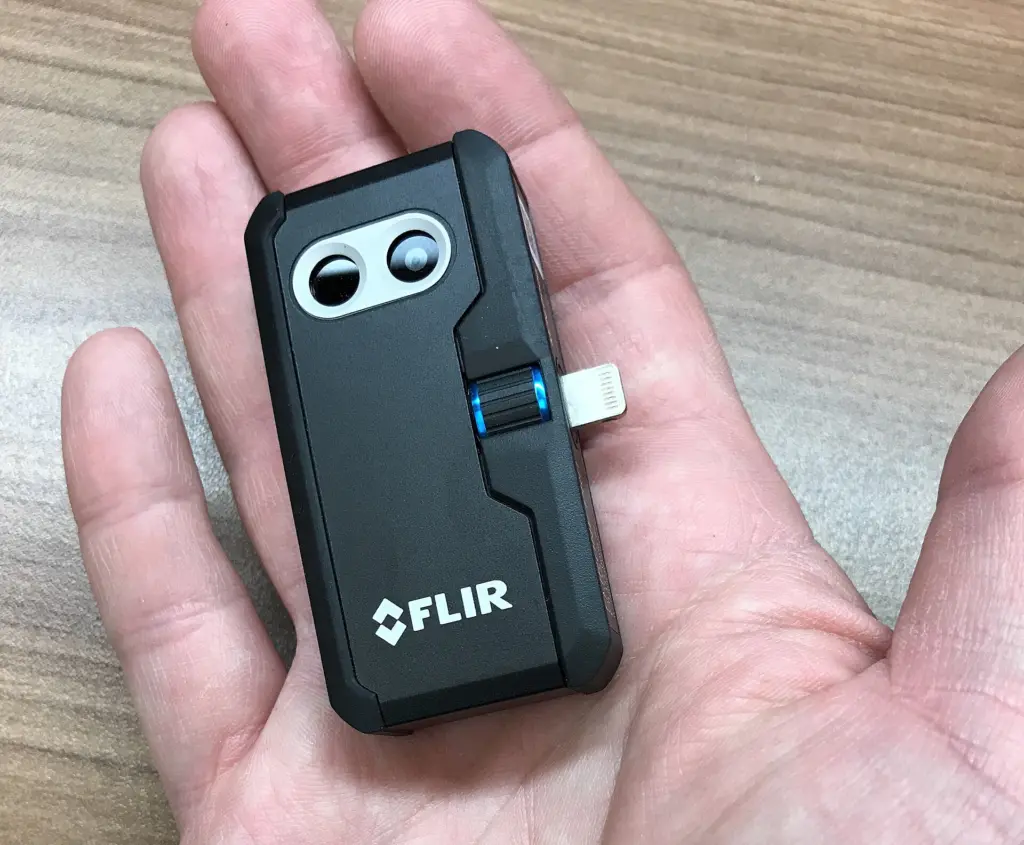
The box advertises a high resolution, but the sensor has 80 × 60 pixels. That’s exactly where many thermal camera purchases go wrong. If you’re looking for thermal bridges, cold window joints or a radiator that only gets warm at the top, you need at least 160 × 120 real pixels, ideally 256 × 192. With a USB-C smartphone, you can usually get this class more cheaply as an attachment than as a handheld unit, for example with the Hikmicro Mini2Plus V2. A handheld mainly makes sense if the camera also goes to the job site.
Two resolutions, only one counts
These days, almost all manufacturers state two figures. The first comes from the sensor. The second is delivered by software that upscales the image; FLIR calls it Super Resolution, Hikmicro SuperIR and Topdon TISR. The upscaled image does look smoother. It doesn’t invent new detail.
So always compare the sensor resolution. For individual windows, radiators and outlets, 160 × 120 pixels is enough. At 256 × 192, you get around 2.5 times as many measuring points, which lets you see exactly where heat escapes from the facade even from a few meters away.
Millikelvin, field of view, connection
The abbreviation NETD stands for thermal sensitivity. The smaller the value in millikelvin, the finer the temperature differences the camera can distinguish; the devices below range from 40 to 70 mK.
When it comes to field of view, there’s no right or wrong, only a use case. A wide angle of around 50 degrees shows the whole wall in tight rooms. Around 25 degrees, on the other hand, brings the facade of the house closer when you’re standing on the street.
Attachments plug into the USB-C port or connect wirelessly to the phone. Take a look at the manufacturer’s compatibility list beforehand. Some smartphones are explicitly not supported.
When a thermal image shows anything at all
Even the best camera is of little use under the wrong conditions. A checklist from the German energy-advice site Energie-Fachberater calls for a difference of at least 15 kelvin between inside and outside, for example 20 degrees Celsius in the living room with 5 degrees outside. Measure on winter nights with no sun on the facade and no rain, fog or strong wind, and solid masonry houses should have been fully heated for a few days beforehand. Be careful with smooth surfaces. Window glass or bare metal reflects thermal radiation from the surroundings, and there the camera quickly shows false temperatures.
The Rhineland-Palatinate consumer advice center in Germany is clear about what a thermal image can’t do: the colorful pictures reveal neither how much heat is lost nor what insulation would save. Whether and how to renovate is something to work out with an energy consultant.
That doesn’t make your own camera useless. It finds drafts at windows, tracks down cold corners with a risk of mold and shows after bleeding whether the radiator heats up evenly again. Found cold corners? We describe the next step in our guide to dehumidifiers for damp rooms (in German). If you’d like to control your heating more precisely, read on in our guide to smart radiator thermostats (in German).
Seven thermal imaging cameras for home and heating
| Model | Type | Sensor resolution | Sensitivity, measuring range | Best for |
|---|---|---|---|---|
| Hikmicro Mini2Plus V2 | Attachment, USB-C (iOS and Android) | 256 × 192 | under 40 mK, −20 to 400 °C | Homeowners with a current smartphone |
| Topdon TC002C Duo | Attachment, USB-C (iOS and Android) | 256 × 192 | 40 mK, −20 to 550 °C | Those who also check cars and electrics |
| Seek Thermal CompactPRO | Attachment, USB-C (Android) | 320 × 240 | under 70 mK, −40 to 330 °C | Android users who want lots of pixels |
| FLIR Edge Pro | Wireless attachment with battery | 160 × 120 | 70 mK, −20 to 400 °C | Those who need distance from the target |
| FLIR C5 | Pocket-size handheld | 160 × 120 | under 70 mK, −20 to 400 °C | Tradespeople, building caretakers |
| Bosch GTC 400 C Professional | Handheld, 12-volt battery | 160 × 120 | max. 50 mK, −10 to 400 °C | Those who already own Bosch 12 V tools |
| Bosch GTC 600 C Professional | Handheld, 12-volt battery | 256 × 192 | max. 50 mK, −20 to 600 °C | Professionals using it daily |
All figures according to the manufacturers or retailer spec sheets. Upscaled resolutions are deliberately left out.
Hikmicro Mini2Plus V2
The attachment weighs around 24 grams, and according to the spec sheet it works with 256 × 192 pixels and under 40 mK. Unlike many competitors, it offers manual focus down to 10 centimeters. Handy at the fuse box and the heating manifold. At 25 × 18.8 degrees, the field of view is on the narrow side: an advantage when aiming at the facade from the sidewalk, a disadvantage in the bathroom. Hikmicro specifies iOS 14 or later and Android 7 or later; older iPhones need a Lightning adapter.
Topdon TC002C Duo
The same sensor class, but the upper limit is 550 degrees, which leaves headroom at the exhaust or the brakes. The attachment draws its power from the phone. And this is where compatibility matters, because according to the listing, Topdon excludes some Samsung models, including the Galaxy S23 and A55.
Seek Thermal CompactPRO
On paper, the most real pixels among the attachments: 320 × 240 with a 32-degree field of view. In sensitivity, though, at under 70 mK it trails Hikmicro and Topdon. The iPhone version also still has a Lightning connector. Newer iPhones with USB-C? More of a second choice. For Android phones with USB-C, worth considering.
FLIR Edge Pro
It used to be called the FLIR ONE Edge Pro. It doesn’t plug into the phone; according to FLIR, it connects via Bluetooth and Wi-Fi over a distance of up to 5 meters. So you can hold the camera behind a radiator or inside a cabinet while looking at the display. According to the manufacturer, the battery lasts about two and a half hours, and the housing meets IP54. At 160 × 120 pixels and 70 mK, however, the sensor is weaker than in the cheaper plug-in attachments. What you’re paying for here is the design.
FLIR C5
Small enough for a jacket pocket. FLIR specifies 160 × 120 pixels, under 70 mK and Wi-Fi, plus MSX, which overlays edges from the regular camera image onto the thermal image. That way you can see right away which outlet or which window frame is meant. For private use, that’s a high price for a sensor that attachments now outperform. Tradespeople tend to appreciate that their smartphone stays free.
Bosch GTC 400 C Professional
160 × 120 measuring points, max. 50 mK, accuracy ±3 degrees, according to Bosch. Power comes from a battery of the 12-volt system or, if need be, from four AA batteries. The ThermalOn app transfers the images to your phone. It becomes interesting if you already have Bosch batteries on the shelf.
Bosch GTC 600 C Professional
According to Bosch, its big sibling reaches 256 × 192 pixels, measures up to 600 degrees and is accurate to ±2 degrees. Dust and splash protection to IP54 and drop protection from 2 meters are part of the package. Price-wise, it plays near the top. Too much for a few winter evenings at your own house.
How we would decide
For your own house and with a USB-C smartphone, the Hikmicro Mini2Plus V2 comes out ahead: real 256 × 192 pixels and manual focus in a very compact package. If you also want to inspect cars and electrics, go for the Topdon TC002C Duo, provided your phone is on the compatibility list. Android users who want as many pixels as possible should pick the Seek Thermal CompactPRO.
Want to measure without a cable and from a distance? The FLIR Edge Pro, with compromises on resolution. For professional use, there’s the FLIR C5 as a compact device, and for users of the Bosch battery system the GTC 400 C or GTC 600 C.
And before any money goes into a renovation, the images belong in an energy audit. That’s where colors turn into numbers.
Frequently asked questions
What resolution does a thermal imaging camera need for the home?
Compare the sensor resolution, not the upscaled one. For individual windows, radiators and outlets, 160 × 120 pixels is enough. At 256 × 192, you get around 2.5 times as many measuring points, which lets you see where heat escapes from the facade even from a few meters away.
What does super resolution mean for thermal imaging cameras?
Alongside the sensor resolution, many manufacturers state a second figure that software delivers by upscaling; FLIR calls it Super Resolution, Hikmicro SuperIR and Topdon TISR. The upscaled image looks smoother, but it doesn't invent new detail.
When should you take measurements with a thermal imaging camera?
A checklist from the German site Energie-Fachberater calls for a difference of at least 15 kelvin between inside and outside, for example 20 degrees Celsius in the living room with 5 degrees outside. Measure on winter nights with no sun on the facade and no rain, fog or strong wind. Glass and bare metal reflect thermal radiation and quickly show false temperatures.
Does a thermal image replace an energy audit?
No. According to the Rhineland-Palatinate consumer advice center in Germany, the images reveal neither how much heat is lost nor what insulation would save. Your own camera does, however, find drafts at windows and cold corners with a risk of mold, and it shows whether a radiator heats up evenly after bleeding.
What does NETD in millikelvin mean?
NETD stands for thermal sensitivity. The smaller the value in millikelvin, the finer the temperature differences the camera can distinguish. The devices in this comparison range from 40 to 70 mK; according to the spec sheet, the Hikmicro Mini2Plus V2 is under 40 mK.
Does every thermal imaging attachment fit every smartphone?
Not necessarily, so check the manufacturer's compatibility list beforehand. According to the listing, Topdon excludes some Samsung models for the TC002C Duo, including the Galaxy S23 and A55. The iPhone version of the Seek Thermal CompactPRO still has a Lightning connector and is better suited to Android phones with USB-C.
Sources
- FLIR: Flir Edge Pro, specifications
- FLIR: renaming of FLIR ONE Edge to Flir Edge
- FLIR: C5, specifications
- Bosch Professional: GTC 400 C
- Bosch Professional: GTC 600 C
- Test-Meter: Hikmicro Mini2Plus V2, spec sheet
- Focus Nordic: Hikmicro Mini2Plus V2
- Seek Thermal: CompactPRO spec sheet
- Energie-Fachberater: thermography checklist (in German)
- Verbraucherzentrale Rheinland-Pfalz: energy audit or colorful picture? (energy tip, March 4, 2025, in German)
Where to buy
- Hikmicro Mini2Plus V2Check price at Amazon.deAvailable in Germany: Amazon.de
- Topdon TC002C DuoCheck price at Amazon.deAvailable in Germany: Amazon.de
- Seek Thermal CompactPROCheck price at Amazon.deAvailable in Germany: Amazon.de
- FLIR Edge ProCheck price at Amazon.deAvailable in Germany: Amazon.de
- FLIR C5Check price at Amazon.deAvailable in Germany: Amazon.de
- Bosch GTC 400 C ProfessionalCheck price at Amazon.deAvailable in Germany: Amazon.de
- Bosch GTC 600 C ProfessionalCheck price at Amazon.deAvailable in Germany: Amazon.de