Contents13 sections
This guide was first published in German on handgetestet.de.
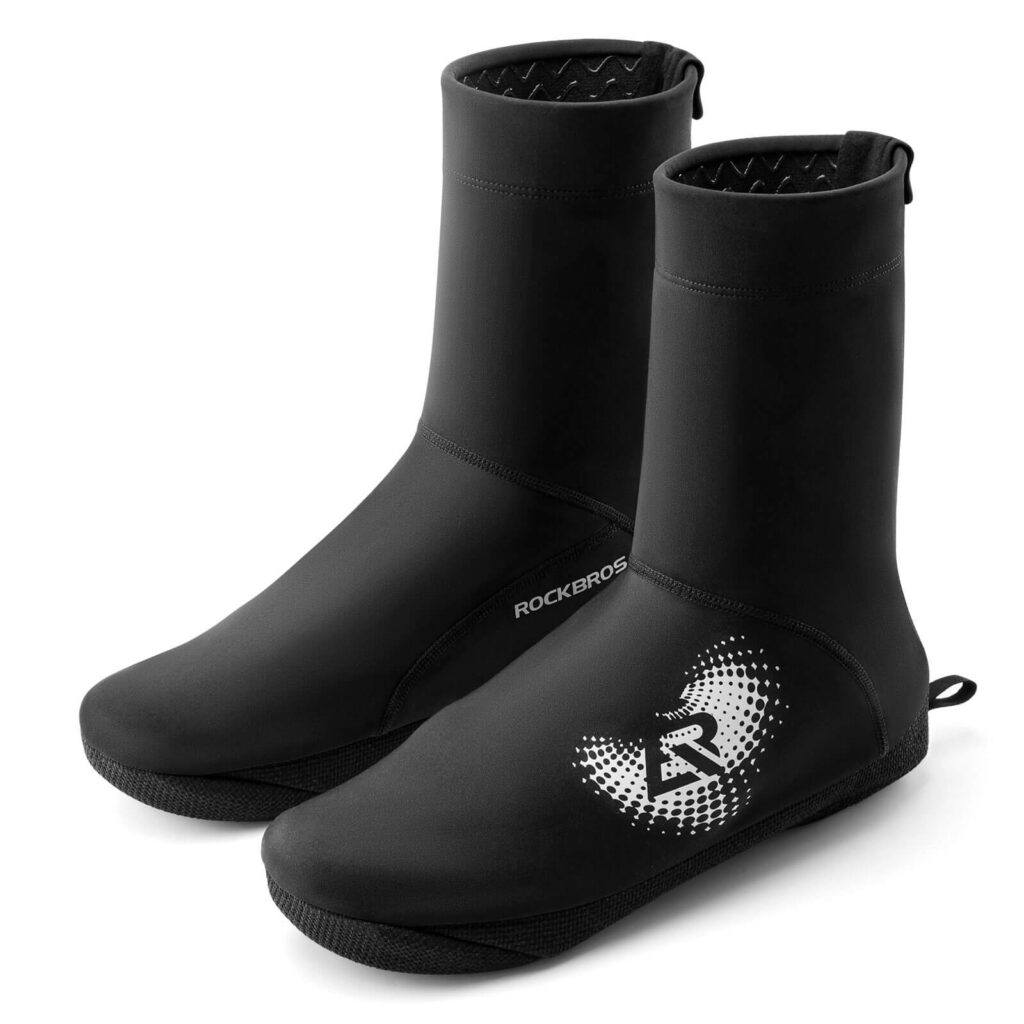
An overshoe is the cheapest piece of clothing that makes the biggest difference on a bike in winter. It costs little, weighs almost nothing and keeps wind and spray away exactly where the foot cools down fastest. For commuters who ride regularly in the cold, we recommend a lined winter overshoe such as the ROCKBROS Winter Warm; for rainy days only, a thin, water-repellent cover is enough. And if you’re still cold, you’ll end up with the heated version.
Why the feet of all places?
They barely move. They sit in the headwind, right at the front, and get a fine spray from the front wheel in the wet. Road and clipless shoes are also designed for airflow, with mesh inserts and thin uppers that keep you cool in summer and do exactly the wrong thing in November.
With clipless pedals, something invisible adds to that. The metal plate in the sole sits close to the foot; the ADFC (German Cyclists‘ Federation) describes it as a possible cold bridge. An insulating insole helps against this; an overshoe alone doesn’t always.
Thin, thick or heated
Roughly speaking, there are three types. Thin overshoes made of synthetic fabric protect against wind and rain. They hardly provide warmth themselves, but they keep the cold out and stop the shoe from soaking up water. Thick models, often made of neoprene or lined with fleece, add insulation. The ADFC names the neoprene version as the better insulator and recommends it especially for longer rides. The third group has battery-powered heating. It’s expensive, but for people with permanently cold feet, often the only way to still enjoy riding in January.
In between are toe covers that only cover the front of the shoe. They are a compromise for transitional days when a full overshoe would be too warm.
Fit, sole, closure
An overshoe has to fit over your shoe, not your foot. The size refers to the shoe size, and a chunky mountain bike shoe needs more room than a slim road shoe. When in doubt, go one size up.
Most models wrap around the toe and are held by a strap under the sole. That’s also where the weak point is. The ADFC points out that frequent walking in overshoes damages the material. If you still climb two flights of stairs and cross the yard on foot at work, it’s better to take the overshoe off at the door. If you wear clipless shoes, also check the cutout for the cleat and heel, and look for a zipper or Velcro that you can operate with cold fingers.
Reflective strips on the overshoe are a plus for the ride home in the dark. Of course, they can’t replace the lights on your bike.
And the shoe underneath?
An overshoe won’t save a shoe that’s too tight. The ADFC advises choosing winter shoes one size larger so thick socks fit inside. If the shoe pinches, the insulating layer of air is missing. For long rides in real cold, the federation recommends waterproof and windproof winter shoes, and at very low temperatures, an overshoe on top of those as well.
There are two add-ons for the sole. Insertable warming insoles that heat up on contact with air last several hours according to the ADFC, but can only be used once. Electric heated insoles with a battery are the expensive but reusable solution. Both target exactly the spot where, with clipless shoes, the cold creeps up through the cleat.
A sizing example. For the ROCKBROS winter cover, size M covers shoe sizes 38 to 42 (EU) and size L covers 42 to 46, according to the retailer. If you wear size 42 in a wide mountain bike shoe, take L. With a slim road shoe of the same size, M may fit, but then it sits tight, and that’s exactly where an overshoe tears first later on. If you’re between two sizes, the larger one is more relaxed, as long as the overshoe still seals tightly at the ankle.
Six overshoes compared
All features are as described in the ROCKBROS retailer listings. Prices appear automatically from the retailer data. Each link leads to a specific size, which you can adjust at the retailer.
| Model | Type according to retailer | Protection according to retailer | Best for |
|---|---|---|---|
| ROCKBROS Winter Warm Overshoes | winter, warm | water-repellent | commuters, frost |
| ROCKBROS Heated Winter Overshoes | with heating | winter | people who are always cold |
| Waterproof cycling shoe covers with cold protection | cold protection | waterproof | wet and cold |
| ROCKBROS warm winter cycling overshoes | winter, warm | not stated | road cycling in winter |
| Reflective waterproof cycling overshoes | Velcro closure | waterproof, reflective | darkness, rain |
| Cycling toe covers | toe only | water-repellent, windproof | spring and fall |
ROCKBROS Winter Warm Overshoes
Described as a winter overshoe and water-repellent. For the daily commute at zero degrees Celsius, this is the type to start with before you spend money on heating. The retailer doesn’t call it waterproof, so in steady rain, water will eventually get in.
ROCKBROS Heated Winter Overshoes
With heating and considerably more expensive. Runtime and battery size aren’t in the product name, so ask about them. You can read more about battery heating on the bike in our guide to heated cycling clothing (in German).
Waterproof cycling shoe covers with cold protection
Here, both terms are in the name: waterproof and cold protection. For commuters in rainy regions such as Hamburg or the Ruhr area in Germany, that’s a better fit than a merely water-repellent model. The retailer doesn’t give a measured value for waterproofness.
ROCKBROS warm winter cycling overshoes
A simple winter cover for cycling as a sport, so intended more for slim road and clipless shoes. With chunky mountain bike soles, pay attention to the size.
Reflective waterproof cycling overshoes
Velcro instead of a zipper, plus reflectors. Velcro is easier to close with gloves on, but clogs with lint over time.
Cycling toe covers
Only the toes are covered. That’s enough in October or March, when the wind whistles through the mesh inserts in the morning but the day turns mild. Too little in deep winter. According to the retailer, it comes in one size for shoe sizes 39 to 45 (EU). For very large or very small feet, that’s a limitation you should consider before buying.
Which overshoe for which rider?
Commuters in street shoes should take a lined winter overshoe in a generous size. Road cyclists with clipless shoes combine a snug winter cover with an insulating insole against the cold bridge of the cleat. If rain is more of a problem than cold, you need a model that is explicitly called waterproof. And if you still have numb toes after half an hour despite everything, don’t buy a third thick overshoe; think about heating instead.
It’s also worth looking at the rest of your gear. Without warm cycling gloves (in German) and a windproof jacket, you’ll be cold despite warm feet.
Frequently asked questions
What is the difference between thin and neoprene overshoes?
Thin overshoes made of synthetic fabric protect against wind and rain. They hardly provide warmth themselves, but they keep the cold out and stop the shoe from soaking up water. Thick models made of neoprene or lined with fleece add insulation; the ADFC (German Cyclists' Federation) recommends them especially for longer rides.
What size cycling overshoes do I need?
The overshoe has to fit over the shoe, not the foot. For the ROCKBROS winter cover, size M covers shoe sizes 38 to 42 (EU) and L covers 42 to 46, according to the retailer. With size 42 in a wide mountain bike shoe, take L. When in doubt, go one size up.
Why do feet get especially cold with clipless pedals?
The metal plate in the sole sits close to the foot; the ADFC describes it as a possible cold bridge. An insulating insole helps against this; an overshoe alone doesn't always. That's why road cyclists combine a snug winter overshoe with such an insole.
Can you walk in overshoes?
Better not much. The ADFC points out that frequent walking in overshoes damages the material, because the strap under the sole is the weak point. If you still climb stairs and cross the yard on foot at work, take the overshoe off at the door.
When are toe covers enough?
Toe covers only cover the front of the shoe. That's enough in October or March, when the wind whistles through the mesh inserts in the morning but the day turns mild. In deep winter it's too little. According to the retailer, the ROCKBROS model comes in only one size for shoe sizes 39 to 45 (EU).
When do heated overshoes make sense?
For people with permanently cold feet, they are often the only way to still enjoy riding in January. If you have numb toes after half an hour despite a lined overshoe, consider heating rather than another thick overshoe. The product name doesn't state runtime or battery size, so ask about them.
Sources
- ADFC (German Cyclists‘ Federation): the right clothing for cold weather
- ADFC: seen and ridden – keeping the right temperature
Where to buy
- ROCKBROS Winter Warm ÜberschuheView at ROCKBROSAvailable in Germany: ROCKBROS
- Halb Überschuhe Fahrrad ShoecoverView at ROCKBROSAvailable in Germany: ROCKBROS
- ROCKBROS Beheizte Überschuhe WinterView at ROCKBROSAvailable in Germany: ROCKBROS
- Überschuhe Fahrrad Wasserdicht Shoecover KälteschutzView at ROCKBROSAvailable in Germany: ROCKBROS
- ROCKBROS Fahrrad Überschuhe Winter warm ÜberzieherView at ROCKBROSAvailable in Germany: ROCKBROS
- Fahrradüberschuhe Reflektierend WasserdichtView at ROCKBROSAvailable in Germany: ROCKBROS